MET-097i vs Zovaglutide: Monthly GLP-1 Agonist Showdown
Evidence-based comparison of MET-097i (Metsera/Pfizer) and zovaglutide (QL Biopharm), two investigational once-monthly GLP-1 receptor agonists competing to redefine dosing convenience in obesity treatment.
Verdict at a Glance
MET-097i and zovaglutide are both investigational once-monthly GLP-1 agonists with promising Phase 2 data showing competitive weight loss and encouraging tolerability. Neither is approved. MET-097i has the advantage of Pfizer's acquisition and development resources (approximately $10 billion deal), a novel biased agonist mechanism via the HALO platform, and a clear Phase 3 pathway. Zovaglutide has the advantage of a true once-monthly dosing design from the start (rather than weekly-to-monthly transition) and an exceptionally low GI discontinuation rate (1.3%). Weight loss efficacy appears comparable between the two based on Phase 2 data. The race to become the first approved monthly GLP-1 agonist will likely be determined by Phase 3 execution speed and regulatory strategy.
| Best for | Pick | Why |
|---|---|---|
| First-to-market monthly GLP-1 (predicted) | MET-097i | Pfizer acquisition provides substantially greater development resources, regulatory expertise, and manufacturing capacity for rapid Phase 3 execution |
| True once-monthly dosing from initiation | Zovaglutide | Phase 2 tested monthly dosing from the start with 13.8% weight loss at 160 mg Q4W; MET-097i VESPER-1 used weekly dosing with monthly maintenance in VESPER-3 |
| Lowest GI side effect risk | Zovaglutide | 1.3% GI discontinuation rate in Phase 2 is notably low; though MET-097i also claims class-leading tolerability, specific discontinuation rates have not been as clearly reported |
| Biased agonist pharmacology | MET-097i | Described as a fully biased GLP-1 receptor agonist via HALO platform, which may contribute to improved tolerability and efficacy profile |
| Larger company backing and development certainty | MET-097i | Pfizer acquisition for approximately $10 billion signals strong commitment to bringing this to market; QL Biopharmaceutical has fewer development resources |
| Category | MET-097i | Zovaglutide | Advantage |
|---|---|---|---|
| Mechanism of Action | Ultra-long acting GLP-1 receptor agonist using Metsera HALO platform technology. Reported approximately 380-hour (16-day) half-life enabling weekly-to-monthly dosing. Described as a fully biased GLP-1 receptor agonist. Acquired by Pfizer. Potential titration-free dosing. | GLP-1 receptor agonist with dual fatty acid chain modification for enhanced albumin binding. Extended half-life supports once-monthly (Q4W) or twice-monthly (Q2W) administration. Developed by Beijing QL Biopharmaceutical. Conventional (unbiased) GLP-1 receptor agonism. | MET-097i |
| Weight Loss Efficacy | VESPER-1 Phase 2b showed up to 14.1% placebo-adjusted weight loss at 1.2 mg after 28 weekly doses. Individual responses up to 26.5%. Dose-dependent and not yet plateaued. VESPER-3 monthly dosing showed 10-12.3% placebo-adjusted at 28 weeks. | Phase 2 showed up to 14.4% mean weight loss at 160 mg Q2W and 13.8% at 160 mg Q4W (monthly) over 24 weeks. 89.9-97.1% achieved 5% or more weight loss. Data presented at EASD 2025. | Comparable |
| Development Stage | Phase 2a (120 patients, 12 weeks) and Phase 2b (VESPER-1 and VESPER-3) completed. Pfizer acquired Metsera for approximately $10 billion. Phase 3 planned for late 2025/2026. Strong pharma backing for rapid development. | Phase 2 completed (303 patients, 24 weeks). Results presented at EASD 2025. Phase 3 planned. QL Biopharmaceutical is a smaller Chinese biotech. Less certain timeline and development resources than Pfizer-backed MET-097i. | MET-097i |
| Dosing and Convenience | VESPER-1 used weekly dosing; VESPER-3 transitioned to monthly maintenance after weekly titration. 380-hour half-life supports flexible dosing. Potential for titration-free dosing in some patients due to 4-fold pharmacological accumulation. | Tested at both Q4W (monthly) and Q2W (biweekly) from the start. Monthly dosing achieves 13.8% weight loss at 160 mg with only 12-13 injections per year. True once-monthly from initiation, not a step-down from weekly. | Zovaglutide |
| Safety and Tolerability | Metsera describes class-leading tolerability. VESPER-3 monthly dosing showed nausea risk difference of 13% from placebo and vomiting of 11% at highest dose. Minimal diarrhea signal. Only 2 titration steps in monthly regimen. | Phase 2 showed only 1.3% discontinuation due to GI AEs, substantially lower than typical GLP-1 agonists. Monthly dosing group had fewer GI events than Q2W group. Nausea and vomiting mainly during dose escalation. | Comparable |

Introduction#
MET-097i and zovaglutide represent the emerging competition to become the first once-monthly GLP-1 receptor agonist for obesity treatment. Both are investigational compounds with promising Phase 2 data, and both aim to reduce injection frequency from weekly (the current standard with semaglutide and tirzepatide) to monthly (12-13 injections per year). This dosing convenience could meaningfully improve long-term treatment adherence, which is a critical challenge in chronic obesity management.
MET-097i was developed by Metsera and subsequently acquired by Pfizer for approximately $10 billion, signaling major pharmaceutical industry conviction that monthly GLP-1 dosing is a commercially viable next step. Zovaglutide was developed by Beijing QL Biopharmaceutical and presented its Phase 2 data at EASD 2025.
This comparison examines the available Phase 2 data, mechanistic differences, and development trajectories of these two pipeline competitors. Both agents are early in development, and all conclusions should be considered preliminary.
Mechanism of Action Comparison#
MET-097i: HALO Platform Biased Agonist#
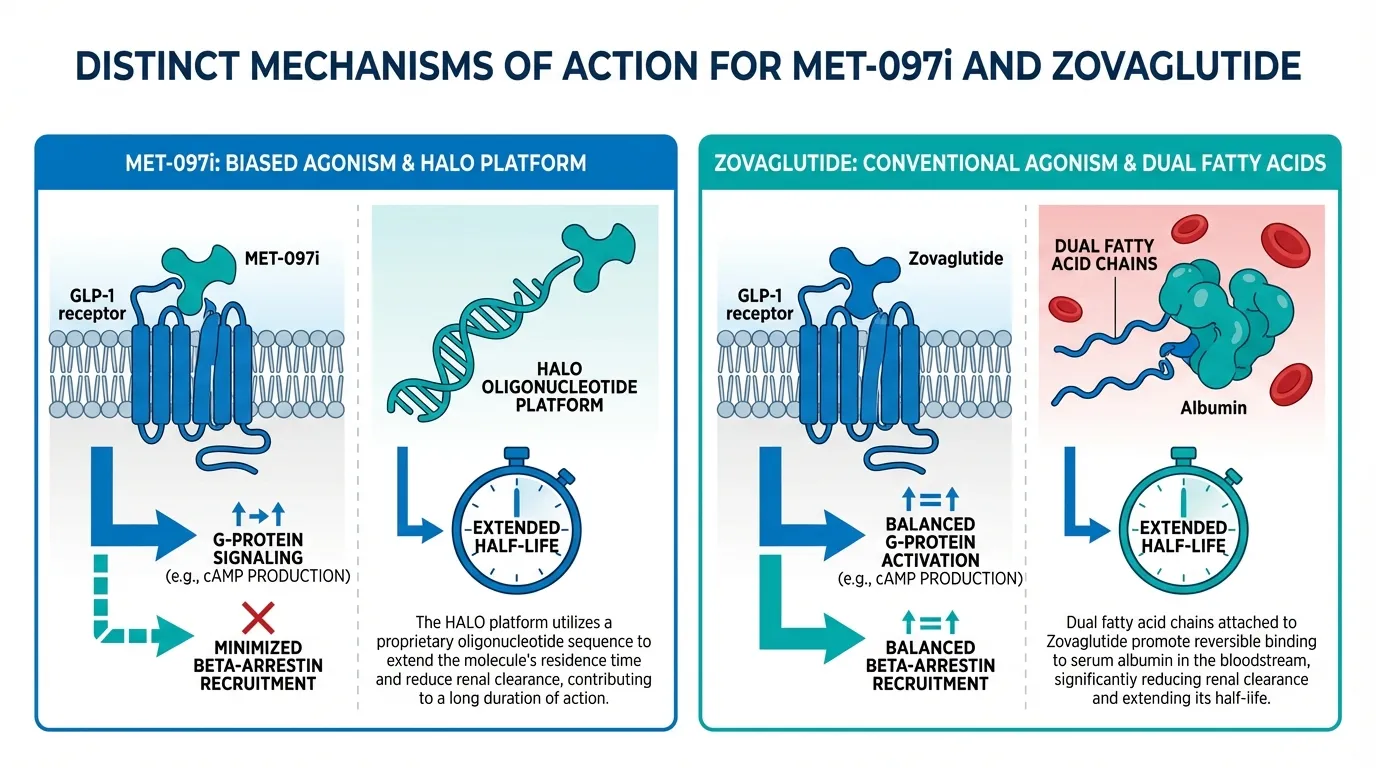
MET-097i uses Metsera's proprietary HALO (Half-life Augmented Ligand Oligonucleotide) platform technology to achieve an ultra-long half-life of approximately 380 hours (approximately 16 days). Key features:
- Biased GLP-1 receptor agonism: Described as a "fully biased" agonist, meaning it preferentially activates certain intracellular signaling pathways (such as G-protein signaling) over others (such as beta-arrestin recruitment). Biased agonism may improve the therapeutic window by enhancing beneficial effects while reducing side effects.
- ~380-hour half-life: Supports dosing intervals from weekly to monthly
- Titration-free potential: The long half-life produces approximately 4-fold pharmacological accumulation over 12 weeks, which may eliminate the need for traditional dose titration in some patients
- Pfizer backing: Acquired for approximately $10 billion, providing substantial development resources
Zovaglutide: Dual Fatty Acid Chain Design#
Zovaglutide achieves its extended duration through a dual fatty acid chain modification:
- Dual fatty acid chains: Enhanced albumin binding beyond single-chain modifications, extending the effective half-life to support monthly administration
- Conventional GLP-1 agonism: Not described as a biased agonist; appears to be a traditional (unbiased) full agonist at the GLP-1 receptor
- Flexible dosing tested: Phase 2 evaluated both Q4W (monthly) and Q2W (biweekly) intervals
- Developed by QL Biopharmaceutical: Smaller Chinese biotech with focused obesity pipeline
Technology Comparison#
| Property | MET-097i | Zovaglutide |
|---|---|---|
| Platform | HALO technology | Dual fatty acid chain |
| Agonist type | Biased GLP-1R agonist | Conventional GLP-1R agonist |
| Half-life | ~380 hours (16 days) | Not disclosed (supports Q4W) |
| Monthly dosing | Via accumulation/transition from weekly | Designed as Q4W from start |
| Developer | Metsera (acquired by Pfizer) | QL Biopharmaceutical (China) |
Weight Loss Efficacy#
MET-097i (VESPER Program)#
Phase 2a (120 participants, 12 weeks):
- Up to 11.3% placebo-adjusted weight loss at 1.2 mg (day 85)
- Titration-free cohorts showed 4-fold accumulation over 12 weeks
VESPER-1 Phase 2b (weekly dosing):
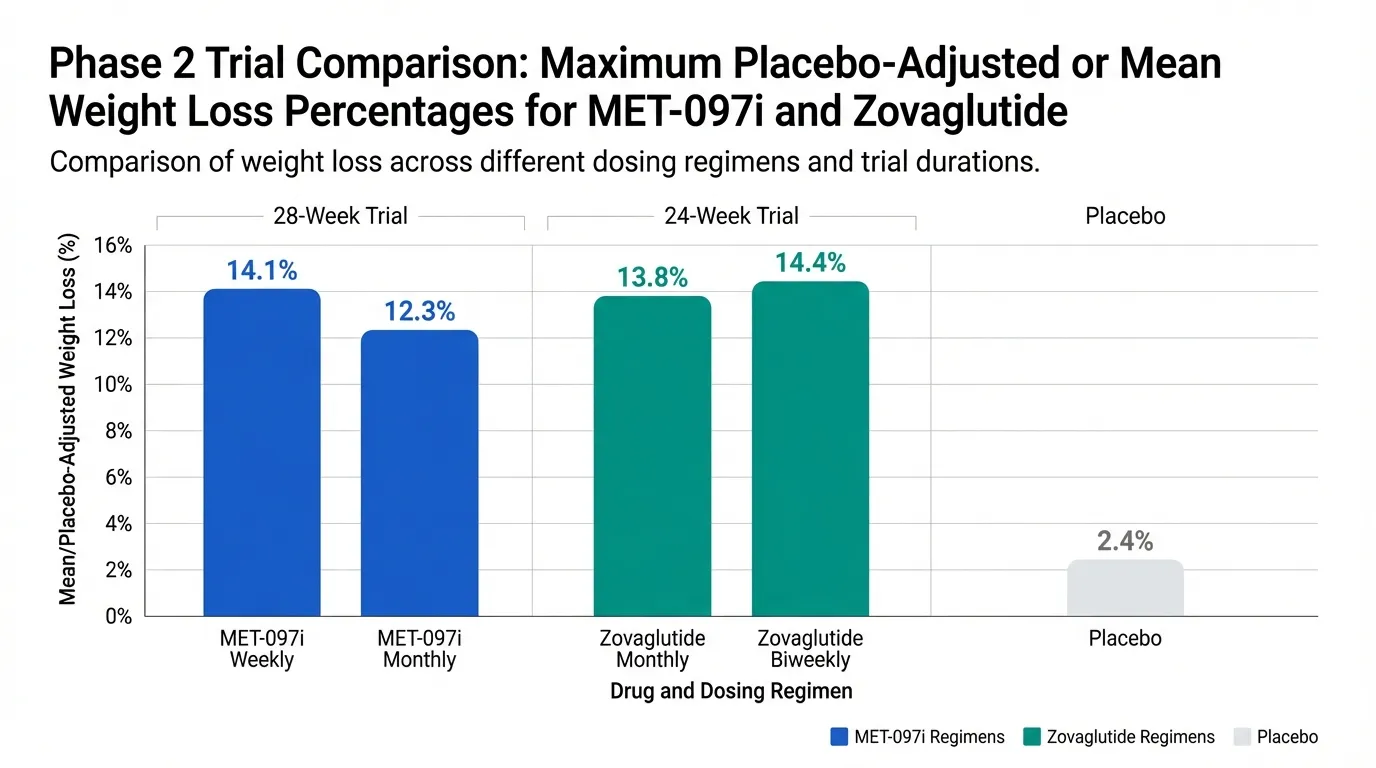
- Up to 14.1% placebo-adjusted weight loss at 1.2 mg after 28 weekly doses
- Individual responses as high as 26.5%
- Weight loss was dose-dependent and not plateaued at 28 weeks
VESPER-3 Phase 2b (monthly maintenance dosing):
- 10% and 12.3% placebo-adjusted weight loss at low and medium monthly maintenance doses at week 28
- Robust and continuous weight loss after switching to monthly dosing
- No plateau observed at 28 weeks
Zovaglutide (Phase 2)#
Phase 2 results (303 participants, 24 weeks), presented at EASD 2025:
| Dose Group | Mean Weight Loss | Achieved 5% or More |
|---|---|---|
| 80 mg Q4W (monthly) | 10.6% | 89.9% |
| 160 mg Q4W (monthly) | 13.8% | 93.9% |
| 80 mg Q2W (biweekly) | 12.5% | 97.1% |
| 160 mg Q2W (biweekly) | 14.4% | 93.6% |
| Placebo | 2.4% | 13.0% |
Efficacy Comparison#
Both compounds show competitive weight loss in Phase 2:
| Metric | MET-097i (VESPER-1/3) | Zovaglutide (Phase 2) |
|---|---|---|
| Max placebo-adjusted loss | 14.1% (28 weeks, weekly) | ~12% (24 weeks, monthly) |
| Max monthly dosing loss | 12.3% PA (28 weeks) | 13.8% mean (24 weeks) |
| Max individual response | 26.5% | Not reported |
| Weight loss plateau | Not yet | Not yet |
| Responder rate (5%+) | Not reported | 89.9-97.1% |
Direct comparison is limited by different trial designs (weekly then monthly vs monthly from start), durations, reporting conventions (placebo-adjusted vs mean), and population characteristics. Both compounds appear to produce weight loss in the range competitive with weekly semaglutide, though Phase 3 confirmation is essential.
Development Stage and Timeline#
MET-097i#
- Phase 2a completed (January 2025, 120 patients)
- VESPER-1 Phase 2b completed (September 2025)
- VESPER-3 Phase 2b interim data reported (September 2025)
- Pfizer acquisition: Approximately $10 billion deal, signaling commitment to rapid Phase 3 execution
- Phase 3 planned for late 2025/2026
- Pfizer's global regulatory and manufacturing infrastructure accelerates the path to market
Zovaglutide#
- Phase 2 completed (EASD 2025, 303 patients)
- Phase 3 planned
- Developed by QL Biopharmaceutical, a smaller biotech company
- Less certain timeline for Phase 3 initiation and completion
- May face additional regulatory hurdles for global (non-China) approval
The Pfizer acquisition gives MET-097i a substantial development advantage in terms of resources, regulatory experience, and manufacturing capacity.
Safety and Tolerability#
MET-097i (VESPER Program)#
- Described as "class-leading tolerability" by Metsera/Pfizer
- VESPER-3 monthly dosing: Nausea risk difference from placebo of 13%, vomiting 11% at highest evaluated dose
- Minimal diarrhea signal
- Only 2 titration steps in monthly regimen
- Phase 2a: All adverse events rated as insignificant or mild
Zovaglutide (Phase 2)#
- GI adverse events predominantly during dose escalation
- Only 1.3% discontinued due to GI adverse events (notably low for GLP-1 class)
- Monthly dosing (Q4W) showed fewer GI events than biweekly (Q2W) dosing
- Nausea, vomiting, and diarrhea were the most common GI events
Tolerability Comparison#
| Safety Metric | MET-097i | Zovaglutide |
|---|---|---|
| GI AE description | "Class-leading" | 1.3% GI discontinuation |
| Nausea (risk difference from placebo) | 13% (VESPER-3) | Not separately quantified |
| Diarrhea | Minimal signal | Present but low |
| Overall discontinuation | Not specifically reported | 1.3% (GI-related) |
Both compounds report encouraging tolerability, which is consistent with the hypothesis that monthly dosing inherently reduces peak-related GI side effects. The very low 1.3% GI discontinuation rate for zovaglutide, if confirmed in Phase 3, would be notably better than the 5-10% typically seen with weekly GLP-1 agonists.
Key Differences Summary#
| Feature | MET-097i | Zovaglutide |
|---|---|---|
| Developer | Metsera (Pfizer) | QL Biopharmaceutical (China) |
| Mechanism | Biased GLP-1R agonist (HALO) | Conventional GLP-1R agonist (dual fatty acid) |
| Half-life | ~380 hours (16 days) | Not disclosed (supports Q4W) |
| Phase 2b weight loss | 14.1% PA (weekly), 12.3% PA (monthly) | 13.8% mean at 160 mg Q4W |
| GI tolerability | "Class-leading" (13% nausea above placebo) | 1.3% GI discontinuation |
| Phase 3 timeline | Late 2025/2026 (Pfizer resources) | Planned (timeline less certain) |
| Dosing design | Weekly to monthly transition | Monthly from initiation |
| Acquisition value | ~$10 billion (Pfizer) | No major pharma acquisition |
| Total patients studied | ~240+ (Phase 2a + 2b) | 303 (Phase 2) |
Conclusion#
The race to develop the first once-monthly GLP-1 agonist features two promising competitors with distinct approaches. MET-097i brings a novel biased agonist mechanism (HALO platform), an ultra-long 380-hour half-life, and the substantial development resources of Pfizer's approximately $10 billion acquisition. Zovaglutide offers a dual fatty acid chain design, true once-monthly dosing from initiation (rather than transition from weekly), and an exceptionally low 1.3% GI discontinuation rate in Phase 2.
Weight loss efficacy appears broadly comparable between the two in Phase 2, though different trial designs and reporting conventions limit direct comparison. Both compounds support the hypothesis that monthly dosing can achieve weight loss competitive with weekly GLP-1 agonists while potentially improving tolerability.
The key differentiator is likely to be Phase 3 execution speed and regulatory strategy. MET-097i has a clear advantage in development resources through Pfizer, while zovaglutide may advance faster in China through QL Biopharmaceutical. Neither compound is approved, and both require Phase 3 confirmation of their Phase 2 promise. Patients and physicians should continue to use proven weekly or daily GLP-1 agonists while these monthly alternatives complete their development programs.
Further Reading#

Which Is Better For...
First-to-market monthly GLP-1 (predicted)
MET-097i
Pfizer acquisition provides substantially greater development resources, regulatory expertise, and manufacturing capacity for rapid Phase 3 execution
True once-monthly dosing from initiation
Zovaglutide
Phase 2 tested monthly dosing from the start with 13.8% weight loss at 160 mg Q4W; MET-097i VESPER-1 used weekly dosing with monthly maintenance in VESPER-3
Lowest GI side effect risk
Zovaglutide
1.3% GI discontinuation rate in Phase 2 is notably low; though MET-097i also claims class-leading tolerability, specific discontinuation rates have not been as clearly reported
Biased agonist pharmacology
MET-097i
Described as a fully biased GLP-1 receptor agonist via HALO platform, which may contribute to improved tolerability and efficacy profile
Larger company backing and development certainty
MET-097i
Pfizer acquisition for approximately $10 billion signals strong commitment to bringing this to market; QL Biopharmaceutical has fewer development resources
Continue Your Research
Get comparison updates
We publish new head-to-head comparisons regularly. Subscribe to see them first.
Frequently Asked Questions About MET-097i vs Zovaglutide: Monthly GLP-1 Agonist Showdown
Which is better, MET-097i or Zovaglutide?
MET-097i and zovaglutide are both investigational once-monthly GLP-1 agonists with promising Phase 2 data showing competitive weight loss and encouraging tolerability. Neither is approved. MET-097i has the advantage of Pfizer's acquisition and development resources (approximately $10 billion deal), a novel biased agonist mechanism via the HALO platform, and a clear Phase 3 pathway. Zovaglutide has the advantage of a true once-monthly dosing design from the start (rather than weekly-to-monthly... Individual responses may vary, and this comparison is based on available research data, not a treatment recommendation.
What are the key differences between MET-097i and Zovaglutide?
The main differences across comparison categories are: Mechanism of Action: advantage goes to MET-097i; Weight Loss Efficacy: advantage goes to neither (tie); Development Stage: advantage goes to MET-097i. 2 additional categories are analyzed in the full comparison. Each category evaluates a different dimension of the two peptides.
When should I consider MET-097i over Zovaglutide?
For the scenario of "First-to-market monthly GLP-1 (predicted)," research data suggests MET-097i may be more relevant. Pfizer acquisition provides substantially greater development resources, regulatory expertise, and manufacturing capacity for rapid Phase 3 execution. This is based on currently available evidence and individual circumstances may differ.
How do MET-097i and Zovaglutide differ in their mechanisms of action?
MET-097i: Ultra-long acting GLP-1 receptor agonist using Metsera HALO platform technology. Reported approximately 380-hour (16-day) half-life enabling weekly-to-monthly dosing. Described as a fully biased GL.... Zovaglutide: GLP-1 receptor agonist with dual fatty acid chain modification for enhanced albumin binding. Extended half-life supports once-monthly (Q4W) or twice-monthly (Q2W) administration. Developed by Beiji....
Which has fewer side effects, MET-097i or Zovaglutide?
In terms of side effects and tolerability, the advantage goes to neither (comparable). MET-097i: Metsera describes class-leading tolerability. VESPER-3 monthly dosing showed nausea risk difference of 13% from placebo and vomiting of 11% at high.... Zovaglutide: Phase 2 showed only 1.3% discontinuation due to GI AEs, substantially lower than typical GLP-1 agonists. Monthly dosing group had fewer GI events t....
Medical Disclaimer
This website is for educational and informational purposes only. The information provided is not intended to diagnose, treat, cure, or prevent any disease. Always consult with a qualified healthcare professional before using any peptide or supplement.