Epitalon vs FOXO4-DRI: Comprehensive Comparison
A detailed comparison of Epitalon and FOXO4-DRI covering mechanisms of action, anti-aging approaches, dosing protocols, side effects, and research evidence for these two peptides targeting distinct hallmarks of aging.
Verdict at a Glance
Epitalon for preventive longevity research targeting telomere maintenance with a broader evidence base; FOXO4-DRI for interventional senescent cell clearance research with a novel but less validated mechanism
| Best for | Pick | Why |
|---|---|---|
| Preventive Anti-Aging Research | Epitalon | Epitalon's telomerase activation mechanism aims to prevent telomere shortening before cells become senescent, making it suited for proactive longevity strategies |
| Clearing Accumulated Senescent Cells | FOXO4-DRI | FOXO4-DRI selectively induces apoptosis in already-senescent cells, directly addressing the burden of accumulated cellular damage associated with aging |
| Preclinical Longevity Studies | Epitalon | Epitalon has demonstrated lifespan extension in multiple animal models with decades of supporting preclinical data from the Khavinson laboratory |
| SASP-Driven Chronic Inflammation | FOXO4-DRI | By eliminating senescent cells, FOXO4-DRI directly reduces the senescence-associated secretory phenotype (SASP) that drives chronic tissue inflammation |
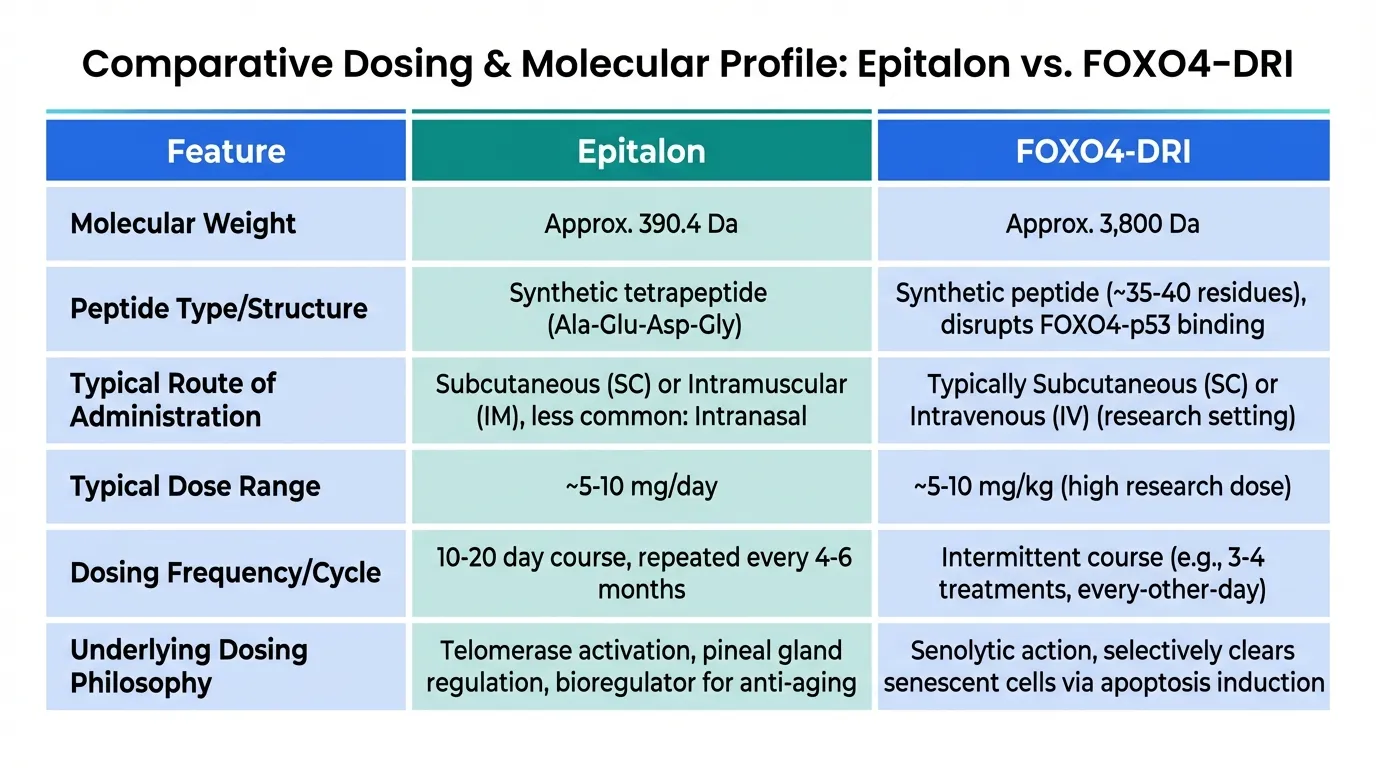
| Ease of Research Implementation | Epitalon | Epitalon is a simple tetrapeptide (390.3 Da) that is easy to synthesize, stable, and has well-documented cyclic administration protocols |
| Combination with Other Senolytics | FOXO4-DRI | FOXO4-DRI's peptide-based senolytic mechanism complements small-molecule senolytics like dasatinib+quercetin, offering a distinct and potentially synergistic approach to senescent cell clearance |
| Category | Epitalon | FOXO4-DRI | Advantage |
|---|---|---|---|
| Mechanism of Action | Synthetic tetrapeptide (Ala-Glu-Asp-Gly) that activates telomerase via hTERT gene expression, promoting telomere elongation and extending replicative lifespan of somatic cells | D-Retro-Inverso peptide that selectively disrupts the FOXO4-p53 protein interaction in senescent cells, triggering p53-mediated apoptosis specifically in damaged, non-dividing cells | Comparable |
| Research Evidence | Decades of preclinical research primarily from Khavinson's group; lifespan extension demonstrated in rodents and Drosophila; telomerase activation confirmed in human cell cultures | Landmark 2017 Cell paper by Baar et al. demonstrated selective senescent cell clearance in mice; limited follow-up studies; strong mechanistic rationale but narrow evidence base | Epitalon |
| Side Effect Profile | No significant adverse effects reported in preclinical studies; theoretical concern about telomerase activation in pre-cancerous cells, though evidence suggests selectivity for normal cells | Potential for off-target apoptosis if selectivity is imperfect; transient effects reported in animal studies; theoretical risk of excessive tissue loss if senescent cell clearance is too aggressive | Epitalon |
| Dosing Complexity | Simple cyclic administration protocol; small tetrapeptide with straightforward synthesis; typically administered in 10-20 day cycles with intervals | Large peptide (4826.5 Da) requiring careful synthesis and handling; D-Retro-Inverso modification adds manufacturing complexity; dosing protocols not well established | Epitalon |
| Anti-Aging Approach | Preventive strategy that maintains telomere length to delay cellular senescence onset; aims to preserve existing cell populations and extend their replicative capacity | Interventional strategy that eliminates already-senescent cells to reduce SASP-driven inflammation and tissue dysfunction; targets accumulated age-related damage | Comparable |
| Translational Potential | Based on pineal gland epithalamin research with decades of preclinical data; simple structure amenable to manufacturing; lacks recent high-profile clinical development | Based on cutting-edge senescence biology with strong mechanistic rationale; complex structure poses manufacturing challenges; senolytic field has significant pharmaceutical investment | FOXO4-DRI |

Introduction#
Epitalon and FOXO4-DRI represent two fundamentally different peptide-based approaches to one of biology's greatest challenges: aging. While both target cellular mechanisms that drive age-related decline, they do so through entirely distinct pathways -- Epitalon by maintaining telomere length to prevent cells from becoming senescent, and FOXO4-DRI by selectively eliminating cells that have already entered the senescent state.
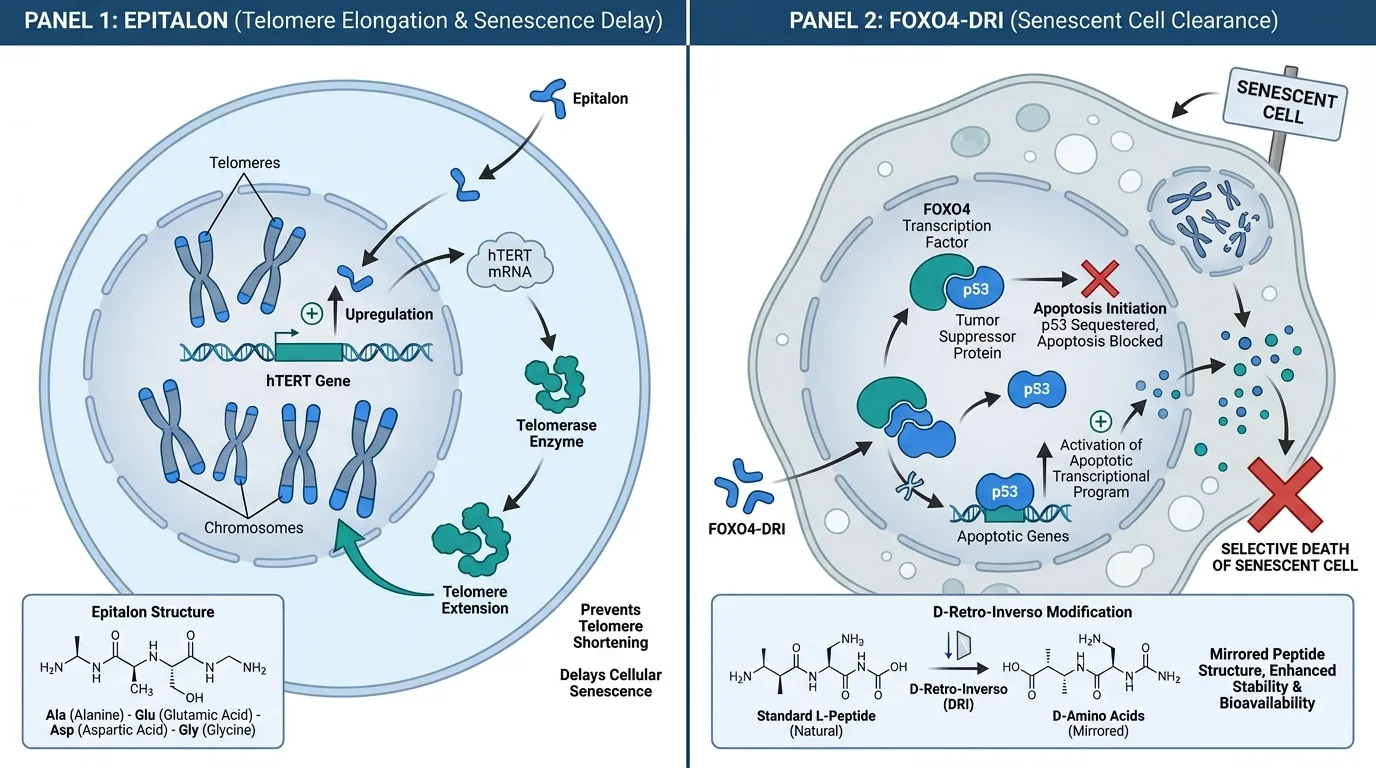
Epitalon (also known as Epithalon or Epithalone) is a synthetic tetrapeptide with the sequence Ala-Glu-Asp-Gly (MW 390.3 Da). It was developed by Professor Vladimir Khavinson at the Saint Petersburg Institute of Bioregulation and Gerontology as a synthetic analog of epithalamin, a polypeptide extract from the pineal gland. Its primary mechanism involves activation of the telomerase enzyme through upregulation of the hTERT (human telomerase reverse transcriptase) gene, promoting telomere elongation in somatic cells.
FOXO4-DRI is a D-Retro-Inverso peptide (MW 4826.5 Da) designed by Peter de Keizer's laboratory at Erasmus University Medical Center. It was engineered to selectively disrupt the interaction between the FOXO4 transcription factor and the p53 tumor suppressor protein within senescent cells, thereby releasing p53 to trigger apoptosis specifically in those damaged, non-dividing cells. The D-Retro-Inverso modification uses D-amino acids in reverse sequence to mimic the native peptide's structure while conferring resistance to proteolytic degradation.
This comparison explores how these two aging-targeted peptides differ in their mechanisms, evidence bases, and potential applications in longevity research.
Mechanism of Action Comparison#
Epitalon#
Epitalon exerts its anti-aging effects primarily through activation of telomerase, the ribonucleoprotein enzyme complex responsible for maintaining telomere length at chromosome ends. As somatic cells divide, telomeres progressively shorten due to the end-replication problem. When telomeres reach a critically short length, cells enter replicative senescence or undergo apoptosis. By activating telomerase, Epitalon aims to counteract this fundamental limitation on cellular lifespan.
The mechanism involves upregulation of the hTERT gene, which encodes the catalytic subunit of telomerase. Research by Khavinson and colleagues demonstrated that Epitalon treatment increased telomerase activity in human fetal fibroblasts and pulmonary somatic cells, resulting in measurable telomere elongation. Treated cells exceeded the Hayflick limit, undergoing additional population doublings beyond what untreated controls achieved.
Beyond telomerase activation, Epitalon has demonstrated effects on melatonin secretion from the pineal gland, circadian rhythm regulation, and antioxidant enzyme expression. It modulates the activity of superoxide dismutase and other antioxidant defense systems, contributing to reduced oxidative stress. These pleiotropic effects suggest that Epitalon's anti-aging properties extend beyond simple telomere maintenance to encompass broader cytoprotective functions.
FOXO4-DRI#
FOXO4-DRI operates through a highly targeted senolytic mechanism. In normal cells, the FOXO4 transcription factor plays roles in cell cycle regulation, apoptosis, and stress resistance. However, in senescent cells, FOXO4 accumulates in the nucleus and binds to p53, effectively sequestering this tumor suppressor and preventing it from initiating the apoptotic cascade. This FOXO4-p53 interaction is a key survival mechanism that allows senescent cells to persist in tissues despite their damaged state.
FOXO4-DRI is designed to competitively interfere with this interaction. By binding to p53 in place of endogenous FOXO4, the peptide liberates p53 to activate its apoptotic transcriptional program, specifically within senescent cells. Because FOXO4 accumulation and the FOXO4-p53 interaction are characteristic of senescent cells rather than healthy cells, FOXO4-DRI achieves selectivity for senescent cell elimination without broadly inducing apoptosis in normal tissue.
The D-Retro-Inverso modification is critical to FOXO4-DRI's function. Native L-peptides are rapidly degraded by proteases in vivo. By using D-amino acids assembled in reverse order, the peptide maintains the same spatial arrangement of side chains as the native sequence while resisting enzymatic degradation, dramatically extending its biological half-life and allowing it to reach intracellular targets.
Dosing Comparison#
Epitalon Dosing#
Epitalon dosing protocols in preclinical research follow a cyclic pattern:
- Subcutaneous injection: The most common route in research protocols, with doses typically ranging from 5-10 mg per day
- Intravenous injection: Used in some clinical observations at similar dose ranges
- Cycle structure: Typically administered for 10-20 consecutive days, followed by a 4-6 month interval before the next cycle
- Annual protocols: Common research designs use 2-3 cycles per year with drug-free intervals between cycles
The cyclic dosing strategy reflects the understanding that telomerase activation does not need to be continuous. Brief periods of enhanced telomerase activity can elongate telomeres, which then provide extended replicative capacity during the drug-free interval. Epitalon's small molecular weight (390.3 Da) and simple tetrapeptide structure contribute to straightforward formulation and stability.
FOXO4-DRI Dosing#
FOXO4-DRI dosing is less well established due to its more recent development and limited research:
- Intraperitoneal injection: Used in the original Baar et al. mouse study at 5 mg/kg body weight
- Dosing frequency: The landmark study used every-other-day dosing for three treatments total
- Intermittent schedule: Senolytic agents are generally used intermittently rather than continuously, as senescent cell accumulation occurs gradually
- Research challenges: The peptide's large size (4826.5 Da) and complex D-Retro-Inverso structure require careful synthesis quality control
The intermittent dosing approach for senolytics is based on the concept that once senescent cells are eliminated, time is required for new senescent cells to accumulate before the next treatment is warranted. This "hit-and-run" dosing philosophy differs fundamentally from Epitalon's cyclic maintenance approach and may reduce cumulative exposure-related risks.
Side Effects Comparison#
Epitalon Side Effects#
Epitalon has demonstrated a favorable safety profile across decades of preclinical study:
- No significant adverse effects reported in animal studies spanning multiple species including rodents and primates
- No observed tumorigenicity in long-term animal studies, despite the theoretical concern that telomerase activation could promote cancer cell immortalization
- Research suggests that Epitalon's telomerase activation may be selective for normal somatic cells, potentially because cancer cells already express telomerase and may not be further responsive
- Mild injection site reactions (redness, transient discomfort) are the most commonly noted local effects
- No significant alterations in standard hematological or biochemical parameters in available preclinical data
- Theoretical concern remains regarding telomerase activation in early-stage pre-cancerous cells that have not yet activated endogenous telomerase
The long research history of Epitalon, while primarily from a single research group, provides some reassurance regarding its safety profile. However, the absence of large-scale, independent safety studies remains a limitation.
FOXO4-DRI Side Effects#
FOXO4-DRI's side effect profile is less characterized due to its more limited research history:
- In the original mouse study, transient loss of approximately 10% body weight was observed, which recovered within days of completing treatment
- Selective liver cell apoptosis was noted as a potential concern if senescent cell clearance is too aggressive in highly senescent tissues
- Theoretical risk of impaired wound healing if senescent cells that play transient beneficial roles (such as in wound repair signaling) are prematurely eliminated
- The possibility of off-target apoptosis in non-senescent cells if the selectivity mechanism is imperfect, though this was not observed in the published research
- Immune system activation following apoptotic cell clearance, which could theoretically trigger inflammatory responses if large numbers of senescent cells are eliminated simultaneously
- Manufacturing impurities in the complex D-Retro-Inverso synthesis could introduce additional unknown risks
The limited evidence base means that the full side effect profile of FOXO4-DRI remains substantially unknown, representing a significant gap compared to Epitalon's longer safety track record.
Research Evidence Comparison#
Epitalon Research#
Epitalon's research base spans approximately three decades, primarily originating from the Khavinson laboratory:
- Lifespan extension: Studies in rodents demonstrated 12-24% increases in mean lifespan in several strains of rats and mice. Drosophila studies showed 11-16% lifespan extension. These represent among the more compelling peptide-based longevity data available
- Telomerase activation: In vitro studies confirmed activation of hTERT in human fetal lung fibroblasts, with treated cells exceeding the Hayflick limit by approximately 10 additional population doublings
- Telomere elongation: Direct measurement of telomere length in treated cells showed statistically significant increases compared to untreated controls
- Pineal gland effects: Research demonstrated that Epitalon restored melatonin secretion rhythms in aged animals toward youthful patterns, suggesting neuroendocrine rejuvenation
- Cancer incidence: Some long-term animal studies reported reduced spontaneous tumor incidence in Epitalon-treated animals, partially addressing the theoretical telomerase-cancer concern
The primary limitation of Epitalon's evidence base is the concentration of research within a single laboratory group. Independent replication by other research institutions is limited, which is a significant caveat in evaluating the strength of the evidence. No controlled human clinical trials have been published.
FOXO4-DRI Research#
FOXO4-DRI's evidence base is more recent but built on a strong mechanistic foundation:
- Landmark 2017 study: Baar et al. published in Cell demonstrating that FOXO4-DRI selectively induced apoptosis in senescent cells in vitro and in vivo. In fast-aging XpdTTD/TTD mice, treatment restored fur density, renal function, and exercise capacity
- Naturally aged mice: The same study showed that FOXO4-DRI improved renal function in naturally aged (>24 months) wild-type mice, providing evidence of efficacy beyond accelerated aging models
- Selectivity validation: The study confirmed selective toxicity toward senescent cells using SA-beta-galactosidase and p21 markers, with minimal effects on non-senescent cell populations
- Senescence biology: FOXO4-DRI research is supported by the broader senescence literature, including extensive evidence that senescent cell accumulation drives age-related pathology through the SASP
The primary limitation is the narrow evidence base -- the core evidence rests heavily on a single publication, albeit in a high-impact journal. Follow-up studies validating the findings across independent laboratories and diverse aging models are still limited. The broader senolytic field, however, provides substantial support for the general approach of senescent cell clearance as an anti-aging strategy.
Key Differences Summary#
- Aging mechanism targeted: Epitalon addresses telomere shortening (a cause of senescence); FOXO4-DRI addresses senescent cell accumulation (a consequence of aging)
- Approach: Epitalon is preventive (maintaining cell health); FOXO4-DRI is interventional (removing damaged cells)
- Molecular size: Epitalon is a small tetrapeptide (390.3 Da); FOXO4-DRI is a large modified peptide (4826.5 Da)
- Synthesis complexity: Epitalon is simple to synthesize with standard peptide chemistry; FOXO4-DRI requires specialized D-Retro-Inverso synthesis
- Evidence base: Epitalon has decades of preclinical data from the Khavinson group; FOXO4-DRI has a single landmark publication with strong mechanistic support
- Dosing philosophy: Epitalon uses periodic maintenance cycles; FOXO4-DRI uses intermittent hit-and-run senolytic dosing
- Clinical development stage: Both are preclinical, though the senolytic field has attracted more pharmaceutical industry investment
- Theoretical risks: Epitalon carries theoretical telomerase-cancer concerns; FOXO4-DRI carries theoretical risks of excessive cell loss and impaired beneficial senescence
Conclusion#
Epitalon and FOXO4-DRI represent complementary rather than competing approaches to the biology of aging. Epitalon works upstream in the aging cascade, aiming to maintain telomere length and thereby delay the onset of cellular senescence. Its preventive strategy, simple molecular structure, favorable safety record, and demonstrated lifespan extension in animal models give it a more established, though geographically concentrated, evidence base. Researchers investigating telomere biology, pineal gland function, or long-term preventive longevity strategies may find Epitalon the more accessible and better-characterized option.
FOXO4-DRI works downstream, targeting senescent cells that have already accumulated. Its mechanism is scientifically elegant and addresses a validated hallmark of aging -- cellular senescence and the SASP -- that has attracted substantial interest from the pharmaceutical industry. For researchers investigating senolytic strategies, SASP-driven chronic inflammation, or the acute reversal of age-related tissue dysfunction, FOXO4-DRI offers a unique peptide-based tool. However, its limited evidence base, complex synthesis, and less characterized safety profile introduce greater uncertainty. The ideal anti-aging research program might ultimately incorporate both strategies: Epitalon to slow the generation of senescent cells and FOXO4-DRI to clear those that have already formed.
Further Reading#

Which Is Better For...
Preventive Anti-Aging Research
Epitalon
Epitalon's telomerase activation mechanism aims to prevent telomere shortening before cells become senescent, making it suited for proactive longevity strategies
Clearing Accumulated Senescent Cells
FOXO4-DRI
FOXO4-DRI selectively induces apoptosis in already-senescent cells, directly addressing the burden of accumulated cellular damage associated with aging
Preclinical Longevity Studies
Epitalon
Epitalon has demonstrated lifespan extension in multiple animal models with decades of supporting preclinical data from the Khavinson laboratory
SASP-Driven Chronic Inflammation
FOXO4-DRI
By eliminating senescent cells, FOXO4-DRI directly reduces the senescence-associated secretory phenotype (SASP) that drives chronic tissue inflammation
Ease of Research Implementation
Epitalon
Epitalon is a simple tetrapeptide (390.3 Da) that is easy to synthesize, stable, and has well-documented cyclic administration protocols
Combination with Other Senolytics
FOXO4-DRI
FOXO4-DRI's peptide-based senolytic mechanism complements small-molecule senolytics like dasatinib+quercetin, offering a distinct and potentially synergistic approach to senescent cell clearance
Continue Your Research
Get comparison updates
We publish new head-to-head comparisons regularly. Subscribe to see them first.
Frequently Asked Questions About Epitalon vs FOXO4-DRI: Comprehensive Comparison
What are the key differences between Epitalon and FOXO4-DRI?
The main differences across comparison categories are: Mechanism of Action: advantage goes to neither (tie); Research Evidence: advantage goes to Epitalon; Side Effect Profile: advantage goes to Epitalon. 3 additional categories are analyzed in the full comparison. Each category evaluates a different dimension of the two peptides.
When should I consider Epitalon over FOXO4-DRI?
For the scenario of "Preventive Anti-Aging Research," research data suggests Epitalon may be more relevant. Epitalon's telomerase activation mechanism aims to prevent telomere shortening before cells become senescent, making it suited for proactive longevity strategies. This is based on currently available evidence and individual circumstances may differ.
How do Epitalon and FOXO4-DRI differ in their mechanisms of action?
Epitalon: Synthetic tetrapeptide (Ala-Glu-Asp-Gly) that activates telomerase via hTERT gene expression, promoting telomere elongation and extending replicative lifespan of somatic cells. FOXO4-DRI: D-Retro-Inverso peptide that selectively disrupts the FOXO4-p53 protein interaction in senescent cells, triggering p53-mediated apoptosis specifically in damaged, non-dividing cells.
Which has fewer side effects, Epitalon or FOXO4-DRI?
In terms of side effects and tolerability, the advantage goes to Epitalon. Epitalon: No significant adverse effects reported in preclinical studies; theoretical concern about telomerase activation in pre-cancerous cells, though evid.... FOXO4-DRI: Potential for off-target apoptosis if selectivity is imperfect; transient effects reported in animal studies; theoretical risk of excessive tissue ....
Medical Disclaimer
This website is for educational and informational purposes only. The information provided is not intended to diagnose, treat, cure, or prevent any disease. Always consult with a qualified healthcare professional before using any peptide or supplement.