Epitalon vs NAD+: Telomerase Activation vs Sirtuin Pathway
Comparison of Epitalon and NAD+ for anti-aging research covering telomerase activation vs sirtuin pathways, evidence quality, and accessibility.
Verdict at a Glance
NAD+ has clear advantages in evidence breadth, human data, accessibility, and multi-hallmark coverage. Epitalon targets a hallmark (telomere attrition) that NAD+ does not directly address, making it a potential complement rather than competitor. Epitalon's evidence base needs independent validation to match NAD+'s international research standard.
| Best for | Pick | Why |
|---|---|---|
| Broadest Anti-Aging Coverage | NAD+ | NAD+ affects at least six hallmarks of aging through sirtuin activation, including DNA repair, mitochondrial function, epigenetic maintenance, nutrient sensing, autophagy, and stem cell function |
| Telomere-Specific Intervention | Epitalon | Epitalon is the only peptide with direct telomerase activation data in human somatic cells, addressing telomere attrition which NAD+ does not directly target |
| Strongest Human Evidence | NAD+ | Multiple randomized controlled trials demonstrate that NAD+ precursors safely restore NAD+ levels in humans, while Epitalon has no human clinical trial data |
| Ease of Access and Self-Administration | NAD+ | NMN and NR are available as oral supplements without prescription, injection, or specialized handling, making them the most accessible longevity intervention |
| Complementary Combination Research | Epitalon | Because Epitalon and NAD+ target non-overlapping hallmarks (telomere attrition vs sirtuin-mediated pathways), they are theoretically complementary rather than redundant in a multi-target longevity strategy |
| Category | Epitalon | NAD+ | Advantage |
|---|---|---|---|
| Mechanism of Action | Synthetic tetrapeptide (Ala-Glu-Asp-Gly) that activates telomerase via hTERT gene upregulation. Promotes telomere elongation in somatic cells, extending replicative lifespan beyond the Hayflick limit. Also restores pineal melatonin secretion and activates antioxidant enzyme expression. Targets a single, specific hallmark of aging (telomere attrition). | Essential coenzyme that activates sirtuins (SIRT1-7), NAD+-dependent deacetylases that regulate DNA repair (PARP enzymes), mitochondrial function (SIRT3), epigenetic modifications (histone deacetylation), nutrient sensing (AMPK/mTOR axis), and autophagy. Endogenous NAD+ levels decline approximately 50% between ages 40 and 60. Targets multiple hallmarks of aging simultaneously. | NAD+ |
| Research Evidence | Decades of preclinical research predominantly from Khavinson's group at the Saint Petersburg Institute. Lifespan extension in rodents (12-13%) and Drosophila (11-16%). Telomerase activation confirmed in human cell cultures with cells exceeding the Hayflick limit. A 2025 study provided partial independent validation. No human clinical trials. Evidence base is geographically concentrated. | Broad international research base across hundreds of laboratories. Multiple randomized controlled trials in humans for NMN and NR precursors demonstrating NAD+ restoration. Animal studies showing metabolic improvement, DNA repair restoration, and stem cell rejuvenation. Translational biomarker data linking NAD+ decline to aging endpoints. Published in top-tier journals with extensive independent replication. | NAD+ |
| Side Effect Profile | No significant adverse effects in decades of preclinical study. Mild injection site reactions possible. Theoretical concern about telomerase activation in pre-cancerous cells, though animal studies showed reduced rather than increased tumor incidence. Safety data primarily from a single research group. No large-scale safety studies. | NMN and NR supplementation have shown favorable safety profiles in multiple human trials at doses up to 1200 mg/day. Most common side effects are mild GI symptoms. Theoretical concern about NAD+ supporting cancer cell metabolism (Warburg effect). Long-term safety data limited to supplement-duration studies. Generally well-tolerated across diverse populations. | NAD+ |
| Dosing and Administration | Administered by subcutaneous injection in cyclic protocols (10-20 days on, 4-6 months off, 2-3 cycles per year). Small tetrapeptide (390.3 Da) with straightforward synthesis and formulation. Requires injection, which limits accessibility. Available as a research peptide but FDA Category 2 banned from compounding since 2024. | NAD+ precursors (NMN, NR) are administered orally as supplements, typically 250-1000 mg daily on a continuous basis. No injection required. Widely commercially available as dietary supplements. IV NAD+ infusions are also offered by longevity clinics. Multiple delivery options across different regulatory categories. | NAD+ |
| Accessibility and Cost | Limited accessibility since FDA Category 2 placement in 2024. Previously available from research peptide suppliers and compounding pharmacies. Requires cold chain storage, sterile reconstitution, and injection supplies. Cost varies by supplier but generally higher per-course than supplement-based alternatives. No insurance coverage. | Highly accessible as NMN and NR are sold as dietary supplements without prescription in most countries. Available from major supplement brands at consumer-friendly price points. No special storage or administration requirements. NMN regulatory status varies (FDA challenged its supplement status in 2022 but it remains widely available). IV NAD+ is more expensive but offered by longevity clinics. | NAD+ |

Introduction#
Epitalon and NAD+ represent two of the most discussed approaches to biological aging, targeting fundamentally different cellular mechanisms. Epitalon, a synthetic tetrapeptide from the Khavinson bioregulator program, activates telomerase to maintain telomere length -- addressing one of the primary hallmarks of aging. NAD+ (nicotinamide adenine dinucleotide), an essential coenzyme present in all living cells, activates sirtuins and supports DNA repair, mitochondrial function, and metabolic regulation -- touching multiple hallmarks simultaneously.
This comparison examines how these two interventions differ in mechanism, evidence quality, practical accessibility, and potential complementarity. For how both fit into the complete hallmarks framework, see The Hallmarks of Aging: Which Peptides Target Which?. For Epitalon compared to another anti-aging peptide, see Epitalon vs FOXO4-DRI.
Mechanism of Action Comparison#
Epitalon: Telomerase Activation#
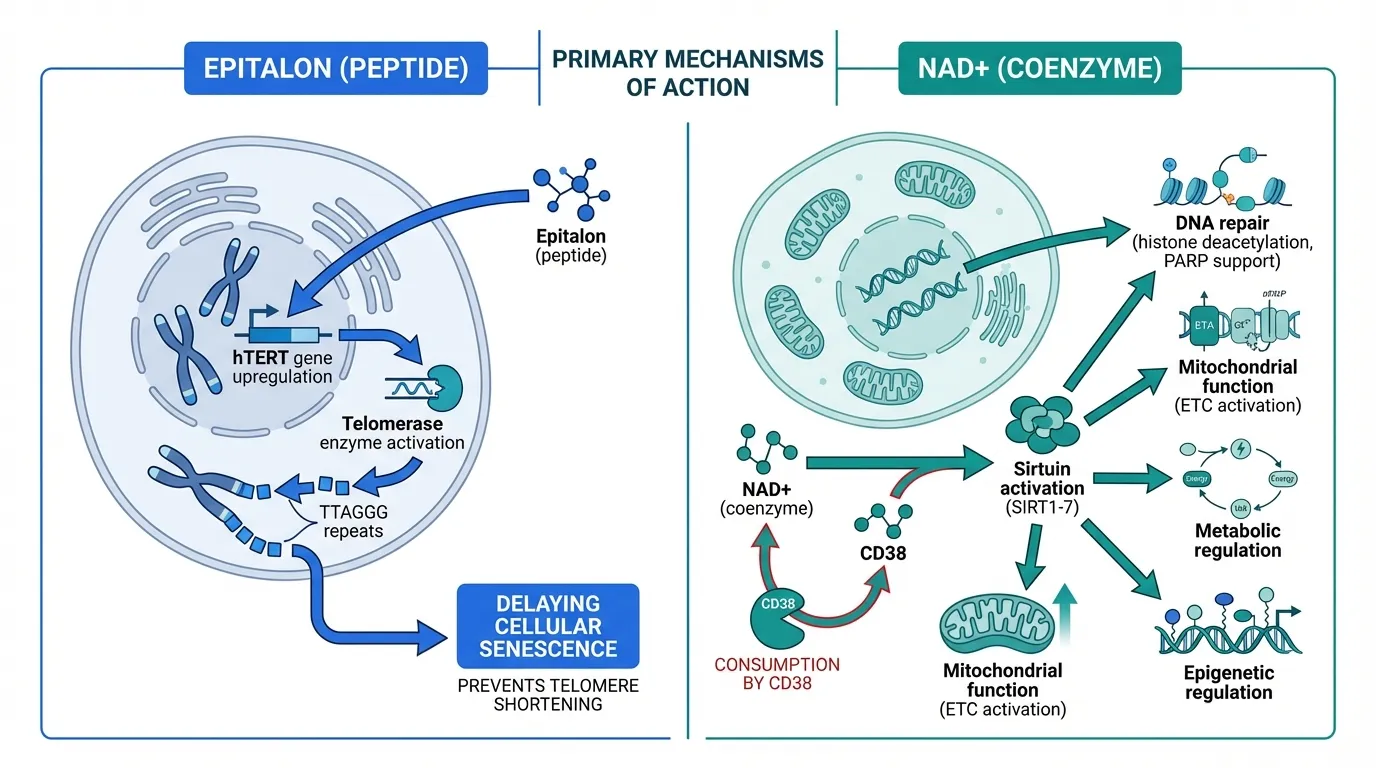
Epitalon (Ala-Glu-Asp-Gly) is a synthetic tetrapeptide developed as a replacement for epithalamin, a bovine pineal gland extract. Its primary mechanism involves upregulation of the hTERT gene, which encodes the catalytic subunit of telomerase -- the enzyme that adds TTAGGG repeats to chromosome ends.
In human somatic cells, telomerase is normally silenced after embryonic development, meaning telomeres shorten with each cell division until reaching a critical length that triggers replicative senescence or apoptosis. By reactivating telomerase, Epitalon aims to extend the replicative capacity of somatic cells, delaying the onset of telomere-driven cellular aging.
Beyond telomerase, Epitalon has secondary effects:
- Melatonin restoration: Epitalon restores nocturnal melatonin secretion patterns in aged animals, improving circadian regulation
- Antioxidant activation: Upregulation of superoxide dismutase and catalase expression
- Gene regulation: The Khavinson bioregulator theory proposes direct DNA binding by short peptides, though this mechanism lacks independent structural validation
Epitalon targets a single primary hallmark: telomere attrition. Its effects on other hallmarks (epigenetic alterations, cellular senescence prevention) are secondary consequences of telomere maintenance.
NAD+: Sirtuin Activation and Beyond#
NAD+ is not a peptide in the traditional sense -- it is a dinucleotide coenzyme essential for redox reactions, energy metabolism, and enzymatic signaling. However, it is increasingly discussed alongside anti-aging peptides because of its profound effects on aging biology and its availability as supplemented precursors (NMN, NR).
NAD+'s anti-aging mechanisms operate through multiple pathways:
- Sirtuin activation: NAD+ is the essential substrate for SIRT1-7, deacetylases that regulate epigenetic modifications (histone deacetylation), DNA repair (Ku70, Werner helicase activation), mitochondrial function (SIRT3 activates ETC complexes), and metabolic regulation (SIRT1 activates PGC-1alpha)
- PARP support: NAD+ powers PARP1 and PARP2, enzymes responsible for detecting and repairing single-strand DNA breaks. Age-related NAD+ decline impairs this critical DNA repair pathway
- CD38 balance: The ectoenzyme CD38 consumes NAD+ and increases with age, creating a vicious cycle of NAD+ depletion and immune dysregulation
By restoring NAD+ levels, supplementation recalibrates multiple aging pathways simultaneously: improved DNA repair, enhanced mitochondrial biogenesis, restored epigenetic regulation, activated autophagy, and improved nutrient sensing. This multi-target action is NAD+'s greatest advantage.
Key Mechanistic Distinction#
Epitalon is a precision intervention targeting one hallmark deeply. NAD+ is a broad-spectrum intervention touching many hallmarks at moderate depth. This distinction shapes their entire comparison -- Epitalon may be more potent at preventing telomere-driven senescence, but NAD+ addresses a wider array of aging mechanisms.
Research Evidence Comparison#
Epitalon Evidence Base#
Epitalon's evidence spans approximately three decades, primarily from the Khavinson laboratory at the Saint Petersburg Institute of Bioregulation and Gerontology:
- Lifespan extension: Multiple rodent studies showed 12-13% increases in mean lifespan in SHR mice; Drosophila studies showed 11-16% extension
- Telomerase activation: In vitro studies confirmed hTERT upregulation in human fetal fibroblasts and pulmonary cells, with treated cells exceeding the Hayflick limit by approximately 10 additional population doublings
- Telomere elongation: Direct measurements showed statistically significant telomere lengthening in treated cells
- Cancer incidence: Long-term animal studies showed reduced spontaneous tumor formation, partially addressing the telomerase-cancer concern
- 2025 validation: An independent study confirmed telomere-lengthening effects across multiple human cell lines, representing the first significant non-Khavinson replication
Key limitations: The evidence base is dominated by a single research group. Publication venues include Russian-language journals and lower-impact international publications. Study designs often lack the rigor expected by Western regulatory standards. No randomized controlled human trials have been conducted.
NAD+ Evidence Base#
NAD+ research spans a massive international effort across hundreds of laboratories:
- Human clinical trials: Multiple RCTs of NMN and NR in humans demonstrate safe NAD+ restoration. Key studies include the Yoshino et al. 2021 Science paper (NMN improved muscle insulin sensitivity in prediabetic women), the Martens et al. 2018 Nature Communications paper (NR reduced blood pressure and arterial stiffness in healthy middle-aged adults), and numerous pharmacokinetic studies
- Animal lifespan data: While NAD+ precursors have shown healthspan improvements in mice (improved physical activity, insulin sensitivity, mitochondrial function), clear lifespan extension data is more limited and inconsistent
- DNA repair: Studies demonstrated restored PARP-dependent DNA repair in aged mice and radiation-exposed human cells following NAD+ repletion
- Stem cell rejuvenation: NMN restored aged muscle stem cell function and improved hematopoietic stem cell parameters in mice
- Epidemiological data: NAD+ levels correlate with biological age across multiple cohort studies, establishing translational relevance
Key limitations: Despite abundant evidence for NAD+ restoration, the downstream clinical benefits in humans are still being established. Not all human trials show significant functional improvement. NAD+ lifespan extension data in animals is less consistent than caloric restriction or rapamycin. The optimal precursor (NMN vs NR), dose, and duration remain debated.
Evidence Quality Comparison#
NAD+ has a fundamentally stronger evidence base by conventional scientific standards: international replication, publication in top-tier journals, multiple human RCTs, and diverse research groups. Epitalon's evidence, while internally consistent, is concentrated in a single research group with limited independent validation. The 2025 telomere study begins to address this gap but does not overcome it.
Side Effects and Safety#
Epitalon Safety Profile#
- Preclinical record: No significant adverse effects across decades of animal studies
- Injection site effects: Mild redness and transient discomfort at injection sites
- Cancer concern: Telomerase activation theoretically risks promoting pre-cancerous cells, though Epitalon studies showed reduced rather than increased tumor incidence
- Limitation: Safety data predominantly from a single research group without large-scale, independent safety assessments
NAD+ Safety Profile#
- Human trial data: NMN (250-1200 mg/day) and NR (300-2000 mg/day) have shown favorable safety in multiple human studies lasting weeks to months
- Common effects: Mild GI symptoms (nausea, bloating) at higher doses; generally well-tolerated
- Cancer concern: NAD+ supports cellular metabolism including in cancer cells; theoretical concern about fueling tumor growth through enhanced bioenergetics and DNA repair in malignant cells
- Long-term data: Limited to supplement-duration studies (typically 2-12 weeks); decades-long safety data not available
- Drug interactions: NAD+ metabolism interacts with various pharmaceuticals; monitoring recommended in polypharmacy settings
NAD+ has the clear safety advantage through human trial data across diverse populations, though long-term safety remains unestablished for both interventions.
Dosing and Administration#
Epitalon#
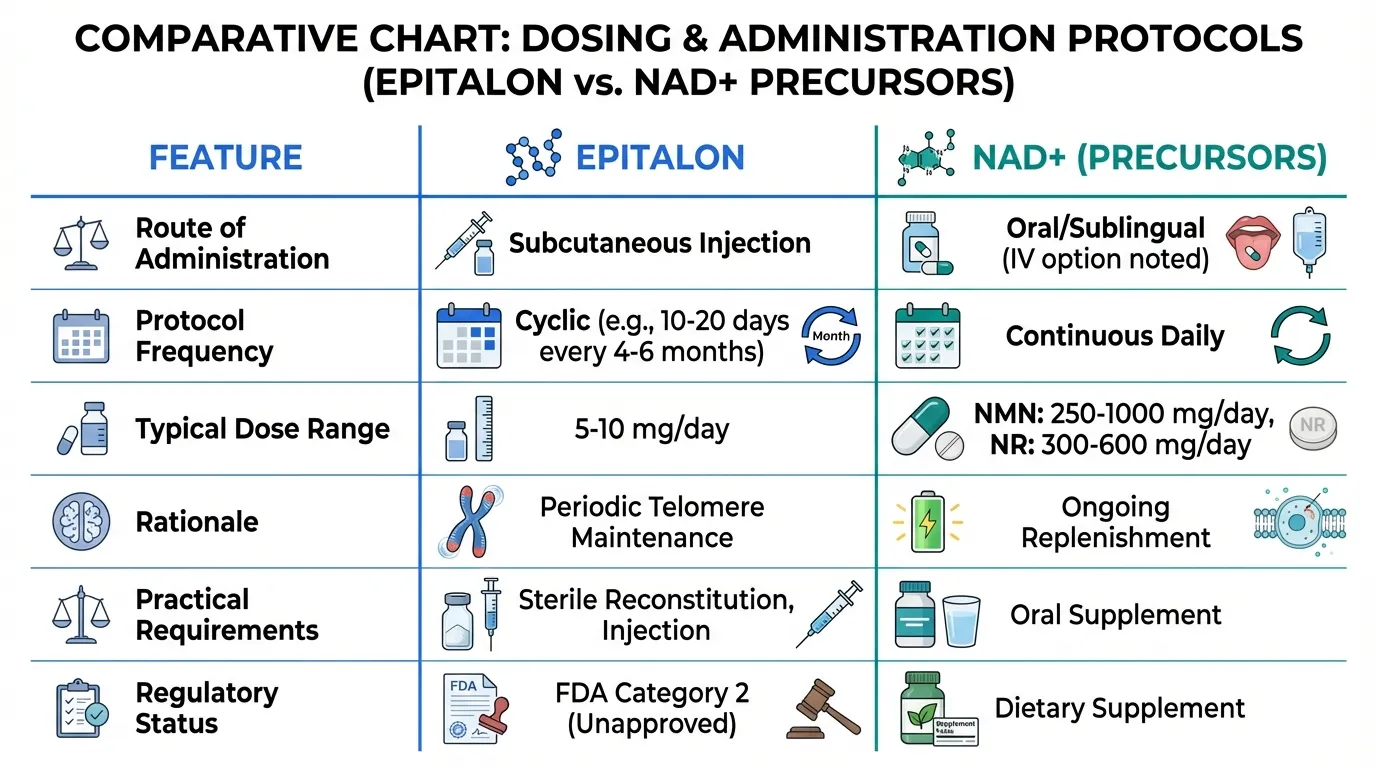
- Route: Subcutaneous injection (primary); intravenous (some studies)
- Protocol: Cyclic -- 5-10 mg/day for 10-20 consecutive days, repeated every 4-6 months (2-3 cycles per year)
- Rationale: Brief telomerase activation extends telomeres, which then provide sustained replicative capacity during drug-free intervals
- Requirements: Sterile reconstitution, cold chain storage, injection supplies, injection technique
- Regulatory status: FDA Category 2 since 2024 (banned from compounding in the US)
NAD+#
- Route: Oral (NMN, NR supplements); sublingual; IV infusion (clinic-based)
- Protocol: Continuous daily supplementation -- typically 250-1000 mg NMN or 300-600 mg NR per day
- Rationale: NAD+ depletion is continuous, requiring ongoing replenishment to maintain elevated levels
- Requirements: No special handling for oral supplements; IV infusion requires clinical setting
- Regulatory status: NMN was challenged by FDA as a supplement (2022) but remains commercially available; NR is marketed as a dietary supplement
The practical accessibility difference is dramatic. NAD+ precursors can be purchased and consumed like any supplement. Epitalon requires sourcing a research peptide, reconstituting under sterile conditions, and self-administering injections -- a process that became more difficult after FDA Category 2 placement.
Hallmark Coverage#
| Hallmark of Aging | Epitalon | NAD+ |
|---|---|---|
| Genomic instability | -- | PARP-dependent DNA repair |
| Telomere attrition | Primary target (hTERT activation) | -- |
| Epigenetic alterations | Proposed (unvalidated) | SIRT1 histone deacetylation |
| Loss of proteostasis | -- | -- |
| Disabled macroautophagy | -- | SIRT1-mediated autophagy activation |
| Deregulated nutrient sensing | -- | Sirtuin/AMPK/mTOR recalibration |
| Mitochondrial dysfunction | -- | SIRT3 mitochondrial deacetylation |
| Cellular senescence | Preventive (delays onset) | -- |
| Stem cell exhaustion | Indirect (telomere preservation) | Muscle/HSC rejuvenation via SIRT1 |
| Altered intercellular communication | -- | -- |
| Chronic inflammation | -- | -- |
| Dysbiosis | -- | -- |
NAD+ covers approximately six hallmarks to Epitalon's one-to-two. Notably, there is minimal overlap -- Epitalon addresses telomere attrition, which NAD+ does not directly target, while NAD+ addresses genomic instability, nutrient sensing, and mitochondrial dysfunction, which Epitalon does not. This non-overlapping coverage makes them theoretically complementary.
The Complementarity Argument#
Rather than viewing Epitalon and NAD+ as competitors, their non-overlapping hallmark coverage suggests potential complementarity. A theoretical multi-target strategy might combine:
- NAD+ for ongoing metabolic support: sirtuin activation, DNA repair, mitochondrial maintenance, nutrient sensing recalibration
- Epitalon for periodic telomere maintenance: cyclic telomerase activation to preserve replicative capacity and delay senescence onset
This combination would address at least seven hallmarks between the two interventions. However, no combination studies have been conducted, and the interaction between telomerase activation and sirtuin-mediated pathways is complex -- SIRT1, for example, can influence telomere biology through effects on shelterin complex proteins.
Conclusion#
NAD+ holds clear advantages over Epitalon in nearly every practical comparison: broader evidence base, human clinical data, multi-hallmark coverage, ease of administration, and commercial accessibility. For anyone seeking the most evidence-supported, accessible anti-aging intervention, NAD+ precursor supplementation has a stronger foundation.
Epitalon's value proposition is more specific: it is the only intervention with direct telomerase activation data in human somatic cells, targeting a hallmark that NAD+ does not reach. For researchers specifically interested in telomere biology or the Khavinson bioregulator paradigm, Epitalon remains a unique tool. Its evidence base needs independent Western validation to match the international standard set by NAD+ research.
The most rational approach may view these as complementary rather than competitive -- Epitalon for periodic telomere maintenance and NAD+ for daily metabolic support, together covering more aging biology than either alone.
For further reading, see Bioregulator Peptides for Aging, The Hallmarks of Aging: Which Peptides Target Which?, and Best Anti-Aging Peptides in 2026.
Further Reading#

Which Is Better For...
Broadest Anti-Aging Coverage
NAD+
NAD+ affects at least six hallmarks of aging through sirtuin activation, including DNA repair, mitochondrial function, epigenetic maintenance, nutrient sensing, autophagy, and stem cell function
Telomere-Specific Intervention
Epitalon
Epitalon is the only peptide with direct telomerase activation data in human somatic cells, addressing telomere attrition which NAD+ does not directly target
Strongest Human Evidence
NAD+
Multiple randomized controlled trials demonstrate that NAD+ precursors safely restore NAD+ levels in humans, while Epitalon has no human clinical trial data
Ease of Access and Self-Administration
NAD+
NMN and NR are available as oral supplements without prescription, injection, or specialized handling, making them the most accessible longevity intervention
Complementary Combination Research
Epitalon
Because Epitalon and NAD+ target non-overlapping hallmarks (telomere attrition vs sirtuin-mediated pathways), they are theoretically complementary rather than redundant in a multi-target longevity strategy
Continue Your Research
Get comparison updates
We publish new head-to-head comparisons regularly. Subscribe to see them first.
Frequently Asked Questions About Epitalon vs NAD+: Telomerase Activation vs Sirtuin Pathway
Which is better, Epitalon or NAD+?
NAD+ has clear advantages in evidence breadth, human data, accessibility, and multi-hallmark coverage. Epitalon targets a hallmark (telomere attrition) that NAD+ does not directly address, making it a potential complement rather than competitor. Epitalon's evidence base needs independent validation to match NAD+'s international research standard. Individual responses may vary, and this comparison is based on available research data, not a treatment recommendation.
What are the key differences between Epitalon and NAD+?
The main differences across comparison categories are: Mechanism of Action: advantage goes to NAD+; Research Evidence: advantage goes to NAD+; Side Effect Profile: advantage goes to NAD+. 2 additional categories are analyzed in the full comparison. Each category evaluates a different dimension of the two peptides.
When should I consider NAD+ over Epitalon?
For the scenario of "Broadest Anti-Aging Coverage," research data suggests NAD+ may be more relevant. NAD+ affects at least six hallmarks of aging through sirtuin activation, including DNA repair, mitochondrial function, epigenetic maintenance, nutrient sensing, autophagy, and stem cell function. This is based on currently available evidence and individual circumstances may differ.
How do Epitalon and NAD+ differ in their mechanisms of action?
Epitalon: Synthetic tetrapeptide (Ala-Glu-Asp-Gly) that activates telomerase via hTERT gene upregulation. Promotes telomere elongation in somatic cells, extending replicative lifespan beyond the Hayflick lim.... NAD+: Essential coenzyme that activates sirtuins (SIRT1-7), NAD+-dependent deacetylases that regulate DNA repair (PARP enzymes), mitochondrial function (SIRT3), epigenetic modifications (histone deacetyl....
Which has fewer side effects, Epitalon or NAD+?
In terms of side effects and tolerability, the advantage goes to NAD+. Epitalon: No significant adverse effects in decades of preclinical study. Mild injection site reactions possible. Theoretical concern about telomerase activa.... NAD+: NMN and NR supplementation have shown favorable safety profiles in multiple human trials at doses up to 1200 mg/day. Most common side effects are m....
Medical Disclaimer
This website is for educational and informational purposes only. The information provided is not intended to diagnose, treat, cure, or prevent any disease. Always consult with a qualified healthcare professional before using any peptide or supplement.