5 Best Peptides for Sleep and Recovery: What the Research Shows

Introduction#
Sleep is the body's primary recovery state — a period when tissue repair, immune function, memory consolidation, and hormonal regulation reach their peak activity. The relationship between peptides and sleep operates in both directions: certain peptides can influence sleep quality, while sleep itself is the physiological context in which many peptide-mediated recovery processes occur.
This guide examines five peptides with research profiles relevant to sleep and recovery. The evidence ranges from DSIP's direct sleep-inducing properties to the indirect sleep-recovery connection of growth hormone secretagogues like ipamorelin. For each compound, we cover the specific research evidence, proposed mechanisms, and important limitations.
Important note: Sleep disorders require proper medical evaluation. No peptide in this guide is FDA-approved for insomnia, sleep disorders, or recovery enhancement.
The Sleep-Recovery Connection#
Understanding why peptides matter for sleep and recovery requires appreciating the biological processes that occur during sleep:
- Growth hormone release — approximately 75% of daily GH secretion occurs during slow-wave (deep) sleep, making sleep the primary driver of GH-mediated recovery
- Tissue repair — protein synthesis and cellular repair processes are upregulated during sleep, driven by GH/IGF-1 signaling
- Immune function — sleep supports immune surveillance and the production of cytokines involved in immune regulation
- Cortisol regulation — the sleep-wake cycle drives the cortisol circadian rhythm, with lowest levels during early sleep (permitting GH release) and rising levels toward morning
Disrupted sleep directly impairs these recovery processes, creating a mechanistic rationale for peptides that improve sleep quality or enhance the biological activities that occur during sleep.
1. DSIP (Delta Sleep-Inducing Peptide)#
Evidence Level: Mixed clinical data; primarily older research (1970s-1990s) Primary Mechanism: Modulation of sleep architecture; proposed effects on delta wave (slow-wave) sleep FDA Status: Not approved; not FDA-evaluated
DSIP is a 9-amino-acid peptide that was isolated in 1977 from the blood of rabbits during electrically induced sleep. Its name reflects its original discovery — it was identified for its ability to promote delta wave sleep (the deepest stage of non-REM sleep) in animal models.
Research Findings#
DSIP has been studied for sleep-related effects across several decades:
- Sleep architecture — early studies suggested DSIP promotes slow-wave sleep (stage 3/4 NREM sleep), the sleep stage most closely associated with physical recovery and GH release
- Insomnia studies — clinical studies conducted primarily in the 1980s and 1990s reported improvements in sleep quality in patients with insomnia, though study designs varied significantly
- Stress response modulation — DSIP has been studied for its effects on the stress response, with some data suggesting normalization of cortisol rhythms and ACTH regulation
- Pain modulation — some studies reported analgesic effects that could indirectly support sleep in patients with pain-disrupted sleep
- Circadian rhythm — DSIP may influence circadian rhythm regulation, though the specific mechanisms remain poorly characterized
Important Considerations#
DSIP research is characterized by inconsistency. Some studies report clear sleep-promoting effects while others find no significant benefit. The peptide's mechanism of action remains unclear — it does not bind to any known sleep-related receptor with high affinity. Much of the clinical research is decades old, conducted before modern sleep study methodology was standardized, and has not been replicated with current research standards. DSIP's instability in solution (it degrades rapidly) adds practical challenges to its study and use.
2. Ipamorelin#
Evidence Level: Clinical data for GH release; indirect evidence for sleep-related recovery Primary Mechanism: Selective GH secretagogue (GHS-R1a agonist); amplifies nocturnal GH pulses FDA Status: Not FDA-approved; investigational
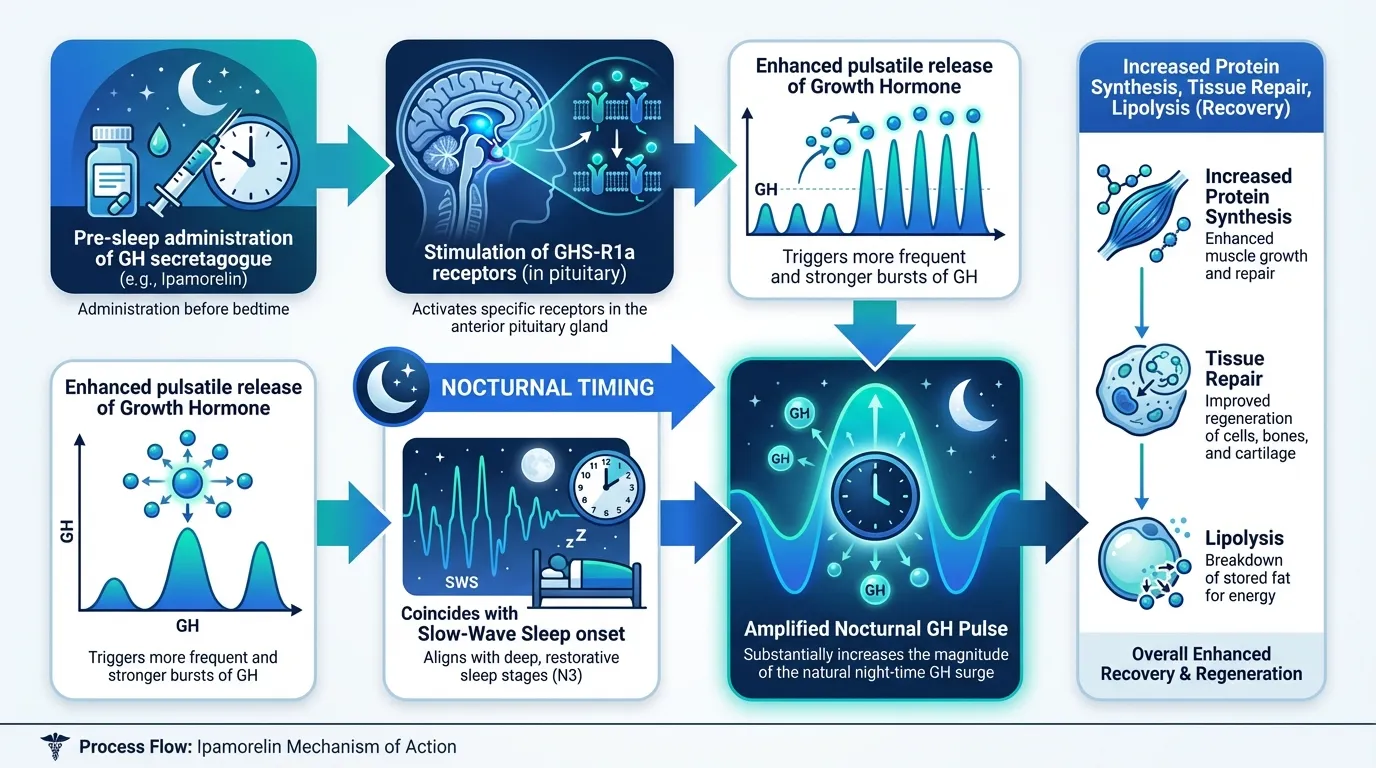
Ipamorelin is a selective growth hormone secretagogue that enhances the body's natural GH release. Its relevance to sleep and recovery centers on the intimate relationship between GH secretion and deep sleep — the two are physiologically linked, and enhancing one may support the other.
Research Findings#
Ipamorelin's sleep-recovery connection is based on established GH physiology:
- Nocturnal GH amplification — when administered before sleep, GH secretagogues amplify the natural nocturnal GH pulse that occurs during slow-wave sleep onset. This pulse is the largest GH release event of the day
- Selective profile — ipamorelin stimulates GH without elevating cortisol (which would disrupt sleep) or prolactin, making it favorable for evening administration
- Recovery support — elevated GH during sleep supports protein synthesis, tissue repair, and lipolysis — the primary recovery processes that occur during the sleep period
- Age-related decline — nocturnal GH release declines significantly with age. Restoring this pulse with ipamorelin may support recovery capacity in older individuals
Important Considerations#
Ipamorelin has not been specifically studied for sleep quality outcomes. The sleep-recovery rationale is based on the well-established relationship between GH and deep sleep, not on direct evidence of ipamorelin improving sleep parameters (sleep latency, duration, architecture). Some users report subjective improvements in sleep quality, but this has not been validated in controlled studies. For more on ipamorelin's mechanisms, see Growth Hormone Secretagogues Compared.
3. Sermorelin#
Evidence Level: Clinical data for GH stimulation; limited direct sleep data Primary Mechanism: GHRH analog; stimulates physiological GH release through the GHRH receptor FDA Status: Previously FDA-approved (discontinued commercial production)
Sermorelin is a synthetic GHRH analog that stimulates GH release through the same pathway as the body's own growth hormone-releasing hormone. Its sleep-recovery relevance parallels ipamorelin's but operates through a different receptor system.
Research Findings#
Sermorelin's connection to sleep is both direct and indirect:
- GHRH and sleep architecture — endogenous GHRH itself has been shown to promote slow-wave sleep in human studies. GHRH administration increased time spent in deep sleep and enhanced the amplitude of nocturnal GH pulses. As a GHRH analog, sermorelin may share these sleep-promoting properties
- Physiological GH release — sermorelin stimulates GH in a pulsatile pattern that mimics natural physiology, including the nocturnal sleep-onset pulse
- Clinical precedent — sermorelin was previously FDA-approved for GH-deficient children, providing a longer clinical safety track record than most research peptides
- Age-related application — sermorelin has been studied specifically in older adults, where the decline in both GH secretion and sleep quality occurs simultaneously
Important Considerations#
The direct sleep-promoting effects of GHRH are better documented than those of sermorelin specifically. While sermorelin mimics GHRH, it is a truncated analog (first 29 amino acids) and may not perfectly replicate all of GHRH's effects. Sermorelin's short half-life (~10-20 minutes) means its effects are transient, though this may be appropriate for pre-sleep administration. For comparisons with ipamorelin, see Ipamorelin vs Sermorelin.
4. BPC-157#
Evidence Level: Extensive preclinical; very limited human data Primary Mechanism: Tissue repair through angiogenesis and growth factor upregulation FDA Status: Category 2 (banned from compounding)
BPC-157 is included in this guide not because it directly promotes sleep, but because the tissue repair processes it supports occur predominantly during the sleep period. BPC-157's relevance to recovery is mechanistic rather than sleep-specific.
Research Findings#
BPC-157's recovery relevance:
- Tissue repair acceleration — BPC-157 has been shown to accelerate healing of tendons, ligaments, muscles, and gut tissue in animal models. These repair processes are most active during sleep, when GH levels are highest and cortisol levels are lowest
- Angiogenesis — BPC-157 promotes new blood vessel formation at injury sites, improving nutrient delivery to damaged tissue during the repair window of sleep
- NO system modulation — BPC-157's effects on the nitric oxide system may support blood flow and tissue perfusion during sleep-phase recovery
- Gut-brain axis — BPC-157's gut-protective effects may indirectly support sleep through the gut-brain connection, as gut health influences neurotransmitter production (including serotonin, a melatonin precursor)
Important Considerations#
BPC-157 is not a sleep peptide. It does not directly influence sleep architecture, sleep latency, or sleep quality. Its inclusion here reflects the principle that recovery occurs during sleep, and peptides that enhance recovery processes may be most effective when those processes are active. All BPC-157 data is preclinical. BPC-157 is FDA Category 2. For its healing applications, see Best Healing Peptides.
5. Pinealon#
Evidence Level: Very limited; primarily from the Khavinson bioregulator research group Primary Mechanism: Proposed pineal gland regulation; melatonin synthesis modulation FDA Status: Not approved; not FDA-evaluated
Pinealon is a synthetic tripeptide (Glu-Asp-Arg) developed by Professor Vladimir Khavinson's research group in Russia as part of the bioregulator peptide framework. It is proposed to specifically target the pineal gland — the endocrine organ responsible for melatonin production.
Research Findings#
Pinealon's research profile is narrow and concentrated in the Khavinson research group:
- Pineal gland function — pinealon is proposed to regulate gene expression in pinealocytes (pineal gland cells), supporting melatonin synthesis
- Melatonin production — the theoretical mechanism suggests pinealon restores age-related declines in melatonin production by modulating pineal gland gene activity
- Neuroprotection — some in vitro data suggests pinealon has protective effects on neuronal cells under oxidative stress conditions
- Circadian rhythm — through its proposed effects on melatonin, pinealon is theoretically relevant to circadian rhythm regulation
Important Considerations#
Pinealon's evidence base is extremely limited. The research comes almost exclusively from a single group, the bioregulator peptide framework has not been widely validated by independent researchers, and the mechanism by which a tripeptide specifically targets pineal gland gene expression has not been convincingly demonstrated. No clinical trials for sleep or melatonin-related outcomes have been published. Pinealon should be considered highly speculative.
How These Peptides Compare#
| Feature | DSIP | Ipamorelin | Sermorelin | BPC-157 | Pinealon |
|---|---|---|---|---|---|
| Mechanism | Direct sleep modulation | GH amplification | GHRH-mediated GH release | Tissue repair (during sleep) | Proposed pineal regulation |
| Sleep-Specific Data | Yes (inconsistent) | No (GH physiology) | Indirect (GHRH-sleep link) | No | Theoretical only |
| Evidence Level | Mixed clinical | Clinical (for GH) | Clinical (for GH) | Extensive preclinical | Very limited |
| FDA Status | Not evaluated | Not approved | Previously approved | Category 2 | Not evaluated |
| Administration | SC injection | SC injection | SC injection | SC injection | Oral / SC |
| Timing | Pre-sleep | Pre-sleep | Pre-sleep | Variable | Variable |
Practical Considerations for Sleep-Related Peptides#
Timing#
For peptides targeting the sleep-recovery window, administration timing matters. GH secretagogues (ipamorelin, sermorelin) are typically administered 30-60 minutes before sleep to coincide with the natural sleep-onset GH pulse. DSIP is similarly administered pre-sleep.
The GH-Sleep Relationship#
The relationship between GH and sleep is bidirectional: GH promotes sleep, and sleep promotes GH. This means that improving sleep through non-peptide interventions (sleep hygiene, environment, consistency) may enhance the efficacy of GH-related peptides, and vice versa.
Cortisol Considerations#
Any peptide that significantly elevates cortisol would be counterproductive for sleep. This is why ipamorelin's selectivity (no cortisol elevation) is specifically relevant for evening use, distinguishing it from less selective GH secretagogues like GHRP-2 or hexarelin that may raise cortisol.
Conclusion#
Sleep and recovery peptides span a spectrum from direct sleep-modulating compounds (DSIP) to peptides that enhance recovery processes occurring during sleep (ipamorelin, sermorelin, BPC-157). The strongest mechanistic rationale exists for GH secretagogues administered before sleep, leveraging the well-established relationship between growth hormone and deep sleep.
DSIP is the only peptide in this guide with direct sleep-promoting data, but its inconsistent evidence and unclear mechanism limit confidence. Ipamorelin and sermorelin offer the strongest pharmacological rationale through GH amplification. Pinealon remains highly speculative.
For dose calculations and further research tools, visit the Dosing Calculator and HED Calculator. For important safety information, see the Safety page.
Related Peptide Profiles#
Learn more about the peptides discussed in this article:
- DSIP Overview and Research Guide
- DSIP Dosing Protocols
- DSIP Side Effects and Safety
- Ipamorelin Overview and Research Guide
- Ipamorelin Dosing Protocols
- Ipamorelin Side Effects and Safety
- Sermorelin Overview and Research Guide
- Sermorelin Dosing Protocols
- Sermorelin Side Effects and Safety
- BPC-157 Overview and Research Guide
- BPC-157 Dosing Protocols
- BPC-157 Side Effects and Safety
- Pinealon Overview and Research Guide
- Pinealon Dosing Protocols
- Pinealon Side Effects and Safety

Frequently Asked Questions About 5 Best Peptides for Sleep and Recovery: What the Research Shows
What does this article cover?
Peptides for sleep and recovery — DSIP, ipamorelin, sermorelin, BPC-157, and pinealon — with evidence levels and practical considerations. This guide is for educational purposes only and does not constitute medical advice.
Which peptides are discussed in this article?
This article covers DSIP, Ipamorelin, Sermorelin, BPC-157, Pinealon. Key context: DSIP (Delta sleep-inducing peptide discovered for its ability to promote slow-wave sleep in animal models); Ipamorelin (Selective GH secretagogue that enhances natural nocturnal growth hormone release patterns linked ...); Sermorelin (GHRH analog that amplifies physiological GH pulses during sleep onset for recovery support). Each peptide is discussed based on available research evidence.
Who is this guide written for?
This guide is written for researchers and individuals seeking an evidence-based overview of the topic covered in "5 Best Peptides for Sleep and Recovery: What the Research Shows." It summarizes available research data without making treatment recommendations. Always consult a healthcare provider for medical decisions.
What are the key takeaways from this article?
The main findings covered in this article include: Delta sleep-inducing peptide discovered for its ability to promote slow-wave sleep in animal models. Selective GH secretagogue that enhances natural nocturnal growth hormone release patterns linked .... GHRH analog that amplifies physiological GH pulses during sleep onset for recovery support. These takeaways are based on the research data available at the time of publication.
What is DSIP and why is it significant?
DSIP is a peptide discussed in this article because: Delta sleep-inducing peptide discovered for its ability to promote slow-wave sleep in animal models. For a complete profile of DSIP, see the dedicated peptide page on this site.
Continue reading this research review
Free access to the complete analysis with citations and evidence ratings.
150+ peptide profiles · 30+ comparisons · 18 research tools
Medical Disclaimer
This website is for educational and informational purposes only. The information provided is not intended to diagnose, treat, cure, or prevent any disease. Always consult with a qualified healthcare professional before using any peptide or supplement.
Join 2,000+ researchers getting biweekly updates
Enjoyed this article?
The Research Briefing delivers deep-dives like this biweekly — plus new study breakdowns, safety updates, and tool announcements.
Free forever. No spam. Unsubscribe in one click.
Where to Find These Peptides
Continue Exploring
Peptide Profiles
Keep Reading

Peptides for Athletic Recovery: Beyond BPC-157 and TB-500
A comprehensive guide to peptides researched for athletic recovery, covering BPC-157, TB-500, GH secretagogues, MGF, GHK-Cu, and DSIP. Includes WADA anti-doping considerations, evidence levels, and recovery-focused protocol rationale.

Peptides for Better Sleep: DSIP, Epitalon, and Growth Hormone Peptides Explained
A deep dive into peptides that influence sleep architecture and nocturnal recovery, including DSIP, epitalon, pinealon, and growth hormone secretagogues like ipamorelin and sermorelin. Mechanisms, evidence levels, and research status explained.

Complete Guide to Sleep Peptides: DSIP, Cortistatin, and Growth Hormone Secretagogues
Complete guide to peptides for sleep optimization — DSIP, cortistatin, ipamorelin, sermorelin, and pinealon with mechanisms, evidence, and practical considerations.
You Might Also Like
Related content you may find interesting