MOTS-c vs SS-31: Comprehensive Comparison
A detailed comparison of MOTS-c and SS-31 (Elamipretide), two mitochondria-targeting peptides with distinct mechanisms -- MOTS-c as a metabolic signaling exercise mimetic and SS-31 as a cardiolipin-stabilizing membrane protector.
Verdict at a Glance
SS-31 is the more clinically advanced mitochondrial peptide with Phase 3 data and clear therapeutic applications in mitochondrial diseases; MOTS-c represents a unique endogenous signaling peptide with promising metabolic applications that remain in early preclinical stages
| Best for | Pick | Why |
|---|---|---|
| Mitochondrial Disease Treatment | SS-31 | SS-31 has Phase 3 clinical trial data for Barth syndrome and Phase 2 data for primary mitochondrial myopathy, with FDA Fast Track designation |
| Metabolic Syndrome Research | MOTS-c | MOTS-c activates AMPK and regulates metabolic pathways as an exercise mimetic, showing preclinical efficacy in insulin resistance and obesity models |
| Cardiac Mitochondrial Protection | SS-31 | SS-31 directly stabilizes cardiolipin in the inner mitochondrial membrane, preserving electron transport chain efficiency in cardiac tissue under stress |
| Aging and Metabolic Decline | MOTS-c | As an endogenous mitochondrial-derived peptide that declines with age, MOTS-c supplementation addresses an age-related signaling deficit through metabolic reprogramming |
| Acute Organ Protection | SS-31 | SS-31 has demonstrated protective effects in ischemia-reperfusion injury models across kidney, heart, and brain tissues through rapid mitochondrial membrane stabilization |
| Category | MOTS-c | SS-31 | Advantage |
|---|---|---|---|
| Mechanism of Action | Mitochondrial-derived peptide encoded in 12S rRNA gene; activates AMPK pathway, regulates folate-methionine cycle, functions as a retrograde signal from mitochondria to nucleus | Synthetic mitochondria-targeted tetrapeptide that selectively binds cardiolipin in the inner mitochondrial membrane, stabilizing cristae structure and optimizing electron transport chain function | Comparable |
| Research Evidence | Preclinical studies in metabolic disease models; demonstrated effects on insulin sensitivity, exercise capacity, and aging in animal models; no human clinical trials completed | Extensive clinical program including Phase 3 trials for Barth syndrome, Phase 2 trials for heart failure and mitochondrial myopathy; IND-enabling safety data in humans | SS-31 |
| Side Effect Profile | Well-tolerated in animal studies; limited safety data in humans; no significant adverse effects reported in preclinical models | Generally well-tolerated in clinical trials; injection site reactions reported; some concerns about anti-drug antibodies with chronic dosing | Comparable |
| Dosing Complexity | Preclinical dosing only; typically administered via intraperitoneal injection in animal studies; optimal human dosing not established | Subcutaneous injection with established clinical dosing from Phase 2/3 trials; once-daily administration protocol | SS-31 |
| Therapeutic Scope | Metabolic syndrome, insulin resistance, obesity, exercise mimetic applications, aging-related metabolic decline | Barth syndrome, heart failure with preserved ejection fraction, primary mitochondrial myopathy, renal ischemia-reperfusion injury | Comparable |
| Clinical Development Stage | Preclinical stage; discovery-phase research compound with strong mechanistic rationale but no IND filing | Phase 3 clinical trials for Barth syndrome; Phase 2 for multiple indications; FDA Fast Track and Orphan Drug designations | SS-31 |

Introduction#
MOTS-c and SS-31 (Elamipretide) are two of the most significant peptides in mitochondrial medicine research, yet they approach mitochondrial function through fundamentally different strategies. MOTS-c is a naturally occurring 16-amino acid peptide encoded within the mitochondrial genome's 12S rRNA gene, functioning as a retrograde signaling molecule that communicates mitochondrial status to the nucleus and activates metabolic reprogramming through AMPK. SS-31, by contrast, is a synthetic tetrapeptide (D-Arg-dimethylTyr-Lys-Phe-NH2) specifically designed to penetrate mitochondrial membranes and stabilize cardiolipin, a phospholipid critical to the structural integrity of the inner mitochondrial membrane and electron transport chain function.
Understanding the distinction between these two mitochondrial peptides is essential for researchers evaluating therapeutic strategies for mitochondrial dysfunction. While both ultimately aim to improve mitochondrial output, MOTS-c operates through upstream metabolic signaling pathways while SS-31 acts directly at the mitochondrial membrane level, making them mechanistically complementary rather than redundant.
Mechanism of Action Comparison#
MOTS-c#
MOTS-c (Mitochondrial Open Reading Frame of the Twelve S rRNA type-c) belongs to a class of peptides called mitochondrial-derived peptides (MDPs), which are encoded by short open reading frames within the mitochondrial genome. Its discovery in 2015 by Changhan Lee and colleagues revealed a previously unknown layer of mitochondria-to-nucleus communication.
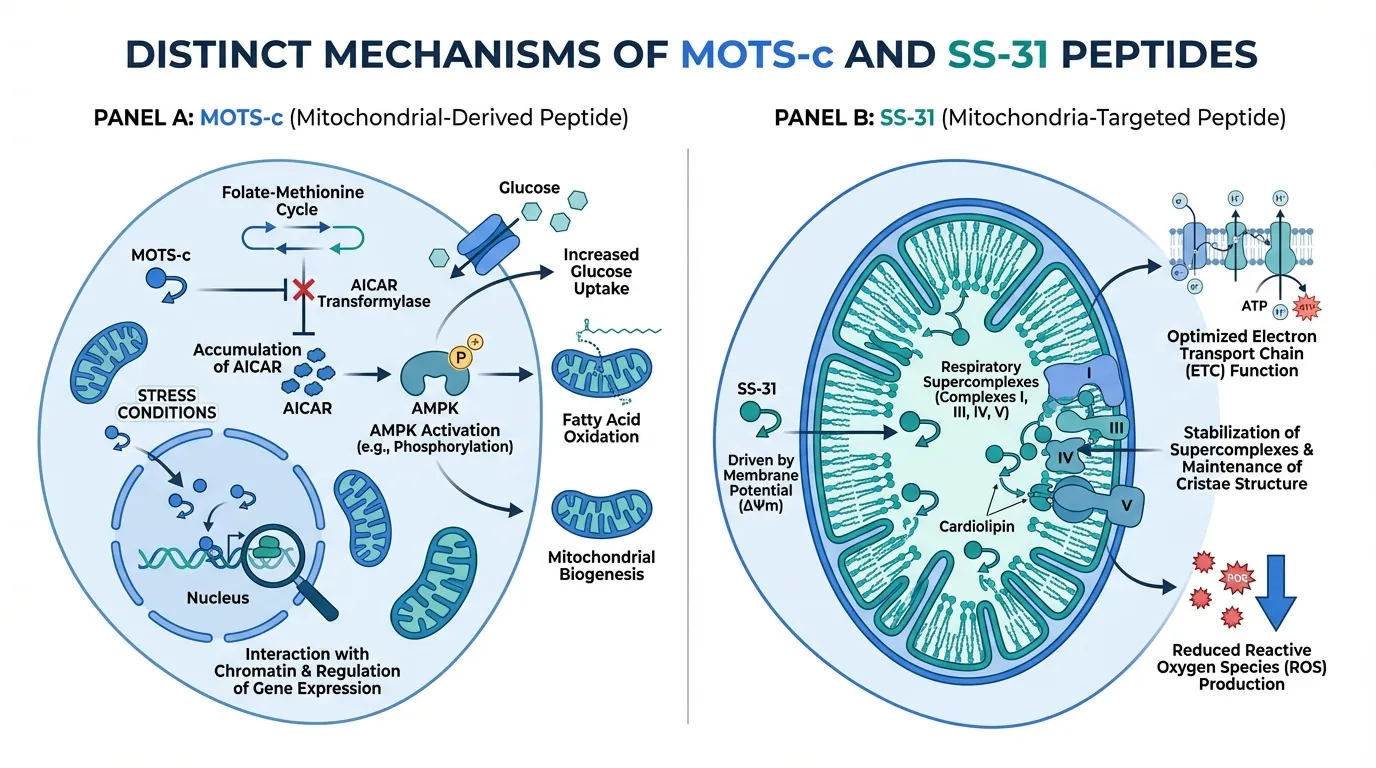
The primary mechanism of MOTS-c centers on AMPK (AMP-activated protein kinase) activation. MOTS-c promotes AMPK phosphorylation, which in turn activates downstream metabolic pathways including glucose uptake, fatty acid oxidation, and mitochondrial biogenesis. This AMPK activation occurs partly through MOTS-c's interference with the folate-methionine cycle in the cytoplasm. By inhibiting the folate cycle at the level of AICAR transformylase, MOTS-c causes accumulation of AICAR (5-aminoimidazole-4-carboxamide ribonucleotide), a direct AMPK activator.
Under metabolic stress conditions, MOTS-c translocates from the cytoplasm to the nucleus, where it interacts with chromatin and regulates the expression of genes involved in antioxidant defense and metabolic adaptation. This nuclear translocation represents a unique aspect of MOTS-c biology, functioning as a stress-responsive retrograde signal from the mitochondrial genome.
In preclinical models, MOTS-c administration has demonstrated effects consistent with exercise mimicry: improved insulin sensitivity, enhanced glucose disposal, increased fatty acid oxidation, and prevention of diet-induced obesity. The peptide's molecular weight of 2174.6 Da makes it relatively small among bioactive peptides, contributing to its stability and bioavailability.
SS-31#
SS-31 (also known as Elamipretide, Bendavia, or MTP-131) is a synthetic cell-permeable tetrapeptide with a molecular weight of 639.8 Da. Unlike MOTS-c, SS-31 does not signal through traditional receptor pathways. Instead, it exploits the mitochondrial membrane potential to concentrate selectively within the inner mitochondrial membrane.
SS-31's mechanism centers on its interaction with cardiolipin, a unique diphosphatidylglycerol lipid found almost exclusively in the inner mitochondrial membrane. Cardiolipin plays essential structural and functional roles: it anchors respiratory chain complexes (I, III, IV, and V) within the membrane, facilitates the formation of respiratory supercomplexes, and is required for cytochrome c's electron carrier function. When cardiolipin becomes oxidized or redistributed -- as occurs in aging, ischemia-reperfusion injury, and genetic mitochondrial diseases -- electron transport efficiency declines and reactive oxygen species (ROS) production increases.
SS-31 binds to cardiolipin through electrostatic interactions between its positively charged residues and cardiolipin's phosphate head groups. This binding stabilizes cardiolipin's conformation, prevents its peroxidation by ROS, maintains cristae structure, and preserves respiratory supercomplex assembly. The result is optimized electron transport with reduced electron leak and ROS generation.
Importantly, SS-31 achieves concentration ratios of approximately 1000-5000-fold within mitochondria relative to cytoplasm, driven by the mitochondrial membrane potential. This selective accumulation means that systemically administered SS-31 achieves pharmacologically relevant concentrations at its target without requiring high systemic doses.
Dosing Comparison#
MOTS-c Dosing#
MOTS-c dosing data comes exclusively from preclinical animal studies:
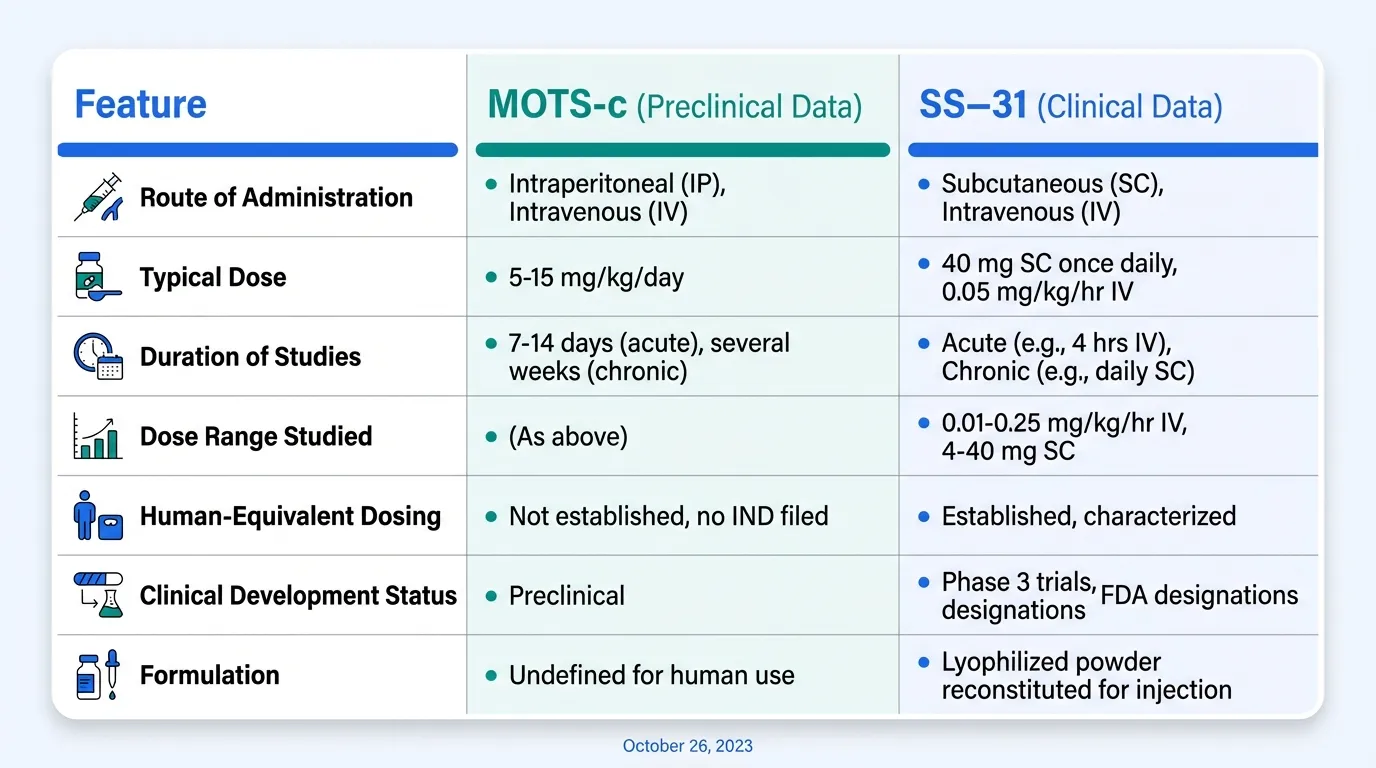
- Intraperitoneal injection: Most commonly studied route in mice at doses of 5-15 mg/kg/day
- Intravenous: Used in some metabolic studies at similar dose ranges
- Duration: Studies typically range from 7-14 days for acute metabolic effects, up to several weeks for obesity and aging models
- Human-equivalent dosing: Not established; no IND has been filed and no formal dose-finding studies have been conducted
A notable limitation is that MOTS-c is an endogenous peptide whose circulating levels decline with age. Baseline plasma levels in humans have been measured but optimal supplementation targets remain undefined. The peptide's stability in circulation and its pharmacokinetic profile in humans have not been formally characterized.
SS-31 Dosing#
SS-31 has established clinical dosing from multiple human trials:
- Subcutaneous injection: 40 mg once daily (used in Phase 3 Barth syndrome trial, TAZPOWER)
- Intravenous infusion: 0.05 mg/kg/hr over 4 hours (used in heart failure and renal studies)
- Dose range studied: 0.01 to 0.25 mg/kg/hr IV; 4 mg to 40 mg SC in various trials
- Titration: Generally not required; fixed-dose protocols used in most trials
- Formulation: Lyophilized powder reconstituted for injection
The clinical dosing experience with SS-31 represents a significant practical advantage, as pharmacokinetic parameters, maximum tolerated dose, and exposure-response relationships have been characterized in human subjects.
Side Effects Comparison#
MOTS-c Side Effects#
The safety profile of MOTS-c is known only from preclinical studies:
- Animal studies report no significant adverse effects at standard research doses
- No evidence of hepatotoxicity, nephrotoxicity, or hematological abnormalities in rodent models
- Theoretical concerns include potential interactions with folate metabolism, which could affect cell proliferation
- As an endogenous peptide, MOTS-c may carry lower immunogenicity risk compared to synthetic peptides
- No human safety data available from clinical trials
SS-31 Side Effects#
SS-31 has a characterized human safety profile from clinical trials:
- Injection site reactions: Most common adverse event in subcutaneous dosing; mild to moderate erythema and pain
- Anti-drug antibodies: Observed in some patients receiving chronic dosing; clinical significance uncertain
- Gastrointestinal: Mild nausea reported in some trials
- Renal: Transient proteinuria observed at higher IV doses in early studies
- Cardiovascular: No significant effects on blood pressure, heart rate, or QTc interval
- Serious adverse events: Rare and generally not attributed to study drug in controlled trials
The TAZPOWER Phase 3 trial and the MMPOWER-3 trial (primary mitochondrial myopathy) provided the most extensive safety datasets, showing that chronic SS-31 administration is generally well-tolerated.
Research Evidence Comparison#
MOTS-c Research#
MOTS-c research is primarily preclinical but mechanistically compelling:
- Metabolic regulation: Lee et al. (2015) demonstrated that MOTS-c prevents diet-induced obesity and insulin resistance in mice through AMPK activation and metabolic reprogramming
- Exercise biology: MOTS-c levels increase with exercise in humans, and exogenous MOTS-c enhances exercise capacity in aged mice, establishing it as an exercise-responsive mitochondrial signal
- Aging: Circulating MOTS-c levels decline with age in both rodents and humans; supplementation in aged mice improved physical performance, insulin sensitivity, and metabolic parameters
- Stress response: Under metabolic and oxidative stress, MOTS-c translocates to the nucleus and regulates adaptive gene expression through interactions with AMPK and the antioxidant response element (ARE) pathway
- Genetic associations: Polymorphisms in the mitochondrial 12S rRNA gene region encoding MOTS-c have been associated with longevity in certain populations, suggesting evolutionary significance
The primary limitation remains the absence of any human interventional studies. While observational data on endogenous MOTS-c levels in humans exists, the translation from preclinical efficacy to clinical application has not yet been attempted.
SS-31 Research#
SS-31 has an extensive research portfolio spanning preclinical and clinical stages:
- Barth syndrome (TAZPOWER): Phase 3 randomized, double-blind, placebo-controlled trial in patients with Barth syndrome, a genetic cardiolipin remodeling deficiency. While the primary endpoint (6-minute walk test) showed improvement, statistical significance was complicated by small sample size due to the ultra-rare disease population
- Heart failure (PROGRESS-HF): Phase 2 trial evaluating SS-31 in heart failure with reduced ejection fraction; demonstrated improvements in left ventricular end-systolic and end-diastolic volumes
- Primary mitochondrial myopathy (MMPOWER-3): Phase 3 trial that did not meet its primary endpoint of 6-minute walk test improvement, though secondary endpoints showed trends toward benefit
- Renal ischemia-reperfusion: Phase 2a trial showing protective effects on kidney function following angioplasty-related ischemia
- Preclinical: Extensive animal data demonstrating protection in models of cardiac ischemia-reperfusion, age-related cardiac dysfunction, skeletal muscle atrophy, diabetic cardiomyopathy, and neurodegenerative disease
SS-31 has received FDA Fast Track designation for Barth syndrome and Orphan Drug designation for multiple mitochondrial diseases, reflecting the strength of its clinical development program despite mixed Phase 3 results.
Key Differences Summary#
- Origin: MOTS-c is an endogenous mitochondrial-derived peptide encoded in mtDNA; SS-31 is a synthetic rationally designed peptide
- Size: MOTS-c is a 16-amino acid peptide (2174.6 Da); SS-31 is a tetrapeptide (639.8 Da)
- Mechanism: MOTS-c works through metabolic signaling (AMPK activation, folate cycle regulation, nuclear translocation); SS-31 works through direct membrane interaction (cardiolipin stabilization)
- Target: MOTS-c targets cytoplasmic and nuclear metabolic pathways; SS-31 targets the inner mitochondrial membrane directly
- Clinical stage: MOTS-c is preclinical; SS-31 is in Phase 3 clinical trials with FDA designations
- Disease focus: MOTS-c is studied for metabolic diseases (obesity, diabetes, aging); SS-31 is studied for structural mitochondrial diseases (Barth syndrome, myopathy) and ischemia-reperfusion
- Administration: MOTS-c dosing in humans is undefined; SS-31 has established subcutaneous and IV dosing protocols from clinical trials
- Age relationship: Endogenous MOTS-c declines with age; SS-31 has no endogenous counterpart
Conclusion#
MOTS-c and SS-31 represent two complementary approaches to mitochondrial medicine. MOTS-c, as an endogenous mitochondrial-derived peptide, offers a unique window into the mitochondrial genome's role as a signaling organelle and shows promise as a metabolic regulator and exercise mimetic for age-related metabolic decline. Its AMPK-mediated mechanism positions it for applications in metabolic syndrome, insulin resistance, and aging research, though it remains entirely in the preclinical phase.
SS-31 (Elamipretide) is the more clinically mature compound, with Phase 3 trial data, FDA designations, and established human dosing protocols. Its direct mechanism of cardiolipin stabilization makes it particularly suited for diseases involving structural mitochondrial membrane dysfunction, such as Barth syndrome and primary mitochondrial myopathies. While its Phase 3 results have been mixed, SS-31 remains the most advanced mitochondria-targeted peptide therapeutic in clinical development.
For researchers investigating mitochondrial dysfunction, these peptides address different levels of the problem: MOTS-c modulates the cellular response to mitochondrial stress through metabolic reprogramming, while SS-31 directly repairs the molecular architecture of the mitochondrial membrane. This mechanistic complementarity suggests potential for synergistic effects, though such combination approaches have not yet been studied.
Further Reading#

Which Is Better For...
Mitochondrial Disease Treatment
SS-31
SS-31 has Phase 3 clinical trial data for Barth syndrome and Phase 2 data for primary mitochondrial myopathy, with FDA Fast Track designation
Metabolic Syndrome Research
MOTS-c
MOTS-c activates AMPK and regulates metabolic pathways as an exercise mimetic, showing preclinical efficacy in insulin resistance and obesity models
Cardiac Mitochondrial Protection
SS-31
SS-31 directly stabilizes cardiolipin in the inner mitochondrial membrane, preserving electron transport chain efficiency in cardiac tissue under stress
Aging and Metabolic Decline
MOTS-c
As an endogenous mitochondrial-derived peptide that declines with age, MOTS-c supplementation addresses an age-related signaling deficit through metabolic reprogramming
Acute Organ Protection
SS-31
SS-31 has demonstrated protective effects in ischemia-reperfusion injury models across kidney, heart, and brain tissues through rapid mitochondrial membrane stabilization
Continue Your Research
Get comparison updates
We publish new head-to-head comparisons regularly. Subscribe to see them first.
Frequently Asked Questions About MOTS-c vs SS-31: Comprehensive Comparison
What are the key differences between MOTS-c and SS-31?
The main differences across comparison categories are: Mechanism of Action: advantage goes to neither (tie); Research Evidence: advantage goes to SS-31; Side Effect Profile: advantage goes to neither (tie). 3 additional categories are analyzed in the full comparison. Each category evaluates a different dimension of the two peptides.
When should I consider SS-31 over MOTS-c?
For the scenario of "Mitochondrial Disease Treatment," research data suggests SS-31 may be more relevant. SS-31 has Phase 3 clinical trial data for Barth syndrome and Phase 2 data for primary mitochondrial myopathy, with FDA Fast Track designation. This is based on currently available evidence and individual circumstances may differ.
How do MOTS-c and SS-31 differ in their mechanisms of action?
MOTS-c: Mitochondrial-derived peptide encoded in 12S rRNA gene; activates AMPK pathway, regulates folate-methionine cycle, functions as a retrograde signal from mitochondria to nucleus. SS-31: Synthetic mitochondria-targeted tetrapeptide that selectively binds cardiolipin in the inner mitochondrial membrane, stabilizing cristae structure and optimizing electron transport chain function.
Which has fewer side effects, MOTS-c or SS-31?
In terms of side effects and tolerability, the advantage goes to neither (comparable). MOTS-c: Well-tolerated in animal studies; limited safety data in humans; no significant adverse effects reported in preclinical models. SS-31: Generally well-tolerated in clinical trials; injection site reactions reported; some concerns about anti-drug antibodies with chronic dosing.
Medical Disclaimer
This website is for educational and informational purposes only. The information provided is not intended to diagnose, treat, cure, or prevent any disease. Always consult with a qualified healthcare professional before using any peptide or supplement.