The Super Human Blend: Multi-System Longevity Peptide Research Guide

Introduction#
The concept of a "Super Human Blend" represents the most ambitious multi-peptide approach in regenerative research: targeting multiple aging pathways simultaneously. Rather than addressing a single tissue or mechanism, this category of blend aims to combine peptides that each address a distinct hallmark of aging -- tissue repair, immune decline, mitochondrial dysfunction, telomere shortening, and metabolic deterioration.
This guide examines five peptides commonly discussed in this context, evaluates the evidence for each, and provides a frank assessment of whether combining them into a single protocol has any scientific basis.
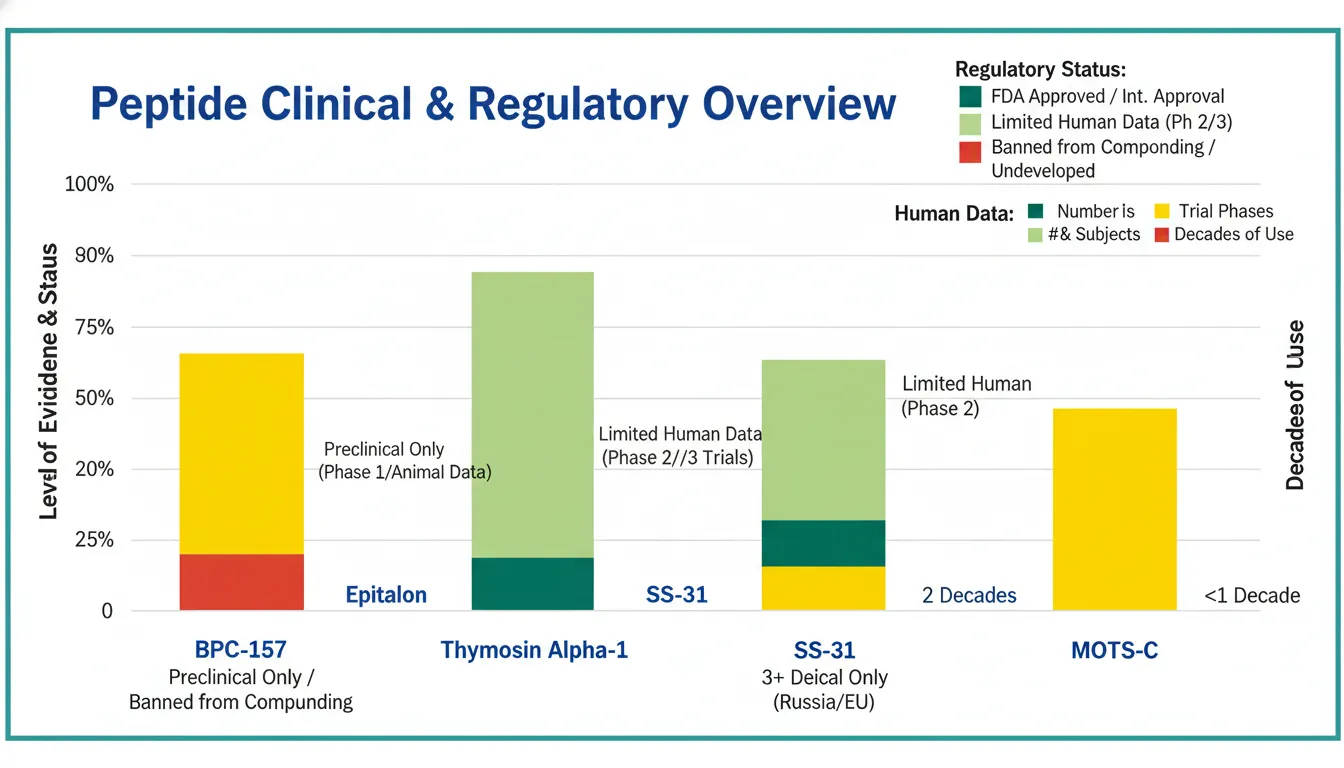
Critical Context: The peptides discussed here span the full evidence spectrum, from FDA-approved (SS-31 for Barth syndrome) to well-studied but off-label (thymosin alpha-1, approved in 35+ countries) to entirely preclinical (MOTS-C). No multi-peptide longevity protocol has been tested in any clinical trial.
The Five Hallmarks Approach#
Mapping Peptides to Aging Hallmarks#
The theoretical framework for a multi-system longevity blend draws from established aging biology:
| Hallmark of Aging | Peptide | Proposed Mechanism |
|---|---|---|
| Tissue damage / impaired repair | BPC-157 | VEGFR2/NO angiogenesis, growth factor upregulation |
| Immune decline (immunosenescence) | Thymosin Alpha-1 | T-cell maturation, dendritic cell activation |
| Telomere attrition | Epitalon | Telomerase activation, hTERT upregulation |
| Mitochondrial dysfunction | SS-31 | Cardiolipin stabilization, cristae structure |
| Metabolic deregulation | MOTS-C | AMPK activation, glucose utilization |
This framework is conceptually appealing because it addresses aging as a multi-system process rather than targeting any single mechanism. However, the evidence for each component varies dramatically.
Component 1: BPC-157 -- Tissue Repair#
What It Contributes#
BPC-157 serves as the tissue repair anchor, promoting healing through angiogenesis, growth factor signaling, and inflammatory modulation. In a longevity context, its primary relevance is maintaining tissue repair capacity as endogenous healing mechanisms decline with age.
Evidence Summary#
- 100+ preclinical studies across multiple tissue types 1
- VEGFR2 upregulation and dual NO pathway activation 2
- Very limited human data (n < 15 total) 3
- FDA Category 2 (banned from compounding, 2024)
Longevity Relevance#
Age-related decline in healing capacity is well-documented. The question is whether exogenous BPC-157 can restore youthful repair kinetics in aged tissue. This has not been tested in aged animal models or human aging studies.
Component 2: Thymosin Alpha-1 -- Immune Restoration#
What It Contributes#
Thymosin Alpha-1 is a 28-amino-acid peptide that modulates immune function through T-cell maturation and dendritic cell activation. In the longevity context, it addresses immunosenescence -- the progressive decline in immune function that increases susceptibility to infections, cancer, and chronic inflammation with age.
Evidence Summary#
Thymosin Alpha-1 has the strongest human evidence of any peptide in this blend:
- 11,000+ human subjects across 30+ clinical trials 4
- Approved in 35+ countries (marketed as Zadaxin) for hepatitis B, hepatitis C, and as an immune adjuvant
- Mechanism: Activation of Toll-like receptors in dendritic cells, promoting both innate and adaptive immunity 5
- Well-characterized safety profile with decades of clinical use internationally
Longevity Relevance#
Immunosenescence is a well-established hallmark of aging. Thymus involution begins in puberty, and by age 60, thymic output of naive T-cells is dramatically reduced. Thymosin Alpha-1's ability to enhance T-cell maturation and function directly addresses this age-related decline.
Regulatory contradiction: Despite extensive international clinical use and 35+ country approvals, the FDA placed Thymosin Alpha-1 in Category 2 (banned from compounding) in 2024, significantly restricting access in the United States.
Component 3: Epitalon -- Telomere Biology#
What It Contributes#
Epitalon (also spelled Epithalon) is a synthetic tetrapeptide (Ala-Glu-Asp-Gly) derived from epithalamin, a pineal gland extract. It has been studied primarily for its ability to activate telomerase and extend telomere length.
Evidence Summary#
Telomerase activation data:
- In human cell lines, epitalon increased telomere length through upregulation of hTERT mRNA expression and telomerase enzyme activity 6
- In human fetal fibroblast cultures, epitalon induced telomerase activity and telomere elongation averaging 33.3% 7
- Recent 2025 research confirmed dose-dependent telomere extension in normal cells through hTERT upregulation 6
Animal lifespan studies:
- Epitalon extended lifespan in mice and rats, particularly in strains predisposed to rapid aging or high cancer risk
- Notably, the peptide achieved lifespan extension without inducing tumor growth, addressing the key concern about telomerase activation 6
Clinical history:
- Studied and used in clinical settings in Russia for over 30 years
- Not FDA-approved; not evaluated by major Western regulatory agencies
Longevity Relevance#
Telomere attrition is one of the primary hallmarks of aging identified by Lopez-Otin et al. Shortened telomeres trigger cellular senescence, contributing to tissue dysfunction across organ systems. If epitalon can safely extend telomeres in vivo, it would address a fundamental driver of aging.
Key concern: Telomerase activation is a double-edged sword. While it may prevent cellular senescence, telomerase is also active in most cancers. The animal data showing no tumor promotion is encouraging but does not eliminate this theoretical risk in humans over long time horizons.
Component 4: SS-31 (Elamipretide) -- Mitochondrial Function#
What It Contributes#
SS-31 is a mitochondria-targeted tetrapeptide that selectively binds cardiolipin in the inner mitochondrial membrane, stabilizing cristae structure, reducing oxidative stress, and enhancing ATP production 8.
Evidence Summary#
SS-31 has the most advanced regulatory status of any peptide in this blend:
- FDA-approved (2025) for Barth syndrome, a rare mitochondrial disorder 9
- Phase 3 clinical trials ongoing for primary mitochondrial myopathy and age-related macular degeneration
- In aged mice, SS-31 restored redox homeostasis, improved mitochondrial quality, and increased exercise tolerance 10
- Preclinical efficacy demonstrated in models of heart failure, neurodegeneration, ischemia-reperfusion injury, and muscle atrophy 8
Longevity Relevance#
Mitochondrial dysfunction is arguably the most impactful hallmark of aging. Declining mitochondrial function reduces cellular energy production, increases reactive oxygen species (ROS), and contributes to virtually every age-related pathology. SS-31's ability to directly stabilize mitochondrial membrane structure makes it uniquely positioned to address this fundamental driver of aging.
The FDA approval for Barth syndrome, while for a rare disease, validates the safety and mechanism of action in humans. The ongoing aging-related trials (macular degeneration, mitochondrial myopathy) will provide data on age-related applications.
Component 5: MOTS-C -- Metabolic Optimization#
What It Contributes#
MOTS-C is a 16-amino-acid peptide encoded by the mitochondrial genome that activates AMPK, the master metabolic sensor. It has been described as an "exercise mimetic" that enhances metabolic function without requiring physical activity 11.
Evidence Summary#
- MOTS-C prevented obesity and insulin resistance in high-fat diet mouse models without affecting food intake 11
- Circulating MOTS-C levels decline with age and are lower in type 2 diabetes, gestational diabetes, and obese populations 12
- Recent research (2025) showed MOTS-C prevents pancreatic islet cell senescence and delays diabetes in aged mice 13
- MOTS-C restored mitochondrial respiration in type 2 diabetic heart tissue 14
- No human clinical trial data for any indication
Longevity Relevance#
Metabolic deregulation encompasses insulin resistance, impaired glucose handling, and dysfunctional nutrient sensing -- all of which accelerate with age. MOTS-C's AMPK activation mimics the metabolic benefits of exercise and caloric restriction, two of the most consistently validated interventions for extending lifespan in model organisms.
The age-related decline in circulating MOTS-C levels suggests that supplementation could restore a natural signaling molecule that diminishes with age. However, this hypothesis remains entirely preclinical.
Evidence Tier Assessment#
Tier 1: Strong Human Evidence#
| Peptide | Human Data | Regulatory Status |
|---|---|---|
| Thymosin Alpha-1 | 11,000+ subjects; 35+ country approvals | FDA Category 2 (US); Approved internationally |
| SS-31 (Elamipretide) | Phase 3 trials; FDA-approved (Barth syndrome) | FDA-approved (specific indication) |
Tier 2: Limited Human Evidence#
| Peptide | Human Data | Regulatory Status |
|---|---|---|
| BPC-157 | n < 15 total | FDA Category 2 |
| Epitalon | Decades of use in Russia; limited Western clinical data | Not FDA-evaluated |
Tier 3: Preclinical Only#
| Peptide | Human Data | Regulatory Status |
|---|---|---|
| MOTS-C | None | Not FDA-evaluated |
This tiered assessment reveals that the blend combines components spanning from FDA-approved to entirely unvalidated in humans. Researchers should weight each component's evidence accordingly.
The Combination Question#
Theoretical Synergism#
The appeal of combining all five peptides is that aging is a multi-system process. Addressing tissue repair alone does not solve mitochondrial dysfunction. Extending telomeres does not restore immune function. Improving metabolism does not heal damaged tissue. The combination approach posits that simultaneous multi-system intervention could produce effects greater than any single-pathway approach.
Practical Reality#
- No combination studies exist. Not a single published study has tested any two-peptide pairing from this blend, let alone the five-peptide combination.
- Interaction pharmacology is unknown. How these five peptides interact pharmacokinetically and pharmacodynamically is entirely unstudied.
- Dose optimization is absent. The optimal dose for each peptide when co-administered with four others has never been investigated.
- Safety of polypharmacy is uncharacterized. Five concurrent peptides create 10 potential pairwise interactions, none of which have safety data.
- The complexity may be counterproductive. Biological systems have compensatory mechanisms. Activating five pathways simultaneously could trigger feedback loops that negate individual benefits.
What Would Validate This Approach#
To move from theoretical framework to evidence-based protocol, the field would need:
- Preclinical combination studies in aged animal models
- Pharmacokinetic interaction studies for key pairings
- Dose-response optimization for multi-peptide administration
- Long-term safety assessment of concurrent use
- Human clinical trials comparing the combination to individual components and placebo
Comparison with Validated Longevity Interventions#
| Intervention | Evidence Level | Primary Mechanism | Accessibility |
|---|---|---|---|
| Caloric restriction | Extensive (animals); limited (humans) | AMPK/mTOR/sirtuins | Behavioral |
| Exercise | Extensive (humans) | Multi-system | Behavioral |
| Metformin | Phase 3 ongoing (TAME trial) | AMPK activation | FDA-approved (diabetes) |
| Rapamycin | Extensive preclinical; limited human | mTOR inhibition | FDA-approved (transplant) |
| NAD+ precursors | Phase 2 human data | NAD+ biosynthesis | OTC supplement |
| Multi-peptide blend | No combination data | Multi-pathway theoretical | Research peptides only |
Researchers should note that the best-validated longevity interventions (exercise, caloric restriction) are free and accessible, while the least validated (multi-peptide blends) are the most expensive and complex.
Safety Considerations#
Individual Safety Profiles#
BPC-157: Limited human safety data; no significant toxicity in preclinical studies 3.
Thymosin Alpha-1: Decades of international clinical use; well-characterized safety profile; 11,000+ human subjects 4.
Epitalon: Decades of use in Russia; limited Western safety data; cancer risk from telomerase activation is theoretical but not observed in available data 6.
SS-31: FDA-approved safety profile for Barth syndrome; ongoing Phase 3 data 9.
MOTS-C: No human safety data; no significant toxicity in animal studies 11.
Five-Peptide Combination Risks#
- 10 potential pairwise interactions with zero published safety data
- Concurrent activation of growth (BPC-157), immune (Thymosin Alpha-1), telomerase (Epitalon), mitochondrial (SS-31), and metabolic (MOTS-C) pathways could have unpredictable systemic effects
- Long-term safety of five simultaneous bioactive peptides is entirely unknown
- Quality control for five-peptide formulations presents significant manufacturing challenges
- The theoretical cancer concern from combining tissue growth promotion (BPC-157) with telomerase activation (Epitalon) has never been evaluated
Key Takeaways for Researchers#
-
The multi-hallmark approach is intellectually compelling but entirely unvalidated. Addressing five aging hallmarks simultaneously is an attractive theoretical framework that has zero combination evidence.
-
Evidence quality varies dramatically. Thymosin Alpha-1 and SS-31 have substantial human data. BPC-157 and Epitalon have limited human data. MOTS-C has none. These should not be treated as equivalent.
-
SS-31's FDA approval is a landmark for mitochondrial peptide research, validating the mechanism of cardiolipin stabilization in humans and providing a foundation for age-related applications.
-
Thymosin Alpha-1 has the deepest clinical evidence base of any peptide commonly discussed in longevity contexts, with 11,000+ human subjects and 35+ country approvals, making its FDA Category 2 designation particularly contentious.
-
Epitalon's telomerase activation is the most theoretically concerning due to the known role of telomerase in cancer biology, though available animal data has not shown tumor promotion.
-
No combination data exists. The ten pairwise interactions and the five-way combination are completely unstudied. All synergy claims are speculative.
-
Validated longevity interventions already exist. Exercise, caloric restriction, and repurposed pharmaceuticals (metformin, rapamycin) have stronger evidence bases and lower complexity than any multi-peptide protocol.
-
The gap between this blend and clinical reality is significant. Moving from theoretical rationale to validated protocol requires years of preclinical and clinical research that has not yet begun.
References#
Related Peptide Profiles#
Learn more about the peptides discussed in this article:
- BPC-157 Overview and Research Guide
- BPC-157 Dosing Protocols
- BPC-157 Side Effects and Safety
- Thymosin Alpha-1 Overview and Research Guide
- Thymosin Alpha-1 Dosing Protocols
- Thymosin Alpha-1 Side Effects and Safety
- Epitalon Overview and Research Guide
- Epitalon Dosing Protocols
- Epitalon Side Effects and Safety
- SS-31 Overview and Research Guide
- SS-31 Dosing Protocols
- SS-31 Side Effects and Safety
- MOTS-C Overview and Research Guide
- MOTS-C Dosing Protocols
- MOTS-C Side Effects and Safety
Footnotes#
-
Gastric pentadecapeptide body protection compound BPC 157 and its role in accelerating musculoskeletal soft tissue healing. PMID: 30915550. 2019. ↩
-
Modulatory effects of BPC 157 on vasomotor tone and the activation of Src-Caveolin-1-endothelial nitric oxide synthase pathway. PMID: 33051481. 2020. ↩
-
Safety of Intravenous Infusion of BPC157 in Humans: A Pilot Study. PMID: 40131143. 2025. ↩ ↩2
-
Comprehensive Review of Safety and Efficacy of Thymosin Alpha 1 in Human Clinical Trials. PMID: 38308608. 2024. ↩ ↩2
-
Immune Modulation with Thymosin Alpha 1 Treatment. PMID: 27450734. 2016. ↩
-
Epitalon increases telomere length in human cell lines through telomerase upregulation or ALT activity. PMID: 40908429. 2025. ↩ ↩2 ↩3 ↩4
-
Epithalon peptide induces telomerase activity and telomere elongation in human somatic cells. PMID: 12937682. 2003. ↩
-
Elamipretide: A Review of Its Structure, Mechanism of Action, and Therapeutic Potential. PMC: 11816484. 2025. ↩ ↩2
-
FDA approves elamipretide for treatment of Barth syndrome. FDA Approval. 2025. ↩ ↩2
-
Improving mitochondrial function with SS-31 reverses age-related redox stress and improves exercise tolerance in aged mice. PMC: 6588449. 2019. ↩
-
The Mitochondrial-Derived Peptide MOTS-c Promotes Metabolic Homeostasis and Reduces Obesity and Insulin Resistance. Cell Metabolism. 2015. ↩ ↩2 ↩3
-
MOTS-c: A promising mitochondrial-derived peptide for therapeutic exploitation. Frontiers in Endocrinology. 2023. ↩
-
Mitochondrial-encoded peptide MOTS-c prevents pancreatic islet cell senescence to delay diabetes. Experimental & Molecular Medicine. 2025. ↩
-
Mitochondria-derived peptide MOTS-c restores mitochondrial respiration in type 2 diabetic heart. Frontiers in Physiology. PMC: 12257629. 2025. ↩

Frequently Asked Questions About The Super Human Blend: Multi-System Longevity Peptide Research Guide
What does this article cover?
An evidence-based review of multi-system peptide blends combining healing, immune, mitochondrial, and telomere-targeting peptides for longevity research, examining BPC-157, thymosin alpha-1, epitalon, SS-31, and MOTS-C. This guide is for educational purposes only and does not constitute medical advice.
Which peptides are discussed in this article?
This article covers BPC-157, Thymosin Alpha-1, Epitalon, SS-31, MOTS-C. Key context: BPC-157 (Tissue repair component targeting angiogenesis and growth factor pathways); Thymosin Alpha-1 (Immune modulation component with 11,000+ human subjects in clinical trials); Epitalon (Telomerase activation component studied for telomere length extension). Each peptide is discussed based on available research evidence.
Who is this guide written for?
This guide is written for researchers and individuals seeking an evidence-based overview of the topic covered in "The Super Human Blend: Multi-System Longevity Peptide Research Guide." It summarizes available research data without making treatment recommendations. Always consult a healthcare provider for medical decisions.
What are the key takeaways from this article?
The main findings covered in this article include: Tissue repair component targeting angiogenesis and growth factor pathways. Immune modulation component with 11,000+ human subjects in clinical trials. Telomerase activation component studied for telomere length extension. These takeaways are based on the research data available at the time of publication.
What is BPC-157 and why is it significant?
BPC-157 is a peptide discussed in this article because: Tissue repair component targeting angiogenesis and growth factor pathways. For a complete profile of BPC-157, see the dedicated peptide page on this site.
Continue reading this research review
Free access to the complete analysis with citations and evidence ratings.
150+ peptide profiles · 30+ comparisons · 18 research tools
Medical Disclaimer
This website is for educational and informational purposes only. The information provided is not intended to diagnose, treat, cure, or prevent any disease. Always consult with a qualified healthcare professional before using any peptide or supplement.
Join 2,000+ researchers getting biweekly updates
Enjoyed this article?
The Research Briefing delivers deep-dives like this biweekly — plus new study breakdowns, safety updates, and tool announcements.
Free forever. No spam. Unsubscribe in one click.
Where to Find These Peptides
Continue Exploring
Peptide Profiles
Keep Reading
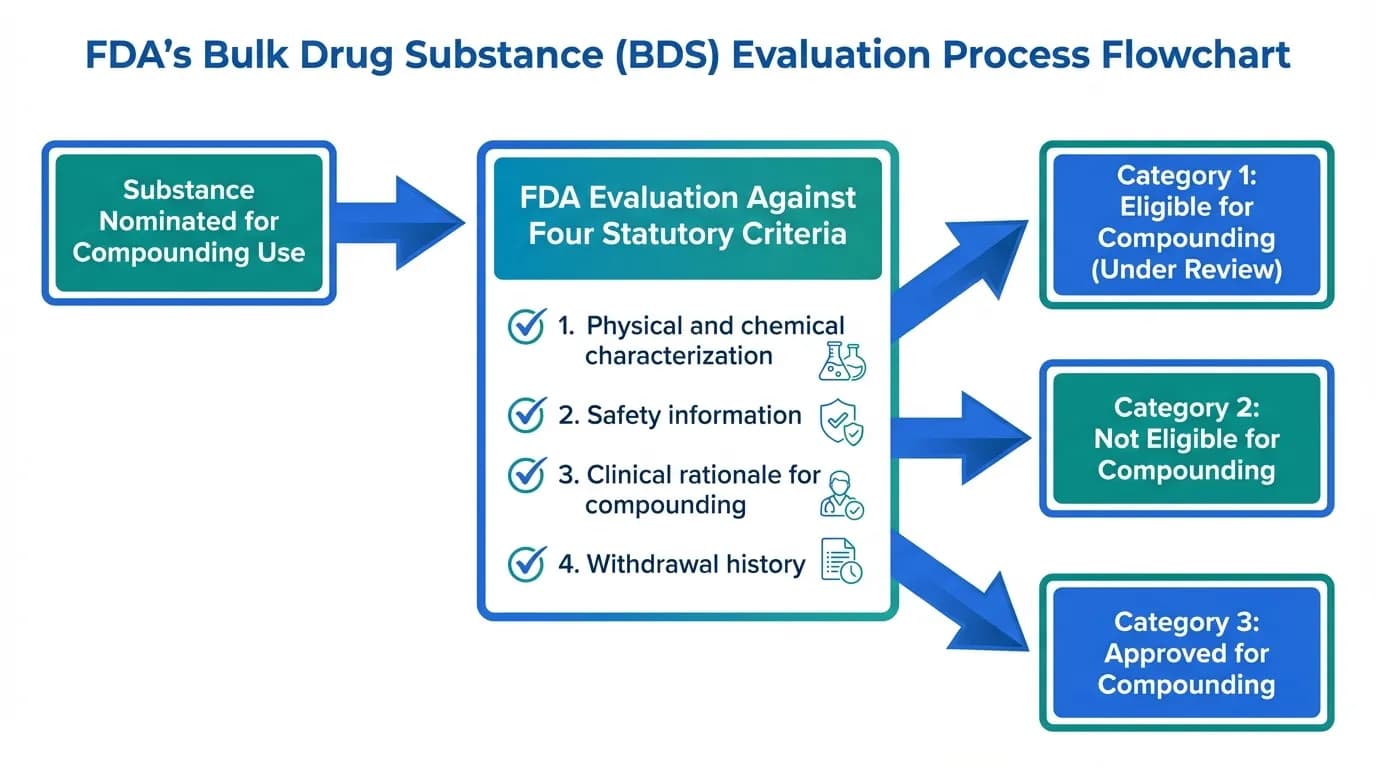
FDA Peptide Categories Explained: Category 1 vs Category 2 (2026)
Understand the FDA peptide classification system. Learn the difference between Category 1, Category 2, and Category 3 peptides and what the 2024-2026 regulatory changes mean for researchers.

Best Peptides for Menopause Symptoms: 2026 Research Guide
Research guide covering peptides studied for menopause symptoms including hot flashes, bone loss, cognitive changes, skin aging, sleep disruption, and hormonal regulation.

13 Best Anti-Aging Peptides (2026): Ranked by Clinical Evidence
From senolytic FOXO4-DRI to mitochondrial SS-31, we ranked 13 anti-aging peptides by clinical trial evidence across 6 mechanisms. See which have human data vs. animal-only studies.
You Might Also Like
Related content you may find interesting