Best Peptides for Hair, Skin & Nails: Evidence-Based Guide (2026)
How Peptides Affect Hair, Skin, and Nails#
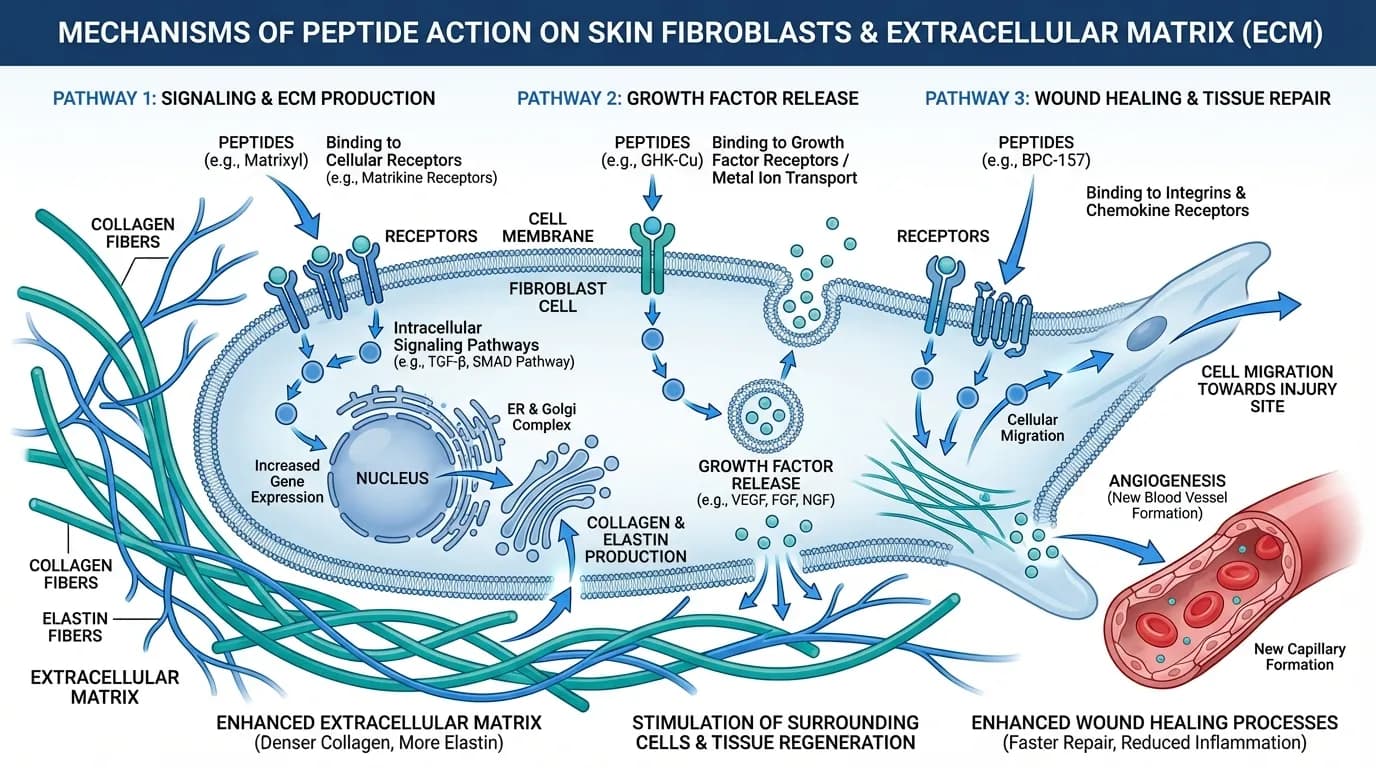
Peptides influence hair, skin, and nail health through several interconnected mechanisms. At the cellular level, specific peptides signal fibroblasts to increase collagen and elastin production, stimulate keratinocyte proliferation, and modulate growth factor expression in hair follicles. Unlike many cosmetic ingredients that work only at the skin surface, bioactive peptides can interact with cellular receptors to trigger meaningful biological responses.
The three primary mechanisms relevant to cosmetic peptide applications are:
- Collagen stimulation: Peptides like Matrixyl act as matrikines, signaling cells to produce new extracellular matrix components including collagen I, III, and IV.
- Growth factor modulation: GHK-Cu upregulates multiple growth factors including VEGF, FGF, and NGF, which promote tissue repair, angiogenesis, and follicle cycling.
- Wound healing and tissue repair: BPC-157 accelerates wound closure and tissue regeneration through VEGFR2-Akt-eNOS signaling, with implications for skin barrier repair and scar reduction.
The quality of evidence varies substantially between peptides. Some have rigorous clinical trial data, while others rely primarily on in vitro studies or animal models.
GHK-Cu: The Strongest Evidence for Hair and Skin#
GHK-Cu (copper tripeptide-1) is the most extensively studied peptide for combined hair, skin, and nail applications. This naturally occurring tripeptide (Gly-His-Lys) complexed with copper(II) was first identified in human plasma, where it declines significantly with age -- from approximately 200 ng/mL at age 20 to 80 ng/mL by age 60.
Hair Growth#
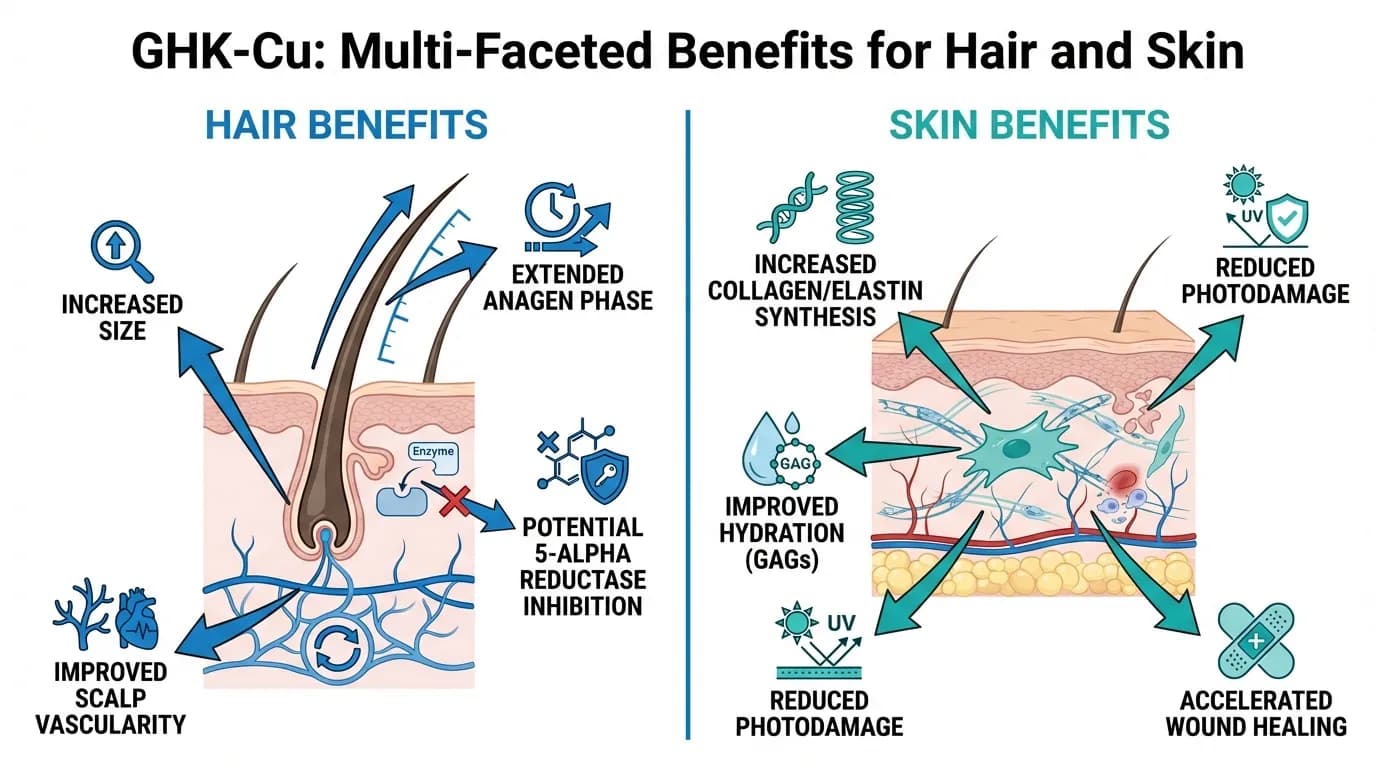
GHK-Cu has demonstrated hair growth effects through multiple mechanisms:
- Follicle enlargement: Studies show GHK-Cu can increase hair follicle size, shifting vellus-like miniaturized follicles toward terminal hair production.
- Anagen extension: The peptide extends the active growth phase of hair cycling, resulting in longer, thicker hair shafts.
- 5-alpha reductase inhibition: Some evidence suggests GHK-Cu may reduce DHT conversion at the follicular level, though this mechanism is less established than its growth factor effects.
- Scalp vascularity: VEGF upregulation improves blood supply to hair follicles, supporting nutrient delivery during active growth.
Topical GHK-Cu at 1-2% concentration has shown comparable or superior results to minoxidil 5% in limited comparative studies, though larger head-to-head trials are needed.
Skin Rejuvenation#
GHK-Cu's skin benefits are supported by both in vitro and clinical data:
- Stimulates collagen synthesis in dermal fibroblasts
- Increases elastin production and skin firmness
- Promotes glycosaminoglycan synthesis for improved hydration
- Reduces photodamage markers and improves skin clarity
- Accelerates wound healing and reduces scarring
A gene expression study found that GHK-Cu modulates over 4,000 human genes, with significant upregulation of collagen, anti-inflammatory, and antioxidant pathways. This broad gene-regulatory activity distinguishes it from peptides with narrower mechanisms.
Nail Strength#
While direct nail studies are limited, GHK-Cu's stimulation of keratinocyte proliferation and extracellular matrix production has theoretical relevance to nail plate integrity. The copper component specifically supports cross-linking of keratin fibers, which is essential for nail hardness.
Matrixyl: Clinical Data for Wrinkle Reduction#
Matrixyl (palmitoyl pentapeptide-4, Pal-KTTKS) is a synthetic matrikine peptide specifically designed to stimulate collagen production in skin. It represents one of the few cosmetic peptides with published clinical trial data supporting its anti-wrinkle claims.
How Matrixyl Works#
The KTTKS sequence mimics a fragment of collagen I that is released during natural collagen turnover. When fibroblasts detect this fragment, they interpret it as a signal to produce new collagen. By providing this signal exogenously, Matrixyl effectively tricks fibroblasts into increasing collagen output.
Key findings from clinical studies include:
- Wrinkle depth reduction: Controlled studies show measurable decreases in wrinkle depth after 8-12 weeks of twice-daily application.
- Collagen I and III synthesis: In vitro studies demonstrate dose-dependent increases in both major dermal collagen types.
- Fibronectin production: Matrixyl also increases fibronectin, a key extracellular matrix glycoprotein that supports skin structure.
Matrixyl is primarily a topical cosmeceutical ingredient. It is not typically used as an injectable and has no significant evidence for hair or nail applications.
Matrixyl 3000 and Synthe'6#
Advanced formulations combine the original Matrixyl (Pal-KTTKS) with palmitoyl tripeptide-1 (Matrixyl 3000) or add hyaluronic acid stimulating peptides (Matrixyl Synthe'6). These combination approaches target multiple matrix components simultaneously but have less independent clinical validation than the original Matrixyl.
BPC-157: Wound Healing with Skin Implications#
BPC-157 (Body Protection Compound-157) is primarily studied for gastrointestinal and musculoskeletal healing, but its tissue repair mechanisms have clear relevance to skin health. This 15-amino-acid peptide derived from human gastric juice promotes angiogenesis, accelerates wound closure, and modulates inflammatory responses.
Skin-Relevant Research#
- Accelerated wound healing: Animal studies consistently show faster wound closure, including in diabetic and corticosteroid-impaired healing models.
- Burn healing: Preclinical data demonstrate improved outcomes in thermal injury models, with enhanced re-epithelialization and reduced scarring.
- Collagen organization: BPC-157 appears to improve the organization of newly deposited collagen, potentially reducing scar formation.
The skin applications of BPC-157 remain primarily preclinical. It is not a cosmeceutical ingredient and is typically administered by injection for research purposes. For pure cosmetic concerns like wrinkles or age spots, GHK-Cu and Matrixyl have more directly relevant evidence.
Popular Peptide Blends: What to Look For#
Commercial "hair, skin, and nails" peptide blends have proliferated, but quality varies enormously. Here is what to evaluate:
Signs of a Quality Blend#
- Named peptides at stated concentrations: Look for specific peptides (e.g., GHK-Cu at 1%, Matrixyl at 4%) rather than vague "peptide complex" labels.
- Third-party testing: Certificate of Analysis (COA) from an independent lab confirming peptide identity and concentration.
- Appropriate delivery system: Peptides need penetration enhancers or proper formulation to cross the skin barrier. A peptide dissolved in plain water will not penetrate effectively.
- Stability considerations: Peptides can degrade with heat, light, and pH changes. Proper packaging (airless pumps, opaque containers) matters.
Red Flags#
- Proprietary blends that do not disclose individual peptide concentrations
- Claims of "hundreds of peptides" without specifying which ones
- Oral peptide supplements for skin without enteric protection (most peptides are digested before absorption)
- Extremely low-cost products claiming high peptide concentrations
Evidence-Ranked Peptide Ingredients#
| Peptide | Best For | Evidence Level | Route |
|---|---|---|---|
| GHK-Cu | Hair, skin, wound healing | Strong preclinical + some clinical | Topical or injectable |
| Matrixyl | Wrinkle reduction | Clinical trial data | Topical only |
| Argireline | Expression lines | Clinical data (modest effect) | Topical only |
| BPC-157 | Wound healing, tissue repair | Strong preclinical | Injectable |
| Collagen peptides | General skin hydration | Clinical data (oral) | Oral supplement |
Practical Recommendations#
For those researching peptides for cosmetic applications, a practical approach based on available evidence:
- For hair thinning: Topical GHK-Cu (1-2%) is the best-supported peptide option. It can be used alongside conventional treatments like minoxidil.
- For wrinkles and fine lines: Matrixyl-containing serums applied twice daily offer the most direct clinical evidence. Combination with GHK-Cu provides complementary mechanisms.
- For skin healing and scarring: GHK-Cu topically for surface wounds; BPC-157 is studied for deeper tissue repair but remains a research compound.
- For nail brittleness: Evidence is weakest here. Oral collagen peptides (not topical) have the most supporting data for nail strength, with one study showing 12% increased nail growth rate and 42% decreased frequency of broken nails after 24 weeks.
- For general anti-aging: GHK-Cu addresses the broadest range of aging markers through its extensive gene-modulatory effects.
The Bottom Line#
Among peptides studied for hair, skin, and nail health, GHK-Cu has the broadest and strongest evidence base, affecting hair follicle cycling, collagen synthesis, and wound healing through over 4,000 gene modulations. Matrixyl is the best-validated peptide specifically for wrinkle reduction, with controlled clinical trial data. BPC-157 offers powerful wound healing but is less directly applicable to cosmetic concerns.
When evaluating peptide blends, prioritize products that name specific peptides at clinically relevant concentrations, provide third-party testing, and use appropriate delivery systems. The most effective approach combines peptides with complementary mechanisms rather than relying on a single compound.
Frequently Asked Questions About Best Peptides for Hair, Skin & Nails: Evidence-Based Guide (2026)
Which peptide is best for hair growth?
GHK-Cu (copper peptide) has the strongest research evidence for hair growth. Studies show it can enlarge hair follicles, stimulate growth, and extend the anagen (growth) phase. It works by upregulating genes involved in follicle cycling and increasing blood flow to the scalp. Topical formulations at 1-2% concentration are most commonly studied.
Do peptide blends for hair, skin, and nails actually work?
Peptide blends vary widely in quality and evidence. The most effective blends contain well-studied peptides like GHK-Cu and Matrixyl at clinically relevant concentrations. Look for products that disclose specific peptide concentrations and have third-party testing. Many commercial blends use peptides at sub-therapeutic doses, which limits their effectiveness.
Can peptides replace retinol for anti-aging?
Peptides like Matrixyl and GHK-Cu work through different mechanisms than retinol and are generally better tolerated. Matrixyl stimulates collagen through matrikine signaling, while retinol modulates gene expression through retinoid receptors. They can be complementary rather than replacements. Peptides may be preferred for sensitive skin that cannot tolerate retinoids.
Are injectable peptides better than topical for skin?
It depends on the goal. Topical peptides like Matrixyl and topical GHK-Cu are effective for surface-level concerns like wrinkles and skin texture. Injectable GHK-Cu or BPC-157 may provide more systemic effects including wound healing and tissue repair. Most cosmetic applications are well served by topical formulations with proper penetration enhancers.
Continue reading this research review
Free access to the complete analysis with citations and evidence ratings.
150+ peptide profiles · 30+ comparisons · 18 research tools
Medical Disclaimer
This website is for educational and informational purposes only. The information provided is not intended to diagnose, treat, cure, or prevent any disease. Always consult with a qualified healthcare professional before using any peptide or supplement.
Join 2,000+ researchers getting biweekly updates
Enjoyed this article?
The Research Briefing delivers deep-dives like this biweekly — plus new study breakdowns, safety updates, and tool announcements.
Free forever. No spam. Unsubscribe in one click.
Where to Find These Peptides
Continue Exploring
Peptide Profiles
Keep Reading

Anti-Wrinkle Peptides: SNAP-8, Argireline, Matrixyl, and Leuphasyl Compared
Evidence-based guide to cosmeceutical anti-wrinkle peptides including SNAP-8, Argireline, Matrixyl, and GHK-Cu — mechanisms, clinical data, and formulation.

Collagen-Boosting Peptides for Skin: From GHK-Cu to Matrixyl
Research review of collagen-stimulating peptides for skin rejuvenation including GHK-Cu, Matrixyl, SNAP-8, and BPC-157 wound healing data.
Where to Buy GHK-Cu in Canada: 2026 Vendor Guide
Where to buy GHK-Cu (copper peptide) in Canada in 2026: Canadian-domestic vendors, CAD pricing, payment options, customs risk, and shipping speeds compared. Includes vendor recommendations by use case.
You Might Also Like
Related content you may find interesting