Amycretin vs CagriSema: Unimolecular vs Combination GLP-1/Amylin Therapy
Comparison of amycretin and CagriSema, two Novo Nordisk therapies targeting GLP-1 and amylin pathways for obesity, with different molecular designs, weight loss data, and development strategies.
Verdict at a Glance
Both amycretin and CagriSema are Novo Nordisk programs targeting the same GLP-1 plus amylin dual pathway, but with fundamentally different molecular strategies. CagriSema has the stronger evidence base with completed phase 3 REDEFINE trials showing 20.4% weight loss, and is closer to potential approval. Amycretin offers the elegance of a single molecule activating both pathways, with the critical advantage of an oral formulation and phase 1b/2a data showing up to 24% weight loss at 36 weeks. If amycretin's early data holds in phase 3, its oral availability could make it the preferred option. CagriSema's advantage is the ability to independently optimize the dose of each component.
| Best for | Pick | Why |
|---|---|---|
| Strongest Current Evidence | CagriSema | REDEFINE 1 and REDEFINE 2 are completed phase 3 trials published in NEJM with over 4,600 participants. CagriSema is closest to potential approval among GLP-1/amylin combinations. |
| Oral Administration (Future) | Amycretin | Amycretin is being developed in both subcutaneous and oral formulations. Oral amycretin showed 13.1% weight loss at 12 weeks in phase 1 and up to 10.1% in phase 2 T2D. CagriSema is injectable only. |
| Maximum Weight Loss Potential (Future) | Amycretin | Subcutaneous amycretin achieved up to 24% weight loss at 36 weeks in phase 1b/2a, exceeding CagriSema's 20.4% at 68 weeks in phase 3. If this trajectory holds in phase 3, amycretin could achieve greater long-term weight loss. |
| Type 2 Diabetes | CagriSema | REDEFINE 2 demonstrated 13.7% weight loss and HbA1c reductions with 73.5% achieving HbA1c of 6.5% or less at 68 weeks. Amycretin's T2D data is from a phase 2 trial with shorter duration. |
| Independent Dose Optimization | CagriSema | As a combination of two separate molecules, CagriSema allows each component's dose to be optimized independently. Amycretin's single- molecule design means both pathways are activated at a fixed ratio. |
| Simplified Treatment (Future) | Amycretin | A single oral tablet activating both GLP-1 and amylin pathways represents the simplest possible treatment paradigm. CagriSema requires weekly injection of two combined peptides. |
| Category | Amycretin | CagriSema | Advantage |
|---|---|---|---|
| Mechanism of Action | Unimolecular dual GLP-1 and amylin receptor agonist. A single molecule that activates both pathways simultaneously. Available in both subcutaneous and oral formulations. Represents the simplest possible approach to dual pathway activation. | Fixed-ratio combination of two separate molecules -- cagrilintide (long- acting amylin analog) and semaglutide (GLP-1 agonist) -- co-administered in a single weekly injection. Each component has independently validated efficacy. | Amycretin |
| Weight Loss Efficacy | Phase 1b/2a showed up to 24% weight loss at 36 weeks with subcutaneous dosing. Phase 2 in T2D showed up to 14.5% at 36 weeks (SC) and up to 10.1% (oral). Oral phase 1 showed 13.1% at 12 weeks. | REDEFINE 1 (phase 3) demonstrated 20.4% mean weight loss at 68 weeks vs 3.0% placebo. 60% achieved 20% or more loss, 23% achieved 30% or more. REDEFINE 2 (T2D) showed 13.7% at 68 weeks. | Comparable |
| Research Evidence | Phase 1 and phase 1b/2a results published in The Lancet (2025). Phase 2 in T2D reported. Phase 3 development planned for 2026. No cardiovascular outcomes data. Early-stage evidence. | Phase 3 REDEFINE program completed. REDEFINE 1 and REDEFINE 2 published in NEJM (2025). Enrolled over 4,600 participants across two pivotal trials. Each component (semaglutide, cagrilintide) has independent phase 3 data. | CagriSema |
| Side Effect Profile | Safety profile consistent with GLP-1 and amylin agonists. GI events were the most common adverse effects, vast majority mild to moderate. Both subcutaneous and oral formulations appeared safe and well tolerated. | GI adverse events affected 79.6% in the CagriSema group vs 39.9% placebo in REDEFINE 1, including nausea, vomiting, diarrhea, constipation, and abdominal pain. Mainly transient and mild to moderate. Well-characterized across large phase 3 trials. | Amycretin |
| Dosing Convenience | Available in both subcutaneous (once weekly) and oral (daily) formulations. The oral option is a major advantage, potentially eliminating the need for injections entirely. Single molecule simplifies manufacturing. | Once-weekly subcutaneous injection combining two peptides in a single pen. Injectable only (no oral formulation possible for the combination). The co-formulation eliminates the need for separate injections of each component. | Amycretin |

Introduction#
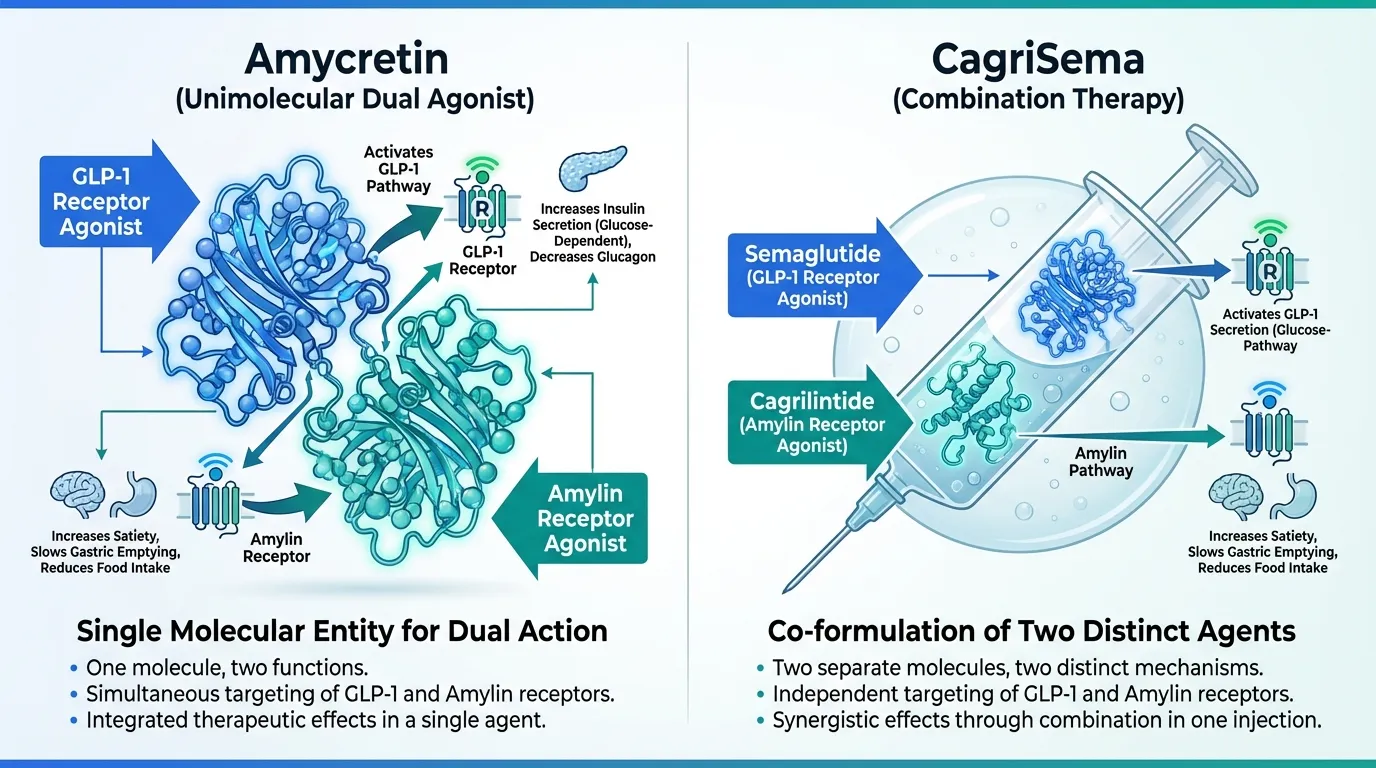
Amycretin and CagriSema represent two approaches to the same therapeutic concept: combining GLP-1 receptor agonism with amylin receptor agonism for obesity and diabetes treatment. Both are Novo Nordisk programs, but they employ fundamentally different molecular strategies. CagriSema is a fixed-ratio combination of two separate peptides (cagrilintide + semaglutide) delivered as a single weekly injection. Amycretin is a unimolecular dual agonist -- a single molecule that activates both GLP-1 and amylin receptors -- available in both injectable and oral formulations.
This intra-company comparison is particularly interesting because it reveals Novo Nordisk's multi-pronged strategy for next-generation obesity therapy. CagriSema leverages two individually validated components and is further along in development (phase 3 completed). Amycretin offers the simplicity of a single molecule and the transformative potential of oral dual agonist therapy, but with earlier-stage evidence.
Mechanism of Action Comparison#
Amycretin#
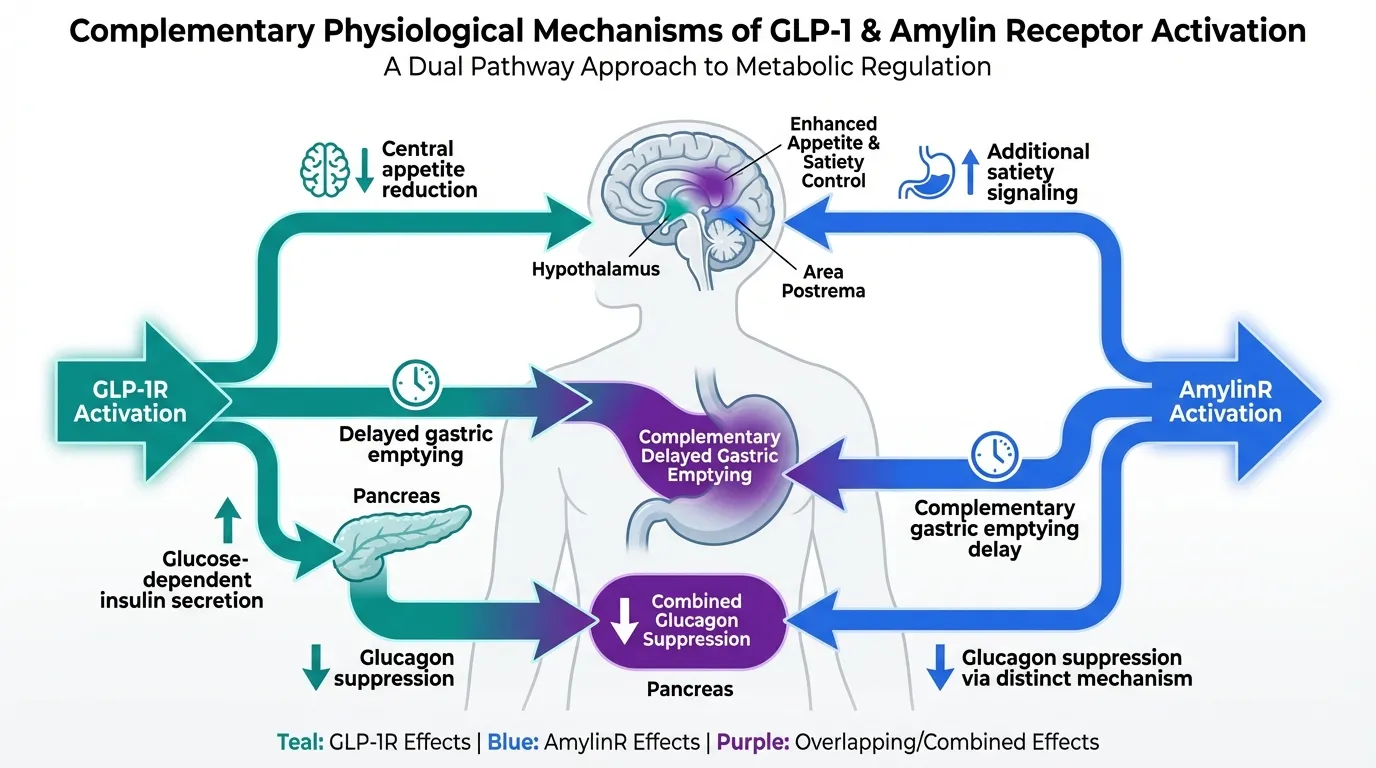
Amycretin is the first unimolecular dual GLP-1 and amylin receptor agonist. A single molecular entity simultaneously activates both the GLP-1 receptor and the amylin receptor (calcitonin receptor complex), combining two complementary satiety and metabolic pathways:
- GLP-1 receptor activation: Glucose-dependent insulin secretion, glucagon suppression, delayed gastric emptying, and central appetite reduction through hypothalamic signaling
- Amylin receptor activation: Additional satiety signaling through the area postrema, complementary gastric emptying delay, and glucagon suppression through a distinct mechanism
The unimolecular design means both receptor activations occur at a fixed ratio determined by the molecular structure. Amycretin has been developed in both subcutaneous (once weekly) and oral (daily) formulations.
CagriSema#
CagriSema is a fixed-ratio combination of two distinct peptide molecules in a single injection device:
- Cagrilintide: A long-acting amylin analog with a ~7-day half-life achieved through fatty acid acylation. Activates amylin receptors for satiety, gastric emptying delay, and glucagon suppression
- Semaglutide: The selective GLP-1 receptor agonist with a ~7-day half-life. The same molecule as Ozempic/Wegovy
The combination approach has the advantage of using two individually optimized and validated components. Each component has demonstrated independent efficacy, and the combination produces additive effects on weight loss and glycemic control.
Mechanistic Comparison#
| Feature | Amycretin | CagriSema |
|---|---|---|
| Molecular design | Unimolecular dual agonist | Fixed-ratio combination (2 molecules) |
| GLP-1R activation | Single molecule | Semaglutide component |
| Amylin receptor activation | Single molecule | Cagrilintide component |
| Ratio flexibility | Fixed (molecular) | Fixed (formulation), but components can be studied independently |
| Formulations | SC weekly + oral daily | SC weekly only |
| Manufacturing complexity | Single molecule | Two peptides co-formulated |
| Developer | Novo Nordisk | Novo Nordisk |
Dosing Comparison#
Amycretin Dosing#
Amycretin dosing is investigational:
- Subcutaneous: Once-weekly injection, doses up to 60 mg studied in phase 1b/2a over 36 weeks
- Oral: Daily tablet, doses up to 50 mg (or 2 x 50 mg) studied in phase 1
- Phase 2 T2D: Both subcutaneous and oral formulations studied over 36 weeks
Phase 3 dose selection will be informed by the completed phase 2 data. Novo Nordisk plans to initiate phase 3 in 2026.
CagriSema Dosing#
CagriSema is a fixed-ratio combination in a single pen injector:
- Once-weekly subcutaneous injection containing both cagrilintide and semaglutide
- REDEFINE 1: Dose escalation to the maintenance combination dose over several weeks
- Dosing ratio: Fixed ratio optimized during the phase 2 program
Dosing Comparison Table#
| Parameter | Amycretin | CagriSema |
|---|---|---|
| Route | SC (weekly) or oral (daily) | SC (weekly) only |
| Injection frequency | 52/year (SC) or 0 (oral) | 52/year |
| Oral option | Yes | No |
| Components per dose | 1 molecule | 2 molecules (co-formulated) |
| Development stage | Phase 2 (entering phase 3) | Phase 3 completed |
Side Effects Comparison#
Amycretin Side Effects#
In the phase 1b/2a trial published in The Lancet, once-weekly subcutaneous amycretin up to 60 mg had a safety and tolerability profile consistent with GLP-1 and amylin agonists. GI events were the most common adverse effects, with the vast majority being mild to moderate in severity. Both subcutaneous and oral formulations appeared safe and well tolerated. The phase 2 T2D trial similarly reported a safe and well-tolerated profile.
CagriSema Side Effects#
In REDEFINE 1, GI adverse events affected 79.6% of participants in the CagriSema group vs 39.9% in the placebo group. These included nausea, vomiting, diarrhea, constipation, and abdominal pain, and were mainly transient and mild to moderate. This high overall GI rate (while mostly mild) likely reflects the combined GI effects of activating both GLP-1 and amylin pathways simultaneously.
For context, CagriSema's GI rate was compared to its individual components: semaglutide alone and cagrilintide alone both had lower GI event rates than the combination, consistent with additive GI effects.
Safety Comparison Table#
| Parameter | Amycretin | CagriSema |
|---|---|---|
| GI adverse events | Consistent with class; mild-moderate | 79.6% (combination) vs 39.9% placebo |
| Evidence duration | Up to 36 weeks | 68 weeks |
| Sample size | Phase 1b/2a + phase 2 | >4,600 (phase 3) |
| Long-term safety | Unknown | Moderate (68-week data) |
| Post-marketing | None | None |
Research Evidence Comparison#
Amycretin Research#
Amycretin has early but impressive data:
- Phase 1 (SC): Published in The Lancet (2025). Safety, tolerability, PK, and PD in people with overweight/obesity. Demonstrated proof-of-concept for the dual agonist approach
- Phase 1b/2a (SC): Up to 24% weight loss at 36 weeks with doses up to 60 mg. Weight loss trajectory was still accelerating
- Phase 1 (oral): 10.4-13.1% weight loss at 12 weeks depending on dosing regimen vs 1.2% placebo
- Phase 2 (T2D): SC amycretin showed up to 14.5% weight loss and HbA1c reductions up to 1.8% at 36 weeks. Oral amycretin showed up to 10.1% weight loss
Evidence level: Low-moderate -- early-phase data with Lancet publication, impressive trajectories, but small samples and short duration.
CagriSema Research#
CagriSema has comprehensive phase 3 evidence:
- REDEFINE 1 (obesity): Phase 3, 68 weeks, ~3,400 patients. Mean weight loss -20.4% vs -3.0% placebo. 60% achieved 20% or more, 23% achieved 30% or more. Semaglutide alone: -14.9%. Cagrilintide alone: -11.5%
- REDEFINE 2 (obesity + T2D): Phase 3, 68 weeks, ~1,200 patients. Weight loss -13.7% vs -3.4% placebo. 73.5% achieved HbA1c of 6.5% or less vs 15.9% placebo
- Publication: Both trials published simultaneously in NEJM (2025) and presented at ADA 2025
Evidence level: High -- completed phase 3 program with dual NEJM publications and >4,600 total participants.
Key Differences Summary#
- Molecular design: Amycretin is a single molecule activating two receptors. CagriSema combines two separate validated molecules. The unimolecular approach is simpler but less flexible; the combination allows independent dose optimization.
- Oral formulation: Amycretin's most transformative advantage. Oral amycretin showed 13.1% weight loss at 12 weeks, offering the possibility of an oral dual GLP-1/amylin agonist. CagriSema's antibody-free peptide combination is injectable only.
- Weight loss data: Subcutaneous amycretin achieved 24% at 36 weeks (phase 1b/2a) -- if this holds in phase 3, it would exceed CagriSema's 20.4% at 68 weeks (phase 3). However, phase 2 results frequently attenuate in larger trials.
- Evidence maturity: CagriSema has completed phase 3 with NEJM publications and >4,600 patients. Amycretin has early-phase data with phase 3 planned for 2026.
- Component validation: CagriSema benefits from each component (semaglutide, cagrilintide) having independent extensive clinical data. Amycretin has no separate component validation since it is a single molecule.
- Developer strategy: Both are Novo Nordisk programs, suggesting the company views them as complementary rather than competing -- CagriSema as the nearer-term injectable option, amycretin as the longer-term oral strategy.
Conclusion#
Amycretin and CagriSema illustrate two philosophies for combining GLP-1 and amylin receptor activation. CagriSema takes the combination approach -- pairing two proven molecules (semaglutide and cagrilintide) in a single injection that produced 20.4% weight loss in phase 3, with 60% of patients losing 20% or more. Its advantages are the strength of the evidence (dual NEJM publications, >4,600 patients) and the independent validation of each component.
Amycretin takes the unimolecular approach -- encoding both GLP-1 and amylin agonism into a single molecule. Its early data is remarkable, with up to 24% weight loss at 36 weeks subcutaneously and 13.1% at 12 weeks orally. The oral formulation is the most significant differentiator: if an oral tablet can produce weight loss comparable to injectable CagriSema, it could fundamentally change how dual pathway obesity therapy is delivered.
Both drugs are being developed by Novo Nordisk, likely reflecting a portfolio strategy: CagriSema as the first-to-market injectable combination, and amycretin as a follow-on oral option for patients who prefer pills. The company's decision to advance both programs suggests confidence that the GLP-1/amylin dual pathway represents the future of obesity pharmacotherapy, with room for multiple formulations serving different patient preferences.
For clinicians and patients, the practical timeline matters: CagriSema is closer to potential approval (phase 3 complete), while amycretin's phase 3 is planned for 2026. The oral option may ultimately be the more transformative contribution, but CagriSema will likely reach the market first.
Further Reading#

Which Is Better For...
Strongest Current Evidence
CagriSema
REDEFINE 1 and REDEFINE 2 are completed phase 3 trials published in NEJM with over 4,600 participants. CagriSema is closest to potential approval among GLP-1/amylin combinations.
Oral Administration (Future)
Amycretin
Amycretin is being developed in both subcutaneous and oral formulations. Oral amycretin showed 13.1% weight loss at 12 weeks in phase 1 and up to 10.1% in phase 2 T2D. CagriSema is injectable only.
Maximum Weight Loss Potential (Future)
Amycretin
Subcutaneous amycretin achieved up to 24% weight loss at 36 weeks in phase 1b/2a, exceeding CagriSema's 20.4% at 68 weeks in phase 3. If this trajectory holds in phase 3, amycretin could achieve greater long-term weight loss.
Type 2 Diabetes
CagriSema
REDEFINE 2 demonstrated 13.7% weight loss and HbA1c reductions with 73.5% achieving HbA1c of 6.5% or less at 68 weeks. Amycretin's T2D data is from a phase 2 trial with shorter duration.
Independent Dose Optimization
CagriSema
As a combination of two separate molecules, CagriSema allows each component's dose to be optimized independently. Amycretin's single- molecule design means both pathways are activated at a fixed ratio.
Simplified Treatment (Future)
Amycretin
A single oral tablet activating both GLP-1 and amylin pathways represents the simplest possible treatment paradigm. CagriSema requires weekly injection of two combined peptides.
Continue Your Research
Get comparison updates
We publish new head-to-head comparisons regularly. Subscribe to see them first.
Frequently Asked Questions About Amycretin vs CagriSema: Unimolecular vs Combination GLP-1/Amylin Therapy
Which is better, Amycretin or CagriSema?
Both amycretin and CagriSema are Novo Nordisk programs targeting the same GLP-1 plus amylin dual pathway, but with fundamentally different molecular strategies. CagriSema has the stronger evidence base with completed phase 3 REDEFINE trials showing 20.4% weight loss, and is closer to potential approval. Amycretin offers the elegance of a single molecule activating both pathways, with the critical advantage of an oral formulation and phase 1b/2a data showing up to 24% weight loss at 36 weeks. ... Individual responses may vary, and this comparison is based on available research data, not a treatment recommendation.
What are the key differences between Amycretin and CagriSema?
The main differences across comparison categories are: Mechanism of Action: advantage goes to Amycretin; Weight Loss Efficacy: advantage goes to neither (tie); Research Evidence: advantage goes to CagriSema. 2 additional categories are analyzed in the full comparison. Each category evaluates a different dimension of the two peptides.
When should I consider CagriSema over Amycretin?
For the scenario of "Strongest Current Evidence," research data suggests CagriSema may be more relevant. REDEFINE 1 and REDEFINE 2 are completed phase 3 trials published in NEJM with over 4,600 participants. CagriSema is closest to potential approval among GLP-1/amylin combinations.. This is based on currently available evidence and individual circumstances may differ.
How do Amycretin and CagriSema differ in their mechanisms of action?
Amycretin: Unimolecular dual GLP-1 and amylin receptor agonist. A single molecule that activates both pathways simultaneously. Available in both subcutaneous and oral formulations. Represents the simplest pos.... CagriSema: Fixed-ratio combination of two separate molecules -- cagrilintide (long- acting amylin analog) and semaglutide (GLP-1 agonist) -- co-administered in a single weekly injection. Each component has in....
Which has fewer side effects, Amycretin or CagriSema?
In terms of side effects and tolerability, the advantage goes to Amycretin. Amycretin: Safety profile consistent with GLP-1 and amylin agonists. GI events were the most common adverse effects, vast majority mild to moderate. Both subc.... CagriSema: GI adverse events affected 79.6% in the CagriSema group vs 39.9% placebo in REDEFINE 1, including nausea, vomiting, diarrhea, constipation, and abd....
Medical Disclaimer
This website is for educational and informational purposes only. The information provided is not intended to diagnose, treat, cure, or prevent any disease. Always consult with a qualified healthcare professional before using any peptide or supplement.