Peptide Stability: Factors That Affect Peptide Degradation

Introduction#
Peptide stability is a central concern in both pharmaceutical development and research applications. Peptides are inherently less stable than small-molecule drugs due to the chemical nature of the peptide bond and the vulnerability of amino acid side chains to various degradation pathways.
Understanding why and how peptides degrade allows researchers to make informed decisions about storage, handling, formulation, and the interpretation of experimental results. A peptide that has partially degraded may produce misleading data -- reduced potency, altered pharmacokinetics, or unexpected biological effects from degradation products.
This article reviews the major chemical and physical degradation pathways for peptides, the environmental factors that influence stability, and the strategies used to maximize peptide shelf life.
Chemical Degradation Pathways#
Hydrolysis#
Hydrolysis is the cleavage of the peptide bond by water. This is the most fundamental chemical degradation pathway for peptides in solution.
Factors that accelerate hydrolysis:
- pH extremes: Both strongly acidic and strongly basic conditions increase hydrolysis rates. Most peptides are most stable at mildly acidic to neutral pH (pH 4-7).
- Temperature: Higher temperatures increase the rate of hydrolysis. The general rule is that a 10 degree C increase in temperature roughly doubles the degradation rate.
- Specific amino acid sequences: Asp-Pro bonds are particularly susceptible to acid-catalyzed hydrolysis. Asp-Gly sequences are also vulnerable.
Hydrolysis produces truncated peptide fragments that may or may not retain biological activity. In reconstituted solutions, hydrolysis is a primary driver of the limited shelf life.
Oxidation#
Oxidation is the addition of oxygen to susceptible amino acid residues, particularly:
- Methionine (Met): Readily oxidized to methionine sulfoxide, then further to methionine sulfone. This is often the most kinetically favorable oxidation reaction in peptides.
- Cysteine (Cys): Can form disulfide bonds (potentially altering structure) or be oxidized to cysteic acid.
- Tryptophan (Trp): Susceptible to photo-oxidation, producing N-formylkynurenine and kynurenine.
- Tyrosine (Tyr): Can undergo photo-oxidation, especially in the presence of UV light.
- Histidine (His): Can be oxidized under harsh conditions.
Sources of oxidative stress include dissolved oxygen in solution, light exposure (particularly UV), metal ion contaminants (iron, copper), and peroxides that may be present in some excipients.
Deamidation#
Deamidation is the loss of an amide group from asparagine (Asn) or glutamine (Gln) residues, converting them to aspartate or glutamate, respectively. This introduces a negative charge and can significantly alter peptide structure and function.
The Asn-Gly sequence is particularly prone to deamidation. The rate depends on pH (fastest at mildly alkaline pH), temperature, and local sequence context.
Deamidation is one of the most common degradation pathways observed during stability studies of pharmaceutical peptides.
Isomerization and Racemization#
Aspartate isomerization produces isoaspartate, introducing a kink in the peptide backbone that can disrupt biological activity. This reaction often occurs alongside deamidation.
Racemization is the conversion of L-amino acids to their D-isomer. While generally slow under physiological conditions, it can become significant over extended storage periods, particularly at elevated temperatures or extreme pH.
Disulfide Exchange#
Peptides containing cysteine residues can undergo disulfide bond scrambling, where existing disulfide bridges break and reform in different pairings. This is particularly relevant for peptides with multiple cysteines and can lead to misfolded structures with reduced or absent biological activity.
Physical Degradation Pathways#
Aggregation#
Aggregation occurs when peptide molecules associate with each other to form larger complexes. These aggregates may be:
- Soluble oligomers: Small clusters that remain in solution
- Insoluble precipitates: Large aggregates that fall out of solution (visible as cloudiness or particulates)
- Fibrils: Ordered, elongated structures (amyloid-like)
Aggregation is driven by hydrophobic interactions, hydrogen bonding, and electrostatic forces. It is accelerated by temperature, agitation (shaking), and high peptide concentration.
Aggregated peptides typically have reduced biological activity and may trigger immune responses if administered.
Adsorption#
Peptides can adsorb (stick) to the surfaces of containers, syringes, and tubing. This is particularly problematic at low concentrations, where the proportion of peptide lost to surface binding becomes significant.
Hydrophobic peptides tend to adsorb to plastic surfaces, while charged peptides may interact with glass. This can lead to apparent loss of potency if not accounted for.
Denaturation#
For larger peptides and small proteins that have defined three-dimensional structures, denaturation refers to the unfolding of the native structure. Denatured peptides lose their biological activity even if the primary sequence remains intact.
Denaturation can be caused by heat, mechanical stress (shaking, stirring), exposure to air-liquid interfaces, and contact with organic solvents.
Environmental Factors Affecting Stability#
Temperature#
Temperature is the single most important environmental factor for peptide stability. Higher temperatures accelerate virtually all degradation pathways.
| Temperature | Effect on Stability |
|---|---|
| -80 degrees C | Maximum stability for lyophilized peptides |
| -20 degrees C | Excellent long-term storage for lyophilized forms |
| 2-8 degrees C | Standard for reconstituted peptides; adequate short-term for lyophilized |
| 25 degrees C | Accelerated degradation; avoid for extended storage |
| 37 degrees C | Significant degradation within days to weeks for most peptides |
| >40 degrees C | Rapid degradation; avoid completely |
pH#
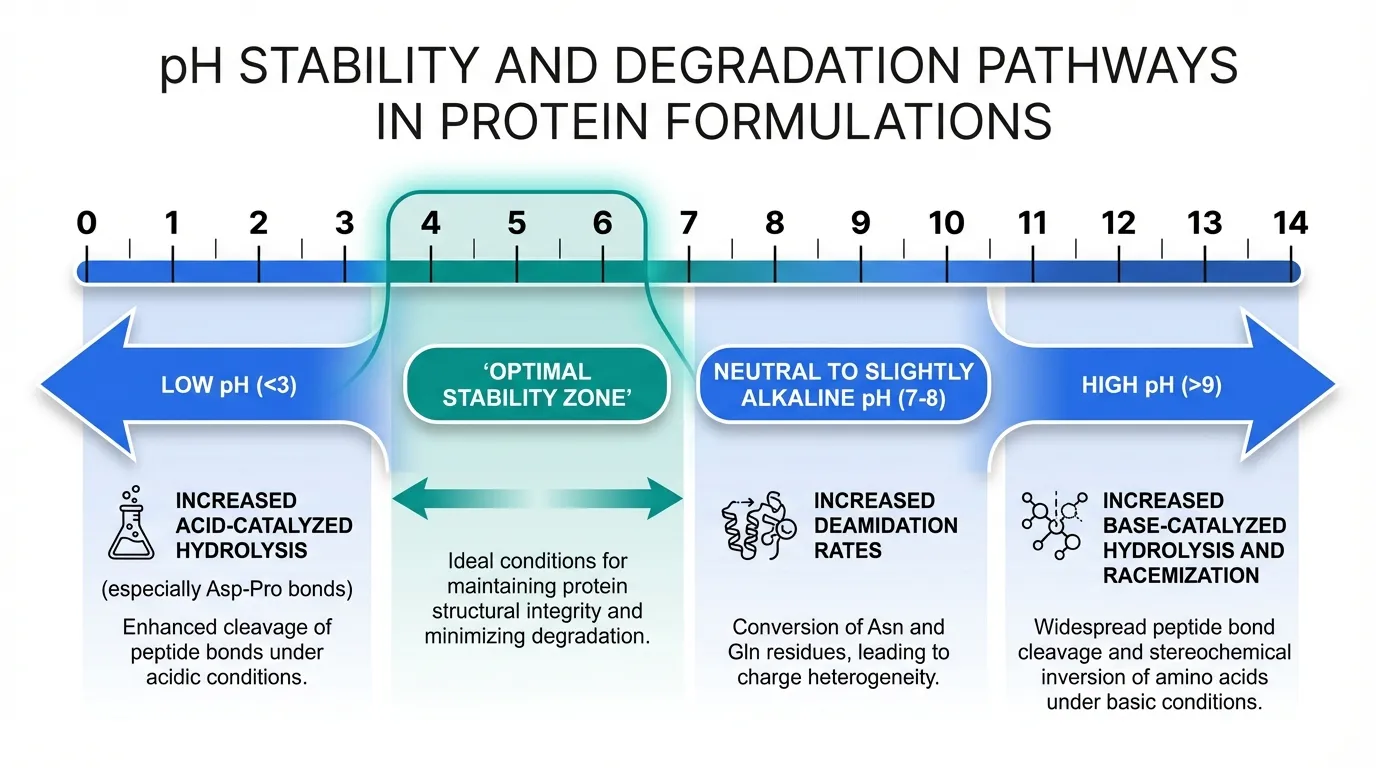
Most peptides have an optimal stability window around pH 4-6. Stability decreases at both pH extremes:
- At low pH (<3): Acid-catalyzed hydrolysis increases, particularly at Asp-Pro bonds
- At neutral to slightly alkaline pH (7-8): Deamidation rates increase
- At high pH (>9): Base-catalyzed hydrolysis and racemization accelerate
The pH of the reconstitution solvent matters. Bacteriostatic water is typically pH 4.5-7, which falls within an acceptable range for most peptides.
Light#
UV and visible light can trigger photodegradation reactions, particularly oxidation of Trp, Tyr, and Phe residues. Light-sensitive peptides should be stored in amber vials or wrapped in foil.
Oxygen#
Dissolved oxygen in solution drives oxidation reactions. Purging solutions with nitrogen or argon before sealing can reduce oxidation, though this is impractical for most research settings.
Ionic Strength and Excipients#
Salt concentration affects peptide solubility, aggregation tendency, and the rate of certain degradation reactions. Some excipients (sugars, amino acids, surfactants) can stabilize peptides, while others (certain metal ions, peroxides) accelerate degradation.
Strategies for Maximizing Peptide Stability#
Formulation Strategies#
Pharmaceutical peptide formulations employ several strategies to enhance stability:
- Lyophilization: Removing water dramatically slows all aqueous degradation pathways
- pH optimization: Formulating at the pH of maximum stability
- Cryoprotectants and lyoprotectants: Sugars (trehalose, sucrose, mannitol) protect peptides during freezing and drying
- Antioxidants: Added to prevent oxidation in solution formulations
- Surfactants: Low concentrations of polysorbate 20 or 80 reduce aggregation at interfaces
- Metal ion chelators: EDTA removes trace metals that catalyze oxidation
Practical Research Guidelines#
For researchers working with peptides in the lab:
- Store lyophilized peptides at -20 degrees C or lower for maximum shelf life
- Reconstitute only what you will use within the recommended timeframe
- Minimize freeze-thaw cycles -- aliquot before freezing if multiple uses are planned
- Protect from light during storage and handling
- Use appropriate containers -- glass is generally preferred over plastic for long-term storage
- Minimize air exposure -- work quickly when vials are open
- Monitor visually -- discard solutions that become cloudy or discolored
For detailed storage recommendations, see our peptide storage guide.
Chemical Modifications for Stability#
Some peptides are intentionally modified to improve their stability:
- PEGylation: Adding polyethylene glycol (PEG) chains increases half-life in vivo and can reduce aggregation
- Acetylation/amidation: Capping the N-terminus or C-terminus protects against exopeptidase degradation
- D-amino acid substitution: Replacing L-amino acids with D-forms at vulnerable positions increases protease resistance
- Cyclization: Connecting the N- and C-termini or forming internal bridges increases structural rigidity
These modifications are relevant for understanding why some peptide analogs (like semaglutide, which has a C18 fatty acid chain) have dramatically different pharmacokinetic profiles than their unmodified counterparts.
Detecting Peptide Degradation#
Visual Indicators#
- Cloudiness or turbidity (aggregation)
- Visible particles or fibers
- Color change (yellow or brown discoloration)
Analytical Methods#
- HPLC: Degradation products appear as new peaks or shoulder peaks on the chromatogram
- Mass spectrometry: Identifies specific degradation products (oxidized forms, deamidated species, fragments)
- Circular dichroism: Detects changes in secondary structure (denaturation)
- Dynamic light scattering: Detects aggregation before it becomes visible
For more on analytical testing, see our peptide quality guide.
Key Takeaways#
-
Peptides degrade through multiple pathways including hydrolysis, oxidation, deamidation, and aggregation. Understanding these pathways explains why storage conditions matter.
-
Temperature is the most important stability factor. Keeping peptides cold is the single most effective way to slow degradation.
-
Lyophilized peptides are far more stable than reconstituted solutions because removing water eliminates aqueous degradation pathways.
-
Methionine and asparagine residues are particularly vulnerable to oxidation and deamidation, respectively. Peptides containing these residues require extra care.
-
Degraded peptides can produce misleading research results through reduced potency, altered activity, or effects from degradation products.
-
Pharmaceutical peptides use multiple stabilization strategies including lyophilization, pH optimization, and chemical modification to extend shelf life and improve pharmacokinetics.
Related Peptide Profiles#
Learn more about the peptides discussed in this article:
- Semaglutide Overview and Research Guide
- Semaglutide Dosing Protocols
- Semaglutide Side Effects and Safety
- [PEG-MGF Overview and Research Guide](/peptides/peg-mgf)
- PEG-MGF Dosing Protocols
- PEG-MGF Side Effects and Safety
- CJC-1295 DAC Overview and Research Guide
- CJC-1295 DAC Dosing Protocols
- CJC-1295 DAC Side Effects and Safety

Frequently Asked Questions About Peptide Stability: Factors That Affect Peptide Degradation
What does this article cover?
Peptide stability and degradation science: oxidation, hydrolysis, physical degradation, environmental factors, and shelf life strategies. This research review is for educational purposes only and does not constitute medical advice.
Which peptides are discussed in this article?
This article covers Semaglutide, PEG-MGF, CJC-1295 DAC. Key context: Semaglutide (); PEG-MGF (); CJC-1295 DAC (). Each peptide is discussed based on available research evidence.
What level of evidence does this research review cover?
This research review examines published preclinical and clinical studies related to the peptides discussed. Evidence quality varies between peptides and indications. The article distinguishes between FDA-approved uses and investigational applications where applicable.
What are the key takeaways from this article?
The main findings covered in this article include: . These takeaways are based on the research data available at the time of publication.
Continue reading this research review
Free access to the complete analysis with citations and evidence ratings.
150+ peptide profiles · 30+ comparisons · 18 research tools
Medical Disclaimer
This website is for educational and informational purposes only. The information provided is not intended to diagnose, treat, cure, or prevent any disease. Always consult with a qualified healthcare professional before using any peptide or supplement.
Join 2,000+ researchers getting biweekly updates
Enjoyed this article?
The Research Briefing delivers deep-dives like this biweekly — plus new study breakdowns, safety updates, and tool announcements.
Free forever. No spam. Unsubscribe in one click.
Where to Find These Peptides
Continue Exploring
Peptide Profiles
Keep Reading

IGF-1 Peptides: LR3, DES, and MGF — Variants and Research Overview
Research overview of IGF-1 variant peptides — IGF-1 LR3, IGF-1 DES, MGF, and PEG-MGF — covering mechanisms, the GH-IGF-1 axis, and preclinical evidence.
Peptide Stacking Safety: Synergies, Interactions, and Protocol Design
A safety-focused guide to combining peptides — covering known synergistic combinations, contraindicated pairings, timing and administration principles, recommended bloodwork monitoring, and red flags to watch for during stacked protocols.
Is Prescott Bio Canada Legit? Independent 2026 Review
Is Prescott Bio Canada legit? Independent 2026 review of the Calgary-based Canadian research peptide supplier: Richmond BC fulfillment, HPLC and mass spectrometry testing, plain CAD pricing, 2-4 day domestic shipping, Stripe card checkout, and community reputation.
You Might Also Like
Related content you may find interesting