Nootropic Peptide Stacks: What Research Says About Combining Cognitive Peptides

Introduction#
The concept of "stacking" -- combining multiple compounds with complementary mechanisms -- is well-established in pharmacology. Combination therapies are standard practice in oncology, cardiology, infectious disease, and psychiatry. The rationale is straightforward: by engaging multiple biological targets simultaneously, combinations can achieve effects that individual compounds cannot.
In the nootropic peptide space, stacking is widely discussed but rarely studied with the same rigor applied to pharmaceutical combinations. Most evidence for peptide stacking is extrapolated from the individual pharmacology of each compound rather than derived from controlled combination studies. This distinction matters: pharmacological synergy is not guaranteed by complementary mechanisms, and co-administration can introduce unexpected interactions.
This guide examines the scientific rationale behind common nootropic peptide combinations, distinguishes between direct evidence (actual combination studies) and indirect evidence (extrapolation from individual mechanisms), and highlights the substantial gaps in the current research base.
The Pharmacological Rationale for Peptide Stacking#
Why Combine Nootropic Peptides?#
Cognitive function depends on multiple interacting systems: neurotrophic factor signaling (BDNF, NGF), neurotransmitter balance (dopamine, serotonin, GABA, glutamate), synaptic structural integrity, neuroinflammatory regulation, and gene expression programs governing neuroplasticity. No single peptide modulates all of these systems effectively.
The theoretical basis for peptide stacking rests on three principles:
1. Mechanistic complementarity. Combining peptides that act through different primary mechanisms may engage a broader range of cognitive-relevant pathways than any single agent. For example, combining a BDNF upregulator with a GABAergic modulator addresses both neurotrophic support and neurotransmitter balance.
2. Temporal complementarity. Some cognitive processes (such as learning acquisition vs. memory consolidation) involve distinct neurochemical events occurring at different timepoints. Peptides with different onset and duration profiles may support different phases of cognitive processing.
3. Dose reduction potential. If two compounds produce additive or synergistic effects on a shared endpoint, each can theoretically be used at lower individual doses, potentially reducing side effects while maintaining efficacy. This principle is well-established in combination pharmacotherapy but has not been rigorously tested for nootropic peptides.
Important Caveats#
Before examining specific combinations, several limitations must be acknowledged:
- No controlled human trials exist for any nootropic peptide combination discussed below. All evidence is preclinical, observational, or theoretical.
- Pharmacokinetic interactions between co-administered peptides are largely unstudied. Peptides may compete for enzymatic degradation, affect each other's absorption, or alter blood-brain barrier transport.
- Additive toxicity is a real concern with combinations, even when individual compounds are well-tolerated.
- Publication bias may overrepresent positive combination results in the limited literature that exists.
The Semax + Selank Stack#
Rationale and Complementary Mechanisms#
The combination of Semax and Selank is the most widely discussed nootropic peptide stack, and it has the strongest mechanistic rationale for complementarity. These two peptides were developed at the same institution (the Institute of Molecular Genetics, Russian Academy of Sciences), share a common intranasal administration route, and have been used concurrently in Russian clinical practice.
Their complementarity arises from fundamentally different parent molecules and primary mechanisms:
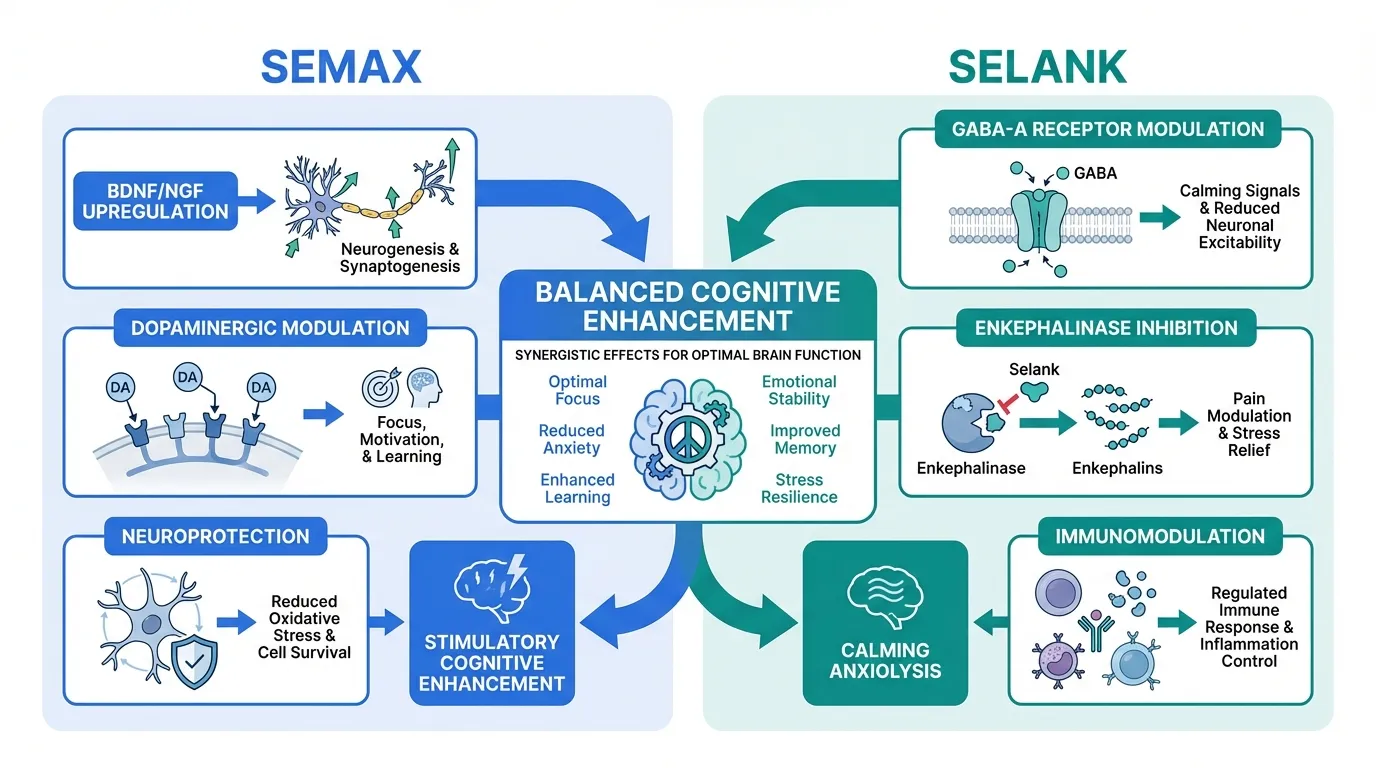
Semax is derived from ACTH(4-7) and acts primarily through:
- Robust upregulation of BDNF and NGF (1.4-fold increase in BDNF protein, 3-fold increase in exon III BDNF mRNA in rat hippocampus)
- Dopaminergic and serotonergic system modulation
- Neuroprotective gene program activation
- Melanocortin-related signaling
Selank is derived from tuftsin and acts primarily through:
- Allosteric modulation of GABA-A receptors (anxiolytic without sedation)
- Enkephalinase inhibition (preserving endogenous opioid peptides)
- BDNF upregulation (via a pathway distinct from Semax)
- Immunomodulatory effects (cytokine and chemokine gene regulation)
The complementarity is evident: Semax provides stimulatory, dopaminergic cognitive enhancement, while Selank provides calming, GABAergic anxiolysis. Together, they could theoretically produce cognitive enhancement without the anxiety or overstimulation that sometimes accompanies purely activating nootropics.
What the Evidence Actually Shows#
It must be stated clearly: no published controlled study has directly compared the Semax + Selank combination against either compound alone using cognitive endpoints. The evidence supporting this stack is entirely indirect:
-
Shared Russian clinical use. Both compounds are approved medications in Russia and are prescribed concurrently by some clinicians. This concurrent use provides some real-world safety data (no reported adverse interactions), but it does not constitute efficacy evidence for the combination.
-
Non-overlapping side effect profiles. Semax's most relevant side effects (potential insomnia, rare paradoxical anxiety from dopaminergic activation) are mechanistically opposed to Selank's effects (anxiolysis, calming without sedation). This suggests the combination may have a more favorable tolerability profile than Semax alone.
-
Converging BDNF pathways. Both peptides upregulate BDNF, but through partially different upstream mechanisms. Whether this produces additive, synergistic, or redundant BDNF enhancement is unknown.
-
Shared C-terminal PGP motif. Both Semax (Met-Glu-His-Phe-Pro-Gly-Pro) and Selank (Thr-Lys-Pro-Arg-Pro-Gly-Pro) share the C-terminal Pro-Gly-Pro sequence. This means they may compete for the same peptidase-mediated degradation pathways, potentially affecting each other's pharmacokinetics when co-administered intranasally.
Practical Considerations#
In Russian clinical practice, when Semax and Selank are used together, they are typically administered at their standard individual doses (200-600 mcg each, intranasally, 2-3 times daily) with staggered timing -- Semax in the morning for its activating properties and Selank later in the day for its calming effects, or Selank used to offset Semax-induced overstimulation. This timing strategy reflects the pharmacological logic of the combination but has not been validated in controlled studies.
For a detailed head-to-head comparison, see Selank vs Semax.
BDNF Upregulation Stacks#
The Central Role of BDNF#
Brain-derived neurotrophic factor (BDNF) is among the most important molecules in cognitive neuroscience. It promotes synaptic plasticity, supports neuronal survival, enhances long-term potentiation (the cellular basis of learning and memory), and drives neurogenesis in the hippocampus. Reduced BDNF levels are associated with depression, Alzheimer's disease, and age-related cognitive decline.
Multiple nootropic peptides upregulate BDNF, but through different mechanisms. This raises the question: can combining BDNF-upregulating peptides produce greater neurotrophic support than any single agent?
Peptides That Upregulate BDNF#
| Peptide | BDNF Mechanism | Evidence Level |
|---|---|---|
| Semax | Direct transcriptional upregulation via melanocortin pathways | Preclinical (quantified in rat hippocampus) |
| Selank | BDNF mRNA upregulation in hippocampus | Preclinical |
| Cerebrolysin | Mimics BDNF/NGF activity directly; may also upregulate endogenous BDNF | Clinical and preclinical |
| Dihexa | Indirect; promotes HGF/c-Met signaling which converges on similar plasticity pathways | Preclinical only |
| PE-22-28 | TREK-1 blockade promotes BDNF release and hippocampal neurogenesis | Preclinical only |
| Pinealon | Proposed epigenetic modulation of neuroprotective gene expression | Preclinical (limited) |
Theoretical BDNF Stack Combinations#
Semax + Cerebrolysin: This combination has the strongest theoretical basis among BDNF stacks. Semax upregulates endogenous BDNF production, while Cerebrolysin provides exogenous neurotrophic factor activity that mimics BDNF and NGF. The combination could theoretically provide both increased endogenous production and supplemental exogenous neurotrophic support. Both compounds have been used clinically in Russia for neurological conditions, though combination studies with cognitive endpoints are not available.
A significant practical barrier exists: Semax is administered intranasally while Cerebrolysin requires intravenous or intramuscular injection, making simultaneous use logistically complex outside clinical settings.
Semax + PE-22-28: This combination pairs BDNF transcriptional upregulation (Semax) with BDNF release facilitation through TREK-1 channel blockade (PE-22-28). PE-22-28 promotes hippocampal neurogenesis within 4 days of treatment in rodent models, which could complement Semax's longer-term neurotrophic support. However, PE-22-28 remains a preclinical compound with no human data, and the interaction between melanocortin-pathway BDNF upregulation and TREK-1-mediated BDNF release has not been studied.
Selank + Pinealon: This combination pairs Selank's anxiolytic-nootropic profile with Pinealon's proposed epigenetic neuroprotection. The rationale is that Selank provides acute neurotransmitter modulation while Pinealon supports longer-term gene expression changes. However, Pinealon's evidence base is substantially weaker than Selank's, and the bioregulator peptide mechanism remains incompletely validated.
The BDNF Ceiling Problem#
An important theoretical consideration for BDNF stacking is whether BDNF upregulation has a ceiling effect -- or worse, whether excessive BDNF signaling could be harmful. Preclinical research suggests that BDNF signaling follows an inverted U-shaped dose-response curve in some contexts. Excessive BDNF has been associated with epileptogenesis and may contribute to certain pain states. While there is no evidence that nootropic peptide combinations produce dangerously elevated BDNF levels, the absence of evidence is not evidence of safety. This is a genuine knowledge gap.
Neuroprotective Combination Strategies#
Multi-Target Neuroprotection#
Neurodegenerative conditions and acute brain injuries involve multiple pathological processes: excitotoxicity, oxidative stress, neuroinflammation, mitochondrial dysfunction, and protein aggregation. Single-target interventions have consistently failed in clinical trials for conditions like Alzheimer's disease and traumatic brain injury, leading to growing interest in multi-target approaches.
Several nootropic peptides have demonstrated neuroprotective properties through different mechanisms, suggesting potential for complementary neuroprotective stacks:
Semax -- reduces excitotoxicity, upregulates survival factor expression, modulates neuroinflammation. Approved in Russia for ischemic stroke recovery.
Cerebrolysin -- provides exogenous neurotrophic support, promotes neuroplasticity, anti-apoptotic signaling. Approved in 40+ countries for stroke and dementia.
Pinealon -- proposed epigenetic modulation of neuroprotective genes, antioxidant properties in cellular models.
Selank -- immunomodulatory effects that may reduce neuroinflammation, BDNF upregulation for neuronal survival.
Semax + Cerebrolysin for Neurological Injury#
The combination of Semax and Cerebrolysin for acute neurological injury has the strongest clinical plausibility among neuroprotective stacks. Both compounds are approved medications used in post-stroke care in Russia and Eastern Europe, and some clinical protocols employ both agents during stroke recovery. Semax is administered intranasally (3-6 mg for stroke) while Cerebrolysin is administered intravenously, providing non-conflicting routes.
The mechanistic rationale is that Semax's rapid BDNF/NGF upregulation and neuroprotective gene activation could complement Cerebrolysin's direct neurotrophic factor delivery, providing both upstream (gene expression) and downstream (protein-level) support for neuronal survival.
Despite this compelling logic and concurrent clinical use, no randomized controlled trial has compared the Semax + Cerebrolysin combination against either agent alone for stroke outcomes or any other neurological endpoint. This represents a significant gap in the evidence base.
Next-Generation Nootropic Stacking Considerations#
Dihexa and the HGF Pathway#
Dihexa operates through a mechanism fundamentally distinct from all other nootropic peptides discussed here. Rather than modulating BDNF, GABA, or monoamine systems, Dihexa potentiates hepatocyte growth factor (HGF) signaling at the c-Met receptor, promoting synaptogenesis and spinogenesis at picomolar concentrations. In preclinical neurotrophic assays, Dihexa demonstrated activity approximately seven orders of magnitude more potent than BDNF.
This mechanistic distinctness makes Dihexa a theoretically attractive stacking candidate with BDNF-based peptides (Semax, Selank) -- engaging both BDNF/TrkB and HGF/c-Met synaptogenic pathways simultaneously. However, several factors complicate this reasoning:
- Retraction concerns. A key 2014 publication supporting Dihexa's mechanism was retracted due to data integrity issues, which introduces uncertainty about some foundational claims.
- No human data. Dihexa has never been tested in humans. Combining two untested compounds dramatically increases risk and regulatory complexity.
- HGF/c-Met oncology concerns. The HGF/c-Met pathway is a known oncogenic signaling axis. Long-term activation of this pathway, especially in combination with other growth factor signaling, raises theoretical safety concerns that have not been addressed experimentally.
For a detailed comparison of the two most discussed next-generation nootropic peptides, see Dihexa vs PE-22-28.
PE-22-28 and TREK-1 Channel Modulation#
PE-22-28 blocks TREK-1 two-pore domain potassium channels with an IC50 of 0.12 nM -- approximately 300-500 times more potent than its parent compound spadin. By blocking these potassium leak channels, PE-22-28 increases neuronal excitability, promotes serotonergic neurotransmission, and induces hippocampal neurogenesis within 4 days of treatment in rodent models.
PE-22-28's mechanism is complementary to both BDNF-upregulating peptides and GABAergic modulators. TREK-1 blockade increases neuronal firing rates and promotes serotonin release, which could synergize with Semax's dopaminergic/serotonergic modulation. However, the combination of increased neuronal excitability (PE-22-28) with decreased inhibitory tone (if GABAergic modulation from Selank shifts the balance) could theoretically lower seizure thresholds in susceptible individuals -- a risk that is entirely speculative but pharmacologically plausible.
Like Dihexa, PE-22-28 is a preclinical compound with no human safety or efficacy data, making any stacking protocol entirely experimental.
Risk Considerations for Peptide Stacking#
Pharmacokinetic Interactions#
When multiple peptides are co-administered, they may interact at several levels:
Absorption. Intranasally co-administered peptides may compete for mucosal absorption. The nasal epithelium has limited surface area and capacity for peptide transport. Administering Semax and Selank simultaneously through the same nostril could reduce the bioavailability of both.
Degradation. Peptides sharing similar structural features (such as the PGP C-terminal motif in Semax and Selank) may compete for the same degrading enzymes. This could paradoxically extend the half-life of both peptides, effectively increasing the dose beyond what was intended.
Blood-brain barrier transport. Peptide transport across the BBB involves saturable carrier systems. Co-administration of multiple BBB-penetrating peptides could create competition for CNS entry.
Safety Unknowns#
The safety profile of peptide combinations is fundamentally unknown. While individual peptides may have favorable safety records, combinations introduce:
- Additive side effects (e.g., Semax's dopaminergic activation combined with PE-22-28's increased neuronal excitability)
- Unexpected pharmacodynamic interactions that do not manifest with either compound alone
- Cumulative burden on peptide clearance systems (liver, kidneys, peptidases)
- Long-term consequences of sustained multi-pathway neurotrophic activation that may differ from short-term cognitive enhancement
The N-of-1 Problem#
Most anecdotal evidence for peptide stacking comes from self-experimenters reporting subjective cognitive improvements. These reports are valuable as hypothesis-generating observations but cannot establish causation, determine optimal dosing, identify rare adverse effects, or distinguish placebo effects from genuine pharmacological synergy. The highly variable and subjective nature of cognitive assessment makes self-experimentation particularly unreliable for evaluating nootropic combinations.
Evidence Gaps and Research Needs#
The following research would substantially advance understanding of nootropic peptide stacking:
-
Controlled combination studies. Head-to-head trials comparing combination vs. individual agents on validated cognitive endpoints (such as working memory, attention, or processing speed). Even well-designed animal studies with combination arms would be informative.
-
Pharmacokinetic interaction studies. Measurement of plasma and brain levels of each peptide when administered alone vs. in combination, particularly for intranasally co-administered compounds.
-
BDNF dose-response characterization. Determining whether BDNF upregulation from peptide combinations follows additive, synergistic, or ceiling-effect patterns.
-
Long-term safety monitoring. Extended observation periods for combination protocols, with monitoring of biomarkers relevant to the theoretical risks (growth factor signaling, seizure thresholds, immune parameters).
-
Standardized outcome measures. Adoption of validated cognitive assessment batteries that allow meaningful comparison across studies and reduce the influence of subjective reporting.
Summary Table: Nootropic Peptide Stack Evidence#
| Combination | Mechanistic Rationale | Direct Evidence | Practical Feasibility | Risk Level |
|---|---|---|---|---|
| Semax + Selank | Strong (complementary pathways) | None (concurrent clinical use only) | High (same route, established doses) | Low-Moderate |
| Semax + Cerebrolysin | Strong (upstream + downstream BDNF) | None (concurrent clinical use) | Moderate (different routes) | Low-Moderate |
| Semax + PE-22-28 | Moderate (BDNF + TREK-1) | None | Low (PE-22-28 preclinical only) | Unknown |
| Semax + Dihexa | Moderate (BDNF + HGF) | None | Low (Dihexa preclinical, retraction concern) | Unknown |
| Selank + Pinealon | Weak (GABAergic + epigenetic) | None | Low (Pinealon limited evidence) | Unknown |
| Cerebrolysin + Pinealon | Weak (neurotrophic + epigenetic) | None | Low (different evidence levels) | Unknown |
Conclusion#
Nootropic peptide stacking has a rational pharmacological basis, particularly for combinations that engage genuinely complementary mechanisms. The Semax + Selank combination stands out as having the strongest rationale: complementary parent molecules, non-overlapping primary mechanisms (dopaminergic/neurotrophic vs. GABAergic/enkephalinergic), opposing side effect profiles, concurrent clinical use in Russia, and shared intranasal administration.
However, rational does not mean validated. No controlled human study has demonstrated that any nootropic peptide combination produces superior cognitive outcomes compared to individual agents. The evidence base consists entirely of mechanistic extrapolation, concurrent clinical use without formal combination testing, and anecdotal reports.
For researchers interested in peptide combinations, the most scientifically defensible approach is to start with well-characterized individual compounds (Semax or Selank individually), establish baseline responses, and introduce additional agents methodically while monitoring both cognitive endpoints and safety markers. Next-generation compounds like Dihexa and PE-22-28 introduce exciting mechanistic possibilities but also substantially greater uncertainty due to their preclinical status.
The field would benefit enormously from even a single well-designed combination study. Until such data exists, peptide stacking should be approached with scientific caution, clear documentation, and honest acknowledgment of the evidence gaps.
Related Peptide Profiles#
Learn more about the peptides discussed in this article:
- Semax Overview and Research Guide
- Semax Dosing Protocols
- Semax Side Effects and Safety
- Selank Overview and Research Guide
- Selank Dosing Protocols
- Selank Side Effects and Safety
- Dihexa Overview and Research Guide
- Dihexa Dosing Protocols
- Dihexa Side Effects and Safety
- PE-22-28 Overview and Research Guide
- PE-22-28 Dosing Protocols
- PE-22-28 Side Effects and Safety
- Pinealon Overview and Research Guide
- Pinealon Dosing Protocols
- Pinealon Side Effects and Safety
- Cerebrolysin Overview and Research Guide
- Cerebrolysin Dosing Protocols
- Cerebrolysin Side Effects and Safety

Frequently Asked Questions About Nootropic Peptide Stacks: What Research Says About Combining Cognitive Peptides
What does this article cover?
Evidence-based review of nootropic peptide stacking, including Semax+Selank combinations, BDNF upregulation stacks, and neuroprotective synergies. This guide is for educational purposes only and does not constitute medical advice.
Which peptides are discussed in this article?
This article covers Semax, Selank, Dihexa, PE-22-28, Pinealon, Cerebrolysin. Key context: Semax (ACTH(4-7) analog with robust BDNF/NGF upregulation, frequently studied alongside Selank as a comp...); Selank (Tuftsin-derived anxiolytic peptide with GABAergic modulation, often combined with Semax for compl...); Dihexa (HGF/c-Met pathway activator with synaptogenic properties, discussed as a next-generation nootropi...). Each peptide is discussed based on available research evidence.
Who is this guide written for?
This guide is written for researchers and individuals seeking an evidence-based overview of the topic covered in "Nootropic Peptide Stacks: What Research Says About Combining Cognitive Peptides." It summarizes available research data without making treatment recommendations. Always consult a healthcare provider for medical decisions.
What are the key takeaways from this article?
The main findings covered in this article include: ACTH(4-7) analog with robust BDNF/NGF upregulation, frequently studied alongside Selank as a comp.... Tuftsin-derived anxiolytic peptide with GABAergic modulation, often combined with Semax for compl.... HGF/c-Met pathway activator with synaptogenic properties, discussed as a next-generation nootropi.... These takeaways are based on the research data available at the time of publication.
What is Semax and why is it significant?
Semax is a peptide discussed in this article because: ACTH(4-7) analog with robust BDNF/NGF upregulation, frequently studied alongside Selank as a complementary nootropic stack. For a complete profile of Semax, see the dedicated peptide page on this site.
Continue reading this research review
Free access to the complete analysis with citations and evidence ratings.
150+ peptide profiles · 30+ comparisons · 18 research tools
Medical Disclaimer
This website is for educational and informational purposes only. The information provided is not intended to diagnose, treat, cure, or prevent any disease. Always consult with a qualified healthcare professional before using any peptide or supplement.
Join 2,000+ researchers getting biweekly updates
Enjoyed this article?
The Research Briefing delivers deep-dives like this biweekly — plus new study breakdowns, safety updates, and tool announcements.
Free forever. No spam. Unsubscribe in one click.
Where to Find These Peptides
Continue Exploring
Peptide Profiles
Keep Reading

Best Nootropic Peptides for Cognitive Enhancement: 2026 Guide
Comprehensive 2026 guide to 9 nootropic peptides for cognitive enhancement — dihexa, semax, selank, cerebrolysin, PE-22-28, davunetide, pinealon, humanin, and DSIP — grouped by mechanism including BDNF upregulation, synaptogenesis, neuroprotection, and anxiolytic/sleep pathways.

Peptide Therapy for Brain Health: Neuroprotection, Cognition, and Recovery
Comprehensive guide to peptides for brain health covering neurotrophic factors, neuroprotective agents, anxiolytics, and experimental cognitive enhancers. Includes cerebrolysin, semax, selank, BPC-157, dihexa, pinealon, SS-31, and rapastinel.
Dihexa (PNB-0408): Structure, Solubility, Paper Controversy & Research Status in 2026
Deep-dive into Dihexa (PNB-0408): chemical structure (C27H44N4O5, MW 504.66), solubility data, the retracted Benoist 2014 paper, HGF/c-Met controversy, and where research stands in 2026.
You Might Also Like
Related content you may find interesting