Dihexa vs PE-22-28: Next-Generation Nootropic Peptides Compared
Detailed comparison of Dihexa and PE-22-28, two preclinical nootropic peptides with distinct mechanisms for cognitive enhancement and neurogenesis.
Verdict at a Glance
Both Dihexa and PE-22-28 are preclinical nootropic peptides with no human data, making any clinical recommendation premature. Dihexa has a more directly characterized cognitive enhancement profile and favorable oral bioavailability, but carries the burden of a retracted key publication and theoretical oncological concerns from HGF/c-Met activation. PE-22-28 has a cleaner evidence record and a well-characterized ion channel target, but its cognitive effects are less directly studied than its antidepressant properties. Neither compound has been adequately characterized for human use.
| Best for | Pick | Why |
|---|---|---|
| Cognitive Enhancement Research | Dihexa | Dihexa has been directly tested in cognitive paradigms (aged rat water maze, scopolamine reversal) and demonstrates synaptogenesis through HGF/c-Met signaling, providing a more direct cognitive enhancement rationale than PE-22-28 |
| Neurogenesis and Mood Research | PE-22-28 | PE-22-28 induces hippocampal neurogenesis within 4 days and demonstrates antidepressant-like effects through TREK-1 blockade, making it more relevant for mood-cognition intersection research |
| Oral Bioavailability Requirement | Dihexa | Dihexa has demonstrated approximately 38% oral bioavailability with BBB penetration, while PE-22-28 oral availability has not been characterized |
| Lower Theoretical Risk Profile | PE-22-28 | PE-22-28 targets an ion channel without known oncological associations, whereas Dihexa activates the HGF/c-Met pathway which is a characterized oncogenic signaling axis |
| Evidence Reliability | PE-22-28 | PE-22-28 has no retracted publications in its evidence base, while a key 2014 Dihexa paper was retracted for data fabrication concerns |
| Category | Dihexa | PE-22-28 | Advantage |
|---|---|---|---|
| Mechanism of Action | Dihexa is derived from angiotensin IV and acts by binding hepatocyte growth factor (HGF) with high affinity, potentiating HGF/c-Met receptor signaling at subthreshold concentrations. This promotes synaptogenesis and spinogenesis in hippocampal neurons. Dihexa activates downstream PI3K/AKT signaling and demonstrates neurotrophic activity approximately seven orders of magnitude more potent than BDNF in cell-based assays. | PE-22-28 is a synthetic 7-amino acid peptide derived from spadin that selectively blocks TREK-1 two-pore domain potassium channels with an IC50 of 0.12 nM. TREK-1 blockade increases neuronal excitability, promotes serotonergic neurotransmission, and induces hippocampal neurogenesis. It is approximately 300-500 times more potent than its parent compound spadin at inhibiting TREK-1. | Dihexa |
| Research Evidence | Dihexa has preclinical data showing cognitive restoration in aged rats and reversal of scopolamine-induced deficits, with oral bioavailability of approximately 38%. However, a key 2014 publication was retracted due to data fabrication concerns, introducing uncertainty about some foundational claims. No human clinical trials have been conducted. | PE-22-28 has preclinical data demonstrating antidepressant-like effects in rodent behavioral tests (forced swimming, novelty suppressed feeding) and rapid hippocampal neurogenesis within 4 days of treatment. The data comes from the group that originally developed spadin. No human clinical trials have been conducted. | Comparable |
| Side Effect Profile | Dihexa has limited safety data. The primary theoretical concern is its mechanism: HGF/c-Met is a known oncogenic signaling pathway, and long-term activation raises unaddressed questions about tumor promotion or growth. Acute toxicity data in animals has not revealed obvious safety signals, but long-term studies are absent. | PE-22-28 has limited safety data from preclinical studies. No obvious toxicity has been reported in rodent studies at effective doses. TREK-1 channels are expressed throughout the body, so systemic effects of blockade (cardiovascular, gastrointestinal) are theoretically possible but have not been characterized. No oncological safety concerns specific to its mechanism have been identified. | PE-22-28 |
| Cognitive Enhancement Potential | Dihexa demonstrated restoration of cognitive function in aged rats to levels comparable to young animals in spatial memory tasks, suggesting strong potential for age-related cognitive decline. It promotes formation of new synaptic connections via the HGF/c-Met pathway, providing a structural basis for cognitive enhancement beyond neurotransmitter modulation. | PE-22-28 promotes rapid hippocampal neurogenesis (within 4 days) and enhances serotonergic neurotransmission. Its cognitive effects are primarily studied through antidepressant behavioral models rather than direct cognitive testing. TREK-1 knockout mice show improved memory, suggesting TREK-1 blockade may enhance cognition, but PE-22-28 has not been directly tested in cognitive paradigms. | Dihexa |
| Practical Considerations | Dihexa has favorable oral bioavailability (approximately 38%) and crosses the blood-brain barrier, making it practically accessible compared to injectable peptides. Molecular weight is 504.66 Da. Available only as a research chemical with no pharmaceutical formulation. | PE-22-28 has demonstrated in vivo activity following intraperitoneal injection in rodent studies. Oral bioavailability has not been characterized. Its duration of action (approximately 23 hours) is longer than parent spadin (7 hours). Molecular weight is 773.89 Da. Available only as a research chemical. | Dihexa |

Introduction#
Dihexa and PE-22-28 represent two of the most discussed next-generation nootropic peptides in research communities. Neither has been tested in humans, and both operate through mechanisms fundamentally different from established nootropic peptides like Semax and Selank. What makes them noteworthy is the novelty of their targets: Dihexa works through the hepatocyte growth factor (HGF) / c-Met receptor system, while PE-22-28 blocks TREK-1 two-pore domain potassium channels. Both pathways are relatively unexplored in nootropic pharmacology.
This comparison examines their mechanisms, evidence quality, safety profiles, and practical considerations. The key context for this comparison is that both compounds are strictly preclinical -- all claims about cognitive effects are based on animal models, and the translation of these findings to human cognition is uncertain.
Mechanism of Action Comparison#
Dihexa: HGF/c-Met Synaptogenesis#
Dihexa (PNB-0408, N-hexanoic-Tyr-Ile-(6)-aminohexanoic amide) is a small oligopeptide derived from angiotensin IV. It was developed at Washington State University by the research group of Joseph Harding and John Wright, who were studying the cognitive effects of angiotensin IV and its analogs.
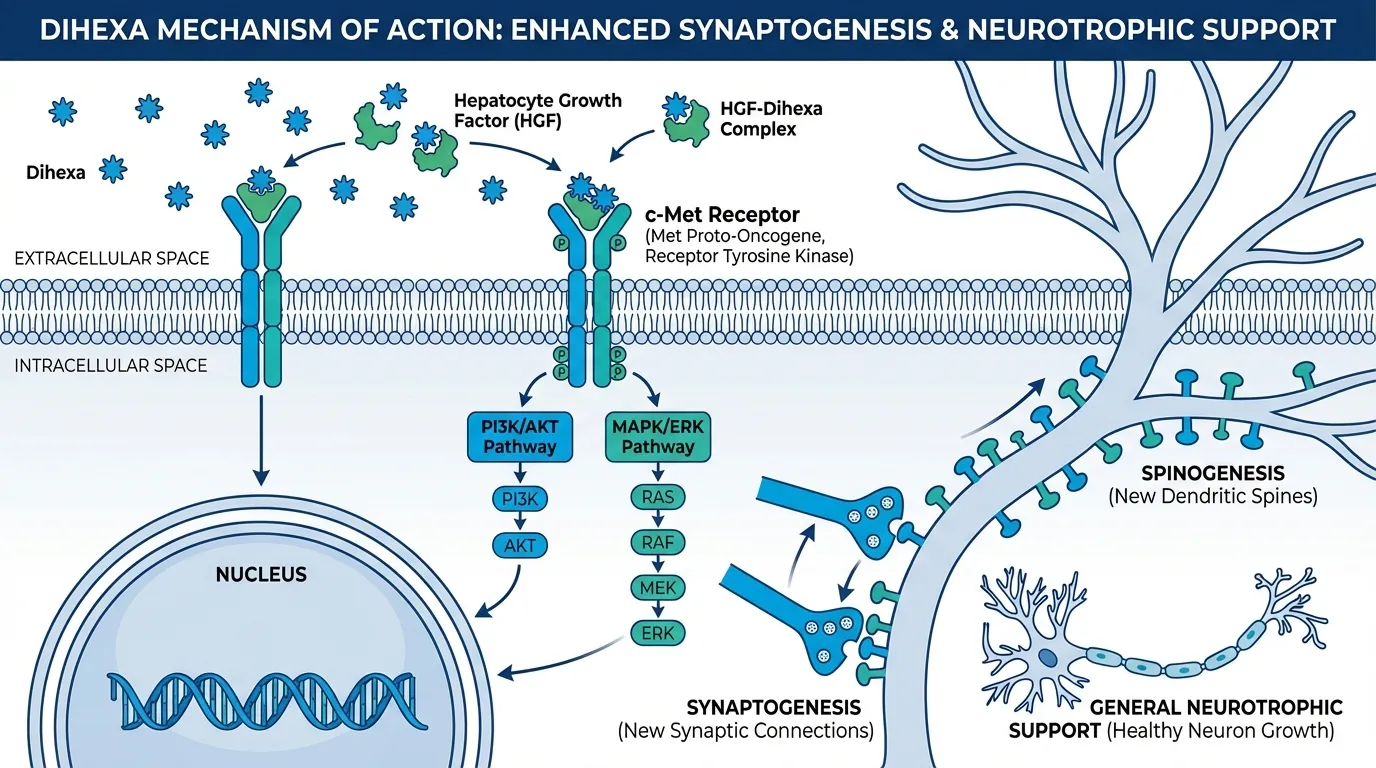
The mechanism centers on hepatocyte growth factor (HGF) and its receptor c-Met. Dihexa binds to HGF with high affinity and potentiates HGF's ability to activate c-Met at concentrations far below normal thresholds. The downstream effects include:
- Synaptogenesis: Formation of new synaptic connections in hippocampal neurons, driven by c-Met-mediated activation of PI3K/AKT and MAPK/ERK signaling cascades
- Spinogenesis: Growth of new dendritic spines, the structural substrate for excitatory synaptic transmission
- Neurotrophic support: In cell-based neurotrophic assays, Dihexa demonstrated potency approximately seven orders of magnitude greater than BDNF
The HGF/c-Met pathway is distinct from the BDNF/TrkB and NGF/TrkA pathways targeted by most nootropic peptides. HGF is primarily known as a morphogen and motogen involved in organ development, wound healing, and tissue regeneration. Its role in the adult brain involves supporting neuronal survival, promoting synaptic plasticity, and facilitating neurogenesis -- functions that make it a plausible target for cognitive enhancement.
PE-22-28: TREK-1 Channel Blockade#
PE-22-28 (Gly-Val-Ser-Trp-Gly-Leu-Arg) is a synthetic 7-amino acid peptide derived from spadin, itself an endogenous peptide released by proteolytic processing of sortilin (neurotensin receptor-3). PE-22-28 was identified through analysis of spadin's active degradation fragments in blood and optimized for enhanced potency and stability.
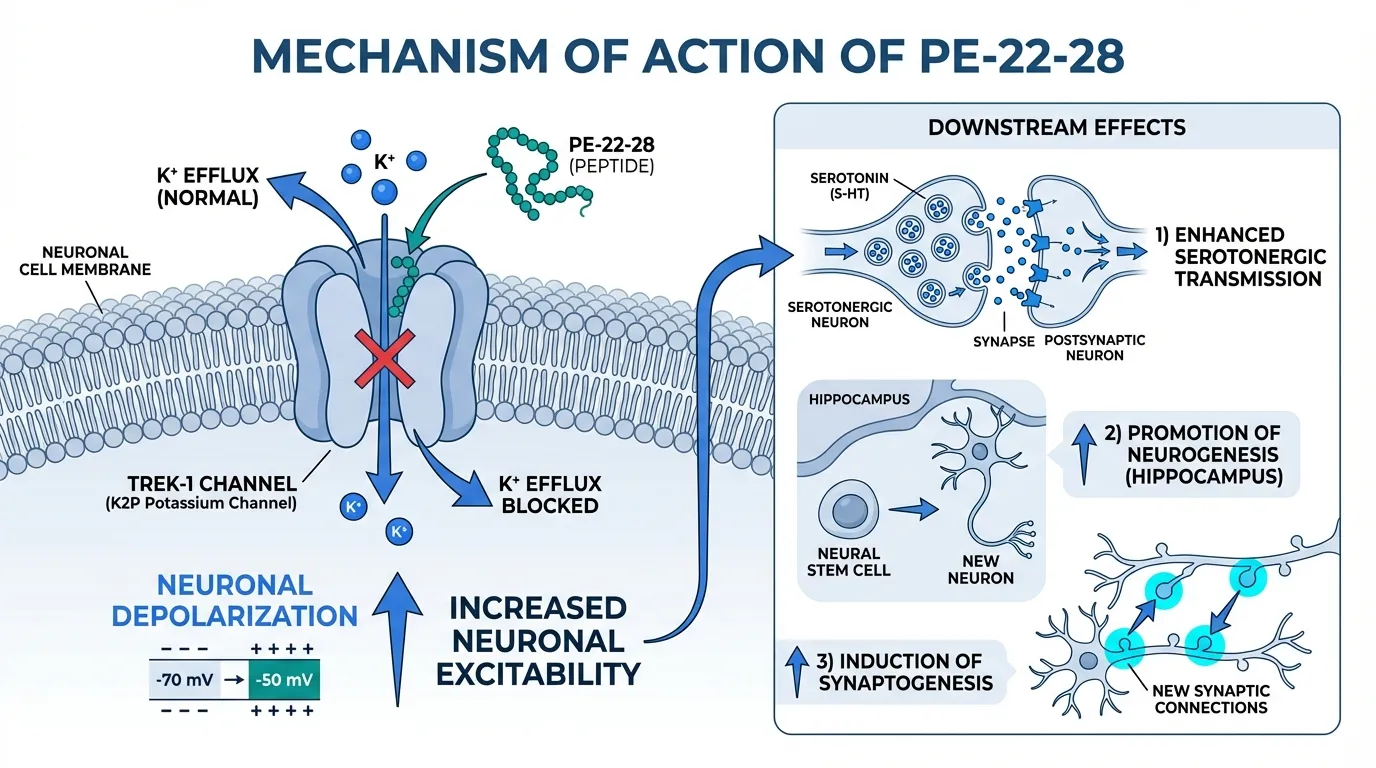
The mechanism centers on TREK-1, a two-pore domain potassium (K2P) channel widely expressed in the central nervous system. TREK-1 channels are "leak" channels that maintain resting membrane potential and regulate neuronal excitability. By blocking TREK-1, PE-22-28:
- Increases neuronal excitability: Reduces potassium efflux, depolarizing neurons toward firing threshold
- Enhances serotonergic transmission: TREK-1 is expressed on serotonergic neurons in the dorsal raphe nucleus; its blockade increases serotonin release
- Promotes neurogenesis: TREK-1 knockout mice show increased hippocampal neurogenesis, and PE-22-28 recapitulates this effect pharmacologically within 4 days of treatment
- Induces synaptogenesis: TREK-1 blockade promotes dendritic growth and synaptic connection formation
PE-22-28 inhibits TREK-1 with an IC50 of 0.12 nM, making it approximately 300-500 times more potent than spadin. It also has a substantially longer duration of action (approximately 23 hours vs. 7 hours for spadin), attributed to its improved metabolic stability.
Key Mechanistic Differences#
| Feature | Dihexa | PE-22-28 |
|---|---|---|
| Parent compound | Angiotensin IV | Spadin (sortilin-derived) |
| Primary target | HGF/c-Met receptor | TREK-1 K2P channel |
| Target class | Growth factor receptor | Ion channel |
| Primary downstream effect | Synaptogenesis via PI3K/AKT | Neurogenesis via increased neuronal excitability |
| BDNF involvement | Indirect (convergent plasticity pathways) | Indirect (TREK-1 blockade promotes BDNF release) |
| Serotonin effects | Not characterized | Increases serotonergic transmission |
| Novel pathway? | Yes (HGF/c-Met for cognition) | Relatively (TREK-1 for cognition) |
The mechanistic distinction is significant: Dihexa promotes structural synaptic plasticity through growth factor signaling (building new connections), while PE-22-28 modulates functional neuronal properties through ion channel blockade (changing how existing neurons fire). These are complementary rather than competing mechanisms.
Research Evidence Comparison#
Dihexa Evidence#
Dihexa's evidence base rests primarily on publications from the Harding/Wright group at Washington State University:
Cognitive restoration in aged rats. Dihexa restored spatial memory performance in aged rats (24 months) to levels comparable to young rats (4 months) in Morris water maze tasks. The compound was effective when administered orally, demonstrating CNS penetration through oral dosing.
Scopolamine reversal. Dihexa reversed cognitive deficits induced by scopolamine (an anticholinergic agent) in rodent models, suggesting relevance to cholinergic aspects of cognitive impairment.
In vitro synaptogenesis. In hippocampal neuron cultures, Dihexa promoted synapse formation at picomolar concentrations, providing cellular-level evidence for its cognitive mechanism.
Oral bioavailability. Pharmacokinetic studies demonstrated approximately 38% oral bioavailability and blood-brain barrier penetration, unusual for a peptide-based compound and attributable to Dihexa's small size (504.66 Da) and hydrophobic modifications.
The retraction issue. A 2014 publication (McCoy et al., Journal of Pharmacology and Experimental Therapeutics) was retracted due to concerns about data fabrication. While other publications from the group remain intact, the retraction introduces uncertainty about the reliability of some mechanistic claims and demands particular caution in interpreting the overall evidence base.
PE-22-28 Evidence#
PE-22-28's evidence comes primarily from French research groups associated with its development:
TREK-1 pharmacology. PE-22-28 inhibits TREK-1 with an IC50 of 0.12 nM, as determined by electrophysiology in HEK293 cells expressing human TREK-1. This high potency has been independently confirmed and represents a well-characterized pharmacological property.
Antidepressant behavioral effects. In the forced swimming test, PE-22-28 reduced immobility time comparably to the SSRI fluoxetine. In the novelty suppressed feeding test, PE-22-28 reduced latency to feed, an effect that requires chronic antidepressant treatment with SSRIs but occurred after acute PE-22-28 administration.
Rapid neurogenesis. PE-22-28 treatment induced hippocampal neurogenesis after only 4 days, as measured by BrdU incorporation and doublecortin staining. This is substantially faster than the 2-3 weeks typically required for SSRIs to induce neurogenesis.
Duration of action. Behavioral effects of PE-22-28 persisted for approximately 23 hours following a single injection, compared to 7 hours for spadin. This extended duration reflects improved resistance to peptidase degradation.
Limitations. PE-22-28 has not been directly tested in cognitive paradigms such as water maze, novel object recognition, or working memory tasks. Its cognitive potential is inferred from TREK-1 knockout mouse phenotypes (enhanced memory) and from neurogenesis data rather than direct cognitive testing.
Evidence Quality Comparison#
| Parameter | Dihexa | PE-22-28 |
|---|---|---|
| Species tested | Rat | Mouse |
| Cognitive paradigms | Water maze, scopolamine reversal | None directly (antidepressant tests only) |
| Neurogenesis demonstrated | Not directly | Yes (4-day hippocampal neurogenesis) |
| Synaptogenesis demonstrated | Yes (in vitro) | Inferred from TREK-1 KO |
| Oral bioavailability | 38% (characterized) | Not characterized |
| Retracted publications | Yes (1 key paper) | None |
| Independent replication | Limited | Limited |
| Human trials | None | None |
Side Effect and Safety Comparison#
Dihexa Safety Considerations#
The primary safety concern for Dihexa is specific to its mechanism. HGF/c-Met signaling is a well-established oncogenic pathway:
- c-Met is amplified or overexpressed in multiple cancers (gastric, lung, renal, hepatocellular)
- HGF/c-Met activation promotes tumor cell proliferation, survival, invasion, and metastasis
- c-Met inhibitors are FDA-approved cancer drugs (cabozantinib, crizotinib, capmatinib)
A compound that potentiates HGF/c-Met signaling raises theoretical concerns about promoting tumor growth or transformation with chronic use. It is important to note that this concern is entirely theoretical -- no oncological adverse effects have been reported in the limited preclinical studies -- but the biological plausibility is high enough to warrant serious consideration.
Additional safety unknowns include long-term effects on organ systems where HGF/c-Met signaling plays regulatory roles (liver, kidney, cardiovascular system), potential reproductive toxicity, and effects in individuals with pre-existing neoplastic conditions.
PE-22-28 Safety Considerations#
PE-22-28's safety profile is less burdened by mechanism-specific concerns:
- TREK-1 channels are expressed throughout the body (brain, heart, vasculature, gastrointestinal tract), so systemic TREK-1 blockade could theoretically affect cardiovascular function, pain sensation, and gastrointestinal motility. However, TREK-1 knockout mice are viable and generally healthy, suggesting that complete loss of TREK-1 function is tolerated.
- TREK-1 knockout mice show increased seizure susceptibility to kainate and ischemia-induced epileptic events. Whether pharmacological TREK-1 blockade (which is partial and reversible, unlike genetic knockout) carries seizure risk at therapeutic doses is unknown.
- No oncological concerns specific to the TREK-1 blockade mechanism have been identified.
- No chronic toxicity studies have been published.
Safety Comparison Summary#
| Concern | Dihexa | PE-22-28 |
|---|---|---|
| Oncological risk | Theoretical (HGF/c-Met is oncogenic pathway) | Not identified |
| Seizure risk | Not characterized | Theoretical (TREK-1 KO mice show susceptibility) |
| Cardiovascular risk | Not characterized | Theoretical (TREK-1 in cardiac tissue) |
| Chronic toxicity data | None | None |
| Acute toxicity signals | None reported | None reported |
Practical Considerations#
Availability and Formulation#
Both Dihexa and PE-22-28 are available only as research chemicals from peptide suppliers. Neither has a pharmaceutical formulation, standardized purity requirements, or GMP manufacturing standards commonly applied to approved drugs. Quality control and purity verification are entirely the responsibility of the researcher.
Administration Route#
Dihexa has a notable advantage in practical administration: its demonstrated oral bioavailability (approximately 38%) means it can be taken by mouth with meaningful CNS exposure. This is unusual for peptides, which are typically degraded in the gastrointestinal tract. Dihexa's oral activity is attributed to its small size, modified N-terminus (hexanoic acid cap), and hydrophobic character.
PE-22-28's in vivo studies have used intraperitoneal injection. Oral bioavailability has not been characterized, and the compound's heptapeptide structure (773.89 Da) makes oral activity less likely than for the smaller Dihexa (504.66 Da), though not impossible given its modified sequence.
Stability and Handling#
Dihexa is relatively stable due to its non-natural modifications (N-hexanoic acid cap, aminohexanoic amide C-terminus), which protect it from typical peptidase degradation.
PE-22-28 was specifically designed for improved stability over spadin, with a duration of action of approximately 23 hours compared to spadin's 7 hours. However, detailed stability data under various storage conditions has not been published for either compound.
Key Differences Summary#
- Target pathway: Dihexa activates a growth factor receptor (HGF/c-Met); PE-22-28 blocks an ion channel (TREK-1)
- Primary effect: Dihexa promotes synaptogenesis (structural connectivity); PE-22-28 promotes neurogenesis and neuronal excitability (functional changes)
- Cognitive data: Dihexa has been directly tested in cognitive paradigms; PE-22-28's cognitive potential is inferred from antidepressant tests and TREK-1 KO phenotypes
- Oral bioavailability: Dihexa demonstrates 38% oral bioavailability; PE-22-28 is uncharacterized orally
- Safety concerns: Dihexa raises oncological concerns via HGF/c-Met; PE-22-28 raises seizure threshold concerns via TREK-1 blockade
- Evidence integrity: Dihexa has a retracted key publication; PE-22-28 does not
- Mood effects: PE-22-28 has demonstrated antidepressant effects; Dihexa has not been tested in mood paradigms
Conclusion#
Dihexa and PE-22-28 both represent genuinely novel approaches to nootropic pharmacology, targeting pathways (HGF/c-Met and TREK-1, respectively) that are largely unexplored in cognitive enhancement research. Their mechanisms are complementary rather than competitive, addressing different aspects of neural plasticity: Dihexa promotes the structural formation of new synaptic connections, while PE-22-28 enhances neuronal excitability and drives neurogenesis.
The critical context for both compounds is their preclinical status. Neither has been tested in humans, and both carry significant unknowns -- Dihexa with its retracted publication and oncological pathway concerns, PE-22-28 with its untested cognitive effects and potential seizure susceptibility. These are not compounds with established safety or efficacy profiles; they are research tools that have generated interesting preclinical data.
For researchers evaluating these compounds, Dihexa offers more direct cognitive enhancement data and the practical advantage of oral bioavailability, but at the cost of greater mechanistic safety concerns and a compromised publication record. PE-22-28 offers a cleaner evidence base and a well-characterized pharmacological target, but its cognitive effects remain inferential rather than directly demonstrated.
Both compounds would benefit significantly from independent replication, chronic safety studies, and -- if warranted by safety data -- carefully designed early human studies. Until such data exists, conclusions about their relative cognitive enhancement potential in humans remain speculative.
For context on how these next-generation nootropics compare to established compounds, see our guides on best nootropic peptides and Selank vs Semax. For information on combining cognitive peptides, see our guide on nootropic peptide stacking.
Further Reading#

Which Is Better For...
Cognitive Enhancement Research
Dihexa
Dihexa has been directly tested in cognitive paradigms (aged rat water maze, scopolamine reversal) and demonstrates synaptogenesis through HGF/c-Met signaling, providing a more direct cognitive enhancement rationale than PE-22-28
Neurogenesis and Mood Research
PE-22-28
PE-22-28 induces hippocampal neurogenesis within 4 days and demonstrates antidepressant-like effects through TREK-1 blockade, making it more relevant for mood-cognition intersection research
Oral Bioavailability Requirement
Dihexa
Dihexa has demonstrated approximately 38% oral bioavailability with BBB penetration, while PE-22-28 oral availability has not been characterized
Lower Theoretical Risk Profile
PE-22-28
PE-22-28 targets an ion channel without known oncological associations, whereas Dihexa activates the HGF/c-Met pathway which is a characterized oncogenic signaling axis
Evidence Reliability
PE-22-28
PE-22-28 has no retracted publications in its evidence base, while a key 2014 Dihexa paper was retracted for data fabrication concerns
Continue Your Research
Get comparison updates
We publish new head-to-head comparisons regularly. Subscribe to see them first.
Frequently Asked Questions About Dihexa vs PE-22-28: Next-Generation Nootropic Peptides Compared
Which is better, Dihexa or PE-22-28?
Both Dihexa and PE-22-28 are preclinical nootropic peptides with no human data, making any clinical recommendation premature. Dihexa has a more directly characterized cognitive enhancement profile and favorable oral bioavailability, but carries the burden of a retracted key publication and theoretical oncological concerns from HGF/c-Met activation. PE-22-28 has a cleaner evidence record and a well-characterized ion channel target, but its cognitive effects are less directly studied than its a... Individual responses may vary, and this comparison is based on available research data, not a treatment recommendation.
What are the key differences between Dihexa and PE-22-28?
The main differences across comparison categories are: Mechanism of Action: advantage goes to Dihexa; Research Evidence: advantage goes to neither (tie); Side Effect Profile: advantage goes to PE-22-28. 2 additional categories are analyzed in the full comparison. Each category evaluates a different dimension of the two peptides.
When should I consider Dihexa over PE-22-28?
For the scenario of "Cognitive Enhancement Research," research data suggests Dihexa may be more relevant. Dihexa has been directly tested in cognitive paradigms (aged rat water maze, scopolamine reversal) and demonstrates synaptogenesis through HGF/c-Met signaling, providing a more direct cognitive enh.... This is based on currently available evidence and individual circumstances may differ.
How do Dihexa and PE-22-28 differ in their mechanisms of action?
Dihexa: Dihexa is derived from angiotensin IV and acts by binding hepatocyte growth factor (HGF) with high affinity, potentiating HGF/c-Met receptor signaling at subthreshold concentrations. This promotes .... PE-22-28: PE-22-28 is a synthetic 7-amino acid peptide derived from spadin that selectively blocks TREK-1 two-pore domain potassium channels with an IC50 of 0.12 nM. TREK-1 blockade increases neuronal excita....
Which has fewer side effects, Dihexa or PE-22-28?
In terms of side effects and tolerability, the advantage goes to PE-22-28. Dihexa: Dihexa has limited safety data. The primary theoretical concern is its mechanism: HGF/c-Met is a known oncogenic signaling pathway, and long-term a.... PE-22-28: PE-22-28 has limited safety data from preclinical studies. No obvious toxicity has been reported in rodent studies at effective doses. TREK-1 chann....
Medical Disclaimer
This website is for educational and informational purposes only. The information provided is not intended to diagnose, treat, cure, or prevent any disease. Always consult with a qualified healthcare professional before using any peptide or supplement.