KPV vs LL-37: Immune Peptides Compared
KPV vs LL-37 compared — anti-inflammatory tripeptide versus antimicrobial cathelicidin for immune defense and gut health research.
Verdict at a Glance
LL-37 has a broader and more developed research base as the only human cathelicidin antimicrobial peptide, with direct pathogen-killing capabilities and extensive mechanistic data across multiple therapeutic areas. KPV occupies a narrower niche as a gut-focused anti-inflammatory tripeptide with promising preclinical data but no human evidence. For antimicrobial and innate immunity research, LL-37 is the established compound. For gut inflammation research specifically targeting NF-kappaB-mediated pathways, KPV offers a simpler, potentially orally bioavailable approach — but one that remains entirely preclinical.
| Best for | Pick | Why |
|---|---|---|
| Antimicrobial and anti-biofilm research | LL-37 | Only human cathelicidin with direct broad-spectrum antimicrobial activity against bacteria, fungi, viruses, and biofilms |
| Gut inflammation and colitis models | KPV | Demonstrated efficacy in DSS and TNBS colitis models with oral bioavailability via PepT1 transporter |
| Wound healing research | LL-37 | Promotes epithelial repair through EGFR transactivation, angiogenesis, and immune cell recruitment to wound sites |
| Simple anti-inflammatory peptide screening | KPV | Tripeptide structure makes it inexpensive to synthesize and straightforward to study as an NF-kappaB pathway inhibitor |
| Category | KPV | LL-37 | Advantage |
|---|---|---|---|
| Mechanism of Action | Anti-inflammatory tripeptide derived from the C-terminal of alpha-MSH; inhibits NF-kappaB nuclear translocation in a dose-dependent manner; suppresses pro-inflammatory cytokines IL-8, TNF-alpha, and IL-1beta | Cationic antimicrobial peptide that directly disrupts pathogen membranes through electrostatic interactions; activates multiple receptors (FPR2, CXCR2, P2X7, EGFR) for immune signaling, chemotaxis, and wound healing | Comparable |
| Research Evidence | Entirely preclinical; efficacy demonstrated in DSS and TNBS murine colitis models; in vitro NF-kappaB inhibition data in intestinal cell lines; no human clinical trials conducted or registered | Extensive in vitro and preclinical data on antimicrobial activity, biofilm disruption, and wound healing; limited human clinical trials for topical applications; no regulatory approvals but broader research base | LL-37 |
| Side Effect Profile | No human safety data available; theoretical risk of immunosuppression through broad NF-kappaB inhibition; preclinical studies report no significant toxicity in murine models | Limited human safety data; potential mast cell activation and histamine release via MRGPRX2; concentration-dependent cytotoxicity to host cells; implicated in psoriasis pathogenesis through TLR9 activation | Comparable |
| Dosing and Administration | No standardized human dosing; tripeptide structure allows oral administration via PepT1 transporter uptake in intestinal epithelial cells; simple and inexpensive to synthesize | No standardized human dosing; 37-amino acid peptide susceptible to proteolytic degradation limiting systemic use; topical and localized delivery routes explored; expensive to manufacture | KPV |
| Scope of Application | Focused primarily on gut mucosal inflammation and inflammatory bowel disease models; anti-inflammatory mechanism may have broader applications but evidence is limited to gut-specific research | Broad-spectrum applications spanning antimicrobial defense, wound healing, biofilm disruption, immune cell recruitment, and endotoxin neutralization; relevant to infectious disease, dermatology, and immunology research | LL-37 |

Introduction#
KPV and LL-37 are both classified as immune peptides, but they approach immune function from opposite directions. LL-37 is the body's primary antimicrobial weapon — a 37-amino-acid peptide that directly kills pathogens and activates inflammatory immune responses. KPV is an anti-inflammatory tripeptide that suppresses the NF-kappaB signaling cascade, dampening the same inflammatory responses that LL-37 can promote.
This fundamental difference — antimicrobial activation versus anti-inflammatory suppression — means these peptides are rarely competing for the same research applications. Understanding when each is appropriate requires clarifying their distinct mechanisms, evidence bases, and research contexts.
Quick Comparison#
| Feature | KPV | LL-37 |
|---|---|---|
| Structure | 3 amino acids (Lys-Pro-Val) | 37 amino acids, alpha-helical |
| Class | Alpha-MSH-derived tripeptide | Cathelicidin antimicrobial peptide |
| Primary action | Anti-inflammatory | Antimicrobial + immunomodulatory |
| Direct pathogen killing | No | Yes (broad-spectrum) |
| NF-kappaB effect | Inhibits | Complex (context-dependent) |
| Oral bioavailability | Possible (PepT1 transport) | No (proteolytic degradation) |
| Clinical trials | None | Limited |
| Key research area | Gut inflammation, IBD models | Infections, biofilms, wound healing |
| Molecular weight | ~342 Da | ~4.5 kDa |
| Synthesis cost | Low (tripeptide) | High (37 residues) |
Mechanism of Action Comparison#
KPV#
KPV is derived from the C-terminal three amino acids of alpha-melanocyte-stimulating hormone (alpha-MSH), a 13-amino-acid neuropeptide with well-characterized anti-inflammatory properties. Despite being only three amino acids, KPV retains — and in some experimental systems exceeds — the anti-inflammatory activity of the parent peptide.
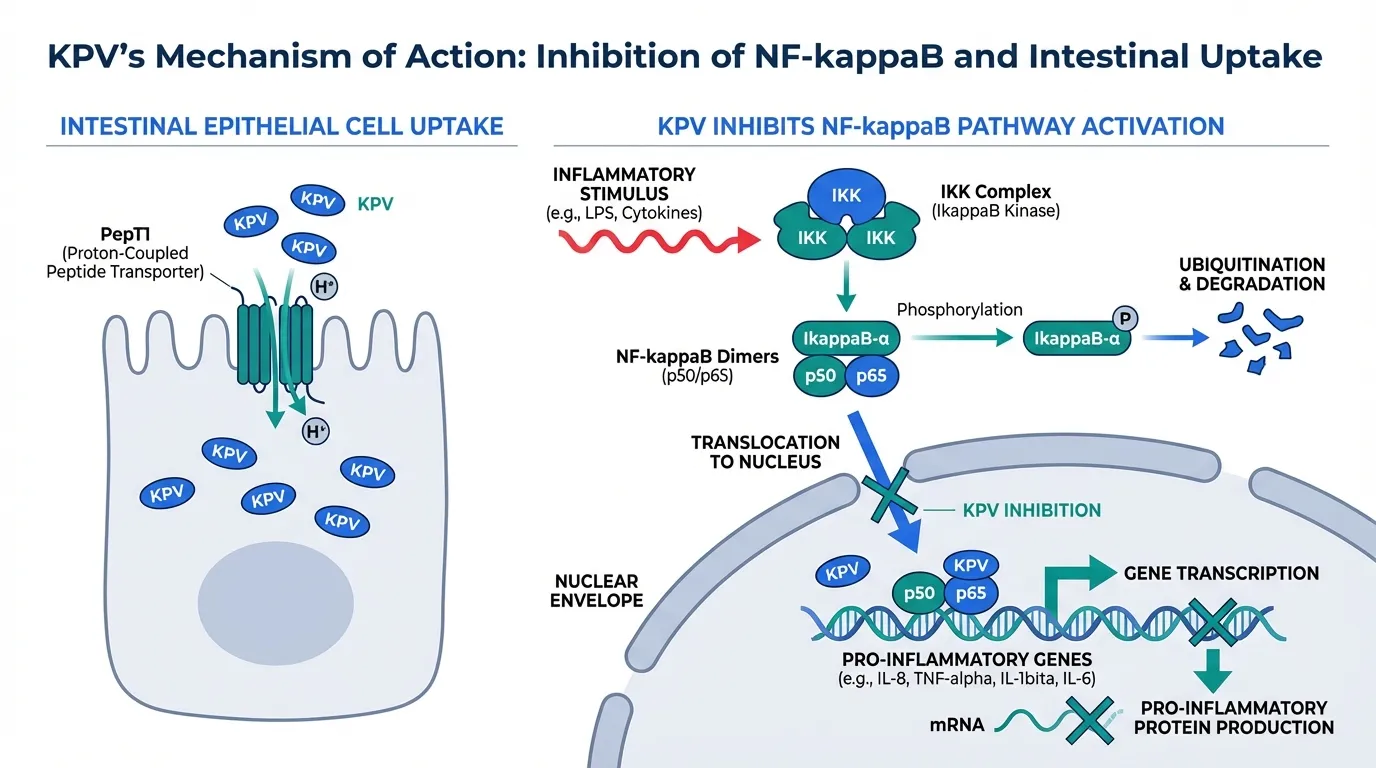
NF-kappaB pathway inhibition: KPV's central mechanism is suppression of NF-kappaB nuclear translocation. When inflammatory stimuli activate the IKK complex, IkappaB-alpha is phosphorylated and degraded, freeing NF-kappaB dimers to enter the nucleus and drive inflammatory gene expression. KPV interferes with this pathway, reducing the transcription of pro-inflammatory cytokines, chemokines, and adhesion molecules.
Downstream effects: By inhibiting NF-kappaB, KPV suppresses the production of IL-8 (neutrophil recruitment), TNF-alpha (systemic inflammation), IL-1beta (inflammasome-mediated inflammation), and IL-6 (acute phase responses). This broad suppression of inflammatory mediators is responsible for KPV's efficacy in colitis models.
PepT1 transporter uptake: KPV is absorbed by the PepT1 proton-coupled peptide transporter expressed on the apical surface of intestinal epithelial cells. This provides a mechanism for oral delivery and direct uptake by the intestinal epithelium — a property that makes KPV uniquely suited to gut-targeted applications among immune peptides.
LL-37#
LL-37 is the only human cathelicidin, produced by neutrophils, macrophages, and epithelial cells as part of the innate immune response to infection. Its mechanism is markedly more complex than KPV's, engaging multiple receptor systems and effector pathways simultaneously.
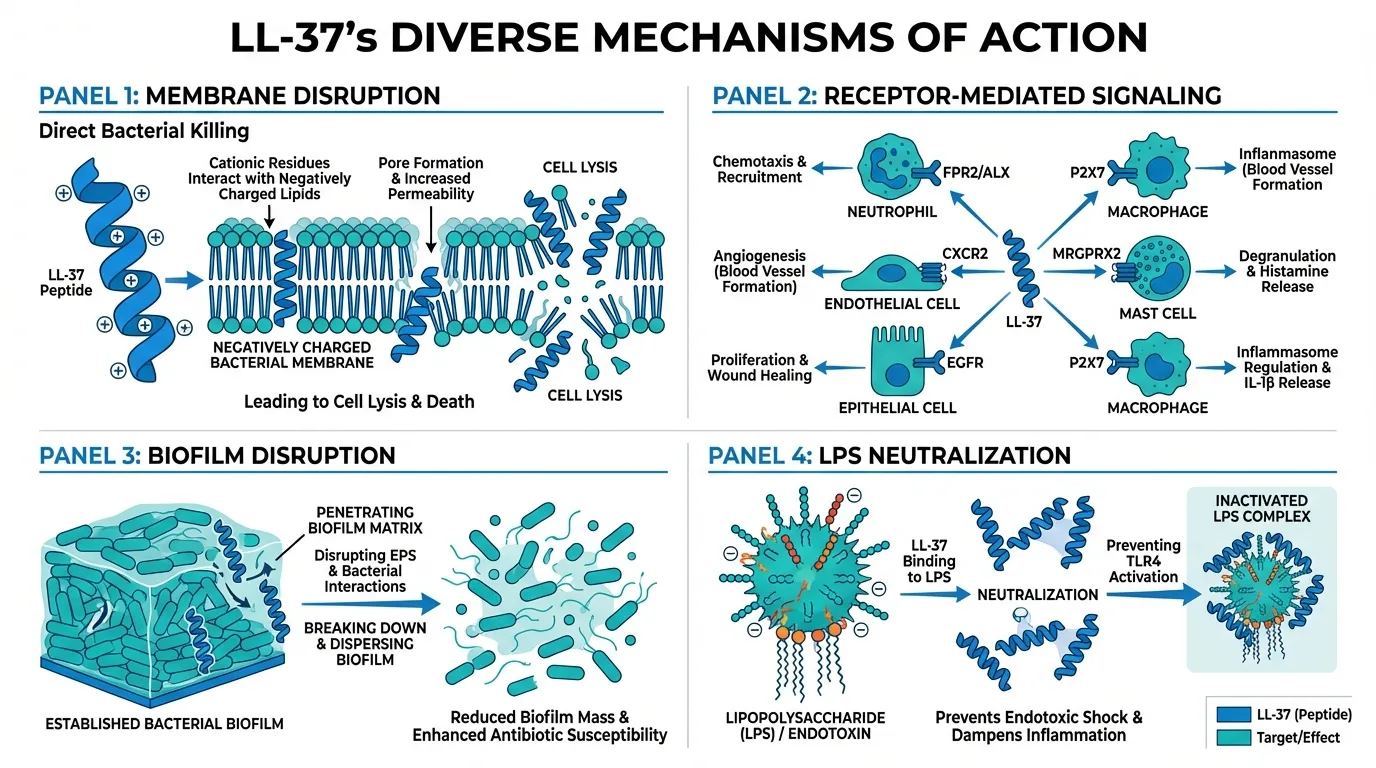
Membrane disruption: LL-37's cationic residues interact electrostatically with negatively charged microbial membrane components. This interaction disrupts membrane integrity, producing rapid bactericidal activity against gram-positive and gram-negative bacteria, fungi, and enveloped viruses. Bacterial resistance develops slowly because the target — fundamental membrane architecture — is difficult to modify.
Receptor-mediated signaling: LL-37 activates FPR2/ALX (neutrophil chemotaxis), CXCR2 (angiogenesis), P2X7 (inflammasome regulation), MRGPRX2 (mast cell degranulation), and EGFR (epithelial proliferation via ADAM17 transactivation). This breadth of signaling makes LL-37 a coordinator of the innate immune response, linking pathogen detection to inflammation, tissue repair, and adaptive immune priming.
Biofilm disruption: LL-37 disrupts bacterial biofilm formation at sub-bactericidal concentrations and penetrates established biofilms. This property is clinically significant because biofilm-associated infections are notoriously resistant to conventional antibiotics.
LPS neutralization: LL-37 binds and neutralizes lipopolysaccharide (endotoxin), reducing the inflammatory cascade triggered by gram-negative bacterial infections.
Evidence Comparison#
KPV Research#
KPV's evidence is entirely preclinical:
- DSS colitis model — Oral KPV reduced colitis severity in the dextran sodium sulfate mouse model, with improvements in weight loss, colon shortening, histological scores, and inflammatory cytokine levels
- TNBS colitis model — Efficacy also demonstrated in this Th1-driven colitis model, suggesting activity across different inflammatory mechanisms
- In vitro NF-kappaB studies — Dose-dependent suppression of NF-kappaB activation in human intestinal epithelial cell lines (Caco-2, HT-29)
- PepT1 transport studies — Confirmed uptake of KPV through PepT1 in intestinal epithelial cells
- Comparison with alpha-MSH — Some studies report stronger anti-inflammatory effects for KPV than for full-length alpha-MSH
No human clinical trials have been conducted. No IND applications or clinical trial registrations exist for KPV.
LL-37 Research#
LL-37 has a substantially larger research base:
- Antimicrobial activity — Demonstrated broad-spectrum activity against MRSA, Pseudomonas aeruginosa, Candida species, drug-resistant organisms, and enveloped viruses in vitro
- Anti-biofilm studies — Effective against biofilm-forming bacteria at sub-MIC concentrations in multiple in vitro systems
- Wound healing — Preclinical evidence for accelerated wound closure through EGFR transactivation and angiogenesis promotion
- Immunology — Extensive literature on innate immune signaling, inflammasome regulation, and immune cell recruitment
- Dermatology — Well-characterized role in psoriasis pathogenesis through LL-37-DNA complex activation of TLR9 in plasmacytoid dendritic cells
- Clinical trials — Limited but existent; topical LL-37 has been explored for wound healing and anti-infective applications
The evidence gap between these peptides is significant. LL-37 has thousands of published studies spanning multiple research areas, while KPV's literature is concentrated in gut inflammation models from a relatively small number of research groups.
Side Effects and Safety#
KPV Safety Profile#
There is no human safety data for KPV. Preclinical observations include:
- No significant toxicity reported in murine colitis studies at effective doses
- Theoretical risk of broad immunosuppression through NF-kappaB inhibition, which could impair host defense
- Unknown long-term effects on gut mucosal immunity
- No data on drug interactions, contraindications, or effects in special populations
The absence of safety data is a fundamental limitation that cannot be resolved without clinical trials.
LL-37 Safety Profile#
Limited human safety data exists:
- Mast cell activation — LL-37 activates MRGPRX2 on mast cells, potentially causing histamine release, flushing, and allergic-type reactions
- Concentration-dependent cytotoxicity — At higher concentrations, LL-37 can damage host cell membranes in addition to pathogen membranes
- Autoimmune implications — LL-37-nucleic acid complexes activate TLR7/8/9, which has been implicated in psoriasis and lupus pathogenesis
- Pro-inflammatory potential — At certain concentrations, LL-37 may exacerbate rather than resolve inflammation
- Topical applications — Generally better tolerated than systemic administration
Neither peptide has sufficient human safety data to make definitive safety comparisons. The safety profiles described are based largely on mechanistic predictions and preclinical observations.
Dosing and Practical Considerations#
KPV#
| Parameter | Details |
|---|---|
| Route | Oral administration demonstrated in preclinical models |
| Standardized dosing | None established for humans |
| Oral uptake | PepT1-mediated transport in intestinal epithelium |
| Synthesis | Simple, inexpensive (tripeptide) |
| Stability | Relatively stable for a peptide due to small size |
| Storage | Standard peptide storage conditions |
LL-37#
| Parameter | Details |
|---|---|
| Route | Topical, injectable, inhaled (research only) |
| Standardized dosing | None established for humans |
| Oral uptake | Not viable (proteolytic degradation) |
| Synthesis | Expensive (37-amino-acid solid-phase synthesis) |
| Stability | Susceptible to proteolytic degradation |
| Storage | Requires careful handling; protease-free conditions |
KPV has a practical advantage in simplicity: it is cheaper to produce, potentially orally bioavailable, and more stable than LL-37. However, these practical advantages are irrelevant without clinical validation of efficacy and safety.
Use Case Recommendations#
Choose KPV When:#
- Gut mucosal inflammation is the specific research target
- NF-kappaB pathway inhibition is the mechanistic focus
- Oral peptide delivery to intestinal epithelium is being studied
- Anti-inflammatory screening requires a simple, inexpensive peptide
- The researcher accepts entirely preclinical evidence limitations
Choose LL-37 When:#
- Direct antimicrobial activity against bacteria, fungi, or viruses is needed
- Biofilm disruption research requires a host defense peptide
- Innate immune signaling mechanisms are being investigated
- Wound healing biology and epithelial repair are the focus
- A peptide with existing (if limited) clinical trial experience is preferred
Can They Be Combined?#
KPV and LL-37 have complementary mechanisms: LL-37 kills pathogens and activates immune responses, while KPV suppresses the excessive inflammation that can result from immune activation. Theoretically, combining an antimicrobial peptide with an anti-inflammatory agent could provide pathogen clearance without collateral inflammatory tissue damage.
This concept has not been tested experimentally. Key questions include whether KPV's NF-kappaB inhibition would dampen LL-37's beneficial immune signaling, whether the combination would impair pathogen clearance, and what the optimal dosing ratios would be. Given the absence of even single-agent human data for KPV, combination studies are premature.
For researchers interested in established immune peptide combinations, Thymosin Alpha-1 offers a clinically validated adaptive immune approach that could complement either of these innate immune peptides. See the LL-37 vs Thymosin Alpha-1 comparison for more context.
Verdict#
LL-37 has the stronger overall research profile, with extensive mechanistic data, broad-spectrum antimicrobial activity, and limited clinical trial experience. It addresses a wider range of research questions spanning infectious disease, wound healing, and immunology. KPV is a more focused compound with compelling preclinical data for gut inflammation but no human evidence whatsoever.
These peptides are best understood as addressing different problems rather than competing for the same niche. LL-37 targets pathogens and activates immune defense; KPV suppresses inflammatory tissue damage. The appropriate choice depends entirely on whether the research question concerns antimicrobial activity or anti-inflammatory modulation.
For additional immune peptide comparisons, see LL-37 vs Thymosin Alpha-1 and Thymalin vs Thymosin Alpha-1, or browse our top immune-boosting peptides guide.
Further Reading#

Which Is Better For...
Antimicrobial and anti-biofilm research
LL-37
Only human cathelicidin with direct broad-spectrum antimicrobial activity against bacteria, fungi, viruses, and biofilms
Gut inflammation and colitis models
KPV
Demonstrated efficacy in DSS and TNBS colitis models with oral bioavailability via PepT1 transporter
Wound healing research
LL-37
Promotes epithelial repair through EGFR transactivation, angiogenesis, and immune cell recruitment to wound sites
Simple anti-inflammatory peptide screening
KPV
Tripeptide structure makes it inexpensive to synthesize and straightforward to study as an NF-kappaB pathway inhibitor
Continue Your Research
Get comparison updates
We publish new head-to-head comparisons regularly. Subscribe to see them first.
Frequently Asked Questions About KPV vs LL-37: Immune Peptides Compared
Which is better, KPV or LL-37?
LL-37 has a broader and more developed research base as the only human cathelicidin antimicrobial peptide, with direct pathogen-killing capabilities and extensive mechanistic data across multiple therapeutic areas. KPV occupies a narrower niche as a gut-focused anti-inflammatory tripeptide with promising preclinical data but no human evidence. For antimicrobial and innate immunity research, LL-37 is the established compound. For gut inflammation research specifically targeting NF-kappaB-media... Individual responses may vary, and this comparison is based on available research data, not a treatment recommendation.
What are the key differences between KPV and LL-37?
The main differences across comparison categories are: Mechanism of Action: advantage goes to neither (tie); Research Evidence: advantage goes to LL-37; Side Effect Profile: advantage goes to neither (tie). 2 additional categories are analyzed in the full comparison. Each category evaluates a different dimension of the two peptides.
When should I consider LL-37 over KPV?
For the scenario of "Antimicrobial and anti-biofilm research," research data suggests LL-37 may be more relevant. Only human cathelicidin with direct broad-spectrum antimicrobial activity against bacteria, fungi, viruses, and biofilms. This is based on currently available evidence and individual circumstances may differ.
How do KPV and LL-37 differ in their mechanisms of action?
KPV: Anti-inflammatory tripeptide derived from the C-terminal of alpha-MSH; inhibits NF-kappaB nuclear translocation in a dose-dependent manner; suppresses pro-inflammatory cytokines IL-8, TNF-alpha, an.... LL-37: Cationic antimicrobial peptide that directly disrupts pathogen membranes through electrostatic interactions; activates multiple receptors (FPR2, CXCR2, P2X7, EGFR) for immune signaling, chemotaxis,....
Which has fewer side effects, KPV or LL-37?
In terms of side effects and tolerability, the advantage goes to neither (comparable). KPV: No human safety data available; theoretical risk of immunosuppression through broad NF-kappaB inhibition; preclinical studies report no significant.... LL-37: Limited human safety data; potential mast cell activation and histamine release via MRGPRX2; concentration-dependent cytotoxicity to host cells; im....
Medical Disclaimer
This website is for educational and informational purposes only. The information provided is not intended to diagnose, treat, cure, or prevent any disease. Always consult with a qualified healthcare professional before using any peptide or supplement.