Thymalin vs Thymosin Alpha-1: Thymic Immune Peptides Compared
Thymalin vs Thymosin Alpha-1 compared: thymic peptide composition, clinical evidence, longevity research, and dosing differences.
Verdict at a Glance
Thymosin Alpha-1 has substantially stronger evidence by international standards, with regulatory approval in 35+ countries, well-characterized molecular identity, and a defined mechanism of action. Thymalin occupies a unique position in the bioregulatory peptide tradition with intriguing longevity data from Russian clinical studies, particularly the long-term Khavinson trials showing reduced mortality in elderly populations. For clinical immune modulation with broad regulatory acceptance, Thymosin Alpha-1 is the evidence-based choice. For longevity research within the bioregulatory peptide framework, Thymalin offers data not available for any other thymic peptide.
| Best for | Pick | Why |
|---|---|---|
| Clinical immune enhancement with international evidence | Thymosin Alpha-1 | Approved in 35+ countries with extensive controlled trial data and standardized synthetic production |
| Longevity and anti-aging research | Thymalin | Unique long-term human studies showing reduced mortality and immune restoration in elderly subjects over 6-15 year follow-up periods |
| Hepatitis B treatment or vaccine adjuvant | Thymosin Alpha-1 | Approved indication with Phase 3 evidence and well-established treatment protocols |
| Neuroendocrine-immune axis research | Thymalin | Studied for pineal-thymic axis interactions alongside epitalon with documented effects on melatonin secretion and circadian function |
| Category | Thymalin | Thymosin Alpha-1 | Advantage |
|---|---|---|---|
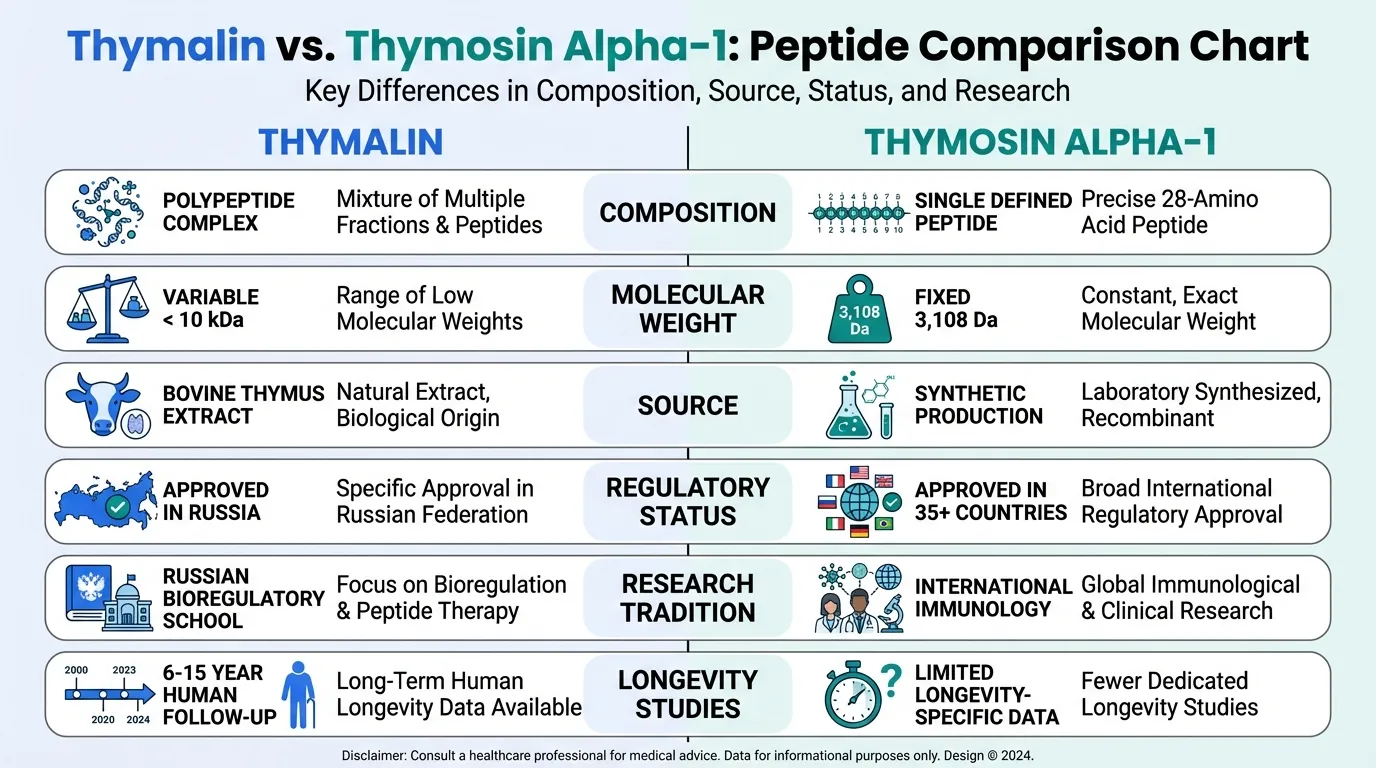
| Composition and Identity | Polypeptide complex extracted from bovine thymus containing multiple bioactive peptide fractions; active components include dipeptides EW (thymogen) and KE (vilon); not a single defined molecule | Single defined 28-amino acid peptide with known sequence and molecular weight (3108 Da); N-terminally acetylated; fully synthetic production possible | Thymosin Alpha-1 |
| Research Evidence | Approved in Russia with clinical studies primarily from Russian and CIS literature; long-term human longevity data from Khavinson studies; limited international peer-reviewed trials | Approved in 35+ countries with extensive international clinical trial data; over 4,400 patients in controlled trials; published in major Western journals | Thymosin Alpha-1 |
| Side Effect Profile | Generally well-tolerated in Russian clinical experience; animal-derived product carries theoretical immunogenicity risk; limited formal safety reporting by Western standards | Well-established safety profile from international clinical trials; mild injection site reactions; no significant immunotoxicity reported across decades of use | Thymosin Alpha-1 |
| Anti-Aging Research | Unique longevity data from 6-year and 15-year Khavinson studies showing reduced mortality in elderly subjects treated with thymalin plus epitalon; pineal-thymic axis research | Investigated for age-related immune decline and vaccine response enhancement in elderly; limited longevity-specific study data | Thymalin |
| Mechanism of Action | Multiple thymic peptide fractions acting on T-cell maturation, immune parameter restoration, and neuroendocrine-immune axis; mechanism attributed to collective peptide activity | Well-characterized TLR2/TLR9 activation on dendritic cells; promotes T-cell maturation through defined molecular pathways; Th1 immune polarization | Thymosin Alpha-1 |

Introduction#
Thymalin and Thymosin Alpha-1 both originate from the thymus gland and share the goal of restoring immune function, but they come from different research traditions and carry very different levels of molecular characterization and clinical validation. Thymosin Alpha-1 is a defined 28-amino acid peptide with international regulatory approval, while Thymalin is a polypeptide complex containing multiple thymic fractions, developed within the Russian bioregulatory peptide paradigm.
This comparison examines the evidence, mechanisms, and practical differences between these two thymic immune peptides, including their distinct strengths in clinical immunology and longevity research.
Quick Comparison#
| Feature | Thymalin | Thymosin Alpha-1 |
|---|---|---|
| Composition | Polypeptide complex (multiple fractions) | Single defined 28-amino acid peptide |
| Molecular Weight | Variable (< 10 kDa fractions) | 3,108 Da |
| Source | Bovine thymus extract | Synthetic (originally from thymic tissue) |
| Known Components | EW (thymogen), KE (vilon) dipeptides | Fully characterized sequence |
| Regulatory Status | Approved in Russia | Approved in 35+ countries |
| Brand Name | Thymalin | Zadaxin |
| Research Tradition | Russian bioregulatory peptide school | International immunology |
| Longevity Studies | 6-15 year human follow-up data | Limited longevity-specific data |
| Administration | Intramuscular injection | Subcutaneous injection |
Mechanism of Action Comparison#
Thymalin#
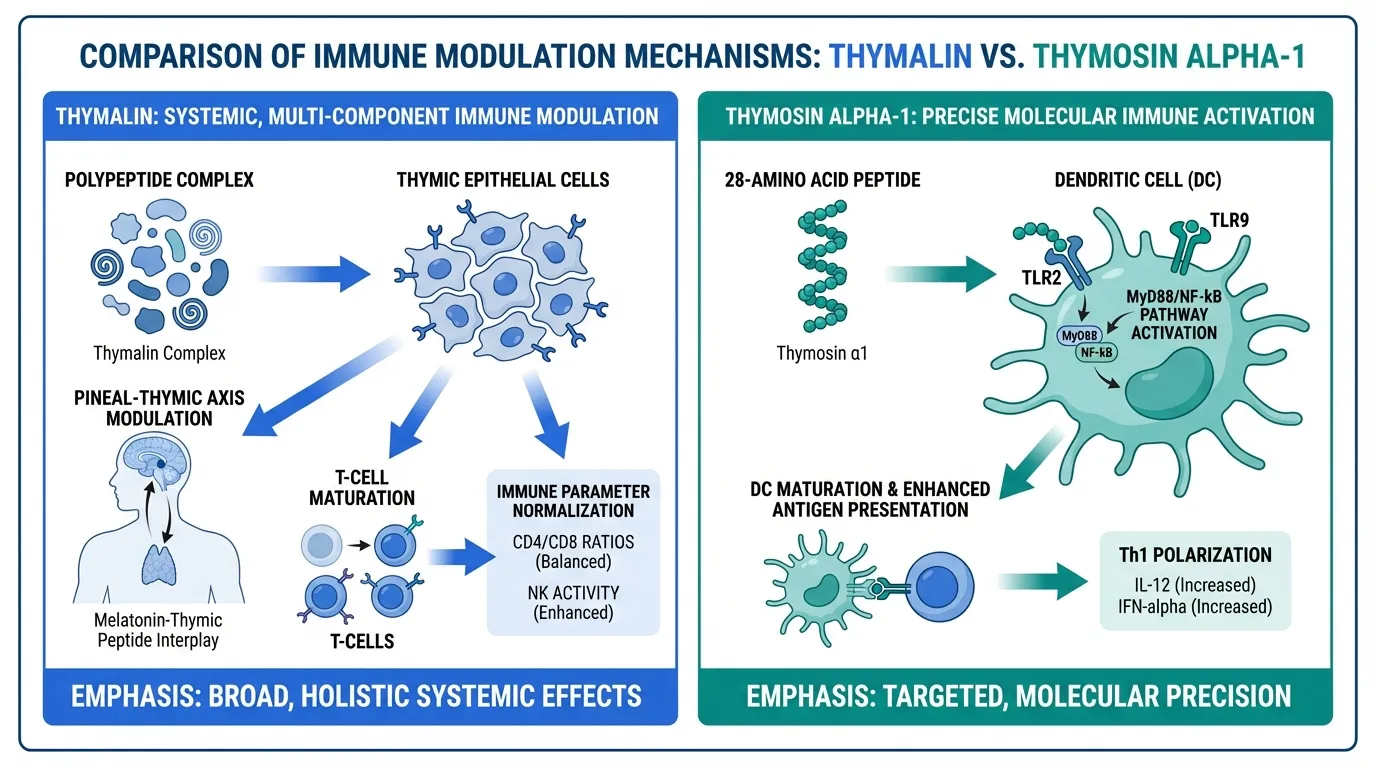
Thymalin is not a single molecular entity but a polypeptide complex extracted from bovine thymus through acid hydrolysis and ultrafiltration. Its biological activity is attributed to the collective effects of multiple low-molecular-weight peptide fractions, with the most studied active components being the dipeptides glutamyl-tryptophan (EW, marketed separately as thymogen) and lysyl-glutamyl (KE, known as vilon).
The proposed mechanisms of action include:
- T-cell maturation: Interaction with thymic epithelial cells to support thymocyte selection and maturation, including upregulation of MHC molecules and enhanced output of mature naive T-cells
- Immune parameter normalization: Restoration of CD4/CD8 T-cell ratios, normalization of total T-lymphocyte counts, improvement of NK cell activity, and modulation of cytokine balance toward balanced Th1/Th2 responses
- Neuroendocrine-immune axis: Modulation of pineal function and melatonin secretion through the pineal-thymic axis, connecting immune restoration with circadian and hormonal regulation
- Gene expression: Within the Khavinson bioregulatory framework, short peptides are proposed to interact with specific DNA sequences to regulate gene expression, though the molecular details of this mechanism remain debated
The mechanism is described as immunomodulatory rather than immunostimulatory, tending to normalize aberrant parameters rather than indiscriminately boosting immune responses.
Thymosin Alpha-1#
Thymosin Alpha-1 has a more precisely characterized molecular mechanism:
- TLR signaling: Activates TLR9 and TLR2 on dendritic cells, engaging MyD88-dependent signaling cascades leading to NF-kB translocation and upregulation of IL-12, IFN-alpha, and TNF-alpha
- Dendritic cell maturation: Promotes maturation of both myeloid and plasmacytoid DCs with upregulation of CD80, CD86, and MHC class II, enhancing antigen presentation
- T-cell effects: Promotes thymocyte maturation through CD3/CD4/CD8/TCR upregulation; enhances IL-2 receptor expression and T-cell proliferation; supports NK cell expansion
- Th1 polarization: Drives Th1-biased cellular immunity through IL-12-mediated pathways, relevant for antiviral and anti-tumor responses
The key mechanistic advantage of Ta1 is that its pathway from receptor engagement to transcriptional output has been mapped at the molecular level, whereas Thymalin's effects are characterized at the cellular and systemic levels with less molecular resolution.
Evidence and Research Comparison#
Thymalin Research#
Thymalin's evidence base is concentrated in Russian and CIS-country publications:
- Immune restoration in elderly: Clinical studies demonstrating normalization of T-cell counts, NK cell activity, and cytokine profiles in elderly subjects after short courses of thymalin administration
- Longevity studies (Khavinson): The most distinctive evidence for thymalin comes from long-term human studies. A 6-year study in elderly subjects treated with combined thymalin and epitalon showed reduced mortality compared to controls. An extended 15-year follow-up continued to show survival benefits in the treatment group
- Pineal-thymic axis: Studies documenting bidirectional interactions between thymalin and pineal function, with thymalin influencing melatonin secretion and the pineal peptide epitalon influencing thymic function
- Immune function in disease: Applied clinically in Russia for immune restoration in immunocompromised patients, post-surgical recovery, and chronic infections
The main limitation is that much of this evidence has not been replicated in international multi-center trials or published in high-impact Western journals, making it difficult to assess by conventional evidence-based medicine standards.
Thymosin Alpha-1 Research#
Ta1's evidence meets international clinical trial standards:
- Hepatitis B: Multiple Phase 3 RCTs demonstrating enhanced HBV clearance rates, leading to regulatory approval in 35+ countries
- Hepatitis C: Controlled trials showing improved sustained virological response as adjunct to standard therapy
- Vaccine adjuvant: Randomized studies demonstrating enhanced antibody responses in elderly and immunocompromised populations
- Cancer immunotherapy: Clinical evidence as adjunct to chemotherapy for immune reconstitution in various malignancies
- Sepsis: Pilot data for immune restoration in critically ill patients
- COVID-19: Explored during the pandemic for immune support in hospitalized patients
With over 4,400 patients studied in controlled clinical trials and decades of post-marketing surveillance in approved markets, Ta1's evidence base is substantially broader and more rigorously validated than thymalin's.
Side Effects and Safety Comparison#
Thymalin Side Effects#
- Clinical experience: Generally well-tolerated in Russian clinical practice
- Injection site: Local reactions at intramuscular injection sites
- Immunogenicity: As an animal-derived polypeptide complex, theoretical risk of allergic or immune reactions exists, though significant reactions have not been prominently reported
- Quality control: Batch-to-batch variability is inherent in extract-based preparations, potentially affecting consistency of effect and safety
- Formal reporting: Safety data have not undergone the rigorous pharmacovigilance reporting typical of internationally approved drugs
Thymosin Alpha-1 Side Effects#
- Common: Mild injection site reactions (redness, transient soreness)
- Rare: Occasional flu-like symptoms during early treatment
- Serious: No significant immunotoxicity, autoimmune induction, or organ damage reported
- Synthetic purity: Fully synthetic production eliminates animal-derived impurity concerns
- Drug interactions: Compatible with interferon, antivirals, and chemotherapy with no significant interactions reported
The safety comparison favors Ta1 due to both better documentation and the inherent consistency advantage of a synthetic, molecularly defined product over an animal-derived extract.
Dosing and Administration Comparison#
Thymalin Dosing#
| Parameter | Details |
|---|---|
| Route | Intramuscular injection |
| Standard course | 10 mg daily for 5-10 days |
| Frequency | Short courses, repeated periodically |
| Longevity protocol | Annual or biannual short courses |
| Combination | Often paired with epitalon in Russian protocols |
| Availability | Primarily available in Russia and CIS countries |
Thymosin Alpha-1 Dosing#
| Parameter | Details |
|---|---|
| Route | Subcutaneous injection |
| Standard dose | 1.6 mg twice weekly |
| Hepatitis B | 1.6 mg SC twice weekly for 6-12 months |
| Vaccine adjuvant | 1.6 mg SC on varying schedules |
| Administration | Self-injectable; prefilled syringes available |
| Availability | Available in 35+ countries as Zadaxin |
The dosing paradigms differ fundamentally: thymalin uses short intensive courses repeated periodically, reflecting the bioregulatory peptide approach of "resetting" organ function, while Ta1 uses continuous low-dose maintenance dosing more typical of conventional immunotherapy.
Use Case Recommendations#
Choose Thymalin When:#
- Longevity and anti-aging research is the primary interest, given the unique long-term human data
- Bioregulatory peptide protocols are being studied, particularly in combination with epitalon
- Neuroendocrine-immune interactions between the thymus and pineal gland are the research focus
- Short-course immune restoration is preferred over continuous dosing
- Russian bioregulatory tradition is the framework for investigation
Choose Thymosin Alpha-1 When:#
- Clinical immune enhancement is needed with international regulatory support
- Defined molecular mechanism and reproducible pharmacology are required
- Hepatitis treatment or viral infection management is the clinical context
- Vaccine immunogenicity enhancement is the goal
- Standardized, synthetic product with guaranteed batch consistency is important
Can They Be Combined?#
Thymalin and Thymosin Alpha-1 have overlapping but not identical mechanisms, making combination use theoretically possible but unstudied. Thymalin's polypeptide complex likely contains peptide fractions with activities distinct from Ta1, and the two could potentially provide complementary immune stimulation.
However, combining them introduces complexity. Both enhance T-cell function and immune parameters, creating potential for immune overstimulation. The different dosing paradigms (short intensive courses vs. continuous maintenance) would need reconciliation. No published studies have examined this combination.
Within their respective traditions, thymalin is more commonly combined with epitalon for neuroendocrine-immune modulation, while Ta1 is combined with interferon or antivirals for viral hepatitis treatment.
Verdict#
Thymosin Alpha-1 is the stronger choice by international evidence-based medicine standards. Its defined molecular identity, characterized mechanism, extensive clinical trial database, and regulatory approval in 35+ countries make it the most validated thymic peptide available. For clinical immunology applications, particularly viral hepatitis and immune reconstitution, Ta1 is the clear standard.
Thymalin holds a distinctive position for its unique longevity research data. The Khavinson long-term studies showing reduced mortality in elderly populations treated with thymalin and epitalon represent some of the only multi-year human data available for any immune peptide. For researchers interested in the intersection of immune function, aging, and the bioregulatory peptide tradition, thymalin offers data that Ta1 simply does not have.
The choice ultimately reflects research priorities: rigorous clinical immunology points toward Ta1, while longevity and neuroendocrine-immune research points toward thymalin. For broader context on immune peptides, see our comparison of LL-37 vs Thymosin Alpha-1 and our profiles on KPV and epitalon. To compare half-lives across immune peptides, use the half-life comparison tool.
Further Reading#

Which Is Better For...
Clinical immune enhancement with international evidence
Thymosin Alpha-1
Approved in 35+ countries with extensive controlled trial data and standardized synthetic production
Longevity and anti-aging research
Thymalin
Unique long-term human studies showing reduced mortality and immune restoration in elderly subjects over 6-15 year follow-up periods
Hepatitis B treatment or vaccine adjuvant
Thymosin Alpha-1
Approved indication with Phase 3 evidence and well-established treatment protocols
Neuroendocrine-immune axis research
Thymalin
Studied for pineal-thymic axis interactions alongside epitalon with documented effects on melatonin secretion and circadian function
Continue Your Research
Get comparison updates
We publish new head-to-head comparisons regularly. Subscribe to see them first.
Frequently Asked Questions About Thymalin vs Thymosin Alpha-1: Thymic Immune Peptides Compared
Which is better, Thymalin or Thymosin Alpha-1?
Thymosin Alpha-1 has substantially stronger evidence by international standards, with regulatory approval in 35+ countries, well-characterized molecular identity, and a defined mechanism of action. Thymalin occupies a unique position in the bioregulatory peptide tradition with intriguing longevity data from Russian clinical studies, particularly the long-term Khavinson trials showing reduced mortality in elderly populations. For clinical immune modulation with broad regulatory acceptance, Thy... Individual responses may vary, and this comparison is based on available research data, not a treatment recommendation.
What are the key differences between Thymalin and Thymosin Alpha-1?
The main differences across comparison categories are: Composition and Identity: advantage goes to Thymosin Alpha-1; Research Evidence: advantage goes to Thymosin Alpha-1; Side Effect Profile: advantage goes to Thymosin Alpha-1. 2 additional categories are analyzed in the full comparison. Each category evaluates a different dimension of the two peptides.
When should I consider Thymosin Alpha-1 over Thymalin?
For the scenario of "Clinical immune enhancement with international evidence," research data suggests Thymosin Alpha-1 may be more relevant. Approved in 35+ countries with extensive controlled trial data and standardized synthetic production. This is based on currently available evidence and individual circumstances may differ.
How do Thymalin and Thymosin Alpha-1 differ in their mechanisms of action?
Thymalin: Multiple thymic peptide fractions acting on T-cell maturation, immune parameter restoration, and neuroendocrine-immune axis; mechanism attributed to collective peptide activity. Thymosin Alpha-1: Well-characterized TLR2/TLR9 activation on dendritic cells; promotes T-cell maturation through defined molecular pathways; Th1 immune polarization.
Which has fewer side effects, Thymalin or Thymosin Alpha-1?
In terms of side effects and tolerability, the advantage goes to Thymosin Alpha-1. Thymalin: Generally well-tolerated in Russian clinical experience; animal-derived product carries theoretical immunogenicity risk; limited formal safety repo.... Thymosin Alpha-1: Well-established safety profile from international clinical trials; mild injection site reactions; no significant immunotoxicity reported across de....
Medical Disclaimer
This website is for educational and informational purposes only. The information provided is not intended to diagnose, treat, cure, or prevent any disease. Always consult with a qualified healthcare professional before using any peptide or supplement.