Ipamorelin vs GHRP-2: Growth Hormone Secretagogues Compared
Comparing ipamorelin and GHRP-2 as growth hormone secretagogues, covering selectivity profiles, GH release potency, side effects, and research evidence.
Verdict at a Glance
Ipamorelin for clean, selective GH release with minimal side effects; GHRP-2 for maximum GH potency and diagnostic applications where selectivity is less critical
| Best for | Pick | Why |
|---|---|---|
| Selective GH Release with Minimal Side Effects | Ipamorelin | Ipamorelin produces GH release without significantly elevating cortisol, prolactin, or ACTH, making it the cleanest GHS option for research requiring isolated GH stimulation |
| Maximum GH Release Potency | GHRP-2 | GHRP-2 produces stronger acute GH release than ipamorelin at comparable doses, making it preferred when maximum GH stimulation is the primary goal |
| GH Deficiency Diagnosis | GHRP-2 | GHRP-2 (pralmorelin) is the only GHRP with regulatory approval as a GH diagnostic agent (approved in Japan as GHRP Kaken) |
| Combined GHRH/GHRP Protocols | Ipamorelin | Ipamorelin selectivity makes it the preferred GHRP partner for combined protocols with GHRH analogs like sermorelin or CJC-1295, minimizing off-target hormonal effects |
| Appetite Stimulation Research | GHRP-2 | GHRP-2 ghrelin receptor activation produces meaningful appetite stimulation, relevant for cachexia and wasting research where appetite enhancement is desirable |
| Anti-Aging and Body Composition | Ipamorelin | The clean GH release profile without cortisol elevation makes ipamorelin preferred for long-term body composition protocols where hormonal balance is important |
| Category | GHRP-2 | Ipamorelin | Advantage |
|---|---|---|---|
| GH Release Potency | Among the most potent GHRPs; robust acute GH release with strong dose-dependent response; synergistic with GHRH | Moderate GH release potency; dose-dependent response with lower peak GH levels compared to GHRP-2 at equivalent doses | GHRP-2 |
| Selectivity Profile | Good selectivity but produces measurable cortisol and prolactin elevations at higher doses; appetite stimulation via ghrelin pathway | Most selective GHS peptide; minimal cortisol, ACTH, or prolactin elevation at effective GH-releasing doses; no appetite stimulation | Ipamorelin |
| Research Evidence | Approved in Japan as GH diagnostic (GHRP Kaken); extensive clinical pharmacology literature; Phase 2 data available | Phase I/II clinical data; well-characterized pharmacology; postoperative ileus trials; no regulatory approvals | GHRP-2 |
| Side Effect Profile | Transient cortisol and prolactin elevations; appetite stimulation; water retention at higher doses; generally well-tolerated | Minimal hormonal side effects; no significant appetite stimulation; clean GH release profile; excellent tolerability | Ipamorelin |
| Clinical Applications | GH deficiency diagnosis (approved); appetite stimulation research; neuroendocrine function testing; body composition studies | Anti-aging research; body composition studies; combined GHRH/GHRP protocols; postoperative recovery investigations | Comparable |

Introduction#
GHRP-2 (Pralmorelin) and Ipamorelin are both synthetic growth hormone secretagogues (GHS) that stimulate pituitary GH release through the ghrelin receptor (GHS-R1a), yet they represent fundamentally different points on the selectivity-potency spectrum. GHRP-2 is among the most potent GHRPs, producing robust GH release with moderate effects on cortisol and prolactin. Ipamorelin is the most selective, delivering a clean GH pulse with minimal off-target hormonal effects.
This trade-off between potency and selectivity defines the choice between these peptides. Understanding their pharmacological differences is essential for researchers designing growth hormone stimulation protocols and for clinicians evaluating secretagogue options.
Quick Comparison Table#
| Feature | GHRP-2 | Ipamorelin |
|---|---|---|
| Structure | Hexapeptide (817.9 Da) | Pentapeptide (711.85 Da) |
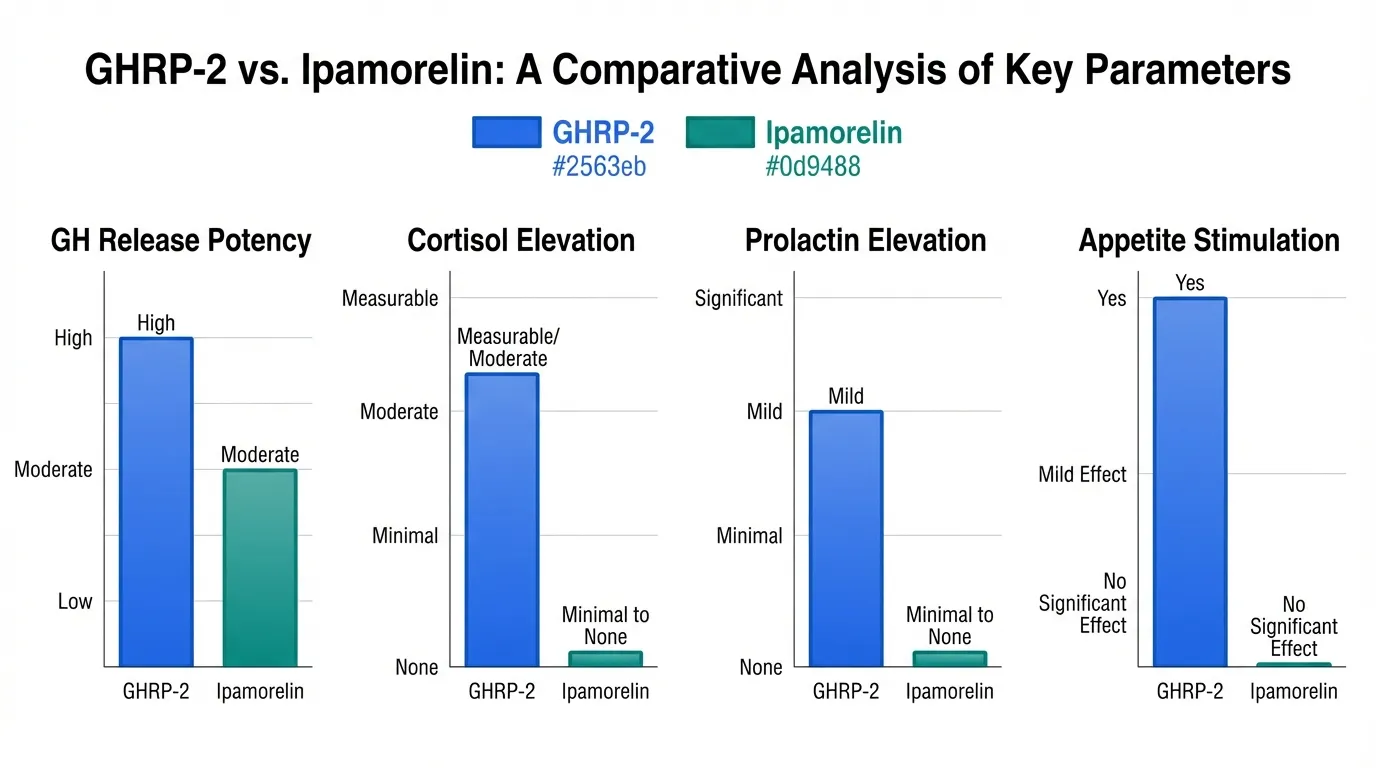
| GH release potency | High (among the most potent GHRPs) | Moderate |
| Cortisol effect | Measurable elevation at higher doses | Minimal to none |
| Prolactin effect | Mild elevation possible | Minimal to none |
| Appetite stimulation | Yes (ghrelin pathway) | No significant effect |
| Regulatory status | Approved in Japan (diagnostic) | No approvals |
| Best paired with | GHRH analogs for synergy | GHRH analogs (e.g., CJC-1295) |
Mechanism of Action Comparison#
GHRP-2#
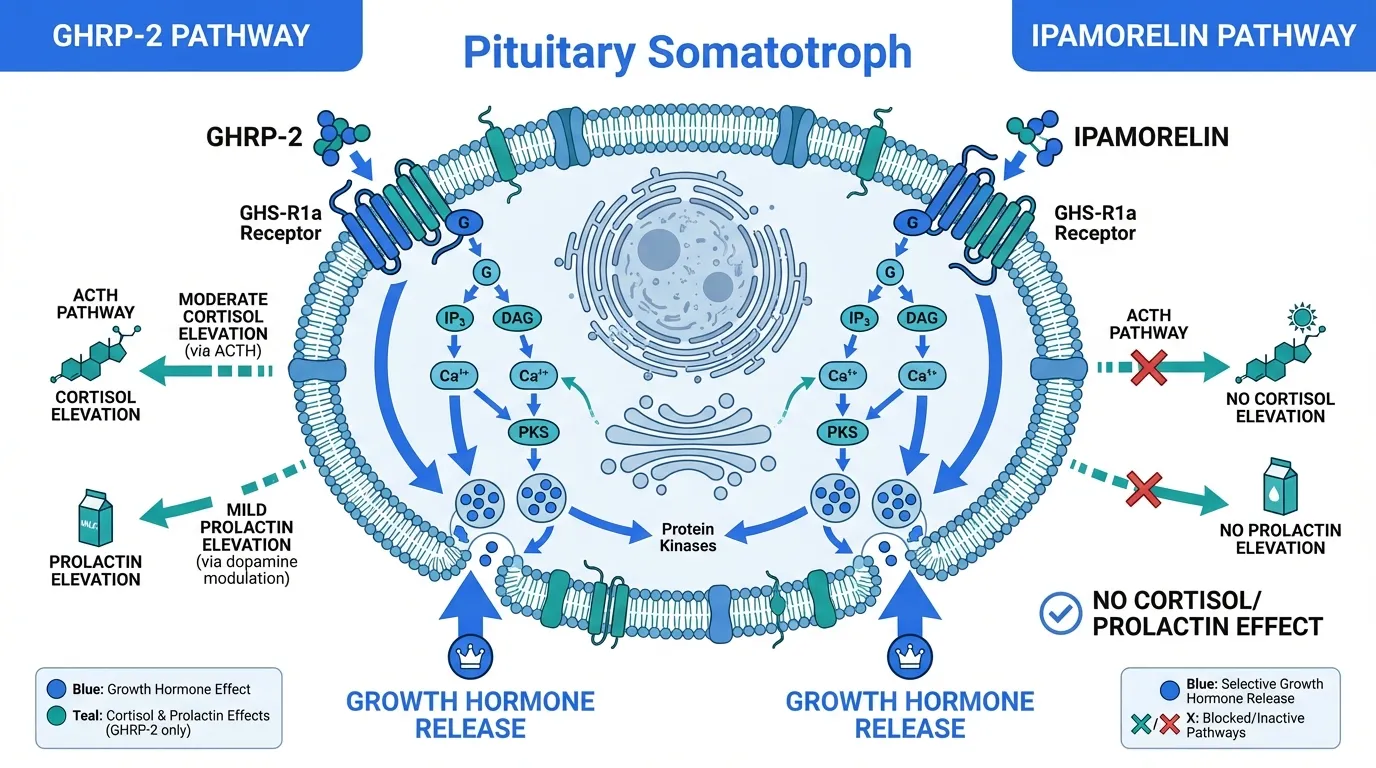
GHRP-2 (D-Ala-D-2-Nal-Ala-Trp-D-Phe-Lys-NH2) is a second-generation GHRP incorporating three unnatural amino acids that enhance GHS-R1a binding affinity and metabolic stability. It activates the ghrelin receptor on pituitary somatotrophs, triggering GH release through phospholipase C/IP3/calcium signaling and suppression of somatostatin tone.
GHRP-2 also activates ghrelin-mediated appetite circuits in the hypothalamus, producing orexigenic effects that distinguish it from ipamorelin. At higher doses, it stimulates modest cortisol and prolactin release, likely through ACTH stimulation and dopamine pathway modulation, respectively. Among the GHRP family, GHRP-2 is considered to have the most favorable selectivity relative to its potency, producing less cortisol and prolactin than hexarelin while maintaining strong GH release.
Its synergy with GHRH is well-documented: combining GHRP-2 with GHRH analogs produces GH release greater than the sum of either agent alone, as GHRPs amplify the somatotroph response to GHRH stimulation.
Ipamorelin#
Ipamorelin (Aib-His-D-2-Nal-D-Phe-Lys-NH2) is a pentapeptide that represents the most selective GHS identified. While it also acts through GHS-R1a, its binding characteristics produce GH release without the cortisol, ACTH, or prolactin elevations seen with other GHRPs.
This selectivity appears to arise from ipamorelin's specific receptor binding mode and its lack of engagement with ACTH-releasing pathways. Clinical studies have confirmed that at GH-effective doses, ipamorelin produces a dose-dependent GH pulse peaking at 30-60 minutes post-administration, with cortisol and prolactin levels remaining at baseline. This clean release profile makes it unique among GHS peptides.
Ipamorelin shows similar GHRH synergy to other GHRPs, making it the preferred partner for combined GHRH/GHRP protocols where hormonal selectivity is prioritized over maximal GH amplitude.
Evidence and Research Comparison#
GHRP-2 Research#
GHRP-2 has a robust clinical evidence base:
- Regulatory approval: Approved in Japan as pralmorelin (GHRP Kaken) for diagnostic evaluation of GH secretory capacity
- Clinical pharmacology: Extensively studied in healthy volunteers and GH-deficient patients for dose-response, selectivity, and GH release kinetics
- Synergy studies: Well-documented synergistic GH release when combined with GHRH, establishing the scientific basis for combined protocols
- Body composition: Studies examining effects on lean mass, fat mass, and metabolic parameters
- Appetite regulation: Ghrelin pathway activation studied in cachexia and appetite disorder contexts
Ipamorelin Research#
Ipamorelin's clinical program has focused on different applications:
- Phase I/II selectivity studies: Human studies confirming dose-dependent GH release without cortisol or prolactin elevation
- Postoperative ileus: Clinical trials investigating accelerated recovery of bowel function after surgery
- Pharmacokinetics: Well-characterized absorption and elimination in human subjects
- Combined protocols: Studies with sermorelin and CJC-1295 demonstrating maintained selectivity in combination settings
Side Effects and Safety Comparison#
GHRP-2 Side Effects#
- Cortisol elevation: Transient and dose-dependent; generally returns to baseline within 1-2 hours
- Prolactin elevation: Mild and transient; less pronounced than with hexarelin
- Appetite stimulation: Increased hunger via ghrelin pathway; may be desirable or undesirable depending on context
- Water retention: Possible at higher doses, consistent with GH-mediated effects
- Injection site reactions: Mild and transient
Ipamorelin Side Effects#
- Minimal hormonal effects: No clinically significant cortisol, ACTH, or prolactin changes at GH-releasing doses
- No appetite stimulation: Unlike GHRP-2 and GHRP-6, does not significantly increase hunger
- Transient headache: Occasionally reported in clinical studies
- Injection site reactions: Mild and transient
- Water retention: Possible with sustained use (GH-mediated)
Dosing and Administration Comparison#
GHRP-2 Dosing#
- Typical research dose: 100-300 mcg per administration, subcutaneous
- Diagnostic dose: 1 mcg/kg IV for GH deficiency testing (Japan protocol)
- Frequency: 2-3 times daily, typically before meals or at bedtime
- Timing: Best administered on an empty stomach; GH release blunted by recent food intake
Ipamorelin Dosing#
- Typical research dose: 200-300 mcg per administration, subcutaneous
- Frequency: 2-3 times daily
- Timing: Empty stomach preferred; often combined with GHRH analog for synergistic effect
- GH pulse: Onset within 15-30 minutes, peak at 30-60 minutes
Can They Be Combined?#
Combining GHRP-2 and ipamorelin would not provide meaningful benefit as both act on the same GHS-R1a receptor, creating competitive binding. The standard approach is to choose one GHRP and pair it with a GHRH analog (sermorelin, CJC-1295) to exploit the synergistic GHRH/GHRP interaction for amplified GH release.
Verdict#
The choice between GHRP-2 and ipamorelin centers on the selectivity-potency trade-off:
Ipamorelin is preferred when clean, selective GH release is the priority -- particularly in anti-aging protocols, body composition research, and combined GHRH/GHRP regimens where minimizing cortisol and prolactin perturbation is important. Its exceptional selectivity profile is unmatched among GHS peptides.
GHRP-2 is preferred when maximum GH release potency is needed, when appetite stimulation is desirable (cachexia, wasting conditions), or for diagnostic applications (where it holds regulatory approval in Japan). It offers the strongest GH release among clinically studied GHRPs while maintaining better selectivity than hexarelin.
For most research applications involving sustained GH optimization protocols, current evidence favors ipamorelin's clean release profile over GHRP-2's greater potency, as the chronic effects of repeated cortisol stimulation may outweigh the marginal GH amplitude advantage.
Explore the full profiles of GHRP-2 and Ipamorelin, or compare with Hexarelin and Sermorelin. Use our Half-Life Comparison Tool for peptide pharmacokinetic comparisons.
Further Reading#

Which Is Better For...
Selective GH Release with Minimal Side Effects
Ipamorelin
Ipamorelin produces GH release without significantly elevating cortisol, prolactin, or ACTH, making it the cleanest GHS option for research requiring isolated GH stimulation
Maximum GH Release Potency
GHRP-2
GHRP-2 produces stronger acute GH release than ipamorelin at comparable doses, making it preferred when maximum GH stimulation is the primary goal
GH Deficiency Diagnosis
GHRP-2
GHRP-2 (pralmorelin) is the only GHRP with regulatory approval as a GH diagnostic agent (approved in Japan as GHRP Kaken)
Combined GHRH/GHRP Protocols
Ipamorelin
Ipamorelin selectivity makes it the preferred GHRP partner for combined protocols with GHRH analogs like sermorelin or CJC-1295, minimizing off-target hormonal effects
Appetite Stimulation Research
GHRP-2
GHRP-2 ghrelin receptor activation produces meaningful appetite stimulation, relevant for cachexia and wasting research where appetite enhancement is desirable
Anti-Aging and Body Composition
Ipamorelin
The clean GH release profile without cortisol elevation makes ipamorelin preferred for long-term body composition protocols where hormonal balance is important
Continue Your Research
Get comparison updates
We publish new head-to-head comparisons regularly. Subscribe to see them first.
Frequently Asked Questions About Ipamorelin vs GHRP-2: Growth Hormone Secretagogues Compared
What are the key differences between GHRP-2 and Ipamorelin?
The main differences across comparison categories are: GH Release Potency: advantage goes to GHRP-2; Selectivity Profile: advantage goes to Ipamorelin; Research Evidence: advantage goes to GHRP-2. 2 additional categories are analyzed in the full comparison. Each category evaluates a different dimension of the two peptides.
When should I consider Ipamorelin over GHRP-2?
For the scenario of "Selective GH Release with Minimal Side Effects," research data suggests Ipamorelin may be more relevant. Ipamorelin produces GH release without significantly elevating cortisol, prolactin, or ACTH, making it the cleanest GHS option for research requiring isolated GH stimulation. This is based on currently available evidence and individual circumstances may differ.
Which has fewer side effects, GHRP-2 or Ipamorelin?
In terms of side effects and tolerability, the advantage goes to Ipamorelin. GHRP-2: Transient cortisol and prolactin elevations; appetite stimulation; water retention at higher doses; generally well-tolerated. Ipamorelin: Minimal hormonal side effects; no significant appetite stimulation; clean GH release profile; excellent tolerability.
Medical Disclaimer
This website is for educational and informational purposes only. The information provided is not intended to diagnose, treat, cure, or prevent any disease. Always consult with a qualified healthcare professional before using any peptide or supplement.