GHRP-6 vs Ipamorelin: Selectivity vs Potency in GH Secretagogues
Comparing GHRP-6 and Ipamorelin — two ghrelin receptor agonists with very different selectivity profiles, side effects, and research applications.
Verdict at a Glance
Ipamorelin is the preferred choice for most research contexts due to its exceptional selectivity — producing clean GH release without cortisol, prolactin, or appetite effects. GHRP-6 produces stronger peak GH release and is the better option when appetite stimulation is a desired outcome, such as in cachexia or wasting research. For standard GH optimization protocols, ipamorelin's clean hormonal profile makes it the more practical and better-tolerated option.
| Best for | Pick | Why |
|---|---|---|
| Selective GH Release | Ipamorelin | Ipamorelin produces GH release without significant cortisol, prolactin, or ACTH elevation, making it the cleanest GHS-R1a agonist for isolated GH stimulation research |
| Combined GHRH/GHRP Protocols | Ipamorelin | Ipamorelin's selectivity makes it the preferred GHRP partner for combination with GHRH analogs like CJC-1295 (No DAC) or sermorelin, capturing synergistic GH release without adding hormonal side effects |
| Appetite Stimulation and Cachexia Research | GHRP-6 | GHRP-6 produces significant appetite stimulation through hypothalamic ghrelin signaling, making it valuable in research on wasting, cachexia, and conditions requiring increased caloric intake |
| Long-Term GH Optimization | Ipamorelin | The absence of cortisol elevation and appetite disruption makes ipamorelin better suited for sustained protocols where repeated dosing over weeks or months is expected |
| Maximum Acute GH Release | GHRP-6 | GHRP-6 produces higher peak GH levels than ipamorelin at comparable doses, making it preferred when the largest possible acute GH pulse is the primary research endpoint |
| Evening or Bedtime Dosing | Ipamorelin | Ipamorelin does not stimulate appetite or elevate cortisol, avoiding sleep disruption from hunger and the cortisol spike that could interfere with natural nighttime GH release patterns |
| Category | GHRP-6 | Ipamorelin | Advantage |
|---|---|---|---|
| Mechanism of Action | First-generation hexapeptide GHS-R1a agonist with broad receptor activation; stimulates GH release, appetite via hypothalamic ghrelin circuits, and modest cortisol/prolactin release through ACTH stimulation and dopamine pathway modulation | Pentapeptide GHS-R1a agonist with highly selective binding profile; stimulates dose-dependent GH release without engaging cortisol, ACTH, or prolactin pathways at GH-effective doses | Ipamorelin |
| GH Release Potency | Potent GH release with strong dose-response; produces robust acute GH peaks comparable to GHRP-2; reliable and reproducible across studies with minimal tachyphylaxis over sustained use | Moderate GH release potency; dose-dependent response with lower peak GH levels than GHRP-6 at equivalent doses; consistent and reproducible with low tachyphylaxis risk | GHRP-6 |
| Side Effect Profile | Significant appetite stimulation via ghrelin signaling; measurable cortisol and prolactin elevation at standard doses; potential water retention; GI discomfort including hunger pangs and gastric motility changes | Minimal cortisol, ACTH, or prolactin elevation; no significant appetite stimulation at GH-releasing doses; mild headache and transient flushing reported; excellent tolerability in clinical studies | Ipamorelin |
| Research Evidence | Extensive clinical pharmacology data spanning decades; studied in healthy volunteers, GH-deficient patients, and aging populations; well-documented synergy with GHRH analogs; foundational peptide in GHS research | Phase I/II clinical trials; selectivity confirmed in human studies; postoperative ileus trials (Phase 2); well-characterized pharmacokinetics; no regulatory approvals | GHRP-6 |
| Practical Considerations | Pronounced hunger may complicate fasting protocols; cortisol elevation undesirable for evening dosing; appetite effect useful for underweight or cachexia contexts; less suitable for combination protocols where clean GH signal is needed | No appetite interference; suitable for fasting or evening dosing; clean profile makes it the preferred GHRP partner for GHRH analog combinations (e.g., with CJC-1295); suitable for longer-duration protocols | Ipamorelin |

Introduction#
GHRP-6 and Ipamorelin are both synthetic growth hormone secretagogues that stimulate pituitary GH release through the ghrelin receptor (GHS-R1a), but they sit at opposite ends of the selectivity spectrum. GHRP-6 was one of the earliest GHRPs developed, a first-generation hexapeptide that produces potent GH release along with significant appetite stimulation, cortisol elevation, and prolactin increase. Ipamorelin, developed later, achieves GH release with remarkable selectivity — virtually no cortisol, prolactin, or appetite effects at GH-releasing doses.
This difference in selectivity is not merely academic. It determines which peptide is appropriate for a given research context, how well it is tolerated over sustained use, and whether its off-target effects are a liability or a feature. For researchers comparing these two GHS-R1a agonists, the core question is straightforward: is maximum GH potency or maximum selectivity more important for the protocol at hand?
Quick Comparison Table#
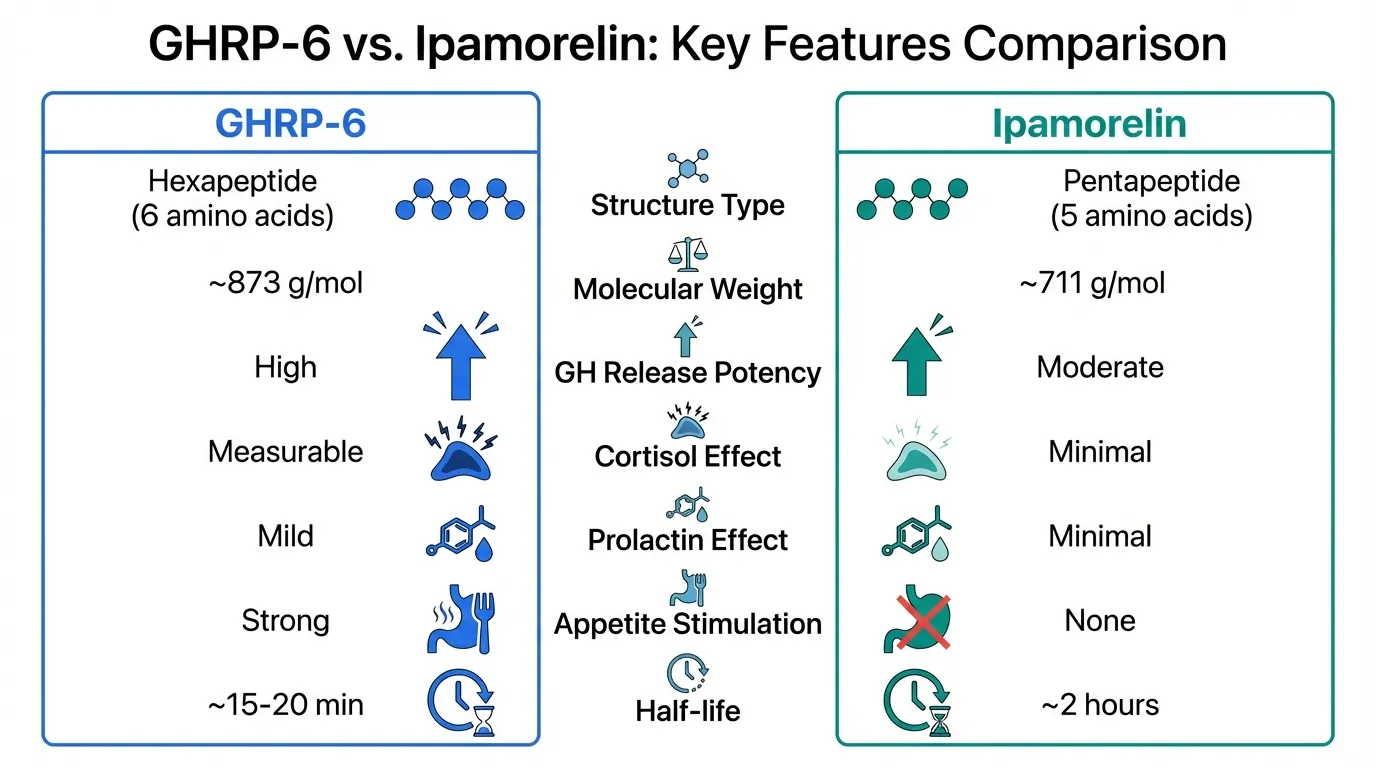
| Feature | GHRP-6 | Ipamorelin |
|---|---|---|
| Structure | Hexapeptide (His-D-Trp-Ala-Trp-D-Phe-Lys-NH2) | Pentapeptide (Aib-His-D-2-Nal-D-Phe-Lys-NH2) |
| Molecular weight | ~873 Da | ~711.85 Da |
| GH release potency | High | Moderate |
| Cortisol effect | Measurable elevation | Minimal to none |
| Prolactin effect | Mild to moderate elevation | Minimal to none |
| Appetite stimulation | Strong (ghrelin-mediated) | None at standard doses |
| Tachyphylaxis | Low | Low |
| Regulatory status | Not approved | Not approved |
| Half-life | ~15-20 minutes | ~2 hours |
| Best paired with | GHRH analog for synergy | GHRH analog (e.g., CJC-1295) |
Mechanism of Action Comparison#
GHRP-6#
GHRP-6 (His-D-Trp-Ala-Trp-D-Phe-Lys-NH2) is a first-generation growth hormone-releasing peptide developed through systematic structure-activity studies beginning in the 1980s. It binds to GHS-R1a on pituitary somatotrophs, activating the Gq-phospholipase C-IP3 signaling cascade to trigger GH granule exocytosis.
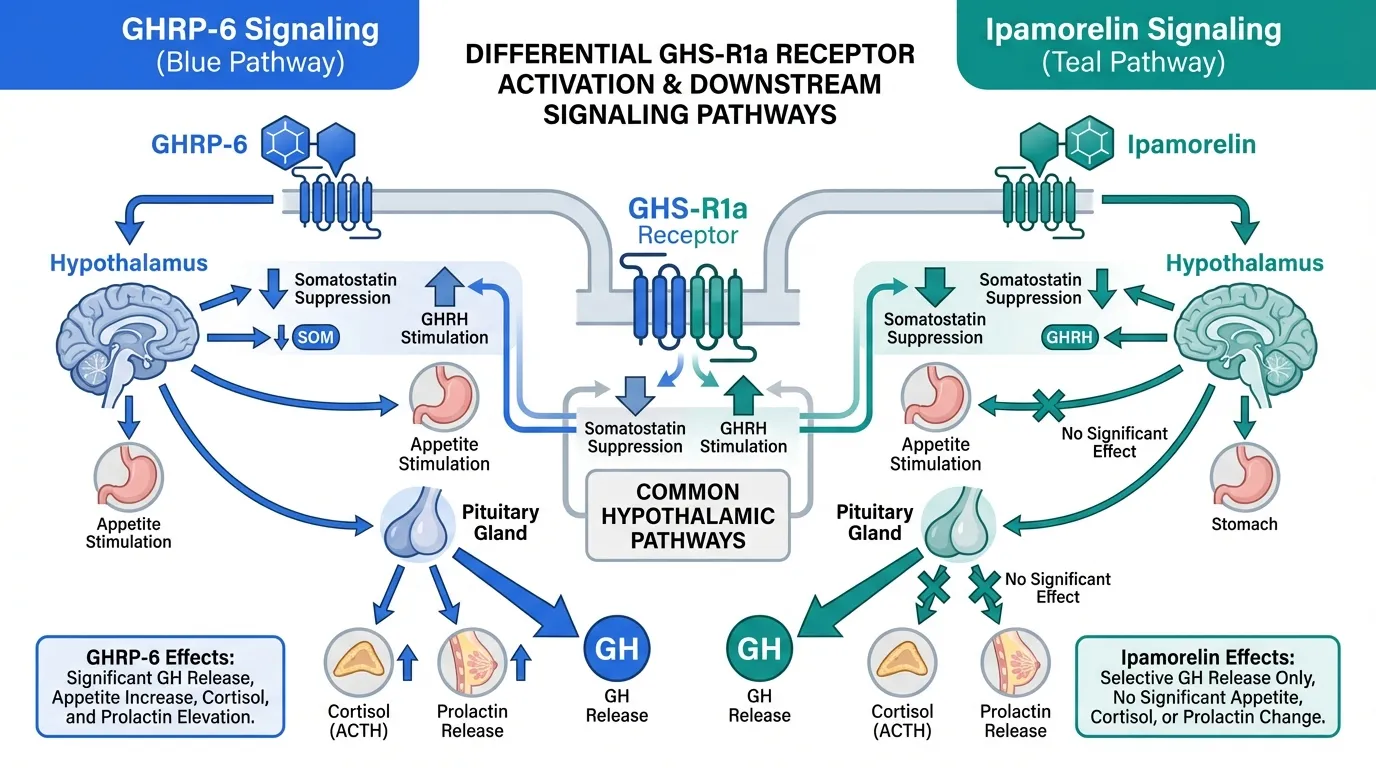
What distinguishes GHRP-6 from more selective GHRPs is the breadth of its receptor engagement. Beyond pituitary GH release, GHRP-6 robustly activates hypothalamic ghrelin circuits involved in appetite regulation. The orexigenic (appetite-stimulating) effect is one of the most noticeable pharmacological actions of GHRP-6 — subjects typically report a pronounced increase in hunger within 20-30 minutes of administration. This effect is mediated through the same GHS-R1a receptor but in hypothalamic neurons rather than pituitary somatotrophs.
GHRP-6 also stimulates modest cortisol release through ACTH stimulation and mild prolactin elevation. These effects are dose-dependent and transient, typically returning to baseline within 1-2 hours. While less pronounced than with Hexarelin, they represent a meaningful off-target hormonal perturbation that is absent with ipamorelin.
At the hypothalamic level, GHRP-6 suppresses somatostatin release and stimulates endogenous GHRH release, creating a dual hypothalamic action that amplifies the pituitary GH signal. This effect is shared with other GHRPs and contributes to the synergistic GH release observed when GHRPs are combined with GHRH analogs.
Ipamorelin#
Ipamorelin (Aib-His-D-2-Nal-D-Phe-Lys-NH2) is a pentapeptide that also acts through GHS-R1a but with a binding profile that produces clean, selective GH release. In human studies, ipamorelin administered at GH-releasing doses produced dose-dependent GH secretion without significant changes in cortisol, ACTH, prolactin, FSH, LH, or TSH.
This selectivity appears to arise from ipamorelin's specific receptor-binding conformation. While GHRP-6 activates GHS-R1a broadly across multiple tissue types with varying downstream consequences, ipamorelin's interaction with the receptor appears to favor the conformational state that drives somatotroph GH release without efficiently engaging the receptor conformations responsible for appetite stimulation or ACTH release.
Ipamorelin shares the hypothalamic effects common to GHRPs — somatostatin suppression and GHRH neuron stimulation — which contribute to its utility in combination protocols. Its longer half-life (approximately 2 hours vs. 15-20 minutes for GHRP-6) provides a more sustained GH pulse, though peak GH levels are lower than with GHRP-6 at comparable doses.
Side Effects and Tolerability#
GHRP-6 Side Effects#
GHRP-6's side effect profile is directly tied to its broad GHS-R1a activation:
- Appetite stimulation: The most prominent and consistent effect. Intense hunger can occur within 20-30 minutes of administration and persist for 30-60 minutes. This is mediated through hypothalamic ghrelin circuits and is a pharmacological action, not a side effect per se — though it is often undesired in GH optimization contexts.
- Cortisol elevation: Transient, dose-dependent increase in cortisol through ACTH stimulation. Returns to baseline within 1-2 hours. Repeated cortisol elevation is a consideration for long-term protocols.
- Prolactin elevation: Mild and transient. Less pronounced than with GHRP-2 or Hexarelin but still measurable.
- Water retention: Possible at higher doses, consistent with GH-mediated fluid retention.
- Gastric motility: Some studies report increased gastric motility and occasional GI discomfort, related to ghrelin's well-established role in gut motility regulation.
- Injection site reactions: Mild and transient, common to all injectable peptides.
Ipamorelin Side Effects#
Ipamorelin is generally well-tolerated with a minimal side effect profile:
- No significant cortisol or prolactin elevation: Confirmed in multiple human pharmacology studies. This is ipamorelin's defining advantage.
- No appetite stimulation: Unlike GHRP-6, ipamorelin does not produce noticeable hunger changes at GH-releasing doses.
- Mild headache: Occasionally reported in clinical studies, typically transient.
- Transient flushing: Mild vasodilation effects reported in some subjects.
- Water retention: Possible with sustained use, related to GH-mediated effects rather than the peptide itself.
- Injection site reactions: Mild and transient.
The tolerability difference between these peptides is significant for sustained protocols. GHRP-6's appetite stimulation can be disruptive for subjects maintaining specific dietary protocols, and repeated cortisol elevation — even if transient — is an undesirable hormonal perturbation over weeks or months of use.
Dosing and Administration#
GHRP-6 Dosing#
- Typical research dose: 100-300 mcg per administration, subcutaneous
- Frequency: 2-3 times daily
- Timing: Best administered on an empty stomach; GH release is blunted by recent food intake. The subsequent appetite stimulation typically drives food intake within 30-60 minutes.
- Combination use: Most commonly paired with a GHRH analog (Sermorelin or CJC-1295 (No DAC)) administered simultaneously for synergistic GH release
- Saturation dose: GH response plateaus around 100-200 mcg in most studies; higher doses increase side effects without proportional GH benefit
Ipamorelin Dosing#
- Typical research dose: 200-300 mcg per administration, subcutaneous
- Frequency: 2-3 times daily
- Timing: Empty stomach preferred; commonly administered before bed to augment the natural nocturnal GH pulse, and/or upon waking
- Combination use: Preferred GHRP partner for GHRH analog combinations; most commonly paired with CJC-1295 (No DAC)
- GH pulse kinetics: Onset within 15-30 minutes, peak at 30-60 minutes, return to baseline within 2-3 hours
When GHRP-6's Side Effects Are Actually Advantages#
While ipamorelin's selectivity makes it the default choice for most protocols, GHRP-6's "side effects" are contextually advantageous in specific scenarios:
Cachexia and wasting research: In subjects who are underweight or struggling with appetite, GHRP-6's potent orexigenic effect is a therapeutic feature rather than a side effect. The combination of GH release (promoting anabolism) and appetite stimulation (increasing caloric intake) addresses two aspects of wasting simultaneously.
Underweight populations: For subjects needing to increase caloric intake, GHRP-6's reliable appetite stimulation can support nutritional goals alongside GH-mediated body composition effects.
GH provocation testing: GHRP-6's higher peak GH release makes it useful as a provocation agent for evaluating pituitary GH secretory capacity. The stronger stimulus helps differentiate between partial and complete GH deficiency.
Short-term intensive protocols: For brief protocols where cumulative cortisol exposure is less of a concern, GHRP-6's higher peak GH output may justify its broader hormonal effects.
Can They Be Combined?#
Combining GHRP-6 and ipamorelin is pharmacologically irrational, as both peptides compete for the same GHS-R1a receptor. The result would be competitive binding without synergy, likely producing a mixed response inferior to either peptide used optimally alone.
The productive combination approach is to pair one GHRP with one GHRH analog:
- CJC-1295 (No DAC) + Ipamorelin: The most commonly studied clean combination
- Sermorelin + GHRP-6: A well-documented combination for maximum GH release where appetite stimulation is acceptable
- CJC-1295 DAC + Ipamorelin: Less common; combines sustained GHRH stimulation with pulsatile GHRP activation
Verdict#
The choice between GHRP-6 and ipamorelin is fundamentally a selectivity-potency trade-off:
Ipamorelin is the clear choice for most GH optimization research. Its selective GH release without cortisol, prolactin, or appetite effects makes it better tolerated, more practical for sustained use, and the preferred GHRP partner for combination protocols with GHRH analogs. The moderate GH release is sufficient for most research endpoints, and the clean hormonal profile avoids confounding variables in study design.
GHRP-6 is the better choice when maximum acute GH release is needed, when appetite stimulation serves the research goal, or when studying ghrelin-mediated effects beyond isolated GH release. Its extensive research history and robust dose-response data make it a well-characterized pharmacological tool.
For the majority of protocols — particularly those involving sustained dosing, combination with GHRH analogs, or body composition endpoints — ipamorelin's selectivity advantage outweighs GHRP-6's potency advantage. The chronic effects of repeated cortisol stimulation and appetite disruption are meaningful considerations that favor the cleaner peptide.
Explore the full profiles of GHRP-6 and Ipamorelin. For related comparisons, see GHRP-2 vs Ipamorelin and our comprehensive Growth Hormone Secretagogues Compared guide.
Further Reading#

Which Is Better For...
Selective GH Release
Ipamorelin
Ipamorelin produces GH release without significant cortisol, prolactin, or ACTH elevation, making it the cleanest GHS-R1a agonist for isolated GH stimulation research
Combined GHRH/GHRP Protocols
Ipamorelin
Ipamorelin's selectivity makes it the preferred GHRP partner for combination with GHRH analogs like CJC-1295 (No DAC) or sermorelin, capturing synergistic GH release without adding hormonal side effects
Appetite Stimulation and Cachexia Research
GHRP-6
GHRP-6 produces significant appetite stimulation through hypothalamic ghrelin signaling, making it valuable in research on wasting, cachexia, and conditions requiring increased caloric intake
Long-Term GH Optimization
Ipamorelin
The absence of cortisol elevation and appetite disruption makes ipamorelin better suited for sustained protocols where repeated dosing over weeks or months is expected
Maximum Acute GH Release
GHRP-6
GHRP-6 produces higher peak GH levels than ipamorelin at comparable doses, making it preferred when the largest possible acute GH pulse is the primary research endpoint
Evening or Bedtime Dosing
Ipamorelin
Ipamorelin does not stimulate appetite or elevate cortisol, avoiding sleep disruption from hunger and the cortisol spike that could interfere with natural nighttime GH release patterns
Continue Your Research
Get comparison updates
We publish new head-to-head comparisons regularly. Subscribe to see them first.
Frequently Asked Questions About GHRP-6 vs Ipamorelin: Selectivity vs Potency in GH Secretagogues
Which is better, GHRP-6 or Ipamorelin?
Ipamorelin is the preferred choice for most research contexts due to its exceptional selectivity — producing clean GH release without cortisol, prolactin, or appetite effects. GHRP-6 produces stronger peak GH release and is the better option when appetite stimulation is a desired outcome, such as in cachexia or wasting research. For standard GH optimization protocols, ipamorelin's clean hormonal profile makes it the more practical and better-tolerated option. Individual responses may vary, and this comparison is based on available research data, not a treatment recommendation.
What are the key differences between GHRP-6 and Ipamorelin?
The main differences across comparison categories are: Mechanism of Action: advantage goes to Ipamorelin; GH Release Potency: advantage goes to GHRP-6; Side Effect Profile: advantage goes to Ipamorelin. 2 additional categories are analyzed in the full comparison. Each category evaluates a different dimension of the two peptides.
When should I consider Ipamorelin over GHRP-6?
For the scenario of "Selective GH Release," research data suggests Ipamorelin may be more relevant. Ipamorelin produces GH release without significant cortisol, prolactin, or ACTH elevation, making it the cleanest GHS-R1a agonist for isolated GH stimulation research. This is based on currently available evidence and individual circumstances may differ.
How do GHRP-6 and Ipamorelin differ in their mechanisms of action?
GHRP-6: First-generation hexapeptide GHS-R1a agonist with broad receptor activation; stimulates GH release, appetite via hypothalamic ghrelin circuits, and modest cortisol/prolactin release through ACTH st.... Ipamorelin: Pentapeptide GHS-R1a agonist with highly selective binding profile; stimulates dose-dependent GH release without engaging cortisol, ACTH, or prolactin pathways at GH-effective doses.
Which has fewer side effects, GHRP-6 or Ipamorelin?
In terms of side effects and tolerability, the advantage goes to Ipamorelin. GHRP-6: Significant appetite stimulation via ghrelin signaling; measurable cortisol and prolactin elevation at standard doses; potential water retention; G.... Ipamorelin: Minimal cortisol, ACTH, or prolactin elevation; no significant appetite stimulation at GH-releasing doses; mild headache and transient flushing rep....
Medical Disclaimer
This website is for educational and informational purposes only. The information provided is not intended to diagnose, treat, cure, or prevent any disease. Always consult with a qualified healthcare professional before using any peptide or supplement.