Carnosine vs Epitalon: Anti-Aging Peptides Compared
Evidence-based comparison of carnosine and epitalon for anti-aging, examining their different mechanisms -- carnosine as an endogenous antioxidant and anti-glycation dipeptide versus epitalon as a pineal tetrapeptide that activates telomerase.
Verdict at a Glance
Carnosine and epitalon represent complementary rather than competing approaches to anti-aging. Carnosine is the safer, more accessible, and better-validated option with extensive human data, oral availability, and multi-pathway protective effects against oxidative stress and glycation. Epitalon targets a more fundamental aging mechanism (telomere shortening) through direct telomerase activation, which is scientifically compelling but supported by limited and non-independent research. For individuals seeking a well-established, evidence-based anti-aging supplement, carnosine is the stronger choice. For those interested in cutting-edge telomere biology, epitalon is the more targeted option but carries greater uncertainty. The two can potentially be combined for complementary effects -- carnosine for damage prevention and epitalon for telomere maintenance.
| Best for | Pick | Why |
|---|---|---|
| Evidence-Based Anti-Aging | Carnosine | Multiple human clinical trials, decades of safety data, oral availability, and established pharmacokinetics. Carnosine/beta-alanine is one of the most well-studied anti-aging supplements available. |
| Telomere Maintenance | Epitalon | Epitalon directly activates telomerase and has been shown to extend telomere length in human cell lines. Carnosine may slow telomere shortening indirectly but does not activate telomerase. |
| Oral Supplementation | Carnosine | Carnosine is effective orally (as L-carnosine or beta-alanine precursor). Epitalon requires subcutaneous injection -- no oral formulation exists. |
| Exercise Performance + Anti-Aging | Carnosine | Beta-alanine supplementation raises muscle carnosine, improving exercise performance while providing anti-glycation and antioxidant benefits. Dual-purpose supplementation. |
| Comprehensive Longevity Protocol | Both (combined) | Carnosine addresses oxidative stress, glycation, and pH buffering while epitalon targets telomere maintenance. The mechanisms are complementary and non-overlapping, making combination use theoretically synergistic. |
| Budget-Conscious Anti-Aging | Carnosine | Beta-alanine supplements cost $15-40/month and are widely available. Epitalon costs more, requires injection, and is only available from research peptide suppliers. |
| Category | Carnosine | Epitalon | Advantage |
|---|---|---|---|
| Mechanism of Action | Carnosine (beta-alanyl-L-histidine) is a naturally occurring dipeptide concentrated in muscle and brain tissue. It acts as a multi-functional anti-aging molecule through antioxidant activity (scavenging reactive oxygen species), anti-glycation (preventing advanced glycation end products that contribute to aging), metal ion chelation, pH buffering in muscle, and cellular senescence modulation. It may slow telomere shortening indirectly through reduced oxidative stress. | Epitalon (Ala-Glu-Asp-Gly) is a synthetic tetrapeptide based on epithalamin, a pineal gland extract. It directly activates telomerase by upregulating hTERT mRNA expression, extending telomere length in human cells. It also modulates melatonin and cortisol secretion, influences circadian rhythms, and has shown effects on oxidative stress resilience and epigenetic regulation. | Epitalon |
| Research Evidence | Carnosine has extensive research including hundreds of preclinical studies and multiple human clinical trials for exercise performance, diabetes, cognitive function, and anti-aging. Available as an oral supplement (beta-alanine as precursor) with well-established pharmacokinetics and safety. Published in mainstream journals. | Epitalon research is primarily from Russian groups (Khavinson and colleagues). Key studies show telomerase activation and telomere extension in human cell lines (published 2003, updated 2025). Limited human data mainly from the same research group. No independent replication of key findings. No Phase 2 or Phase 3 trials. | Carnosine |
| Safety Profile | Carnosine has an excellent safety profile established over decades of human use as an oral supplement. Beta-alanine supplementation (which raises carnosine levels) is used by millions of athletes worldwide. The main side effect is transient paresthesia (tingling) from beta-alanine at high doses. No serious adverse effects reported. | Epitalon has limited safety data. It is administered by subcutaneous injection or IV in research settings. No systematic adverse event data from large clinical trials. Reported side effects from unregulated use include injection site reactions and transient fatigue. Theoretical concern about telomerase activation in cancer cells. | Carnosine |
| Accessibility and Practicality | Carnosine is widely available as an oral supplement (L-carnosine) or via its precursor beta-alanine. Sold over the counter in most countries. Affordable (typically $15-40 for a month's supply). No injection required. Well-established dosing protocols. GRAS status. | Epitalon is available from research peptide suppliers as a lyophilized powder requiring reconstitution and subcutaneous injection. Not approved as a supplement or drug. More expensive ($40-100 per vial). Typical protocols involve 10-day injection cycles. Not widely available in mainstream retail. | Carnosine |
| Anti-Aging Specificity | Carnosine targets aging through multiple indirect pathways -- reducing oxidative damage, preventing protein glycation, buffering pH, and chelating metals. It is a protective agent that may slow the rate of aging-related damage rather than directly reversing cellular age markers. | Epitalon directly targets one of the most fundamental mechanisms of cellular aging -- telomere shortening. By activating telomerase, it has been shown to extend telomere length in human cells, potentially resetting the replicative clock. This represents a more targeted and direct anti-aging mechanism. | Epitalon |

Introduction#
Carnosine and epitalon represent two distinct philosophies in anti-aging peptide therapy. Carnosine is a naturally occurring dipeptide that protects cells from damage by scavenging reactive oxygen species, preventing protein glycation, and buffering intracellular pH -- a "shield" against the molecular damage that accumulates with age. Epitalon is a synthetic tetrapeptide designed to address aging at a more fundamental level by activating telomerase, the enzyme that maintains telomere length and cellular replicative capacity.
Their approaches are complementary: carnosine slows the rate of aging-related damage, while epitalon aims to reset the biological clock at the telomere level. This comparison examines the evidence, mechanisms, safety, and practical considerations for each peptide.
Mechanism of Action Comparison#
Carnosine#
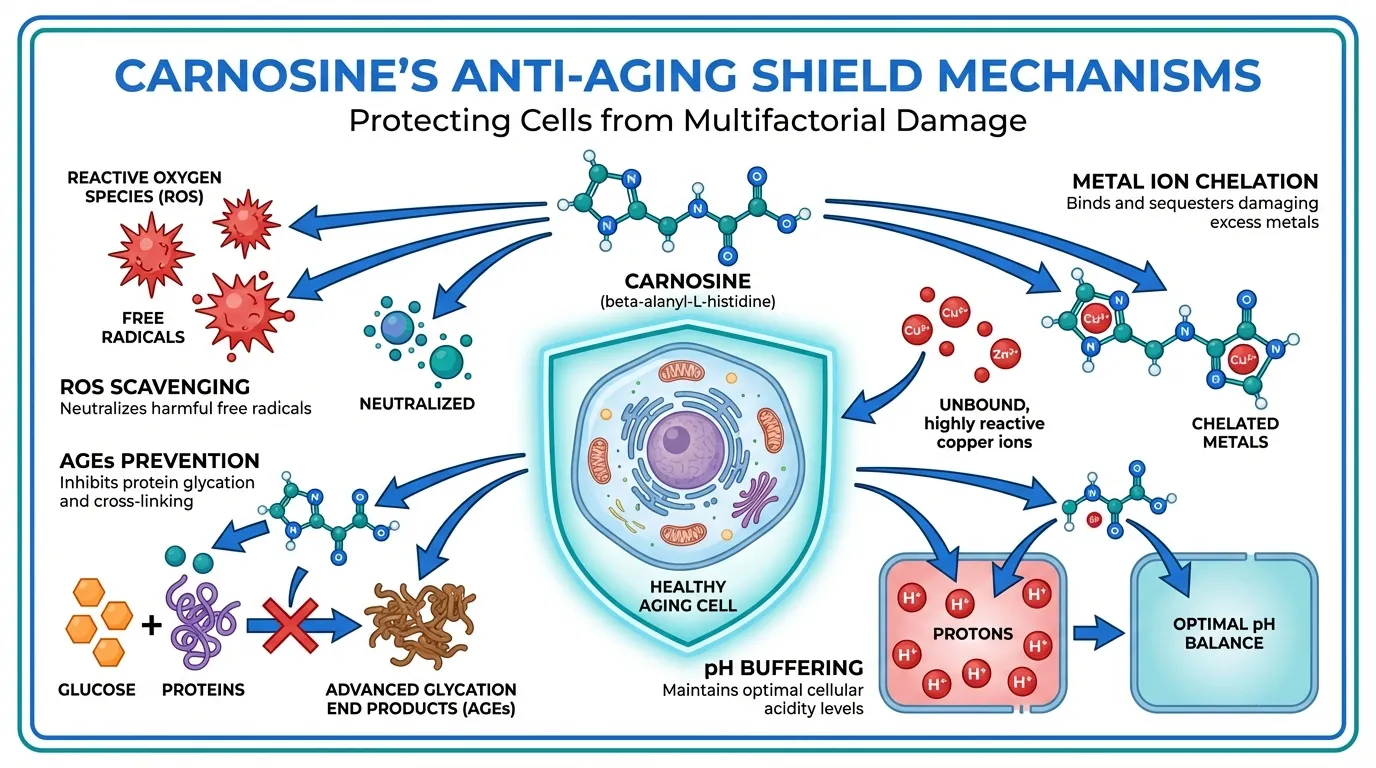
Carnosine (beta-alanyl-L-histidine) is an endogenous dipeptide found at high concentrations in skeletal muscle (20-30 mM), cardiac muscle, and brain tissue. Its levels decline with age, particularly in muscle. Carnosine's anti-aging mechanisms include:
- Antioxidant activity: Scavenges hydroxyl radicals, superoxide, and singlet oxygen. Protects lipid membranes from peroxidation.
- Anti-glycation: Prevents formation of advanced glycation end products (AGEs) by reacting with carbonyl groups on sugars and aldehydes before they can cross-link proteins. AGEs are major contributors to aging in skin, vasculature, and kidneys.
- Metal ion chelation: Binds copper and zinc ions, preventing Fenton-type reactions that generate damaging hydroxyl radicals.
- pH buffering: The imidazole ring of histidine provides pH buffering in muscle tissue, maintaining cellular function during metabolic stress.
- Cellular senescence modulation: May delay entry of cells into senescent states through reduced oxidative and glycation damage.
- Indirect telomere protection: By reducing oxidative damage that accelerates telomere shortening, carnosine may indirectly help preserve telomere length.
Epitalon#
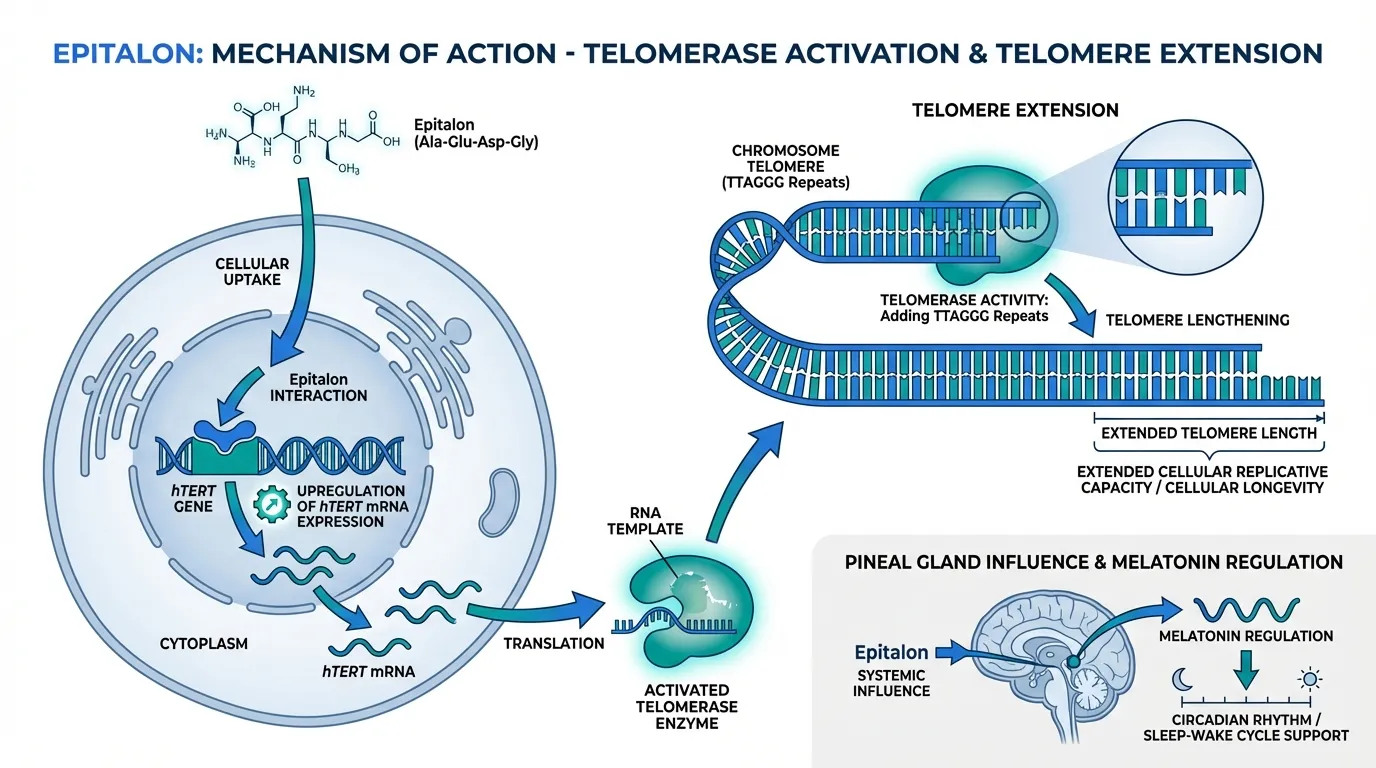
Epitalon (Ala-Glu-Asp-Gly) is a synthetic tetrapeptide designed to mimic the active component of epithalamin, an extract from the pineal gland. Its anti-aging mechanisms are more targeted:
- Telomerase activation: Directly upregulates hTERT (human telomerase reverse transcriptase) mRNA expression, activating the telomerase enzyme
- Telomere extension: Has been shown to increase telomere length in human cell lines, extending replicative lifespan beyond the Hayflick limit
- Melatonin modulation: Stimulates melatonin secretion from the pineal gland, which may improve sleep quality and circadian rhythm regulation
- Cortisol regulation: May help normalize cortisol patterns that become dysregulated with age
- Epigenetic effects: Appears to interact with promoter regions of the telomerase gene, potentially binding ATTTC motifs to modulate transcriptional activity
Mechanistic Comparison#
| Feature | Carnosine | Epitalon |
|---|---|---|
| Type | Endogenous dipeptide | Synthetic tetrapeptide |
| Size | 2 amino acids (~226 Da) | 4 amino acids (~390 Da) |
| Primary aging target | Oxidative/glycation damage | Telomere shortening |
| Telomerase effect | None (indirect protection only) | Direct activation (hTERT upregulation) |
| Antioxidant | Strong direct antioxidant | Indirect (via stress resilience) |
| Anti-glycation | Primary mechanism | Not reported |
| Circadian/melatonin | No direct effect | Stimulates melatonin secretion |
| Natural occurrence | Endogenous (muscle, brain) | Synthetic (based on pineal extract) |
| Route of action | Intracellular protective agent | Gene expression modulator |
Research Evidence Comparison#
Carnosine Research#
Carnosine has extensive research across multiple domains:
Human clinical trials:
- Exercise performance: Beta-alanine supplementation (raising muscle carnosine) improves high-intensity exercise capacity in hundreds of studies
- Type 2 diabetes: Carnosine supplementation improved glycemic control in multiple RCTs
- Cognitive function: Studies in elderly subjects showed improved cognitive measures
- Anti-aging biomarkers: Human studies demonstrate reduced AGE formation and oxidative stress markers
Preclinical highlights:
- Extended lifespan in senescence-accelerated mice
- Reduced oxidative damage and lipid peroxidation in multiple animal models
- Neuroprotective effects in Alzheimer's disease models
- Cardiac protection in ischemia-reperfusion models
Evidence level: Moderate to high -- multiple human RCTs for specific outcomes, extensive preclinical support.
Epitalon Research#
Epitalon research is primarily from one research group:
Key studies:
- Khavinson et al. (2003): Demonstrated telomerase activation and telomere elongation in human fetal lung fibroblasts treated with epitalon. Cells exceeded the Hayflick limit while maintaining normal morphology and function.
- PMC 2025 study: Updated confirmation that epitalon increases telomere length in human cell lines through upregulation of hTERT mRNA expression and telomerase enzyme activity, or through ALT (alternative lengthening of telomeres) activity.
- Anisimov et al.: Animal studies in aged mice and rats showing increased lifespan and improved physiological markers with epitalon treatment.
- Pineal function studies: Demonstrated restoration of melatonin secretion patterns in aged animals.
Key limitation: Most epitalon research originates from Khavinson's group at the St. Petersburg Institute of Bioregulation and Gerontology. Independent replication by other research groups is limited.
Evidence level: Low to moderate -- interesting cell culture and animal data, but limited independent replication and no Phase 2/3 clinical trials.
Evidence Comparison Table#
| Feature | Carnosine | Epitalon |
|---|---|---|
| Human clinical trials | Multiple RCTs | Very limited (pilot studies) |
| Independent replication | Yes (global research groups) | Very limited |
| Preclinical studies | Hundreds | Dozens (primarily one group) |
| Lifespan studies | Yes (mice) | Yes (mice/rats) |
| Publication quality | Mainstream journals | Mixed (some peer-reviewed) |
| Safety data (human) | Extensive (supplement use) | Very limited |
| Regulatory status | Dietary supplement (GRAS) | Research peptide only |
Dosing Comparison#
Carnosine Dosing#
| Parameter | Details |
|---|---|
| Form | L-carnosine capsules or beta-alanine powder |
| Oral dose (L-carnosine) | 500-2,000 mg/day |
| Oral dose (beta-alanine) | 3.2-6.4 g/day (sustained-release preferred) |
| Route | Oral |
| Frequency | 1-2 times daily |
| Bioavailability | Moderate (rapidly hydrolyzed by carnosinase in blood) |
| Duration | Chronic supplementation (ongoing) |
| Beta-alanine loading | 4-6 weeks to saturate muscle carnosine stores |
Epitalon Dosing#
| Parameter | Details |
|---|---|
| Form | Lyophilized powder for injection |
| Dose | 5-10 mg/day |
| Route | Subcutaneous injection |
| Frequency | Once daily for 10-20 day cycles |
| Cycle frequency | Every 4-6 months |
| Reconstitution | Required (bacteriostatic water) |
| Duration | Cyclic (not continuous) |
| Half-life | Not well characterized |
Side Effects Comparison#
Carnosine/Beta-Alanine Side Effects#
- Paresthesia: Tingling sensation (from beta-alanine), transient and harmless; mitigated by sustained-release formulations
- GI discomfort: Mild at high doses of L-carnosine
- No serious adverse effects in decades of supplement use
- Safe in pregnancy at standard supplement doses
Epitalon Side Effects#
- Injection site reactions (redness, swelling)
- Transient fatigue
- Headache (rare)
- Theoretical cancer risk: Telomerase activation could theoretically promote cancer cell immortality. No evidence of this in animal longevity studies, but the theoretical concern persists.
- No systematic safety data from large clinical trials
Key Differences Summary#
- Evidence strength: Carnosine has multiple human RCTs and decades of supplement safety data. Epitalon lacks independent replication and large clinical trials.
- Mechanism: Carnosine protects against damage (antioxidant/anti-glycation). Epitalon targets the aging clock (telomerase/telomeres).
- Administration: Carnosine is taken orally. Epitalon requires injection.
- Availability: Carnosine is a mainstream supplement. Epitalon is a research peptide.
- Cost: Beta-alanine is affordable ($15-40/month). Epitalon is more expensive and requires research supplier sourcing.
- Safety: Carnosine has decades of human safety data. Epitalon's safety profile is poorly characterized.
- Aging target: Carnosine addresses multiple aging pathways broadly. Epitalon targets the single most fundamental aging mechanism (telomere shortening).
Conclusion#
Carnosine and epitalon address aging through different mechanisms that are fundamentally complementary. Carnosine is the more practical, evidence-based, and accessible option -- a naturally occurring dipeptide with extensive human safety data, oral availability, and multi-pathway protective effects against the molecular damage that drives aging. For anyone seeking a well-validated anti-aging supplement, carnosine (or its precursor beta-alanine) is the lower-risk, higher-evidence choice.
Epitalon is scientifically more ambitious, directly targeting telomere maintenance through telomerase activation. If its effects on human telomere length are confirmed by independent research groups, it would represent one of the most direct anti-aging interventions available. However, the current evidence base is limited in scope and independence, and the need for injection and cyclic dosing protocols reduces its practicality.
For comprehensive anti-aging approaches, the two peptides are not mutually exclusive. Carnosine provides daily protection against oxidative and glycation damage, while periodic epitalon cycles could theoretically address telomere maintenance. This combination leverages different anti-aging mechanisms without redundancy, though the evidence for epitalon's effectiveness in humans remains to be firmly established.
Further Reading#

Which Is Better For...
Evidence-Based Anti-Aging
Carnosine
Multiple human clinical trials, decades of safety data, oral availability, and established pharmacokinetics. Carnosine/beta-alanine is one of the most well-studied anti-aging supplements available.
Telomere Maintenance
Epitalon
Epitalon directly activates telomerase and has been shown to extend telomere length in human cell lines. Carnosine may slow telomere shortening indirectly but does not activate telomerase.
Oral Supplementation
Carnosine
Carnosine is effective orally (as L-carnosine or beta-alanine precursor). Epitalon requires subcutaneous injection -- no oral formulation exists.
Exercise Performance + Anti-Aging
Carnosine
Beta-alanine supplementation raises muscle carnosine, improving exercise performance while providing anti-glycation and antioxidant benefits. Dual-purpose supplementation.
Comprehensive Longevity Protocol
Both (combined)
Carnosine addresses oxidative stress, glycation, and pH buffering while epitalon targets telomere maintenance. The mechanisms are complementary and non-overlapping, making combination use theoretically synergistic.
Budget-Conscious Anti-Aging
Carnosine
Beta-alanine supplements cost $15-40/month and are widely available. Epitalon costs more, requires injection, and is only available from research peptide suppliers.
Continue Your Research
Get comparison updates
We publish new head-to-head comparisons regularly. Subscribe to see them first.
Frequently Asked Questions About Carnosine vs Epitalon: Anti-Aging Peptides Compared
Which is better, Carnosine or Epitalon?
Carnosine and epitalon represent complementary rather than competing approaches to anti-aging. Carnosine is the safer, more accessible, and better-validated option with extensive human data, oral availability, and multi-pathway protective effects against oxidative stress and glycation. Epitalon targets a more fundamental aging mechanism (telomere shortening) through direct telomerase activation, which is scientifically compelling but supported by limited and non-independent research. For indi... Individual responses may vary, and this comparison is based on available research data, not a treatment recommendation.
What are the key differences between Carnosine and Epitalon?
The main differences across comparison categories are: Mechanism of Action: advantage goes to Epitalon; Research Evidence: advantage goes to Carnosine; Safety Profile: advantage goes to Carnosine. 2 additional categories are analyzed in the full comparison. Each category evaluates a different dimension of the two peptides.
When should I consider Carnosine over Epitalon?
For the scenario of "Evidence-Based Anti-Aging," research data suggests Carnosine may be more relevant. Multiple human clinical trials, decades of safety data, oral availability, and established pharmacokinetics. Carnosine/beta-alanine is one of the most well-studied anti-aging supplements available.. This is based on currently available evidence and individual circumstances may differ.
How do Carnosine and Epitalon differ in their mechanisms of action?
Carnosine: Carnosine (beta-alanyl-L-histidine) is a naturally occurring dipeptide concentrated in muscle and brain tissue. It acts as a multi-functional anti-aging molecule through antioxidant activity (scave.... Epitalon: Epitalon (Ala-Glu-Asp-Gly) is a synthetic tetrapeptide based on epithalamin, a pineal gland extract. It directly activates telomerase by upregulating hTERT mRNA expression, extending telomere lengt....
Which has fewer side effects, Carnosine or Epitalon?
In terms of side effects and tolerability, the advantage goes to Carnosine. Carnosine: Carnosine has an excellent safety profile established over decades of human use as an oral supplement. Beta-alanine supplementation (which raises c.... Epitalon: Epitalon has limited safety data. It is administered by subcutaneous injection or IV in research settings. No systematic adverse event data from la....
Medical Disclaimer
This website is for educational and informational purposes only. The information provided is not intended to diagnose, treat, cure, or prevent any disease. Always consult with a qualified healthcare professional before using any peptide or supplement.