Monthly GLP-1 Injections: How MET-097i and MariTide Could Change Treatment

Introduction#
Current GLP-1 drugs require weekly or daily dosing. While effective, this frequency creates adherence challenges: real-world data consistently show that medication persistence drops over time, with many patients discontinuing within the first year. Monthly dosing could fundamentally improve adherence by reducing injection frequency from 52 to 12 times per year.
Two drugs are leading the monthly GLP-1 revolution through entirely different molecular strategies: MET-097i (PF-08653944), an ultra-long-acting GLP-1 receptor agonist from Pfizer/Metsera, and MariTide (maridebart cafraglutide), an antibody-peptide conjugate from Amgen. This review examines the science, clinical data, and adherence implications of monthly GLP-1 dosing.
Important: Neither MET-097i nor MariTide is FDA-approved. Both are investigational.
The Adherence Problem#
Why Dosing Frequency Matters#
Real-world adherence to anti-obesity medications is poor. Studies show:
- Only 30-50% of patients remain on weekly GLP-1 agonists at 12 months
- Daily dosing has even lower persistence rates
- Each additional dosing event is a potential point of discontinuation
- Needle anxiety affects approximately 10-20% of patients
The Monthly Advantage#
Reducing from weekly to monthly dosing offers several practical benefits:
| Factor | Weekly (52 doses/yr) | Monthly (12 doses/yr) |
|---|---|---|
| Annual injections | 52 | 12 |
| Injection burden | Moderate | Low |
| Travel impact | Weekly refill cycle | Monthly refill cycle |
| Adherence checkpoints | 52 potential misses | 12 potential misses |
| Healthcare visits | Can be self-administered | Can align with monthly visits |
MET-097i (PF-08653944): The Ultra-Long-Acting GLP-1#
Background#
MET-097i was originally developed by Metsera, which was acquired by Pfizer in 2025 for approximately $10 billion. The drug is a fully biased, ultra-long-acting GLP-1 receptor agonist designed for monthly maintenance dosing.
Molecular Strategy#
MET-097i achieves its ultra-long duration through proprietary structural modifications that extend the pharmacokinetic profile far beyond existing GLP-1 agonists:
| Drug | Half-life | Dosing Interval |
|---|---|---|
| Liraglutide | ~13 hours | Daily |
| Semaglutide (SC) | ~7 days | Weekly |
| Tirzepatide | ~5 days | Weekly |
| MET-097i | Ultra-long (exact value not disclosed) | Monthly (after weekly titration) |
Pharmacokinetic analysis revealed that MET-097i has a mean time to peak concentration of approximately 18 days, with predictable, dose-proportional plasma levels and minimal variability.
Biased Agonism#
MET-097i is described as a "fully biased" GLP-1 receptor agonist, meaning it preferentially activates the cAMP signaling pathway over beta-arrestin recruitment. This biased profile may contribute to:
- Sustained receptor signaling without desensitization
- Potentially improved tolerability at high receptor occupancy
- More consistent pharmacodynamic effects over extended dosing intervals
VESPER Clinical Program#
VESPER-1 Phase 2b (Weekly Dosing):
- Placebo-subtracted weight loss of 14.1% at 28 weeks (1.2 mg weekly dose)
- Described as "class-leading tolerability"
VESPER-3 Phase 2b (Monthly Maintenance Dosing):
- Participants underwent weekly titration through week 12, then switched to monthly dosing through week 28
- Placebo-adjusted weight loss up to 12.3% at 28 weeks
- Two dose arms selected for Phase 3 showed 10% and 12.3% weight loss
- Weight reduction continued after transition to monthly dosing (no plateau)
- Competitive tolerability profile
The continued weight loss after switching from weekly to monthly dosing is a critical finding. It demonstrates that the ultra-long-acting pharmacokinetics maintain sufficient drug exposure to sustain efficacy without the peaks and troughs of weekly dosing.
Phase 3 Plans#
Pfizer has announced an expansive development program:
- 10+ Phase 3 trials planned for 2026
- VESPER-4, -5, -6, and at least seven additional Phase 3 studies
- Studies planned across obesity, T2D, and cardiovascular outcomes
Key Advantages#
- Monthly maintenance after weekly titration -- Allows GI tolerability optimization during titration while offering convenience during maintenance
- Biased agonism -- May provide tolerability advantages
- Pfizer's resources -- $10 billion acquisition demonstrates commitment to a comprehensive development program
- No antibody component -- Avoids immunogenicity concerns of antibody-based approaches
MariTide (Maridebart Cafraglutide): The Antibody Approach#
Molecular Strategy#
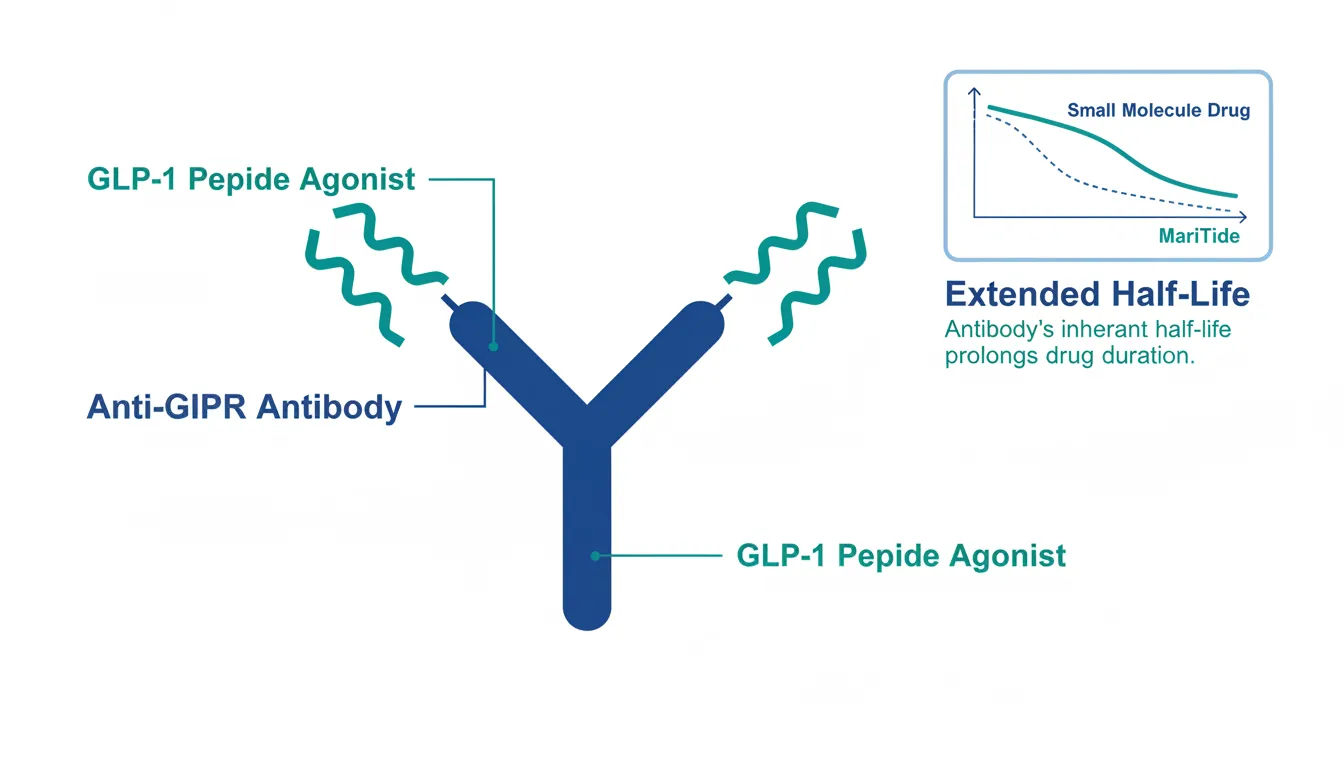
MariTide takes a completely different approach to achieving monthly dosing. It is an antibody-peptide conjugate consisting of:
- Anti-GIPR antibody (~150 kDa): A monoclonal antibody that blocks the GIP receptor
- Two GLP-1 peptide agonists: Attached to the antibody, providing GLP-1 receptor activation
- Total molecular weight: 153,514 Da
The antibody's inherent ~21-day half-life (typical of IgG antibodies) extends the pharmacokinetic profile to enable monthly or less frequent dosing.
Dual Mechanism#
Unlike MET-097i (which is a pure GLP-1 agonist), MariTide has a dual mechanism:
- GLP-1 receptor agonism: From the conjugated peptides, providing appetite suppression
- GIPR antagonism: From the antibody backbone, blocking GIP signaling
This creates an interesting pharmacological comparison with tirzepatide, which activates GIPR (agonism). MariTide achieves similar weight loss (~20%) by blocking GIPR (antagonism), demonstrating that GIP pathway modulation in either direction enhances GLP-1-mediated weight loss.
Phase 2 Results (NEJM, 2025)#
The Phase 2 trial enrolled 592 participants across 11 dose groups:
Cohort 1 (Obesity without T2D):
- Approximately 20% weight loss at 52 weeks at the highest dose
- No weight loss plateau at 52 weeks
- Monthly or less frequent dosing maintained efficacy
Cohort 2 (Obesity with T2D):
- Approximately 17% weight loss at 52 weeks
- HbA1c reduction up to 2.2 percentage points
Phase 3 MARITIME Program#
- 72-week chronic weight management studies
- Dosing intervals optimized based on Phase 2 dose-response
- Expected to generate pivotal data for regulatory submission
Key Advantages#
- True monthly dosing from the start -- No weekly titration period required
- Dual mechanism -- GLP-1 agonism plus GIPR antagonism in a single molecule
- Higher efficacy -- ~20% weight loss vs 12.3% for MET-097i (at different timepoints)
- Autoinjector delivery -- Patient-friendly device
Key Considerations#
- Immunogenicity -- As an antibody-based therapeutic, MariTide may elicit anti-drug antibodies
- Injection volume -- Large-molecule antibodies typically require larger injection volumes
- Cold chain -- Antibody therapeutics typically require refrigerated storage (2-8 C)
- Cost -- Antibody manufacturing is generally more expensive than peptide or small molecule manufacturing
Head-to-Head Comparison#
| Feature | MET-097i | MariTide |
|---|---|---|
| Company | Pfizer (acquired Metsera) | Amgen |
| Molecular format | Ultra-long-acting peptide/small molecule | Antibody-peptide conjugate |
| Molecular weight | Not disclosed | 153,514 Da |
| Half-life | Ultra-long | ~21 days |
| Mechanism | GLP-1 agonist (biased) | GLP-1 agonist + GIPR antagonist |
| Monthly dosing | After weekly titration | From treatment initiation |
| Weight loss | 12.3% (28 wk, PA) | ~20% (52 wk) |
| Phase | Phase 2b (Phase 3 planned) | Phase 2 / Phase 3 (MARITIME) |
| Tolerability | "Class-leading" | Consistent with GLP-1 class |
| Immunogenicity risk | Low (non-antibody) | Moderate (antibody component) |
| Storage | Likely room temperature | Likely refrigerated |
Monthly vs Weekly: Clinical Implications#
Titration Strategies#
The two monthly drugs take different approaches to titration:
- MET-097i: Weekly titration for 12 weeks, then monthly maintenance. This approach optimizes GI tolerability during dose escalation.
- MariTide: Monthly dosing from the start. The inherently lower peak-to-trough ratio of the antibody format may reduce peak-related GI effects.
Pharmacokinetic Considerations#
| Parameter | Weekly GLP-1 | MET-097i Monthly | MariTide Monthly |
|---|---|---|---|
| Peak-to-trough ratio | Higher | Moderate | Lower |
| Steady-state timing | ~4-5 weeks | After titration switch | ~3-4 months |
| Drug washout if AE | ~2-4 weeks | Longer | ~2-3 months |
| PK variability | Moderate | Low | Low |
The lower peak-to-trough ratio of monthly formulations may be a double-edged sword: it reduces peak-related GI side effects but means that adverse effects, once present, persist longer. For MariTide with its 21-day half-life, it would take approximately 2-3 months for the drug to substantially clear the system if adverse events occur.
The Adherence Impact#
Monthly dosing could fundamentally change treatment persistence. In other therapeutic areas (osteoporosis, contraception), monthly formulations have demonstrated superior adherence compared to daily or weekly alternatives. If monthly GLP-1 drugs maintain the efficacy of weekly formulations, the adherence benefit alone could improve real-world weight loss outcomes.
Beyond Monthly: Could Dosing Be Even Less Frequent?#
MariTide's Phase 2 data included dosing intervals even less frequent than monthly, raising the possibility of quarterly or biannual anti-obesity injections. While specific data on less-frequent dosing intervals have not been fully disclosed, the no-plateau weight loss curve at 52 weeks suggests sustained efficacy across extended dosing intervals.
Other approaches under investigation:
- Depot formulations: Slow-release injectable microspheres
- Implantable devices: Long-acting drug delivery implants
- Gene therapy: One-time treatments producing sustained GLP-1 expression
What to Watch#
- MET-097i Phase 3 initiation -- 10+ trials planned for 2026
- MariTide MARITIME readouts -- 72-week Phase 3 data
- Real-world adherence data -- Will monthly dosing translate to better persistence?
- Comparative tolerability -- How do monthly pharmacokinetic profiles affect GI side effects?
- Cost comparison -- Will monthly dosing affect per-treatment costs?
Conclusion#
Monthly GLP-1 dosing represents a potential paradigm shift in obesity treatment. MET-097i and MariTide offer two distinct molecular strategies to achieve the same goal: reducing injection frequency to improve patient adherence without sacrificing efficacy.
MET-097i brings ultra-long pharmacokinetics and biased agonism with the backing of Pfizer's resources. MariTide brings a dual-mechanism antibody approach with higher weight loss data and true monthly dosing from initiation. Both drugs are expected to generate Phase 3 data in 2026, which will establish whether monthly GLP-1 therapy can match or exceed the efficacy of weekly standards.
For patients who struggle with weekly injections -- whether due to needle anxiety, forgetfulness, travel, or simply preference -- monthly dosing could be the difference between staying on treatment and discontinuing.
This article is for educational and informational purposes only. It does not constitute medical advice.
References#
Related Peptide Profiles#
Learn more about the peptides discussed in this article:
- MET-097i Overview and Research Guide
- MET-097i Dosing Protocols
- MET-097i Side Effects and Safety
- MariTide Overview and Research Guide
- MariTide Dosing Protocols
- MariTide Side Effects and Safety
- Semaglutide Overview and Research Guide
- Semaglutide Dosing Protocols
- Semaglutide Side Effects and Safety
- Tirzepatide Overview and Research Guide
- Tirzepatide Dosing Protocols
- Tirzepatide Side Effects and Safety

Frequently Asked Questions About Monthly GLP-1 Injections: How MET-097i and MariTide Could Change Treatment
What does this article cover?
A research review of ultra-long-acting monthly GLP-1 injections, covering MET-097i (PF-08653944) and MariTide, how extended dosing intervals improve adherence, and clinical trial data. This research review is for educational purposes only and does not constitute medical advice.
Which peptides are discussed in this article?
This article covers MET-097i, MariTide, Semaglutide, Tirzepatide. Key context: MET-097i (Ultra-long-acting GLP-1 agonist with monthly dosing from weekly titration, 12.3% weight loss at 2...); MariTide (Antibody-peptide conjugate enabling monthly dosing via 21-day half-life, ~20% weight loss at 52 w...); Semaglutide (Weekly GLP-1 benchmark for comparing adherence and dosing frequency advantages). Each peptide is discussed based on available research evidence.
What level of evidence does this research review cover?
This research review examines published preclinical and clinical studies related to the peptides discussed. Evidence quality varies between peptides and indications. The article distinguishes between FDA-approved uses and investigational applications where applicable.
What are the key takeaways from this article?
The main findings covered in this article include: Ultra-long-acting GLP-1 agonist with monthly dosing from weekly titration, 12.3% weight loss at 2.... Antibody-peptide conjugate enabling monthly dosing via 21-day half-life, ~20% weight loss at 52 w.... Weekly GLP-1 benchmark for comparing adherence and dosing frequency advantages. These takeaways are based on the research data available at the time of publication.
What is MET-097i and why is it significant?
MET-097i is a peptide discussed in this article because: Ultra-long-acting GLP-1 agonist with monthly dosing from weekly titration, 12.3% weight loss at 28 weeks. For a complete profile of MET-097i, see the dedicated peptide page on this site.
Continue reading this research review
Free access to the complete analysis with citations and evidence ratings.
150+ peptide profiles · 30+ comparisons · 18 research tools
Medical Disclaimer
This website is for educational and informational purposes only. The information provided is not intended to diagnose, treat, cure, or prevent any disease. Always consult with a qualified healthcare professional before using any peptide or supplement.
Join 2,000+ researchers getting biweekly updates
Enjoyed this article?
The Research Briefing delivers deep-dives like this biweekly — plus new study breakdowns, safety updates, and tool announcements.
Free forever. No spam. Unsubscribe in one click.
Where to Find These Peptides
Continue Exploring
Peptide Profiles
Keep Reading

GLP-1 Drugs Ranked by Weight Loss: 2026 Data Comparison
Every GLP-1 and incretin drug ranked by clinical weight loss data as of 2026, from retatrutide at 28.7% to oral orforglipron at 11.2%, with comparison tables and trial details.
Is Prescott Bio Canada Legit? Independent 2026 Review
Is Prescott Bio Canada legit? Independent 2026 review of the Calgary-based Canadian research peptide supplier: Richmond BC fulfillment, HPLC and mass spectrometry testing, plain CAD pricing, 2-4 day domestic shipping, Stripe card checkout, and community reputation.

Finnrick Analytics Review: Transparency Concerns and Conflicts of Interest (2026)
Is Finnrick Analytics trustworthy? We examine COI gaps, vendor pay-for-play, 15% lab discrepancies, and their astroturfing job listing. Full analysis.
You Might Also Like
Related content you may find interesting