Dihexa vs Semax: Nootropic Peptides for Cognitive Enhancement
Comparison of dihexa and semax, two nootropic peptides with different mechanisms, evidence levels, and regulatory status for cognitive enhancement and neuroprotection.
Verdict at a Glance
Semax is the substantially more evidence-based choice, with decades of clinical use in Russia, multiple human trials, regulatory approval, and a well-characterized safety profile. Dihexa has a fascinating preclinical mechanism (HGF/c-Met pathway activation for synaptogenesis) but zero human clinical data. For anyone considering a nootropic peptide, semax offers proven safety and established dosing, while dihexa remains an intriguing but unvalidated research compound with unknown human safety.
| Best for | Pick | Why |
|---|---|---|
| Established Safety and Clinical Use | Semax | Approved in Russia for clinical use since the 1990s with decades of safety data. Multiple human clinical trials in stroke and cognitive disorders. The only option with human evidence. |
| Non-Invasive Administration | Semax | Semax's intranasal spray delivery is non-invasive, well-tolerated, and easily self-administered. Dihexa typically requires subcutaneous injection in research settings. |
| Stroke Recovery | Semax | Semax has been studied and approved in Russia specifically for stroke recovery, with clinical data supporting neuroprotective effects in cerebral ischemia. |
| Synaptogenesis Research | Dihexa | Dihexa's mechanism of promoting new synaptic connections through HGF/c-Met activation is unique among nootropic peptides. For researchers studying synaptogenesis, dihexa is a valuable preclinical tool. |
| Preclinical Research on Neurodegeneration | Dihexa | Dihexa has shown remarkable potency in animal models of cognitive impairment and may be valuable for preclinical research into neurodegenerative disease mechanisms. |
| Category | Dihexa | Semax | Advantage |
|---|---|---|---|
| Mechanism of Action | Angiotensin IV analog that acts as a potent hepatocyte growth factor (HGF) receptor (c-Met) agonist. Promotes synaptogenesis and dendritic spine formation. Described as 10-million-fold more potent than BDNF in promoting new synaptic connections in preclinical models. | Synthetic analog of ACTH(4-10), the biologically active fragment of adrenocorticotropic hormone. Modulates BDNF and NGF expression, enhances monoaminergic neurotransmission, and provides neuroprotective effects. Approved in Russia for clinical use. | Comparable |
| Research Evidence | Preclinical only. Primarily based on the work of Harding, Wright, and colleagues at Washington State University. No human clinical trials conducted. Animal data shows potent pro-cognitive effects in aged rats and scopolamine-impaired models. | Approved in Russia since the 1990s for stroke recovery and cognitive enhancement. Multiple human clinical trials in stroke, TBI, and cognitive disorders. Decades of clinical use in Russian medicine. Limited Western peer-reviewed data. | Semax |
| Side Effect Profile | No human safety data available. Theoretical concerns include uncontrolled c-Met activation (oncogenic pathway in some contexts) and unknown long- term effects. Completely uncharacterized safety profile in humans. | Well-tolerated in decades of Russian clinical use. Mild nasal irritation (intranasal route). No significant systemic adverse effects reported. One of the better-characterized nootropic peptides for safety due to its regulatory approval and clinical history. | Semax |
| Administration | Typically administered subcutaneously in research contexts. Small hexapeptide (6 amino acids) with oral bioavailability reported in animal studies. No standardized dosing protocols. Research chemical only. | Administered intranasally via nasal spray (primary route) or subcutaneously. Well-established intranasal dosing protocol (200-600 mcg daily). Available as a pharmaceutical product in Russia. Non-invasive nasal delivery is a practical advantage. | Semax |

Introduction#
Dihexa and semax are both peptides investigated for cognitive enhancement and neuroprotection, but they occupy very different positions in the evidence hierarchy. Semax is a synthetic ACTH analog approved in Russia since the 1990s for stroke recovery and cognitive enhancement, with decades of clinical use. Dihexa is a preclinical research compound with a novel mechanism of action (HGF/c-Met pathway activation) that has shown extraordinary potency in animal models but has never been tested in humans.
This comparison highlights a common tension in the nootropic peptide space: mechanism-of-action novelty versus clinical evidence. Dihexa's preclinical data is scientifically fascinating, while semax's regulatory approval and clinical history provide practical reassurance.
Mechanism of Action Comparison#
Dihexa#
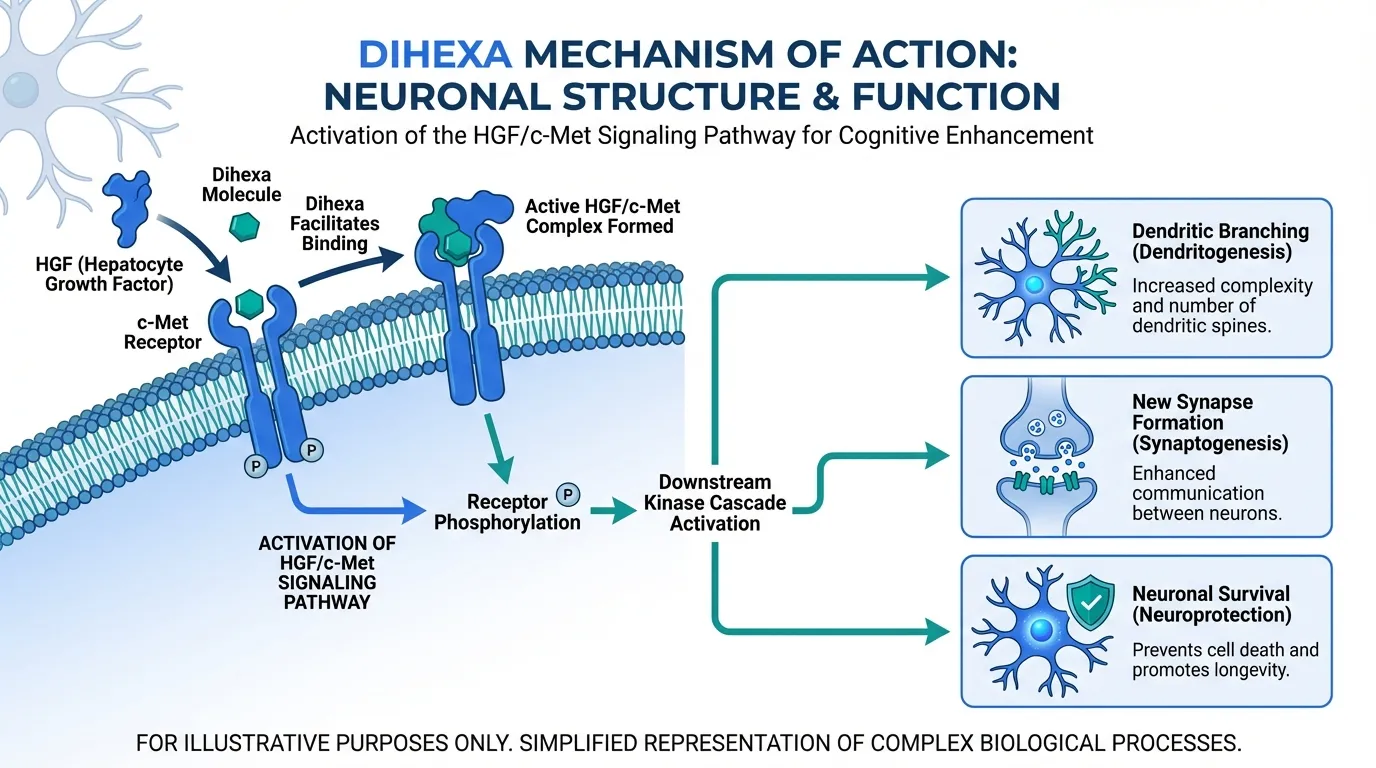
Dihexa (N-hexanoic-Tyr-Ile-(6) aminohexanoic amide) is an angiotensin IV analog that was discovered to be a potent agonist of the hepatocyte growth factor (HGF) receptor, c-Met. Its primary mechanism involves:
- c-Met activation: Dihexa binds to and activates the HGF/c-Met signaling pathway, which promotes neuronal survival, dendritic branching, and new synapse formation
- Synaptogenesis: In preclinical models, dihexa promoted the formation of new functional synaptic connections, an effect described as approximately 10-million-fold more potent than BDNF on a molar basis
- Cognitive restoration: In aged rats and scopolamine-impaired models, dihexa restored cognitive performance to levels comparable to young animals
The c-Met pathway is a potent growth and survival pathway that, in the brain, promotes neuroplasticity. However, c-Met is also involved in cancer biology, which raises theoretical safety concerns about chronic activation.
Semax#
Semax (Met-Glu-His-Phe-Pro-Gly-Pro) is a synthetic heptapeptide analog of the ACTH(4-10) fragment. Unlike full-length ACTH, semax does not stimulate adrenal cortisol production. Its mechanisms include:
- Neurotrophin modulation: Upregulates expression of BDNF and NGF in the brain, promoting neuronal survival and plasticity
- Monoaminergic enhancement: Modulates dopaminergic and serotonergic neurotransmission
- Neuroprotection: Reduces oxidative stress and neuroinflammation in ischemic brain tissue
- Immune modulation: Has documented immunomodulatory properties beyond pure cognitive effects
Mechanistic Comparison#
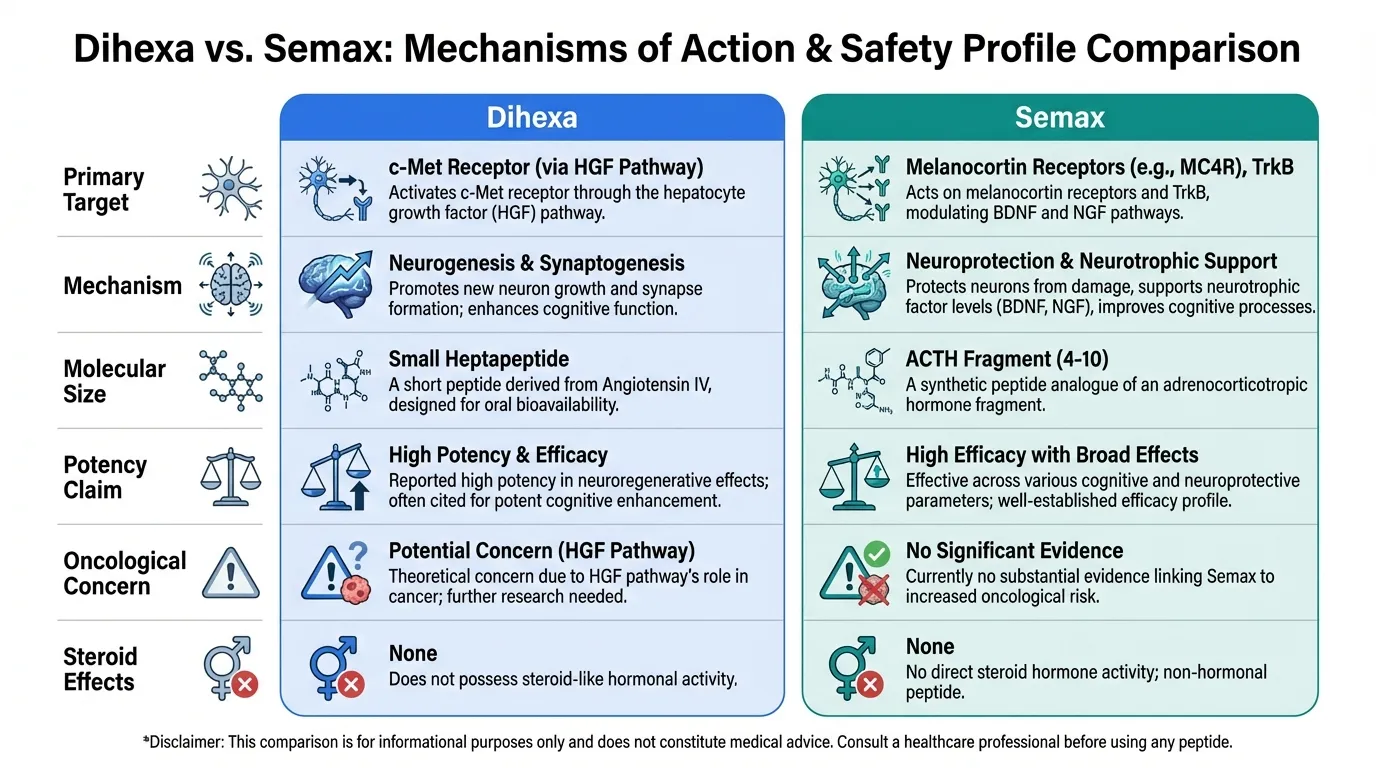
| Feature | Dihexa | Semax |
|---|---|---|
| Primary target | HGF/c-Met receptor | BDNF/NGF expression, monoamine modulation |
| Mechanism | Synaptogenesis via growth factor pathway | Neurotrophin upregulation + neuroprotection |
| Molecular size | Hexapeptide (6 amino acids) | Heptapeptide (7 amino acids) |
| Potency claim | 10-million-fold > BDNF (preclinical) | Moderate enhancement of endogenous systems |
| Oncological concern | c-Met is a known oncogene | No known oncological concerns |
| Steroid effects | None | None (unlike full-length ACTH) |
Dosing Comparison#
Dihexa Dosing#
No standardized human dosing exists. Research contexts have used:
- Subcutaneous: Doses in the low microgram range (extrapolated from animal studies)
- Oral: Animal studies suggest oral bioavailability, but no human PK data
- Duration: Unknown optimal treatment duration
Semax Dosing#
Well-established clinical dosing (Russian protocols):
- Intranasal: 200-600 mcg daily, divided into 2-3 administrations
- Stroke/TBI: Higher doses up to 12 mg daily have been used in acute settings
- Duration: Typically 10-14 day courses, repeated as needed
- Available formulation: 0.1% and 1% nasal spray solutions
Side Effects Comparison#
Dihexa Side Effects#
No human safety data exists. Theoretical concerns include:
- c-Met oncogenic potential: The HGF/c-Met pathway is a known driver of certain cancers. Chronic systemic c-Met activation could theoretically promote tumor growth, though this has not been observed in animal studies at nootropic doses
- Unknown systemic effects: Without human trials, effects on liver, kidney, cardiovascular, and reproductive systems are completely unknown
- Unknown drug interactions: No interaction data available
Semax Side Effects#
Based on decades of clinical use in Russia:
- Common: Mild nasal mucosa irritation (intranasal route)
- Uncommon: Transient headache, dizziness
- Rare: No serious adverse events consistently reported
- No corticosteroid effects: Despite being derived from ACTH, semax does not stimulate cortisol production
- No dependence/tolerance: No evidence of dependence or withdrawal effects
Research Evidence Comparison#
Dihexa Research#
- Harding et al. (2013): Demonstrated that dihexa augments c-Met signaling and restores cognitive function in aged rats. Published in Journal of Pharmacology and Experimental Therapeutics
- Synaptogenesis: Showed promotion of new functional synaptic connections in hippocampal neurons
- Scopolamine model: Reversed scopolamine-induced cognitive impairment in rats
- No human trials: Zero published human clinical data
Evidence level: Very low -- preclinical animal data only from a single research group.
Semax Research#
- Russian clinical trials: Multiple trials in stroke recovery, traumatic brain injury, and cognitive disorders
- Regulatory approval: Approved in Russia for clinical use (stroke, cognitive enhancement)
- Clinical experience: Decades of use in Russian healthcare system
- Western data: Limited but growing body of literature; some studies published in international journals
- Mechanistic studies: BDNF and NGF upregulation confirmed in both animal and human studies
Evidence level: Moderate -- regulatory approval and clinical use in Russia, but limited Western-standard RCTs.
Key Differences Summary#
- Human evidence: Semax has decades of clinical use and regulatory approval. Dihexa has zero human data.
- Safety profile: Semax is well-characterized as safe through clinical experience. Dihexa has theoretical oncological concerns (c-Met pathway) and an unknown safety profile.
- Route of administration: Semax uses non-invasive intranasal delivery. Dihexa requires injection or has uncharacterized oral PK.
- Mechanism novelty: Dihexa's HGF/c-Met synaptogenesis mechanism is unique and scientifically compelling. Semax's neurotrophin modulation is better understood but less novel.
- Regulatory status: Semax is a regulated pharmaceutical in Russia. Dihexa is a research chemical with no regulatory status anywhere.
- Availability: Semax is commercially available in Russia and through international suppliers. Dihexa is available only through research chemical suppliers.
Conclusion#
For practical cognitive enhancement applications, semax is the clear evidence-based choice. Its decades of clinical use in Russia, intranasal delivery convenience, well-characterized safety profile, and established dosing protocols make it the more responsible option. The lack of extensive Western-standard RCTs is a limitation, but the regulatory approval and clinical history provide meaningful safety assurance.
Dihexa occupies a different space -- it is a fascinating research compound with a uniquely potent mechanism for promoting synaptogenesis. Its preclinical data is scientifically compelling, and the HGF/c-Met pathway represents a novel target for cognitive enhancement. However, the complete absence of human data and the theoretical concerns about chronic c-Met activation mean that dihexa should be considered an experimental research tool rather than a practical nootropic option.
The two peptides are better viewed as complementary rather than competing: semax for evidence-based clinical application, and dihexa for preclinical research into novel synaptogenic mechanisms.
Further Reading#

Which Is Better For...
Established Safety and Clinical Use
Semax
Approved in Russia for clinical use since the 1990s with decades of safety data. Multiple human clinical trials in stroke and cognitive disorders. The only option with human evidence.
Non-Invasive Administration
Semax
Semax's intranasal spray delivery is non-invasive, well-tolerated, and easily self-administered. Dihexa typically requires subcutaneous injection in research settings.
Stroke Recovery
Semax
Semax has been studied and approved in Russia specifically for stroke recovery, with clinical data supporting neuroprotective effects in cerebral ischemia.
Synaptogenesis Research
Dihexa
Dihexa's mechanism of promoting new synaptic connections through HGF/c-Met activation is unique among nootropic peptides. For researchers studying synaptogenesis, dihexa is a valuable preclinical tool.
Preclinical Research on Neurodegeneration
Dihexa
Dihexa has shown remarkable potency in animal models of cognitive impairment and may be valuable for preclinical research into neurodegenerative disease mechanisms.
Continue Your Research
Get comparison updates
We publish new head-to-head comparisons regularly. Subscribe to see them first.
Frequently Asked Questions About Dihexa vs Semax: Nootropic Peptides for Cognitive Enhancement
Which is better, Dihexa or Semax?
Semax is the substantially more evidence-based choice, with decades of clinical use in Russia, multiple human trials, regulatory approval, and a well-characterized safety profile. Dihexa has a fascinating preclinical mechanism (HGF/c-Met pathway activation for synaptogenesis) but zero human clinical data. For anyone considering a nootropic peptide, semax offers proven safety and established dosing, while dihexa remains an intriguing but unvalidated research compound with unknown human safety. Individual responses may vary, and this comparison is based on available research data, not a treatment recommendation.
What are the key differences between Dihexa and Semax?
The main differences across comparison categories are: Mechanism of Action: advantage goes to neither (tie); Research Evidence: advantage goes to Semax; Side Effect Profile: advantage goes to Semax. 1 additional categories are analyzed in the full comparison. Each category evaluates a different dimension of the two peptides.
When should I consider Semax over Dihexa?
For the scenario of "Established Safety and Clinical Use," research data suggests Semax may be more relevant. Approved in Russia for clinical use since the 1990s with decades of safety data. Multiple human clinical trials in stroke and cognitive disorders. The only option with human evidence.. This is based on currently available evidence and individual circumstances may differ.
How do Dihexa and Semax differ in their mechanisms of action?
Dihexa: Angiotensin IV analog that acts as a potent hepatocyte growth factor (HGF) receptor (c-Met) agonist. Promotes synaptogenesis and dendritic spine formation. Described as 10-million-fold more potent .... Semax: Synthetic analog of ACTH(4-10), the biologically active fragment of adrenocorticotropic hormone. Modulates BDNF and NGF expression, enhances monoaminergic neurotransmission, and provides neuroprote....
Which has fewer side effects, Dihexa or Semax?
In terms of side effects and tolerability, the advantage goes to Semax. Dihexa: No human safety data available. Theoretical concerns include uncontrolled c-Met activation (oncogenic pathway in some contexts) and unknown long- t.... Semax: Well-tolerated in decades of Russian clinical use. Mild nasal irritation (intranasal route). No significant systemic adverse effects reported. One ....
Medical Disclaimer
This website is for educational and informational purposes only. The information provided is not intended to diagnose, treat, cure, or prevent any disease. Always consult with a qualified healthcare professional before using any peptide or supplement.