Peptides for Brain Injury and Neuroprotection: TBI, Stroke, and Neurodegeneration Research

Introduction#
Brain injuries -- whether acute (traumatic brain injury, ischemic stroke) or chronic (neurodegenerative diseases) -- share overlapping pathological cascades: excitotoxicity, oxidative stress, neuroinflammation, blood-brain barrier disruption, and ultimately neuronal death. Despite decades of research and hundreds of clinical trials, therapeutic options for limiting brain damage and promoting neural recovery remain limited. This has driven interest in neuroprotective peptides: short amino acid sequences that may support neuronal survival and recovery through diverse mechanisms.
This review examines the research evidence for five peptides studied in the context of brain injury and neuroprotection. The evidence ranges substantially -- from Semax, which is an approved medication for stroke in Russia, to Dihexa, which has only preclinical data with notable retraction concerns. For each compound, we distinguish clearly between human clinical data and animal/cell culture evidence, note regulatory status, and identify the key gaps in the research base.
Semax: From Russian Stroke Wards to Neuroscience Labs#
Clinical Context#
Semax holds a unique position among neuroprotective peptides: it is an approved pharmaceutical product for ischemic stroke treatment in Russia, listed on the Russian List of Vital and Essential Drugs. This approval is based on Russian clinical trials conducted from the 1990s onward, making Semax one of very few peptides with actual clinical neuroprotection data, albeit primarily from a single national regulatory framework.
Semax is a synthetic heptapeptide (Met-Glu-His-Phe-Pro-Gly-Pro) derived from the ACTH(4-7) fragment. Critically, it retains the neurotrophic and neuroprotective properties of ACTH fragments while lacking adrenocortical hormonal activity -- it does not stimulate cortisol release at therapeutic doses.
Mechanism of Neuroprotection#
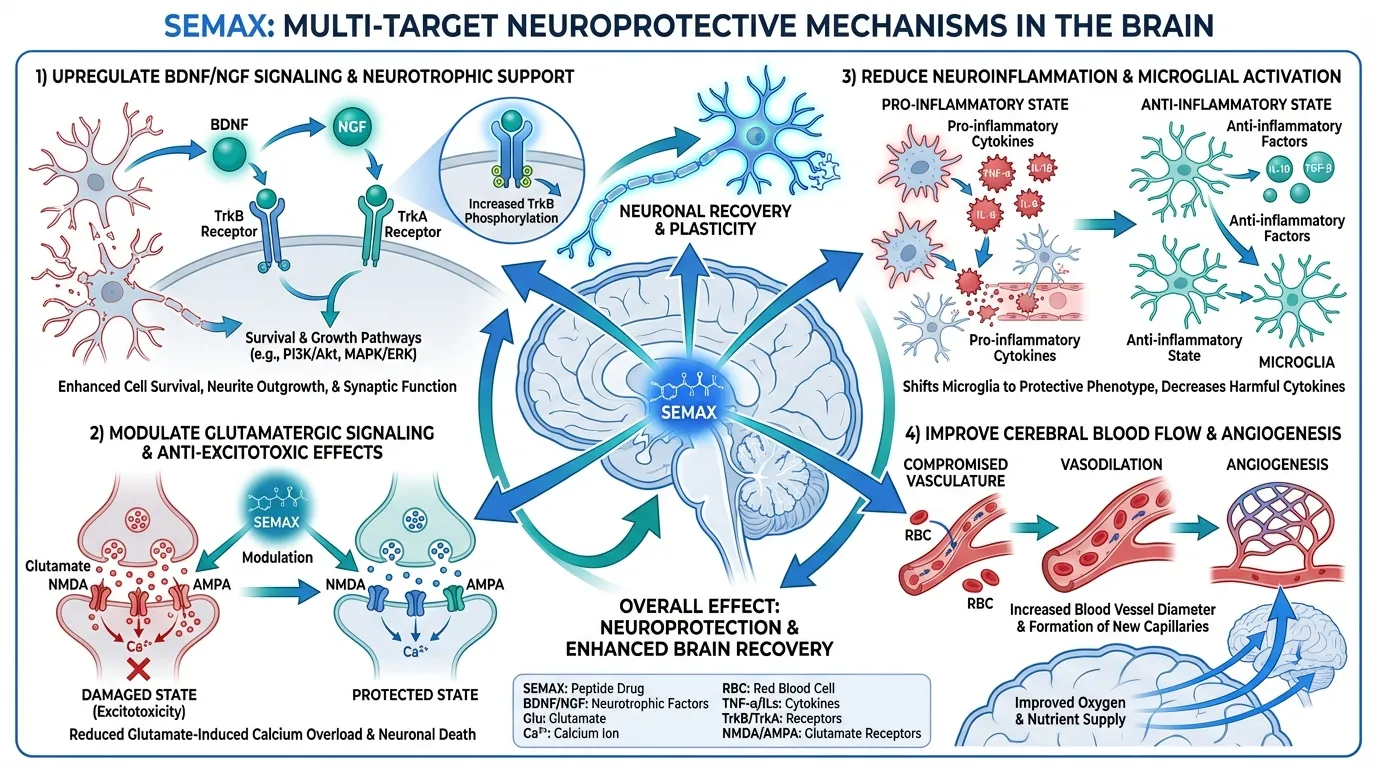
Semax's neuroprotective effects operate through multiple converging pathways:
Neurotrophic factor upregulation. Semax robustly upregulates BDNF and NGF in the brain. Dolotov et al. demonstrated that a single intranasal dose (50 mcg/kg) produces a 1.4-fold increase in BDNF protein and a 1.6-fold increase in TrkB phosphorylation in the rat hippocampus. This neurotrophic support is critical in the penumbral zone around ischemic lesions, where neurons are damaged but potentially salvageable.
Anti-excitotoxic effects. During ischemic stroke, excessive glutamate release causes excitotoxic neuronal death. Semax has been shown to modulate glutamatergic signaling and reduce excitotoxic damage in animal models of cerebral ischemia.
Neuroinflammation modulation. Semax activates broad transcription programs affecting genes involved in inflammation, apoptosis, and vascular remodeling. This includes modulation of cytokine expression and microglial activation states, which are key determinants of secondary injury following stroke.
Vascular effects. Some research suggests Semax may improve cerebral blood flow in the ischemic penumbra, potentially through effects on vascular endothelial function and angiogenic signaling.
Human Evidence for Stroke#
Semax has been used in Russian clinical stroke care at high doses (3-6 mg intranasally, 2-4 times daily) administered within hours of ischemic stroke onset. Russian clinical studies have reported improved neurological outcomes including better scores on standard neurological deficit scales, faster recovery of motor and cognitive function, and reduced infarct volume on neuroimaging.
However, these results must be interpreted with important caveats:
- Most clinical studies were conducted within the Russian regulatory framework and published in Russian-language journals, limiting their accessibility for independent review.
- Study designs have varied, and not all studies meet current international standards for randomized, double-blind, placebo-controlled methodology.
- Semax has never been submitted to the FDA or EMA for stroke treatment, and no international multicenter trials have been conducted.
- The positive results have not been independently replicated by research groups outside Russia and the CIS countries.
Beyond Stroke: Other Neurological Applications#
Beyond acute stroke, Semax is approved in Russia for cognitive disorders and optic nerve disease. Preclinical research has explored its potential in traumatic brain injury models, where its BDNF-upregulating and anti-inflammatory properties may support recovery from diffuse axonal injury and contusional damage. However, TBI-specific clinical data for Semax is limited.
Evidence Rating#
Human clinical data: Moderate (Russian approval for stroke based on domestic clinical trials; limited international replication) Preclinical neuroprotection data: Strong (extensive mechanistic characterization, multiple animal models) Regulatory status: Approved in Russia and Ukraine; not FDA/EMA approved
Davunetide: Lessons from a Landmark Failure#
The ADNP Connection#
Davunetide (NAP, AL-108, CP201) is an octapeptide (NAPVSIPQ) derived from activity-dependent neuroprotective protein (ADNP), one of the most highly expressed neuroprotective factors in the brain. ADNP is essential for brain development -- ADNP-knockout mice die in utero -- and mutations in the ADNP gene cause ADNP syndrome, a rare neurodevelopmental disorder characterized by intellectual disability, autism spectrum features, and global developmental delay.
Davunetide represents the minimal active fragment of ADNP, retaining its neuroprotective properties in a clinically deliverable form. Its primary mechanism is microtubule stabilization: davunetide interacts with tubulin to stabilize the microtubule network, which is critical for axonal transport, neuronal morphology, and synaptic function.
The PSP Trial: A Pivotal Negative Result#
Davunetide's most significant clinical moment was a phase 2/3 trial in progressive supranuclear palsy (PSP), a devastating tauopathy characterized by progressive motor and cognitive decline. PSP was chosen because it involves tau protein aggregation and microtubule dysfunction -- processes directly relevant to davunetide's mechanism of action.
The trial, led by Boxer et al. and published in 2014, enrolled 313 patients with probable PSP who received either intranasal davunetide (30 mg twice daily) or placebo for 52 weeks. The results were unambiguously negative: davunetide showed no significant difference from placebo on either co-primary endpoint (the PSP Rating Scale and the Schwab and England Activities of Daily Living Scale).
This failure had multiple consequences:
- Allon Therapeutics, the developer, became insolvent and was acquired by Paladin Labs in 2013.
- The PSP research community refocused on alternative therapeutic strategies.
- Questions were raised about whether microtubule stabilization alone is sufficient to modify disease course in established tauopathies.
Why Did It Fail?#
Several hypotheses have been proposed for the PSP trial failure:
Disease-stage mismatch. PSP patients enrolled in the trial had established disease with substantial neuronal loss. Microtubule stabilization may be more relevant for preventing neurodegeneration than reversing it. By the time clinical PSP is diagnosed, the pathological process may be too advanced for neuroprotective intervention.
Insufficient CNS exposure. While intranasal davunetide achieves some CNS penetration, the actual brain concentrations achieved in the trial may have been insufficient for therapeutic effect, particularly in deep brain structures most affected in PSP.
Wrong disease target. PSP is a complex tauopathy involving multiple pathological mechanisms beyond microtubule dysfunction. Addressing only one component of a multifactorial disease process may be insufficient.
The ADNP Syndrome Pivot#
Despite the PSP failure, davunetide's story continues. In 2021, ExoNavis licensed the compound from Tel Aviv University and in 2024 initiated a phase 3 trial for children with ADNP syndrome. This represents a fundamentally different therapeutic strategy: rather than trying to modify a complex neurodegenerative disease in adults, the ADNP syndrome trial targets a monogenic disorder where the compound directly replaces the function of the mutated gene product.
This pivot illustrates an important principle in neuroprotective drug development: the same compound may fail in one indication and succeed in another, depending on the match between mechanism and disease biology.
Evidence Rating#
Human clinical data: Substantial but negative for PSP (well-designed phase 2/3 trial with 313 patients) Preclinical neuroprotection data: Strong (extensive in vitro and in vivo evidence for microtubule stabilization and neuroprotection) Current status: Active development for ADNP syndrome (phase 3, 2024)
BPC-157: Neuroprotection Through the Gut-Brain Axis#
A Healing Peptide with Brain Effects#
BPC-157 (Body Protection Compound-157) is a synthetic pentadecapeptide derived from a protective protein found in human gastric juice. It is best known for its preclinical tissue-healing properties -- tendon repair, gastrointestinal protection, wound healing -- but a growing body of animal research has explored its neuroprotective effects, particularly in models of traumatic brain injury and ischemic brain damage.
BPC-157's entry into neuroprotection research is notable because it was not designed as a brain-targeting compound. Rather, its neuroprotective effects appear to emerge from its broader cytoprotective and angiogenic properties, including modulation of the gut-brain axis, nitric oxide (NO) system regulation, and promotion of growth factor expression.
Preclinical Neuroprotection Evidence#
Traumatic brain injury models. Several rodent studies have examined BPC-157 in TBI models, reporting reduced brain edema, decreased contusion volume, improved behavioral outcomes on neurological scoring, and reduced neuroinflammatory markers. These findings suggest a multi-target neuroprotective profile involving anti-inflammatory, anti-edema, and vascular protective effects.
Ischemic stroke models. BPC-157 has been studied in middle cerebral artery occlusion (MCAO) models, where it demonstrated reduced infarct volume and improved functional recovery when administered systemically. The mechanism appears to involve modulation of the NO system -- BPC-157 interacts with both endothelial NOS (eNOS) and inducible NOS (iNOS), promoting beneficial NO signaling while limiting NO-mediated excitotoxicity.
Dopaminergic neuroprotection. BPC-157 has shown protective effects in animal models of dopaminergic neurotoxicity, including protection against MPTP-induced dopamine depletion (a model of Parkinson's disease). These effects appear mediated through modulation of dopamine system function and reduction of oxidative stress.
Gut-brain axis mediation. A distinctive feature of BPC-157's neuroprotective profile is the proposed involvement of the gut-brain axis. BPC-157 has potent gastroprotective effects, and some research suggests its CNS effects may be partially mediated by vagal afferents and enteric nervous system signaling. This mechanism, while scientifically plausible, remains largely speculative.
Critical Evidence Limitations#
Despite the breadth of preclinical data, BPC-157's neuroprotection evidence has significant limitations:
- No human clinical trials. BPC-157 has never been tested in humans for any neurological indication. All neuroprotection data comes from rodent studies.
- Lack of independent replication. Much of BPC-157's published neuroprotection data comes from a single research group at the University of Zagreb, led by Predrag Sikiric. While the work is extensive and mechanistically detailed, broader replication by independent groups is needed.
- Route and dose translation. Animal studies use systemic (intraperitoneal) administration at doses that may not translate to practical human routes and doses. Blood-brain barrier penetration has not been rigorously quantified.
- FDA regulatory action. In 2023, the FDA categorized BPC-157 as a compound that does not meet the criteria for use under sections 503A/503B of the Federal Food, Drug, and Cosmetic Act, limiting its availability through compounding pharmacies in the US.
Evidence Rating#
Human clinical data: None for neurological indications Preclinical neuroprotection data: Moderate (extensive animal data, limited independent replication) Regulatory status: Not approved; FDA restrictions on compounding (2023)
Pinealon: Bioregulator Neuroprotection#
The Khavinson Bioregulator Approach#
Pinealon (Glu-Asp-Arg, EDR) is a synthetic tripeptide developed as part of Vladimir Khavinson's bioregulator peptide research program at the St. Petersburg Institute of Bioregulation and Gerontology. The bioregulator hypothesis proposes that ultrashort peptides (2-4 amino acids) can penetrate cells, interact with DNA sequences, and modulate gene expression in tissue-specific patterns.
Pinealon is designated as a CNS-targeted bioregulator, with research focused on its potential neuroprotective and cognitive-enhancing properties. Its neuroprotective mechanism is proposed to involve epigenetic modulation of gene expression related to neuronal survival, stress responses, and antioxidant defenses.
Preclinical Evidence#
Cellular models. In neuronal cell cultures, pinealon has demonstrated protective effects against oxidative stress-induced cell death. Studies report that pinealon treatment upregulates expression of genes involved in antioxidant defense and anti-apoptotic signaling, consistent with the bioregulator hypothesis of gene expression modulation.
In silico and biophysical studies. Computational and biophysical studies have investigated how a tripeptide as small as pinealon could modulate gene expression. Some evidence supports the ability of short peptides to interact with DNA double-helix structures, though the specificity and functional significance of these interactions remain debated.
Animal models. Limited animal studies have explored pinealon's effects on cognitive function in aging and neurodegeneration models. Results suggest modest improvements in learning and memory tasks, though study designs and reporting standards vary.
Evidence Limitations#
Pinealon represents the most preliminary stage of evidence among the compounds reviewed here:
- The bioregulator peptide concept, while scientifically interesting, has not been widely validated outside the Khavinson research group.
- The mechanistic claim that a tripeptide can achieve tissue-specific gene expression modulation is extraordinary and requires extraordinary evidence that has not yet been provided.
- No clinical trials for neuroprotection or brain injury have been conducted.
- The compound's pharmacokinetics (absorption, distribution, brain penetration, half-life) have not been rigorously characterized.
Evidence Rating#
Human clinical data: None for neuroprotection Preclinical neuroprotection data: Limited (cell culture and small animal studies, single research group) Regulatory status: Not approved anywhere; research compound
Dihexa: Preclinical Promise with Significant Caveats#
HGF/c-Met Pathway and Neurodegeneration#
Dihexa (PNB-0408) is a small oligopeptide derived from angiotensin IV, developed at Washington State University. Unlike other neuroprotective peptides that work through BDNF, microtubule stabilization, or anti-inflammatory mechanisms, Dihexa operates through a distinctive pathway: potentiation of hepatocyte growth factor (HGF) signaling at the c-Met receptor.
HGF/c-Met signaling promotes synaptogenesis (formation of new synapses), spinogenesis (growth of dendritic spines), and neuronal survival. Dihexa binds HGF with high affinity and augments its ability to activate c-Met at concentrations far below normal thresholds. In neurotrophic assays, Dihexa demonstrated activity approximately seven orders of magnitude more potent than BDNF -- a remarkable finding that generated significant research interest.
Preclinical Evidence in Neurodegeneration Models#
Dihexa's neuroprotection and cognitive enhancement data comes exclusively from animal studies:
Aged rat cognitive restoration. The foundational studies, conducted by Harding, Wright, and colleagues at Washington State University, demonstrated that Dihexa restored cognitive function in aged rats to levels comparable to young animals in water maze tasks. The compound was effective when administered orally -- an unusual feature for a peptide, attributed to its small size and favorable oral bioavailability (approximately 38%).
Scopolamine-induced cognitive impairment. Dihexa reversed the cognitive deficits induced by scopolamine (an anticholinergic agent that impairs memory) in rodent models, suggesting relevance to cholinergic aspects of neurodegenerative disease.
Synaptogenesis promotion. In hippocampal neuron cultures, Dihexa promoted the formation of new synaptic connections, providing a cellular-level mechanism for its cognitive effects.
The Retraction Problem#
A critical caveat for Dihexa's evidence base is that a key 2014 publication supporting its mechanism was retracted due to data integrity concerns, specifically related to data fabrication. While the retraction does not necessarily invalidate all of Dihexa's research -- other publications from the group remain intact -- it introduces significant uncertainty about the reliability of some foundational claims.
This retraction, combined with the complete absence of human data, means that Dihexa's neuroprotective potential should be viewed as preliminary and requiring independent validation before any clinical conclusions can be drawn.
Oncological Safety Concerns#
An additional consideration specific to Dihexa's mechanism is the role of HGF/c-Met signaling in cancer biology. The HGF/c-Met pathway is a well-characterized oncogenic signaling axis, and c-Met is a therapeutic target in multiple cancers. While short-term activation of this pathway for neuroprotection may not pose cancer risk, long-term or repeated administration raises theoretical concerns that have not been experimentally addressed.
Evidence Rating#
Human clinical data: None Preclinical neuroprotection data: Moderate (animal cognitive data, but compromised by retraction of key publication) Regulatory status: Not approved; preclinical research compound
Comparative Evidence Summary#
| Peptide | Human Data | Animal Data | Key Mechanism | Strongest Evidence For | Major Limitation |
|---|---|---|---|---|---|
| Semax | Russian clinical trials (stroke) | Extensive | BDNF/NGF upregulation | Acute ischemic stroke recovery | No international clinical trials |
| Davunetide | Phase 2/3 (PSP, negative) | Extensive | Microtubule stabilization | ADNP syndrome (current trial) | Failed pivotal PSP trial |
| BPC-157 | None | Moderate | NO system, cytoprotection | Preclinical TBI models | Single research group, no human data |
| Pinealon | None | Limited | Epigenetic modulation | Cell culture neuroprotection | Weak evidence base, unvalidated mechanism |
| Dihexa | None | Moderate | HGF/c-Met potentiation | Aged rat cognitive restoration | Key paper retracted, oncology concerns |
The Translational Gap in Neuroprotection Research#
The peptides reviewed here illustrate a broader challenge in neuroprotection research: the persistent gap between preclinical promise and clinical success. Dozens of compounds have shown neuroprotective effects in animal models of stroke, TBI, and neurodegeneration, yet very few have translated into effective clinical therapies.
Several factors contribute to this translational gap:
Timing of intervention. Many neuroprotective agents work best when administered early in the injury cascade. In clinical settings, patients with stroke or TBI often present hours after injury onset, potentially outside the therapeutic window demonstrated in animal studies.
Complexity of human disease. Animal models capture specific aspects of brain injury but rarely reproduce the full complexity of human pathology. The heterogeneity of TBI (ranging from mild concussion to severe penetrating injuries), the diversity of stroke presentations, and the multifactorial nature of neurodegeneration all complicate translation from controlled animal experiments.
Outcome measurement. Cognitive and neurological outcomes in humans are inherently more variable and harder to measure than behavioral endpoints in rodent models, requiring larger sample sizes and longer observation periods.
Regulatory barriers. Neuroprotection trials require large, expensive, multicenter studies with long follow-up periods. The regulatory pathway is demanding, and commercial incentives may favor other indications.
Conclusion#
The neuroprotective peptide landscape spans a wide range of evidence maturity. Semax stands alone as a compound with clinical approval for a neurological indication (ischemic stroke in Russia), backed by decades of clinical use, though its evidence base has not been replicated internationally. Davunetide provides a sobering lesson in the difficulty of translating preclinical neuroprotection to clinical efficacy, while also demonstrating that failed compounds can find new life in better-matched indications. BPC-157 and Dihexa offer intriguing preclinical data through novel mechanisms but lack any human evidence. Pinealon represents the earliest stage of investigation, with a mechanistic hypothesis that requires broader validation.
For researchers and clinicians evaluating these compounds, the critical distinction is between evidence of neuroprotective mechanisms (which exists for all five compounds) and evidence of clinical neuroprotective efficacy (which exists only for Semax, and only within the Russian regulatory context). This distinction should guide expectations and inform the design of future studies.
The most promising directions for the field include rigorous international trials of compounds with existing clinical data (particularly Semax), independent replication of preclinical findings by groups outside the original research teams, and carefully designed combination studies that leverage the mechanistic complementarity of different neuroprotective peptides. For detailed information on combining these compounds, see our guide on nootropic peptide stacks.
Related Peptide Profiles#
Learn more about the peptides discussed in this article:
- Semax Overview and Research Guide
- Semax Dosing Protocols
- Semax Side Effects and Safety
- Davunetide Overview and Research Guide
- Davunetide Dosing Protocols
- Davunetide Side Effects and Safety
- BPC-157 Overview and Research Guide
- BPC-157 Dosing Protocols
- BPC-157 Side Effects and Safety
- Pinealon Overview and Research Guide
- Pinealon Dosing Protocols
- Pinealon Side Effects and Safety
- Dihexa Overview and Research Guide
- Dihexa Dosing Protocols
- Dihexa Side Effects and Safety

Frequently Asked Questions About Peptides for Brain Injury and Neuroprotection: TBI, Stroke, and Neurodegeneration Research
What does this article cover?
Research review of neuroprotective peptides for TBI, stroke, and neurodegeneration, including Semax, Davunetide, BPC-157, and Dihexa. This research review is for educational purposes only and does not constitute medical advice.
Which peptides are discussed in this article?
This article covers Semax, Davunetide, BPC-157, Pinealon, Dihexa. Key context: Semax (ACTH(4-7) analog approved in Russia for ischemic stroke recovery, with robust clinical and precli...); Davunetide (ADNP-derived microtubule stabilizer that completed phase 2/3 trials in PSP and is being developed...); BPC-157 (Gastric pentadecapeptide with preclinical neuroprotective data in TBI and stroke models, includin...). Each peptide is discussed based on available research evidence.
What level of evidence does this research review cover?
This research review examines published preclinical and clinical studies related to the peptides discussed. Evidence quality varies between peptides and indications. The article distinguishes between FDA-approved uses and investigational applications where applicable.
What are the key takeaways from this article?
The main findings covered in this article include: ACTH(4-7) analog approved in Russia for ischemic stroke recovery, with robust clinical and precli.... ADNP-derived microtubule stabilizer that completed phase 2/3 trials in PSP and is being developed.... Gastric pentadecapeptide with preclinical neuroprotective data in TBI and stroke models, includin.... These takeaways are based on the research data available at the time of publication.
What is Semax and why is it significant?
Semax is a peptide discussed in this article because: ACTH(4-7) analog approved in Russia for ischemic stroke recovery, with robust clinical and preclinical neuroprotection data. For a complete profile of Semax, see the dedicated peptide page on this site.
Continue reading this research review
Free access to the complete analysis with citations and evidence ratings.
150+ peptide profiles · 30+ comparisons · 18 research tools
Medical Disclaimer
This website is for educational and informational purposes only. The information provided is not intended to diagnose, treat, cure, or prevent any disease. Always consult with a qualified healthcare professional before using any peptide or supplement.
Join 2,000+ researchers getting biweekly updates
Enjoyed this article?
The Research Briefing delivers deep-dives like this biweekly — plus new study breakdowns, safety updates, and tool announcements.
Free forever. No spam. Unsubscribe in one click.
Where to Find These Peptides
Continue Exploring
Peptide Profiles
Keep Reading

Peptide Therapy for Brain Health: Neuroprotection, Cognition, and Recovery
Comprehensive guide to peptides for brain health covering neurotrophic factors, neuroprotective agents, anxiolytics, and experimental cognitive enhancers. Includes cerebrolysin, semax, selank, BPC-157, dihexa, pinealon, SS-31, and rapastinel.

Best Nootropic Peptides for Cognitive Enhancement: 2026 Guide
Comprehensive 2026 guide to 9 nootropic peptides for cognitive enhancement — dihexa, semax, selank, cerebrolysin, PE-22-28, davunetide, pinealon, humanin, and DSIP — grouped by mechanism including BDNF upregulation, synaptogenesis, neuroprotection, and anxiolytic/sleep pathways.

Nootropic Peptide Stacks: What Research Says About Combining Cognitive Peptides
Evidence-based review of nootropic peptide stacking, including Semax+Selank combinations, BDNF upregulation stacks, and neuroprotective synergies.
You Might Also Like
Related content you may find interesting