Compounded Semaglutide Cost Guide 2026: Prices, Pharmacies & What to Expect
Key Takeaways
- Compounded semaglutide costs $150-400/month in 2026, compared to $1,349/month for brand-name Wegovy.
- Telehealth platforms typically charge $200-500/month bundled with consultations, while direct compounding pharmacy pricing starts lower at $150-300/month.
- The FDA's evolving stance on GLP-1 compounding means availability could shift, so patients should understand 503A vs 503B pharmacy distinctions and verify COA documentation.
Why Compounded Semaglutide Exists#
Brand-name semaglutide -- sold as Wegovy for weight management and Ozempic for type 2 diabetes -- carries a list price exceeding $1,300 per month. For the millions of patients without adequate insurance coverage, this price is prohibitive. Compounding pharmacies have stepped in to fill this gap, producing semaglutide preparations at a fraction of the brand-name cost.
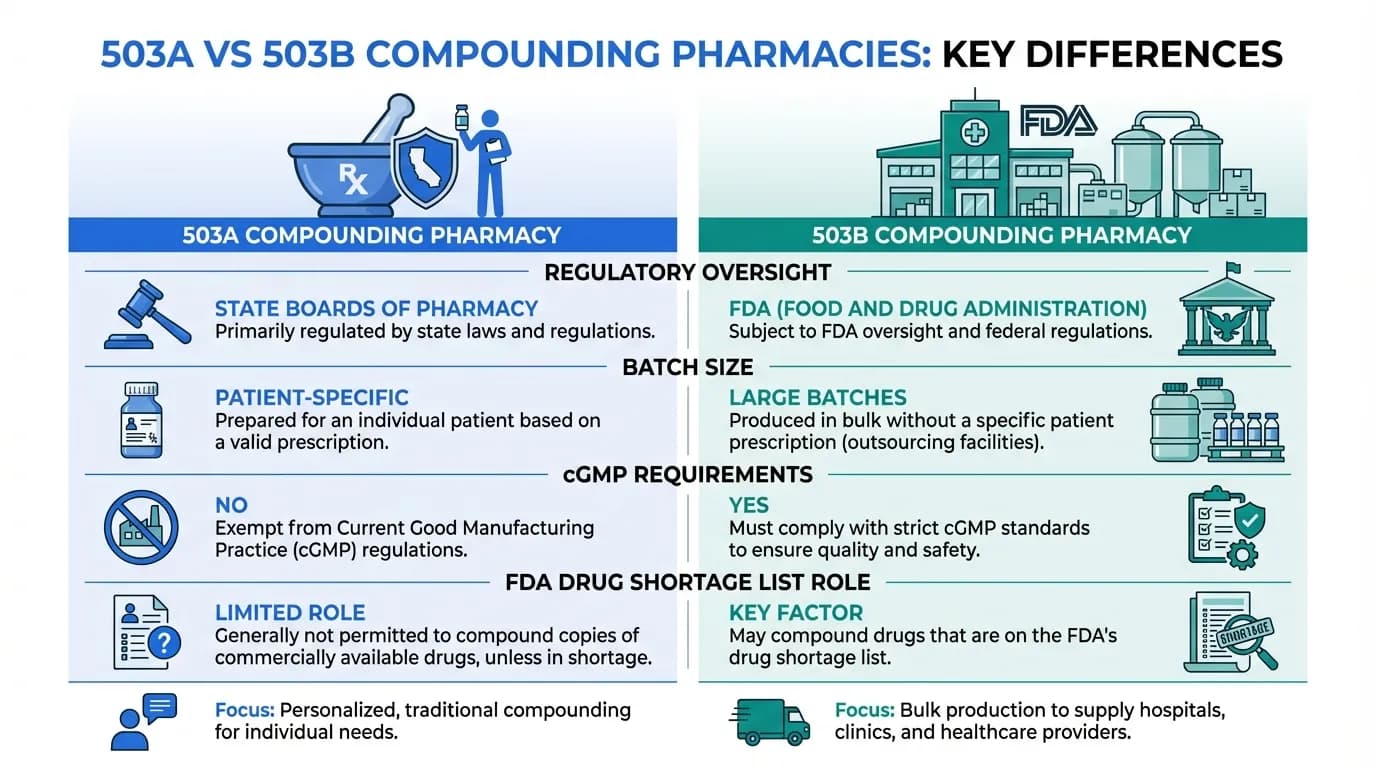
Compounding is permitted under specific conditions outlined in the Federal Food, Drug, and Cosmetic Act. Two pathways exist:
- 503A pharmacies prepare patient-specific prescriptions based on an individual prescription from a licensed provider. These are traditional compounding pharmacies.
- 503B outsourcing facilities operate under more rigorous FDA oversight and can produce compounded drugs in larger batches without patient-specific prescriptions. They are subject to current Good Manufacturing Practice (cGMP) requirements.
The key regulatory trigger is the FDA's drug shortage list. When a brand-name drug is designated as being in shortage, compounding pharmacies gain broader latitude to produce it. Both semaglutide and tirzepatide have appeared on this list at various points, enabling the compounded market to grow significantly.
Compounded Semaglutide Pricing by Source#
Prices for compounded semaglutide vary substantially depending on where and how you obtain it. The three main channels each have distinct pricing structures.
Telehealth Platforms#
Telehealth companies that bundle a provider consultation with compounded semaglutide have become the most visible channel for patients. These platforms handle the prescription, pharmacy coordination, and shipping in a single monthly fee.
| Platform Type | Monthly Cost Range | What's Included |
|---|---|---|
| Premium telehealth (branded programs) | $350-500 | Provider visits, medication, ongoing monitoring, coaching |
| Mid-tier telehealth | $250-400 | Provider visits, medication, basic check-ins |
| Budget telehealth | $200-300 | Provider visits, medication only |
Telehealth pricing tends to be higher than going directly to a compounding pharmacy because it bundles clinical services. However, for patients who need a prescribing provider, the convenience factor can justify the premium.
Direct Compounding Pharmacy#
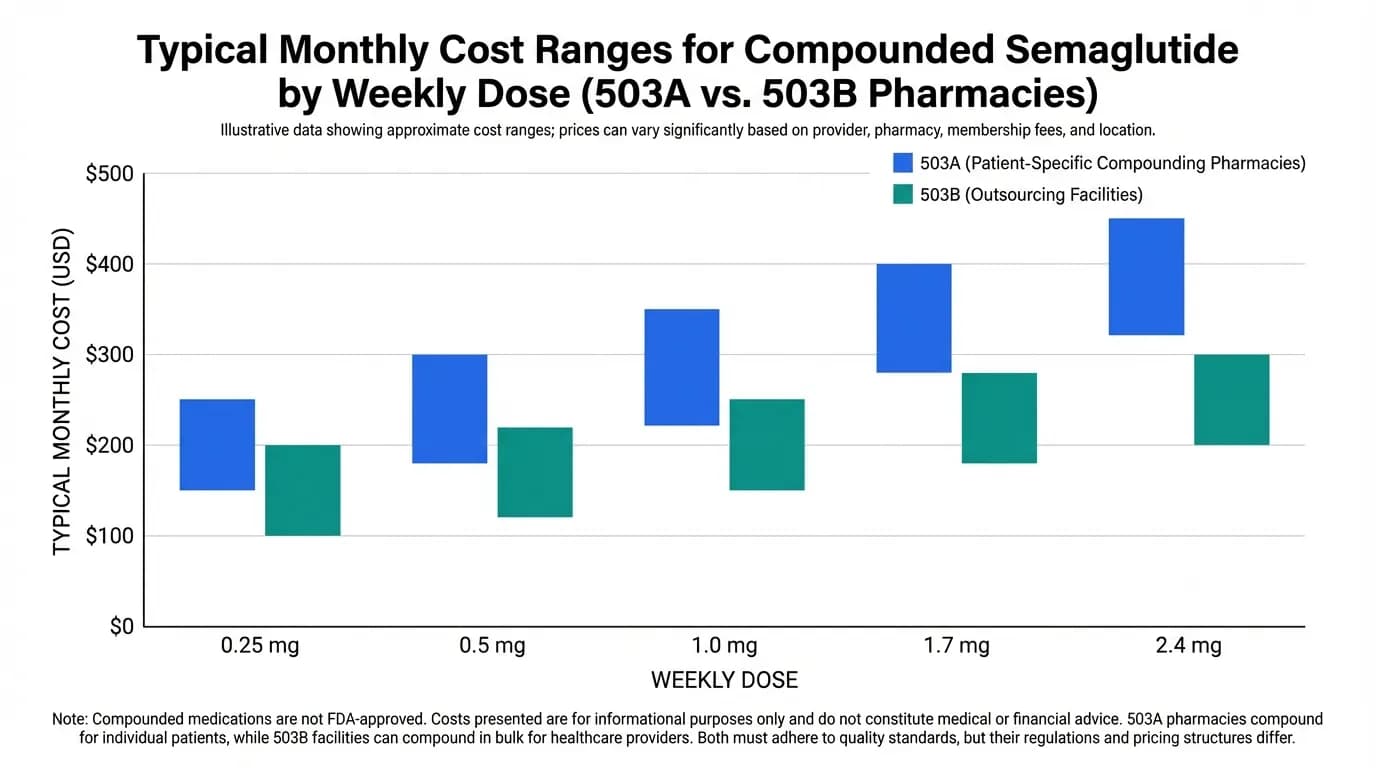
Patients with an existing prescription from their own provider can often obtain compounded semaglutide directly from a 503A or 503B pharmacy at lower cost.
| Dose (weekly injection) | Typical Monthly Cost (503A) | Typical Monthly Cost (503B) |
|---|---|---|
| 0.25 mg (starting dose) | $100-175 | $125-200 |
| 0.5 mg | $125-200 | $150-225 |
| 1.0 mg | $150-250 | $175-275 |
| 1.7 mg | $200-325 | $225-350 |
| 2.4 mg (maintenance dose) | $250-400 | $275-425 |
These ranges reflect the most commonly reported prices across multiple compounding pharmacies in early 2026. Actual prices vary by pharmacy, geographic region, and whether the pharmacy is running promotions. Multi-month supplies sometimes offer per-month savings of 10-20%.
Research Chemical Suppliers#
Some patients have turned to research peptide vendors for semaglutide. These products are labeled "for research use only" and are not intended for human use. They are typically sold as lyophilized powder requiring reconstitution and lack the quality assurance infrastructure of regulated pharmacies. We do not recommend this route due to significant quality and safety concerns, but for context, prices range from $50-150 for multi-week supplies. See our vendor directory for more information on peptide sourcing.
Monthly Cost Breakdown: Brand vs Compounded#
To put compounded semaglutide pricing in context, here is a side-by-side comparison at the most common maintenance dose:
| Option | Monthly Cost (2.4 mg/week equivalent) | Annual Cost |
|---|---|---|
| Wegovy (list price) | ~$1,349 | ~$16,188 |
| Wegovy (with insurance + copay card) | $0-25 | $0-300 |
| Wegovy (cash with GoodRx) | ~$1,100 | ~$13,200 |
| Compounded (telehealth platform) | $300-500 | $3,600-6,000 |
| Compounded (direct pharmacy) | $250-400 | $3,000-4,800 |
For patients without insurance coverage, compounded semaglutide represents a savings of roughly 70-80% compared to brand-name cash pricing. For a broader comparison that includes tirzepatide, liraglutide, and insurance strategies, see our GLP-1 cost comparison guide.
The Tirzepatide Compounding Landscape#
Compounded tirzepatide -- the active ingredient in Mounjaro and Zepbound -- has followed a similar trajectory. As a dual GIP/GLP-1 agonist, tirzepatide has shown slightly greater weight loss efficacy in head-to-head comparisons, which has driven strong demand for compounded versions.
Compounded tirzepatide generally costs $200-500 per month, roughly 20-30% more than compounded semaglutide at equivalent doses. The higher price reflects the greater complexity of the molecule and more limited raw material availability.
Key differences from compounded semaglutide:
- Fewer compounding sources: Not all pharmacies that compound semaglutide also offer tirzepatide
- More variable pricing: The tirzepatide compounding market is less mature, leading to wider price variation
- Separate regulatory timeline: Tirzepatide's shortage status has followed a different trajectory than semaglutide's, affecting compounding legality independently
How FDA Regulations Could Change the Market#
The regulatory environment for compounded GLP-1 medications remains one of the most actively debated areas in pharmaceutical policy. Several developments could reshape pricing and availability in 2026 and beyond:
Shortage list changes. When the FDA removes semaglutide or tirzepatide from the drug shortage list, the legal basis for compounding narrows significantly. The FDA has issued guidance that compounders should wind down production within a defined transition period after a shortage is resolved, though the exact enforcement approach has been subject to legal challenges.
State-level variation. Some states have moved to protect patient access to compounded GLP-1 medications through state pharmacy board regulations, even as federal policy tightens. This creates a patchwork where availability depends partly on where you live.
Congressional action. Multiple bills have been introduced to either protect or restrict compounded GLP-1 access. The political dynamics -- balancing pharmaceutical industry interests against patient access and cost concerns -- make the legislative outcome difficult to predict.
Novo Nordisk and Eli Lilly responses. Both manufacturers have launched programs aimed at reducing out-of-pocket costs for uninsured patients, partly in response to compounding competition. Eli Lilly's direct-to-consumer Zepbound vial program and Novo Nordisk's patient assistance expansions represent attempts to recapture patients who migrated to compounded alternatives.
What to Look for in a Compounding Pharmacy#
Not all compounding pharmacies operate at the same quality level. Patients considering compounded semaglutide should evaluate pharmacies on several key criteria:
Accreditation and Registration#
- PCAB accreditation (Pharmacy Compounding Accreditation Board) is the gold standard for compounding pharmacies and indicates adherence to rigorous quality standards
- 503B registration with the FDA means the facility is subject to regular FDA inspections and must follow cGMP requirements
- State board of pharmacy licensure is the minimum requirement; verify the pharmacy is in good standing
Quality Documentation#
- Certificates of Analysis (COAs) should be available for each batch, showing identity testing, potency verification, sterility testing, and endotoxin testing
- Beyond-use dating should be clearly stated, indicating how long the compounded product remains stable
- Source material documentation showing the Active Pharmaceutical Ingredient (API) comes from an FDA-registered supplier
Practical Considerations#
- Cold-chain shipping is essential for peptide medications; the pharmacy should use insulated packaging with cold packs
- Transparent pricing with no hidden fees for consultations, shipping, or supplies
- Responsive customer support that can answer questions about their compounding process and quality controls
For a deeper look at evaluating peptide vendors and pharmacies, see our vendor directory and analytics labs directory for third-party testing resources.
Alternatives to Compounded Semaglutide#
If compounded semaglutide becomes unavailable or too expensive for your situation, several alternatives are worth exploring:
- Manufacturer savings programs. Both Novo Nordisk and Eli Lilly offer copay assistance that can reduce costs to $0-25/month for commercially insured patients.
- Insurance appeals. If your plan denies coverage, a letter of medical necessity from your provider -- citing BMI, comorbidities, and prior treatment failures -- can sometimes overturn the decision.
- Eli Lilly's direct vial program. Zepbound vials are available at reduced pricing through Lilly's website for patients paying out of pocket.
- Oral semaglutide (Rybelsus). The oral formulation may have different insurance coverage or copay structures than injectable Wegovy.
- Liraglutide (Saxenda). An older GLP-1 with somewhat lower efficacy but potentially lower cost, especially as generic options approach.
Key Takeaways#
Compounded semaglutide remains one of the most accessible entry points for patients seeking GLP-1 therapy without the burden of brand-name pricing. At $150-400 per month through compounding pharmacies, it costs a fraction of the $1,349 monthly list price for Wegovy. However, the regulatory landscape is shifting, and patients should stay informed about FDA guidance changes that could affect availability.
The most important steps for anyone considering compounded semaglutide: work with a licensed prescriber, choose a pharmacy with verifiable accreditation and COA documentation, and have a backup plan in case compounding access changes. For the full picture on GLP-1 pricing including brand-name drugs and insurance strategies, see our complete GLP-1 cost comparison for 2026.
Frequently Asked Questions About Compounded Semaglutide Cost Guide 2026: Prices, Pharmacies & What to Expect
How much does compounded semaglutide cost per month in 2026?
Compounded semaglutide typically costs between $150 and $400 per month in 2026, depending on the dose, pharmacy type, and whether you obtain it through a telehealth platform or directly from a compounding pharmacy. Lower doses (0.25-0.5 mg/week) tend toward the lower end of that range, while maintenance doses (1.7-2.4 mg/week) are more expensive.
Is compounded semaglutide the same as Ozempic or Wegovy?
Compounded semaglutide contains the same active ingredient as Ozempic and Wegovy but is prepared by a compounding pharmacy rather than manufactured by Novo Nordisk. It is not FDA-approved as a finished product, and formulations may differ in inactive ingredients, concentration, or delivery method. The semaglutide molecule itself is identical.
Is compounded semaglutide legal in 2026?
Compounded semaglutide occupies a legally complex space. Under Section 503A and 503B of the FD&C Act, pharmacies can compound medications when the brand-name version is on the FDA drug shortage list. As shortage designations change and the FDA updates enforcement guidance, the legality of compounding specific drugs can shift. Patients should verify current status with their provider.
What should I look for in a compounding pharmacy for semaglutide?
Key indicators of quality include PCAB accreditation, third-party certificates of analysis (COAs) for each batch, 503B outsourcing facility registration with the FDA, transparent ingredient sourcing, and proper cold-chain shipping. Avoid pharmacies that cannot provide COA documentation or that operate without verifiable accreditation.
Continue reading this research review
Free access to the complete analysis with citations and evidence ratings.
150+ peptide profiles · 30+ comparisons · 18 research tools
Medical Disclaimer
This website is for educational and informational purposes only. The information provided is not intended to diagnose, treat, cure, or prevent any disease. Always consult with a qualified healthcare professional before using any peptide or supplement.
Join 2,000+ researchers getting biweekly updates
Enjoyed this article?
The Research Briefing delivers deep-dives like this biweekly — plus new study breakdowns, safety updates, and tool announcements.
Free forever. No spam. Unsubscribe in one click.
Where to Find These Peptides
Continue Exploring
Peptide Profiles
Keep Reading

Semaglutide Vs Tirzepatide Cost
Semaglutide vs Tirzepatide: Cost Comparison — part of the GLP-1 Pricing & Access content cluster.

Tirzepatide Cost Canada
How Much Does Tirzepatide Cost in Canada? — part of the GLP-1 Pricing & Access content cluster.

Living on GLP-1 Medications: Diet, Exercise, and Lifestyle Adjustments
Practical lifestyle guidance for people on GLP-1 receptor agonist medications, covering diet optimization, exercise strategies, managing reduced appetite, protein intake, hydration, and building sustainable habits while on semaglutide, tirzepatide, or liraglutide.
You Might Also Like
Related content you may find interesting