Orforglipron vs VK2735: Oral GLP-1 vs Oral Dual Agonist for Obesity
Comparison of orforglipron (Eli Lilly) and VK2735 (Viking Therapeutics), two oral obesity drug candidates with different receptor profiles, weight loss data, and development strategies.
Verdict at a Glance
Orforglipron has the stronger evidence base with completed phase 3 trials (ATTAIN program) and NEJM publication. VK2735 has only phase 2 oral data but showed faster weight loss in a shorter timeframe and offers dual GLP-1/GIP agonism versus orforglipron's single GLP-1 target. Both represent the future of oral obesity treatment. Orforglipron's small-molecule design eliminates the need for special oral delivery technology, while VK2735's dual mechanism may provide enhanced efficacy. VK2735's additional injectable formulation provides a flexibility advantage. Neither is yet approved.
| Best for | Pick | Why |
|---|---|---|
| Most Advanced Oral Candidate | Orforglipron | Orforglipron has completed phase 3 trials (ATTAIN-1, ATTAIN-2, ATTAIN-MAINTAIN) and is closest to potential FDA approval among oral obesity drug candidates. VK2735 oral is still in phase 2. |
| Dual Incretin Mechanism (Oral) | VK2735 | VK2735 is the only oral dual GLP-1/GIP agonist in development. This dual mechanism has been validated by tirzepatide's superiority over semaglutide, suggesting it may produce greater effects than single-target GLP-1 agonism. |
| Weight Loss Trajectory | VK2735 | VK2735 achieved 12.2% weight loss in just 13 weeks with weight still declining, while orforglipron achieved 11.2% at 72 weeks. Though different trial phases limit direct comparison, VK2735's trajectory suggests potentially greater long-term efficacy. |
| Switch from Injectable to Oral | Orforglipron | ATTAIN-MAINTAIN specifically demonstrated that orforglipron can maintain weight loss after switching from injectable incretins (Wegovy, Zepbound), validating the injectable-to-oral transition strategy. |
| Formulation Flexibility | VK2735 | VK2735 is being developed in both oral and injectable formulations, allowing patients to choose their preferred route. Orforglipron is oral only due to its small-molecule design. |
| Type 2 Diabetes | Orforglipron | ATTAIN-2 demonstrated orforglipron's efficacy in T2D with weight loss up to 9.6% and significant HbA1c reductions. VK2735 has not been studied in diabetes populations. |
| Category | Orforglipron | VK2735 | Advantage |
|---|---|---|---|
| Mechanism of Action | Oral non-peptide small-molecule GLP-1 receptor agonist. Selectively activates GLP-1R with a mechanism of action equivalent to injectable peptide GLP-1 agonists but achieved through a small molecule that does not require specialized oral delivery technology. | Dual GLP-1 and GIP receptor agonist developed by Viking Therapeutics. Available in both injectable and oral peptide formulations. The dual mechanism targets both incretin pathways simultaneously, similar to tirzepatide. | VK2735 |
| Weight Loss Efficacy | ATTAIN-1 (phase 3) showed 11.2% mean weight loss at 72 weeks with 36 mg daily (placebo-adjusted ~9.1%). 54.6% achieved 10% or more, 36.0% achieved 15% or more, 18.4% achieved 20% or more weight reduction. | VENTURE-Oral (phase 2) showed up to 12.2% mean weight loss at 13 weeks vs 1.3% placebo (10.9% placebo-adjusted). Weight loss was still accelerating at study end, suggesting greater reductions with longer treatment. | VK2735 |
| Research Evidence | Phase 3 ATTAIN program completed. ATTAIN-1 tested 6, 12, and 36 mg in obesity. ATTAIN-2 studied obesity with T2D. ATTAIN-MAINTAIN demonstrated weight maintenance after switching from injectable incretins. Published in NEJM (2025). | Phase 2 data only. VENTURE-Oral enrolled patients over 13 weeks. Subcutaneous VENTURE provided supporting data. Phase 3 VANQUISH program planned. No published peer-reviewed full trial reports. | Orforglipron |
| Side Effect Profile | GI adverse events consistent with the GLP-1 agonist class. Nausea, diarrhea, and vomiting were the most common. Safety profile considered consistent with injectable GLP-1 medicines. Generally mild to moderate. | GI adverse events are common. Vomiting reported in 26% of VK2735-treated subjects vs 10% placebo in the oral trial. 99% of GI events were mild or moderate. Short-term data only. | Orforglipron |
| Dosing Convenience | Once-daily oral tablet. Small molecule with no special fasting or water restrictions reported in trial designs, unlike oral semaglutide (Rybelsus) which requires empty stomach and minimal water. | Once-daily oral tablet (oral formulation) or once-weekly subcutaneous injection (injectable formulation). The availability of both oral and injectable options provides flexibility. Down-titration maintenance strategy explored in phase 2. | VK2735 |

Introduction#
Orforglipron and VK2735 are two of the most closely watched oral obesity drug candidates, each representing a different strategy for delivering incretin-based therapy in pill form. Orforglipron, developed by Eli Lilly, is an oral non-peptide small-molecule GLP-1 receptor agonist that has completed phase 3 trials and is closest to potential market entry. VK2735, developed by Viking Therapeutics, is a dual GLP-1/GIP receptor agonist being developed in both oral and injectable formulations, with phase 2 oral data showing rapid weight loss.
This comparison represents the emerging competitive landscape for oral obesity medications -- a market expected to be worth tens of billions of dollars as patients and physicians seek alternatives to injectable therapies. The two drugs differ in molecular class (small molecule vs peptide), receptor targets (GLP-1 only vs dual GLP-1/GIP), and development stage (phase 3 vs phase 2).
Mechanism of Action Comparison#
Orforglipron#
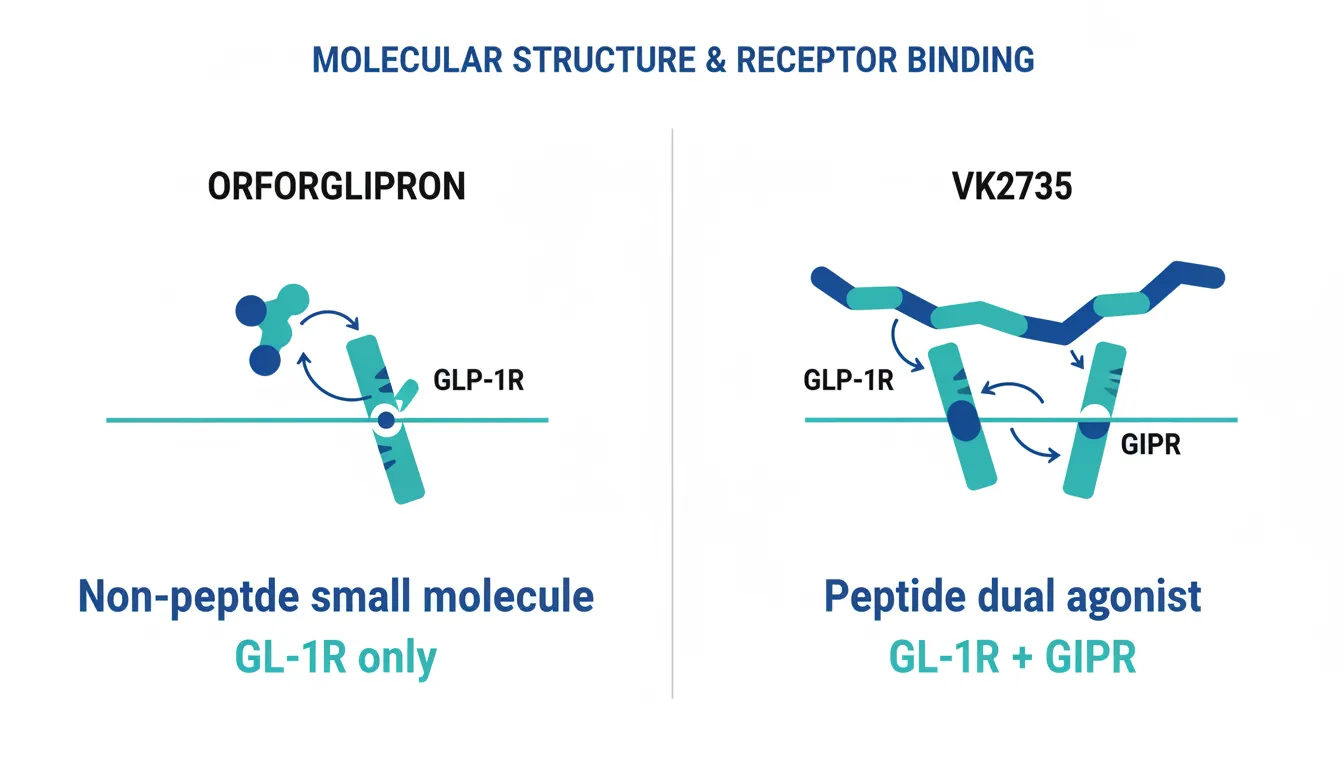
Orforglipron is a once-daily oral non-peptide small-molecule GLP-1 receptor agonist. Unlike oral semaglutide (Rybelsus), which is a peptide requiring the SNAC absorption enhancer and strict fasting conditions, orforglipron is a synthetic small molecule that activates GLP-1R directly without requiring specialized delivery technology.
The small-molecule design offers several advantages: standard oral bioavailability without fasting requirements, simpler manufacturing than peptide synthesis, and potentially lower cost of goods. Orforglipron activates the same GLP-1R-mediated pathways as injectable agonists -- glucose-dependent insulin secretion, glucagon suppression, gastric emptying delay, and central appetite reduction.
VK2735#
VK2735 is a dual GLP-1 and GIP receptor agonist with both oral and injectable formulations. The dual mechanism targets both incretin pathways simultaneously, similar to tirzepatide's approach. GIP receptor co-activation is believed to potentiate the metabolic effects of GLP-1R activation, potentially producing greater weight loss and glycemic improvements than single-target GLP-1 agonism.
The oral VK2735 formulation represents the first dual GLP-1/GIP agonist to demonstrate competitive oral weight loss efficacy in clinical trials. The injectable formulation provides an additional option for patients who prefer or require parenteral administration.
Mechanistic Comparison#
| Feature | Orforglipron | VK2735 |
|---|---|---|
| Molecular type | Non-peptide small molecule | Peptide (dual agonist) |
| Receptor targets | GLP-1R only | GLP-1R + GIPR (dual) |
| Oral delivery | Standard (no special technology) | Peptide oral formulation |
| Fasting required | Not reported as required | Not disclosed |
| Injectable option | No | Yes (weekly subcutaneous) |
| Developer | Eli Lilly | Viking Therapeutics |
Dosing Comparison#
Orforglipron Dosing#
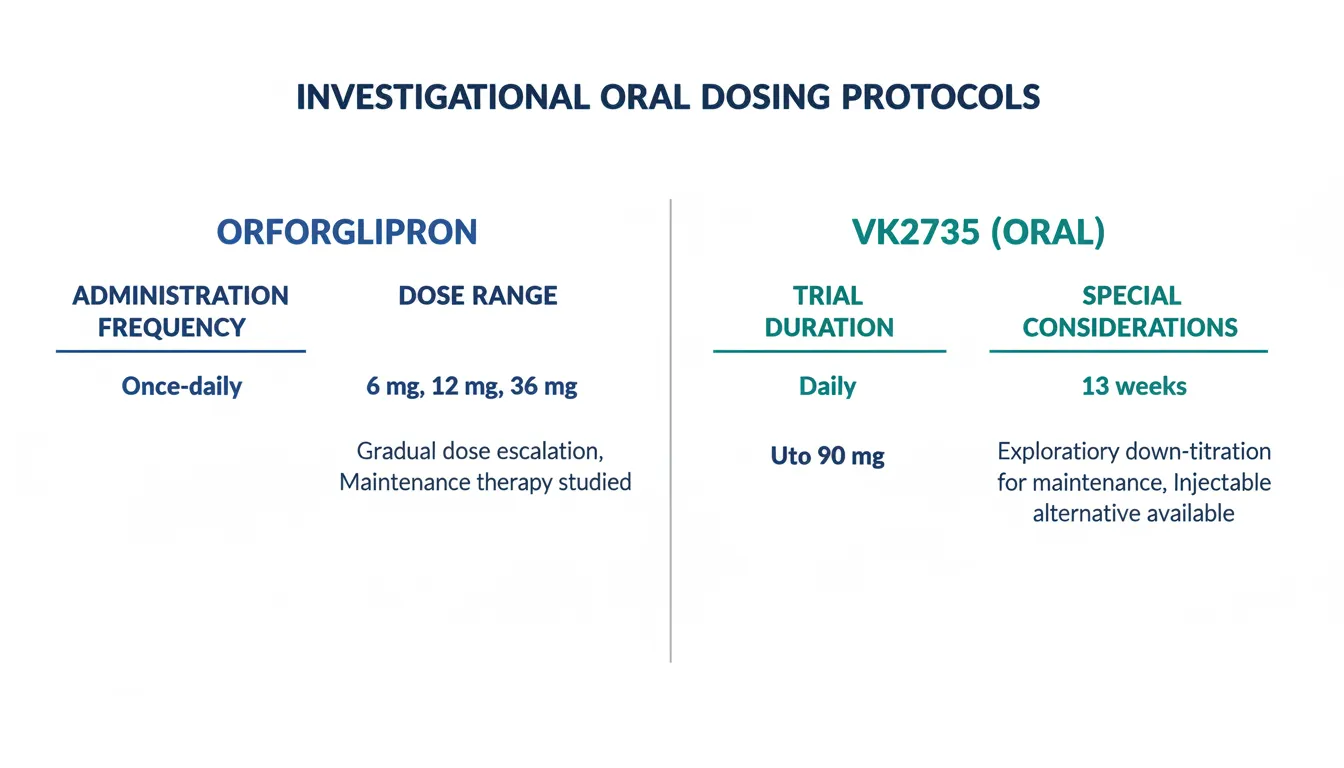
Orforglipron is administered as a once-daily oral tablet:
- ATTAIN-1 doses: 6 mg, 12 mg, and 36 mg daily over 72 weeks
- Escalation: Gradual dose escalation to target dose
- ATTAIN-MAINTAIN: Studied as oral maintenance therapy after switching from injectable incretins
VK2735 Oral Dosing#
VK2735 oral dosing is investigational:
- VENTURE-Oral: Daily dosing up to 90 mg over 13 weeks
- Maintenance strategy: Exploratory down-titration from 90 mg to 30 mg for weight maintenance
- Injectable alternative: Once-weekly subcutaneous injection also available
Side Effects Comparison#
Orforglipron Side Effects#
Orforglipron's safety profile from ATTAIN-1 was consistent with the established GLP-1 receptor agonist class. The most common adverse events were GI-related: nausea, diarrhea, and vomiting, generally mild to moderate in severity. The overall safety profile was described as consistent with injectable GLP-1 medicines, which is noteworthy because oral delivery might be expected to have different GI tolerability than subcutaneous injection.
VK2735 Side Effects#
VK2735 oral safety data comes from the phase 2 VENTURE-Oral trial. Vomiting was reported in 26% of VK2735-treated subjects compared with 10% placebo. However, 99% of GI-specific adverse events were classified as mild or moderate. The higher vomiting rate is notable but must be interpreted cautiously given the small sample size and short duration of the phase 2 trial.
Safety Comparison Table#
| Parameter | Orforglipron | VK2735 |
|---|---|---|
| GI adverse events | Class-consistent, mild-moderate | 26% vomiting (oral); 99% mild-moderate |
| Evidence duration | 72 weeks (ATTAIN-1) | 13 weeks (VENTURE-Oral) |
| Sample size | Large phase 3 | Small phase 2 |
| Long-term safety | Moderate (phase 3 data) | Unknown |
| Post-marketing | None | None |
Research Evidence Comparison#
Orforglipron Research#
Orforglipron has the most advanced evidence base among oral obesity candidates:
- ATTAIN-1 (obesity): Phase 3, 72 weeks. Mean weight loss of -7.5% (6 mg), -8.4% (12 mg), -11.2% (36 mg) vs -2.1% placebo. Published in NEJM (2025). 54.6% of 36 mg patients achieved 10% or more loss, 36.0% achieved 15% or more, 18.4% achieved 20% or more
- ATTAIN-2 (obesity + T2D): Phase 3, weight loss up to 9.6% with highest dose. Significant HbA1c reductions
- ATTAIN-MAINTAIN: Phase 3, demonstrated weight maintenance after switching from injectable incretins (Wegovy or Zepbound) to oral orforglipron
Evidence level: High -- completed phase 3 program with NEJM publication.
VK2735 Oral Research#
- VENTURE-Oral: Phase 2, 13 weeks. Up to 12.2% weight loss vs 1.3% placebo. Down-titration maintenance explored.
- VENTURE (subcutaneous): Phase 2, 13 weeks. Up to 14.7% weight loss from baseline. Supports the dual mechanism.
Evidence level: Low -- phase 2 data only, short duration, small sample size.
Key Differences Summary#
- Molecular class: Orforglipron is a non-peptide small molecule (GLP-1 only). VK2735 is a peptide dual agonist (GLP-1 + GIP). Different manufacturing, delivery, and intellectual property profiles.
- Receptor targets: Orforglipron activates GLP-1R only. VK2735 activates both GLP-1R and GIPR. The dual mechanism has been validated by tirzepatide's clinical superiority over semaglutide.
- Weight loss data: Orforglipron 36 mg achieved 11.2% at 72 weeks (phase 3). VK2735 oral achieved 12.2% at 13 weeks (phase 2). The trajectories suggest VK2735 may achieve greater long-term weight loss, but phase 2 results frequently do not replicate in phase 3.
- Development stage: Orforglipron has completed phase 3 and is closest to approval. VK2735 oral has phase 2 data with phase 3 planned.
- Formulation options: VK2735 offers both oral and injectable formulations. Orforglipron is oral only.
- Diabetes data: Orforglipron has phase 3 T2D data (ATTAIN-2). VK2735 has not been studied in diabetes.
- Transition strategy: Orforglipron's ATTAIN-MAINTAIN uniquely demonstrated successful maintenance after switching from injectable therapies, a critical real-world use case.
Conclusion#
Orforglipron and VK2735 represent the two leading approaches to oral obesity pharmacotherapy beyond oral semaglutide. Orforglipron has the clear advantage in evidence maturity, with a completed phase 3 program and NEJM-published results demonstrating meaningful weight loss of up to 11.2% at 72 weeks. Its small-molecule design simplifies manufacturing and oral delivery compared to peptide-based alternatives.
VK2735 counters with a dual GLP-1/GIP mechanism that produced faster weight loss in short-term phase 2 trials (12.2% at 13 weeks) and the flexibility of both oral and injectable formulations. The dual mechanism has been clinically validated by tirzepatide's superiority over single-target GLP-1 agonism, lending biological plausibility to VK2735's potentially greater efficacy.
The critical unknown is whether VK2735's phase 2 trajectory will translate into greater long-term weight loss than orforglipron in phase 3. The history of metabolic drug development shows that phase 2 promise frequently attenuates in larger, longer trials. However, if VK2735 confirms even a portion of its early trajectory, an oral dual agonist achieving greater weight loss than an oral GLP-1 agonist would represent a significant competitive advantage.
Neither drug is currently approved. Orforglipron is expected to reach market first given its more advanced regulatory timeline. The oral obesity market will ultimately have room for multiple agents serving different patient populations and preferences.
Further Reading#

Which Is Better For...
Most Advanced Oral Candidate
Orforglipron
Orforglipron has completed phase 3 trials (ATTAIN-1, ATTAIN-2, ATTAIN-MAINTAIN) and is closest to potential FDA approval among oral obesity drug candidates. VK2735 oral is still in phase 2.
Dual Incretin Mechanism (Oral)
VK2735
VK2735 is the only oral dual GLP-1/GIP agonist in development. This dual mechanism has been validated by tirzepatide's superiority over semaglutide, suggesting it may produce greater effects than single-target GLP-1 agonism.
Weight Loss Trajectory
VK2735
VK2735 achieved 12.2% weight loss in just 13 weeks with weight still declining, while orforglipron achieved 11.2% at 72 weeks. Though different trial phases limit direct comparison, VK2735's trajectory suggests potentially greater long-term efficacy.
Switch from Injectable to Oral
Orforglipron
ATTAIN-MAINTAIN specifically demonstrated that orforglipron can maintain weight loss after switching from injectable incretins (Wegovy, Zepbound), validating the injectable-to-oral transition strategy.
Formulation Flexibility
VK2735
VK2735 is being developed in both oral and injectable formulations, allowing patients to choose their preferred route. Orforglipron is oral only due to its small-molecule design.
Type 2 Diabetes
Orforglipron
ATTAIN-2 demonstrated orforglipron's efficacy in T2D with weight loss up to 9.6% and significant HbA1c reductions. VK2735 has not been studied in diabetes populations.
Continue Your Research
Get comparison updates
We publish new head-to-head comparisons regularly. Subscribe to see them first.
Frequently Asked Questions About Orforglipron vs VK2735: Oral GLP-1 vs Oral Dual Agonist for Obesity
Which is better, Orforglipron or VK2735?
Orforglipron has the stronger evidence base with completed phase 3 trials (ATTAIN program) and NEJM publication. VK2735 has only phase 2 oral data but showed faster weight loss in a shorter timeframe and offers dual GLP-1/GIP agonism versus orforglipron's single GLP-1 target. Both represent the future of oral obesity treatment. Orforglipron's small-molecule design eliminates the need for special oral delivery technology, while VK2735's dual mechanism may provide enhanced efficacy. VK2735's ad... Individual responses may vary, and this comparison is based on available research data, not a treatment recommendation.
What are the key differences between Orforglipron and VK2735?
The main differences across comparison categories are: Mechanism of Action: advantage goes to VK2735; Weight Loss Efficacy: advantage goes to VK2735; Research Evidence: advantage goes to Orforglipron. 2 additional categories are analyzed in the full comparison. Each category evaluates a different dimension of the two peptides.
When should I consider Orforglipron over VK2735?
For the scenario of "Most Advanced Oral Candidate," research data suggests Orforglipron may be more relevant. Orforglipron has completed phase 3 trials (ATTAIN-1, ATTAIN-2, ATTAIN-MAINTAIN) and is closest to potential FDA approval among oral obesity drug candidates. VK2735 oral is still in phase 2.. This is based on currently available evidence and individual circumstances may differ.
How do Orforglipron and VK2735 differ in their mechanisms of action?
Orforglipron: Oral non-peptide small-molecule GLP-1 receptor agonist. Selectively activates GLP-1R with a mechanism of action equivalent to injectable peptide GLP-1 agonists but achieved through a small molecule.... VK2735: Dual GLP-1 and GIP receptor agonist developed by Viking Therapeutics. Available in both injectable and oral peptide formulations. The dual mechanism targets both incretin pathways simultaneously, s....
Which has fewer side effects, Orforglipron or VK2735?
In terms of side effects and tolerability, the advantage goes to Orforglipron. Orforglipron: GI adverse events consistent with the GLP-1 agonist class. Nausea, diarrhea, and vomiting were the most common. Safety profile considered consisten.... VK2735: GI adverse events are common. Vomiting reported in 26% of VK2735-treated subjects vs 10% placebo in the oral trial. 99% of GI events were mild or m....
Medical Disclaimer
This website is for educational and informational purposes only. The information provided is not intended to diagnose, treat, cure, or prevent any disease. Always consult with a qualified healthcare professional before using any peptide or supplement.