FOXO4-DRI vs Tat-Beclin-1: Senolytic vs Autophagy-Based Cellular Clearance
Comparison of FOXO4-DRI and Tat-Beclin-1 for cellular clearance in aging research including senolytic vs autophagy mechanisms, evidence, and safety.
Verdict at a Glance
Tat-Beclin-1 has stronger evidence through genetic lifespan data and human centenarian correlations, plus broader hallmark coverage through autophagy's connections to multiple aging pathways. FOXO4-DRI offers a more dramatic intervention by eliminating entire senescent cells, addressing the SASP directly. Both are entirely preclinical with no human trials.
| Best for | Pick | Why |
|---|---|---|
| Addressing Accumulated Senescent Cell Burden | FOXO4-DRI | FOXO4-DRI directly eliminates senescent cells, removing the source of SASP-driven inflammation and tissue dysfunction rather than managing its downstream effects |
| Broad Anti-Aging Strategy Targeting Multiple Hallmarks | Tat-Beclin-1 | Autophagy enhancement intersects with multiple aging hallmarks including proteostasis, mitochondrial quality control, and nutrient sensing, providing broader anti-aging coverage |
| Strongest Lifespan Extension Data | Tat-Beclin-1 | The beclin 1 F121A knock-in mouse model demonstrated actual lifespan extension through constitutive autophagy enhancement, supported by human centenarian biomarker correlations |
| SASP-Driven Chronic Inflammation Research | FOXO4-DRI | Selectively removing senescent cells eliminates the source of the senescence-associated secretory phenotype rather than modulating its effects downstream |
| Theoretical Combination Approach | FOXO4-DRI | FOXO4-DRI and Tat-Beclin-1 target complementary clearance mechanisms and could theoretically be combined, with FOXO4-DRI clearing senescent cells and Tat-Beclin-1 enhancing intracellular recycling in remaining healthy cells |
| Category | FOXO4-DRI | Tat-Beclin-1 | Advantage |
|---|---|---|---|
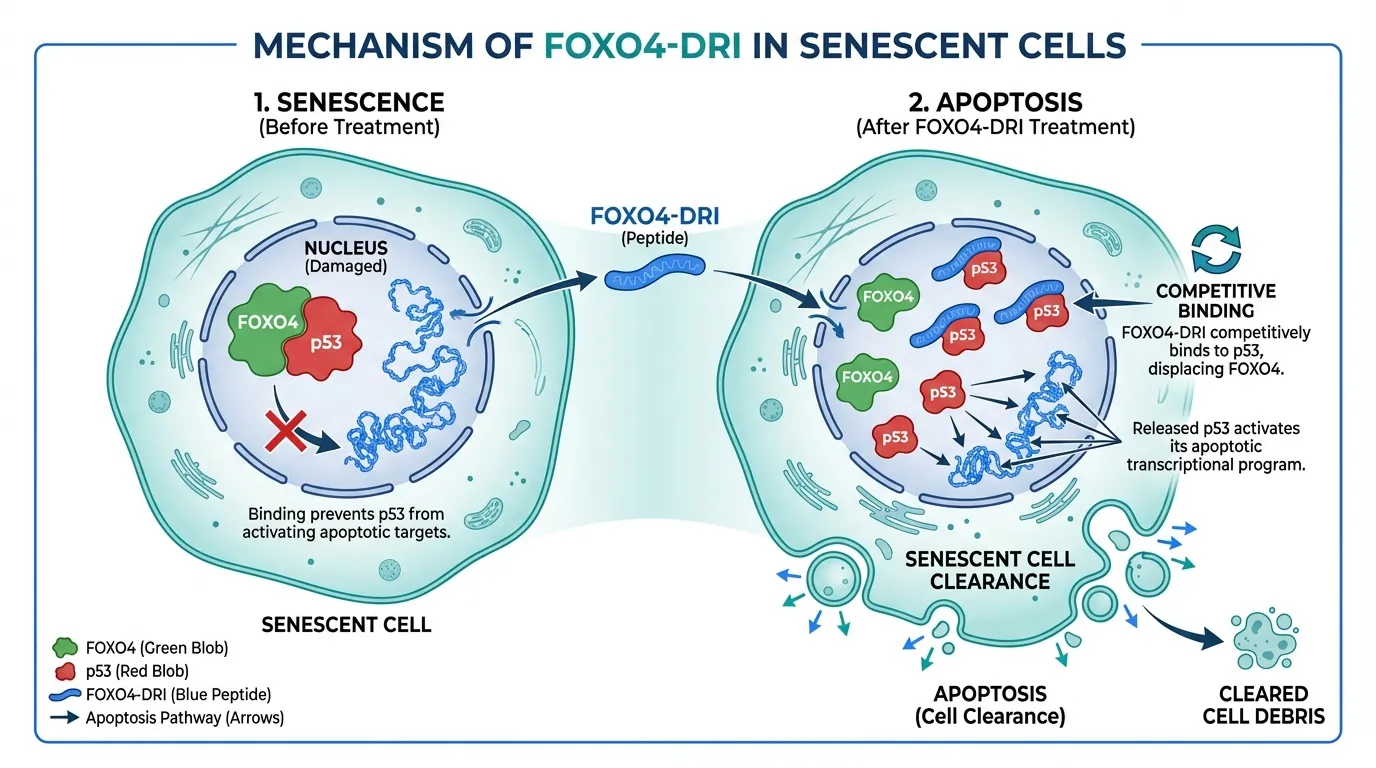
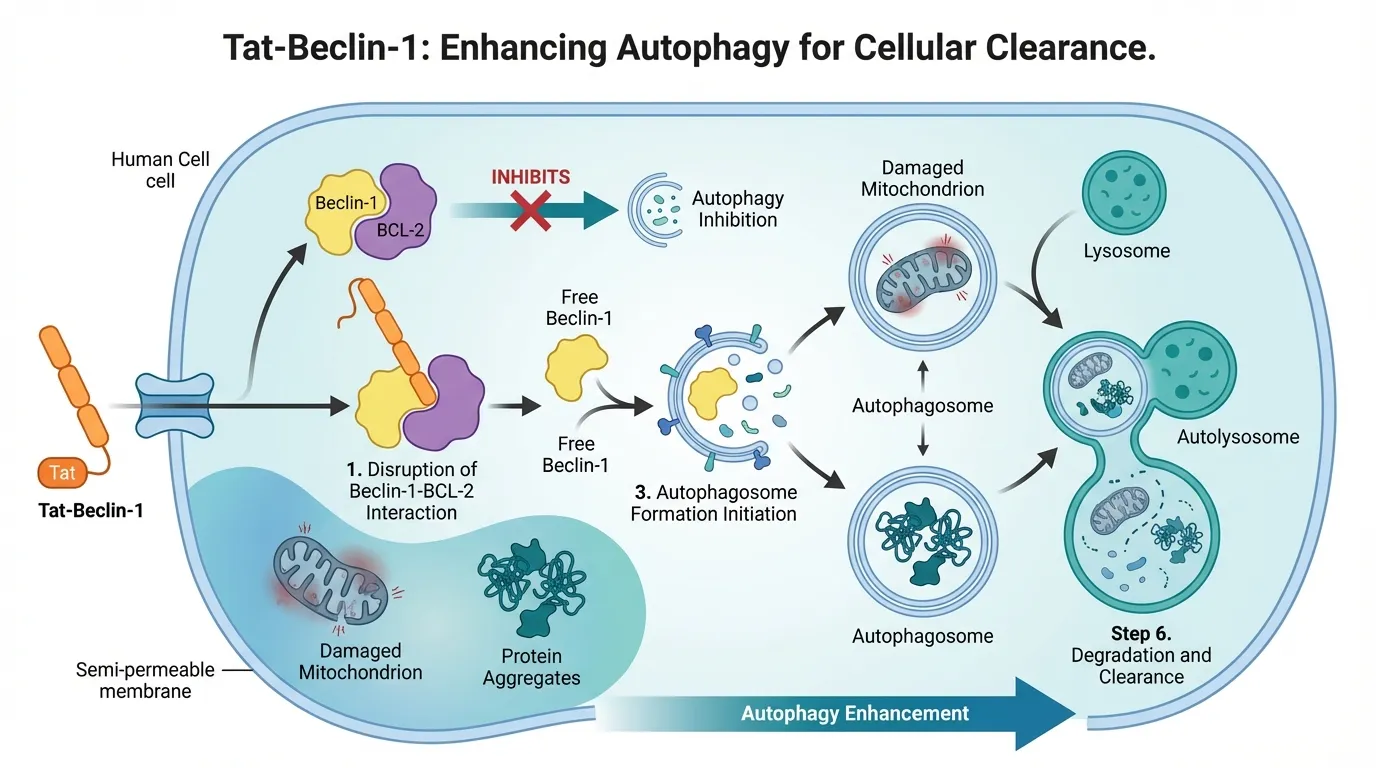
| Mechanism of Action | D-Retro-Inverso peptide that disrupts the FOXO4-p53 interaction in senescent cells. FOXO4 sequesters p53 in the nucleus of senescent cells, preventing apoptosis. FOXO4-DRI competitively displaces FOXO4, freeing p53 to trigger selective apoptosis. Targets whole-cell elimination of damaged senescent cells. | Cell-penetrating peptide that induces autophagy by disrupting the inhibitory beclin 1-BCL2 interaction. Freeing beclin-1 activates autophagosome formation and enhances cellular recycling of damaged organelles, misfolded proteins, and intracellular pathogens. Targets subcellular clearance rather than whole-cell elimination. | Comparable |
| Research Evidence | Landmark 2017 Cell paper (Baar et al.) demonstrated selective senescent cell clearance in fast-aging and naturally aged mice, restoring fur density, renal function, and fitness. Follow-up studies expanded to chondrocyte rejuvenation, testosterone restoration, and keloid clearance. Evidence base concentrated in a few publications. | Genetic validation via beclin 1 F121A knock-in mice showed increased autophagy, improved healthspan, and extended lifespan (Fernandez et al., Nature 2018). Human correlative data shows centenarians with beclin-1 levels above 1.5 ng/mL have 3.4-fold odds of healthy aging. Broader autophagy-longevity literature provides strong supportive context. | Tat-Beclin-1 |
| Side Effect Profile | Transient weight loss (~10%) observed in treated mice, recovering within days. Theoretical risks include off-target apoptosis in non-senescent cells, excessive tissue loss in highly senescent organs, impaired wound healing if beneficial transient senescence is disrupted, and immune activation from mass apoptotic cell clearance. Safety profile incompletely characterized. | Autophagy induction is generally considered safer than cell killing, as it enhances existing cellular recycling rather than eliminating cells. However, excessive autophagy can cause autosis (autophagy-dependent cell death). Theoretical cancer concerns are complex as autophagy is both tumor-suppressive and tumor-promoting depending on context. No long-term safety data available. | Tat-Beclin-1 |
| Scope of Anti-Aging Application | Specifically targets cellular senescence, one of the twelve hallmarks of aging. Indirectly addresses chronic inflammation by removing SASP-producing cells and may improve altered intercellular communication. Does not address other hallmarks like mitochondrial dysfunction, nutrient sensing, or autophagy decline. | Directly targets disabled macroautophagy, one of the twelve hallmarks of aging. Also addresses loss of proteostasis through enhanced protein aggregate clearance. Autophagy interacts with multiple other hallmarks including mitochondrial quality control (mitophagy), nutrient sensing (AMPK/mTOR axis), and cellular senescence (autophagy can modulate SASP). | Tat-Beclin-1 |
| Translational Feasibility | Large peptide (4826.5 Da) with D-Retro-Inverso modification requiring specialized synthesis. The DRI modification confers protease resistance but adds manufacturing complexity and cost. Intermittent dosing (hit-and-run) reduces cumulative exposure requirements. No clinical development programs announced, though the senolytic field has attracted significant pharmaceutical investment. | Smaller peptide derived from beclin-1 fused to HIV Tat cell-penetrating sequence. Cell-penetrating peptide technology is well-established but faces delivery challenges for systemic administration. No clinical development programs for aging indications. The autophagy field is primarily pursuing small-molecule approaches (spermidine, rapamycin analogs) rather than peptide-based interventions. | Comparable |

Introduction#
FOXO4-DRI and Tat-Beclin-1 represent two fundamentally different approaches to the same problem: removing cellular damage that accumulates with aging. FOXO4-DRI takes a senolytic approach, selectively killing entire cells that have become senescent. Tat-Beclin-1 takes an autophagy approach, enhancing the cell's internal recycling machinery to clear damaged components without destroying the cell itself.
Both peptides address hallmarks of aging outlined in the Lopez-Otin framework -- FOXO4-DRI targets cellular senescence while Tat-Beclin-1 targets disabled macroautophagy. Both are entirely preclinical with no human trials. Yet they offer conceptually complementary strategies that together cover two of the most validated aging-longevity connections.
For a broader mapping of peptides to all twelve hallmarks, see The Hallmarks of Aging: Which Peptides Target Which?.
Mechanism of Action Comparison#
FOXO4-DRI: Senolytic Clearance#
FOXO4-DRI's mechanism centers on a specific protein-protein interaction that keeps senescent cells alive. In normal cells, the FOXO4 transcription factor participates in stress response and cell cycle regulation. In senescent cells, however, FOXO4 accumulates in the nucleus and physically binds p53, the master tumor suppressor and apoptosis regulator. This FOXO4-p53 interaction sequesters p53 away from its apoptotic targets, effectively granting senescent cells survival despite their damaged state.
FOXO4-DRI is a D-Retro-Inverso peptide -- it uses D-amino acids in reverse sequence to mimic the spatial arrangement of the native FOXO4 interface while resisting protease degradation. By competitively binding p53 in place of endogenous FOXO4, the peptide releases p53 to activate its apoptotic transcriptional program. Because FOXO4 accumulation is characteristic of senescent cells, the selectivity for senescent cell killing is mechanistic rather than pharmacokinetic.
The result is whole-cell elimination: the senescent cell dies, its SASP is silenced, and surrounding tissue is freed from paracrine inflammatory damage.
Tat-Beclin-1: Autophagy Enhancement#
Tat-Beclin-1 works at the subcellular level, enhancing the cell's built-in recycling system. Beclin-1 is a core autophagy protein required for autophagosome nucleation -- the first step in forming the double-membrane vesicles that engulf cellular debris. Under basal conditions, BCL-2 and BCL-XL bind beclin-1 and inhibit its autophagy function, balancing cell survival against self-digestion.
Tat-Beclin-1 is a fusion peptide: the active sequence derived from beclin-1 is fused to the HIV Tat cell-penetrating peptide to enable cellular uptake. Once inside the cell, it disrupts the beclin 1-BCL2 interaction, freeing beclin-1 to nucleate autophagosomes. The result is enhanced autophagy -- increased clearance of damaged mitochondria (mitophagy), misfolded protein aggregates, damaged organelles, and intracellular pathogens.
Unlike FOXO4-DRI, Tat-Beclin-1 preserves the cell. It enhances internal quality control rather than triggering cell death, making it applicable to all cells with declining autophagy, not just senescent ones.
Key Mechanistic Distinction#
The fundamental difference is the unit of action: FOXO4-DRI operates at the cellular level (eliminating entire cells), while Tat-Beclin-1 operates at the subcellular level (clearing damaged components within cells). This distinction has profound implications for safety, breadth of application, and therapeutic strategy.
Research Evidence Comparison#
FOXO4-DRI Evidence#
The core evidence for FOXO4-DRI rests on the landmark 2017 Cell paper by Baar et al.:
- Fast-aging mice (XpdTTD/TTD): FOXO4-DRI treatment restored fur density, improved renal function (reduced serum creatinine, BUN; restored podocyte density), and improved running wheel activity
- Naturally aged mice (>24 months): Treatment improved renal function parameters, demonstrating efficacy beyond accelerated aging models
- Selectivity validation: SA-beta-galactosidase and p21 staining confirmed that FOXO4-DRI selectively targeted senescent cells with minimal effects on non-senescent populations
- Subsequent studies: Chondrocyte rejuvenation (2021), age-related testosterone restoration (2020), and keloid fibroblast clearance (Communications Biology, 2025) expanded the tissue types responsive to FOXO4-DRI
The evidence base is narrow but published in a high-impact journal with strong mechanistic rationale. The broader senolytic field (dasatinib+quercetin, navitoclax, cardiac glycosides) provides substantial validation for the general approach.
Tat-Beclin-1 Evidence#
Tat-Beclin-1's evidence includes both direct peptide studies and genetic validation of its target pathway:
- Genetic lifespan data: The beclin 1 F121A knock-in mouse (constitutive disruption of the beclin 1-BCL2 interaction -- the same interaction Tat-Beclin-1 disrupts pharmacologically) showed increased autophagy, improved healthspan metrics, and extended lifespan (Fernandez et al., Nature 2018). This represents one of the strongest genetic validations of an aging target
- Centenarian correlation: Serum beclin-1 levels above 1.5 ng/mL are associated with 3.4-fold increased odds of being a healthy centenarian, providing human correlative evidence for the pathway
- Viral protection: Tat-Beclin-1 reduced mortality from chikungunya, West Nile, and other viral infections in mice
- Aggregate clearance: Treatment reduced polyglutamine aggregate accumulation in cellular models, relevant to proteostasis and neurodegenerative disease
- Broader autophagy literature: Autophagy enhancement extends lifespan in yeast, worms, flies, and mice across multiple genetic and pharmacological approaches, providing robust cross-species validation
Evidence Quality Assessment#
Tat-Beclin-1 has the edge in evidence quality for two reasons: (1) the genetic lifespan data from F121A mice provides the gold-standard target validation (proving that constitutive disruption of the beclin 1-BCL2 interaction extends life), and (2) the human centenarian data adds a translational correlation that FOXO4-DRI lacks. However, FOXO4-DRI's evidence is more direct -- the peptide itself was tested in aging models, whereas Tat-Beclin-1's strongest data comes from genetic models of its target pathway rather than the peptide itself.
Side Effects and Safety#
FOXO4-DRI Safety Considerations#
- Observed effects: Transient approximately 10% body weight loss in treated mice, which recovered within days of treatment cessation
- Off-target risk: If selectivity is imperfect, apoptosis induction in non-senescent cells could cause tissue damage
- Tissue depletion: In highly senescent tissues, aggressive senescent cell clearance could compromise organ function before regeneration occurs
- Beneficial senescence: Transient senescence plays roles in wound healing, embryonic development, and tumor suppression; systemic senolysis could impair these processes
- Immune burden: Simultaneous apoptosis of many senescent cells could trigger inflammatory immune responses during clearance
- Manufacturing risk: The complex DRI synthesis introduces potential impurity concerns
Tat-Beclin-1 Safety Considerations#
- Autosis: Excessive autophagy can trigger autophagy-dependent cell death, a distinct cell death pathway characterized by enhanced cell-substrate adhesion and ER dilation
- Cancer complexity: Autophagy suppresses tumor initiation (by removing damaged organelles and maintaining genomic stability) but supports established tumor survival (by providing nutrients under metabolic stress). Enhanced autophagy in cancer-bearing individuals could theoretically support existing tumors
- Immune effects: Autophagy regulates immune cell function, antigen presentation, and inflammatory signaling; systemic enhancement could have unpredictable immunological consequences
- Cell-penetrating peptide concerns: The Tat CPP sequence enables non-selective cellular uptake, meaning all cell types are affected -- there is no tissue selectivity
Comparative Safety#
Tat-Beclin-1's approach of enhancing an existing cellular process is generally considered more physiological than FOXO4-DRI's induction of cell death. Autophagy enhancement amplifies a process that cells already perform, while senolysis introduces an exogenous death signal. However, neither peptide has long-term safety data, and the theoretical risks of both are significant.
Anti-Aging Scope#
FOXO4-DRI is a precision tool for one hallmark (cellular senescence) with meaningful indirect effects on one other (chronic inflammation via SASP removal). Tat-Beclin-1 has broader aging relevance because autophagy intersects with multiple hallmarks:
- Disabled macroautophagy (direct target)
- Loss of proteostasis (aggregate clearance)
- Mitochondrial dysfunction (mitophagy -- selective autophagy of damaged mitochondria)
- Deregulated nutrient sensing (autophagy is regulated by mTOR and AMPK)
- Cellular senescence (autophagy modulates SASP composition and can influence senescence onset)
This broader coverage gives Tat-Beclin-1 a theoretical advantage as a single-agent anti-aging intervention. However, FOXO4-DRI's narrower focus comes with greater potency for its specific target -- it completely eliminates senescent cells rather than modulating their behavior.
Translational Feasibility#
Neither peptide is near clinical development for aging indications. Both face significant translational challenges:
FOXO4-DRI: The 4826.5 Da DRI peptide requires specialized synthesis and has uncertain pharmacokinetics for systemic delivery. The intermittent dosing model (treating once every months or years) is pharmaceutically unusual. The senolytic field has attracted significant industry investment, but primarily for small-molecule approaches (Unity Biotechnology, Senolytic Therapeutics) rather than peptide-based ones.
Tat-Beclin-1: Cell-penetrating peptide delivery is well-established but faces scalability and cost challenges. The lack of tissue selectivity (Tat CPP enters all cells) means systemic autophagy induction without the ability to target specific aging tissues. The autophagy-longevity field is primarily pursuing repurposed small molecules (rapamycin analogs, spermidine) and dietary interventions (caloric restriction, intermittent fasting) rather than peptide-based autophagy enhancers.
Conclusion#
FOXO4-DRI and Tat-Beclin-1 address aging through complementary clearance mechanisms. FOXO4-DRI eliminates the entire senescent cell, removing both the cell and its toxic SASP. Tat-Beclin-1 enhances intracellular recycling, clearing damaged components while preserving the cell itself. Neither has human data, but Tat-Beclin-1 benefits from stronger genetic validation (lifespan extension in F121A mice) and human correlative data (centenarian beclin-1 levels).
The conceptual ideal might combine both approaches: Tat-Beclin-1 to maintain cellular quality control in healthy cells and prevent the accumulation of damage that leads to senescence, and FOXO4-DRI to clear cells that have already become irreversibly senescent. This combinatorial strategy has not been tested but represents a logical integration of two validated aging biology pathways.
For broader anti-aging context, see Best Anti-Aging Peptides in 2026, Epitalon vs FOXO4-DRI, and The Hallmarks of Aging: Which Peptides Target Which?.
Further Reading#

Which Is Better For...
Addressing Accumulated Senescent Cell Burden
FOXO4-DRI
FOXO4-DRI directly eliminates senescent cells, removing the source of SASP-driven inflammation and tissue dysfunction rather than managing its downstream effects
Broad Anti-Aging Strategy Targeting Multiple Hallmarks
Tat-Beclin-1
Autophagy enhancement intersects with multiple aging hallmarks including proteostasis, mitochondrial quality control, and nutrient sensing, providing broader anti-aging coverage
Strongest Lifespan Extension Data
Tat-Beclin-1
The beclin 1 F121A knock-in mouse model demonstrated actual lifespan extension through constitutive autophagy enhancement, supported by human centenarian biomarker correlations
SASP-Driven Chronic Inflammation Research
FOXO4-DRI
Selectively removing senescent cells eliminates the source of the senescence-associated secretory phenotype rather than modulating its effects downstream
Theoretical Combination Approach
FOXO4-DRI
FOXO4-DRI and Tat-Beclin-1 target complementary clearance mechanisms and could theoretically be combined, with FOXO4-DRI clearing senescent cells and Tat-Beclin-1 enhancing intracellular recycling in remaining healthy cells
Continue Your Research
Get comparison updates
We publish new head-to-head comparisons regularly. Subscribe to see them first.
Frequently Asked Questions About FOXO4-DRI vs Tat-Beclin-1: Senolytic vs Autophagy-Based Cellular Clearance
Which is better, FOXO4-DRI or Tat-Beclin-1?
Tat-Beclin-1 has stronger evidence through genetic lifespan data and human centenarian correlations, plus broader hallmark coverage through autophagy's connections to multiple aging pathways. FOXO4-DRI offers a more dramatic intervention by eliminating entire senescent cells, addressing the SASP directly. Both are entirely preclinical with no human trials. Individual responses may vary, and this comparison is based on available research data, not a treatment recommendation.
What are the key differences between FOXO4-DRI and Tat-Beclin-1?
The main differences across comparison categories are: Mechanism of Action: advantage goes to neither (tie); Research Evidence: advantage goes to Tat-Beclin-1; Side Effect Profile: advantage goes to Tat-Beclin-1. 2 additional categories are analyzed in the full comparison. Each category evaluates a different dimension of the two peptides.
When should I consider FOXO4-DRI over Tat-Beclin-1?
For the scenario of "Addressing Accumulated Senescent Cell Burden," research data suggests FOXO4-DRI may be more relevant. FOXO4-DRI directly eliminates senescent cells, removing the source of SASP-driven inflammation and tissue dysfunction rather than managing its downstream effects. This is based on currently available evidence and individual circumstances may differ.
How do FOXO4-DRI and Tat-Beclin-1 differ in their mechanisms of action?
FOXO4-DRI: D-Retro-Inverso peptide that disrupts the FOXO4-p53 interaction in senescent cells. FOXO4 sequesters p53 in the nucleus of senescent cells, preventing apoptosis. FOXO4-DRI competitively displaces F.... Tat-Beclin-1: Cell-penetrating peptide that induces autophagy by disrupting the inhibitory beclin 1-BCL2 interaction. Freeing beclin-1 activates autophagosome formation and enhances cellular recycling of damaged....
Which has fewer side effects, FOXO4-DRI or Tat-Beclin-1?
In terms of side effects and tolerability, the advantage goes to Tat-Beclin-1. FOXO4-DRI: Transient weight loss (~10%) observed in treated mice, recovering within days. Theoretical risks include off-target apoptosis in non-senescent cell.... Tat-Beclin-1: Autophagy induction is generally considered safer than cell killing, as it enhances existing cellular recycling rather than eliminating cells. Howe....
Medical Disclaimer
This website is for educational and informational purposes only. The information provided is not intended to diagnose, treat, cure, or prevent any disease. Always consult with a qualified healthcare professional before using any peptide or supplement.