Best Peptide Vendors 2026: Ranked by Third-Party Testing
Introduction#
Choosing a peptide vendor is one of the most consequential decisions in peptide research. The difference between a reliable vendor and a poor one can mean the difference between receiving a product that matches its label and receiving an underdosed, contaminated, or misidentified substance.
This guide explains how we evaluate peptide vendors, what to look for when choosing a supplier, and how to interpret Certificates of Analysis (COAs). For current vendor scores and detailed profiles, visit our vendor directory.
Our Scoring Methodology#
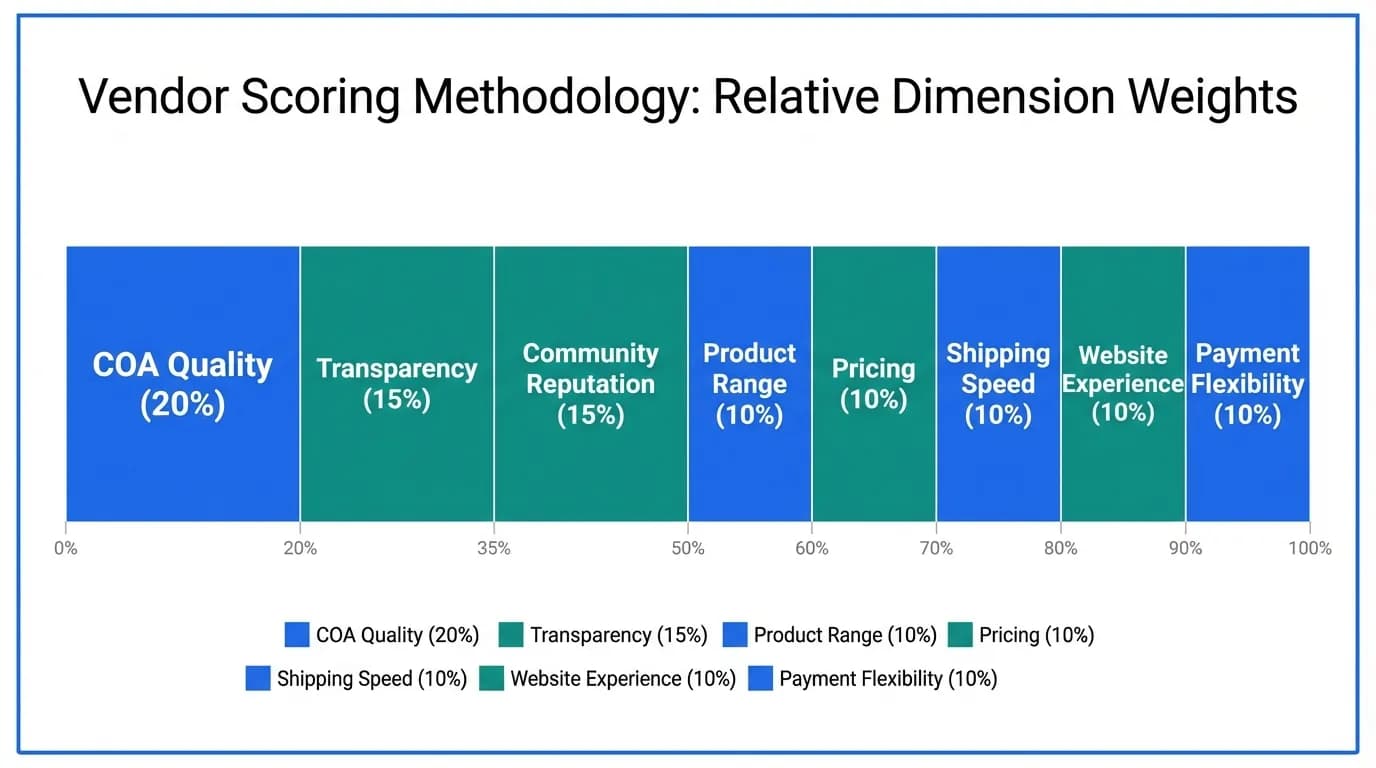
We evaluate every vendor in our directory across 8 dimensions, each scored on a 0-10 scale with specific weights reflecting their importance to researchers:
| Dimension | Weight | What It Measures |
|---|---|---|
| COA Quality | 20% | Third-party testing, HPLC purity data, mass spec confirmation, lab independence |
| Transparency | 15% | Public COAs, clear business information, honest product descriptions |
| Community Reputation | 15% | Forum feedback, Reddit reviews, longevity in the market, dispute resolution |
| Product Range | 10% | Breadth of peptide catalog, availability of popular compounds |
| Pricing | 10% | Competitiveness relative to market, value for quantity |
| Shipping Speed | 10% | Domestic delivery times, tracking, packaging quality |
| Website Experience | 10% | Ease of ordering, product information quality, educational content |
| Payment Flexibility | 10% | Number of accepted payment methods, convenience |
Overall scores translate to tiers: Excellent (8.0+), Good (6.0+), Fair (4.0+), and Poor (below 4.0). Visit the vendor directory for current scores -- we do not publish specific numerical scores in blog posts because they are updated regularly.
Vendor Categories#
US Domestic Vendors#
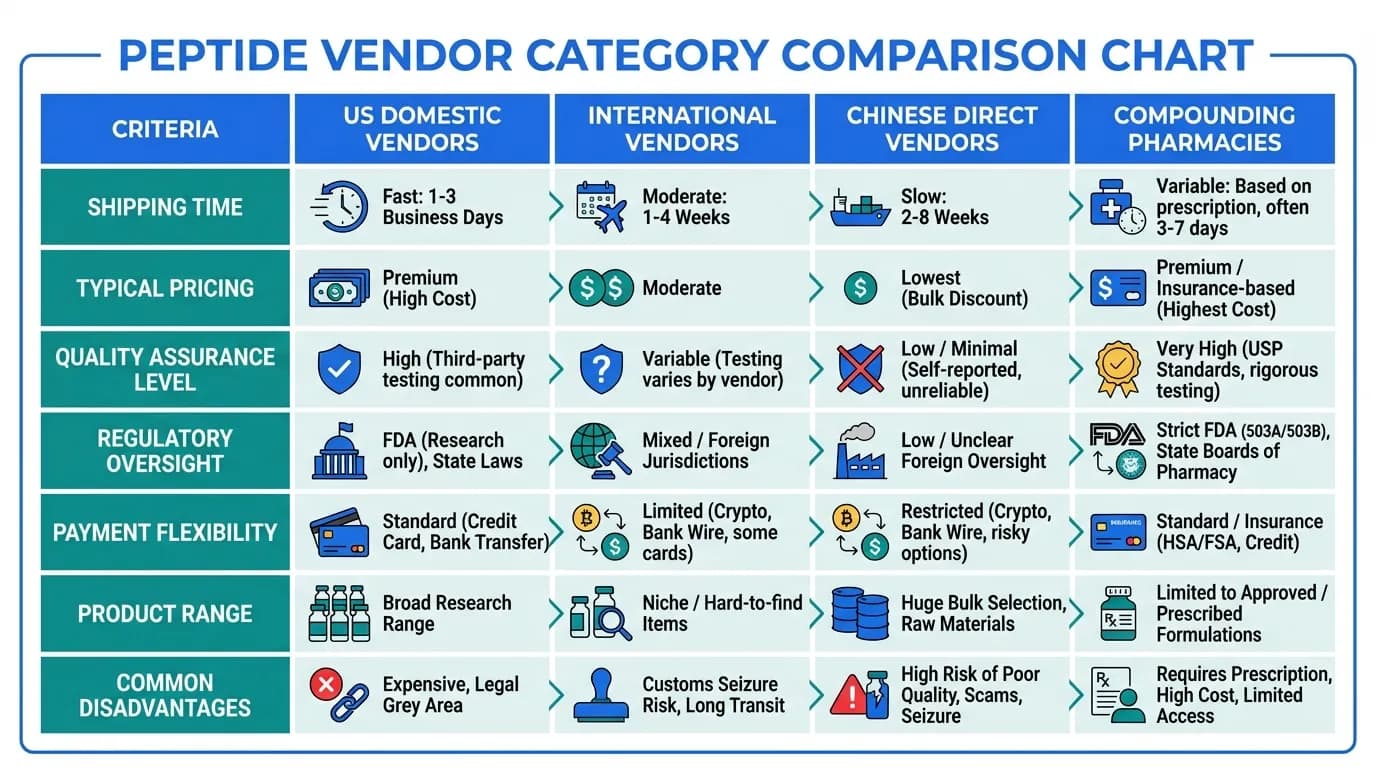
US domestic vendors ship from within the United States, typically offering faster delivery times (1-5 business days) and easier returns. They generally accept a wider range of payment methods and are subject to US business regulations.
Advantages: fast shipping, domestic customer service, easier payment options. Disadvantages: typically higher prices than international sources, product range may be more limited due to US regulatory landscape.
Browse all US domestic vendors in our vendor directory.
International Vendors#
International vendors ship from outside the US, often from Europe, the UK, or Asia. Shipping times are longer (5-15+ business days) but pricing can be significantly lower.
Advantages: competitive pricing, broader product availability in some cases. Disadvantages: longer shipping, potential customs delays, more difficult dispute resolution, variable quality standards depending on country of origin.
Chinese Direct Vendors#
Chinese direct vendors sell peptides manufactured in China, which is the primary global source of raw peptide synthesis. These vendors often offer the lowest prices but require more due diligence from buyers.
Advantages: lowest pricing, direct from manufacturing source. Disadvantages: longer shipping, quality varies widely, COA verification is especially important, limited recourse for quality issues.
Compounding Pharmacies#
Compounding pharmacies operate under FDA oversight and follow USP quality standards. They require a physician prescription and offer the highest quality assurance of any vendor category.
Advantages: FDA oversight, USP standards, physician involvement, highest quality assurance. Disadvantages: prescription required, highest pricing, limited to Category 1 and Category 3 peptides.
Browse compounding pharmacies in our vendor directory.
What to Look for in a Vendor#
Certificate of Analysis (COA) Quality#
The COA is the single most important document when evaluating a peptide vendor. A legitimate COA should include:
- Third-party lab name and contact information -- not in-house testing
- HPLC purity analysis showing peptide purity percentage (look for 98%+ for research-grade)
- Mass spectrometry (MS) data confirming molecular weight matches the expected peptide
- Batch/lot number matching the product you received
- Date of analysis that is recent and relevant to the batch
Red flags in COAs: generic templates without lab identification, COAs that look identical across different peptides, missing mass spec data, purity claims without supporting chromatograms, in-house testing with no third-party verification.
Community Reputation#
Long-standing vendors with consistent positive feedback across multiple forums (Reddit r/Peptides, r/PeptideResearch, Excel Male Forum) are generally more reliable. Look for:
- Consistent reviews over time (not just recent positive reviews, which can be manufactured)
- How the vendor handles problems -- response to quality complaints, willingness to reship or refund
- Longevity -- vendors operating for 3+ years have more track record to evaluate
Transparency#
Trustworthy vendors are transparent about their operations:
- Business registration and contact information are publicly available
- COAs are accessible before purchase (not only after)
- Product sourcing is described honestly
- Marketing claims match what clinical evidence actually supports
Red Flags to Avoid#
Be cautious of vendors that exhibit any of these patterns:
- No COAs available or COAs only provided after purchase
- Claims of pharmaceutical-grade purity without supporting documentation
- Prices dramatically below market rate -- this often indicates underdosed products
- No verifiable business information -- no address, no phone number, no business registration
- Aggressive marketing claims about health benefits (legitimate research vendors do not make therapeutic claims)
- Requiring cryptocurrency-only payment with no alternative methods
- Brand-new websites with no community track record
- Fake reviews or paid testimonials (check if reviews appear across independent platforms)
How COAs Work#
A Certificate of Analysis is a document from an analytical laboratory reporting the results of testing on a specific batch of a substance. For peptides, the two critical tests are:
HPLC (High-Performance Liquid Chromatography): Separates the components of a sample to determine purity. A result of 99.1% means 99.1% of the sample is the target peptide and 0.9% is impurities. Research-grade peptides should be 98% or higher.
Mass Spectrometry: Measures the molecular weight of the sample. The observed mass should match the theoretical molecular weight of the peptide within a narrow tolerance. This confirms the sample is actually the peptide it claims to be, not a substitute.
Some vendors also provide additional testing such as endotoxin testing (LAL), amino acid analysis, or sterility testing. These are positive indicators of quality commitment but are not universally provided.
For guidance on verifying COAs independently, see the testing lab profiles in our labs directory.
Frequently Asked Questions#
Frequently Asked Questions About Best Peptide Vendors 2026: Ranked by Third-Party Testing
How do you rank peptide vendors?
We use an 8-dimension scoring system that evaluates COA quality (20%), transparency (15%), community reputation (15%), product range (10%), pricing (10%), shipping speed (10%), website experience (10%), and payment flexibility (10%). Each dimension is scored 0-10 and weighted to produce an overall score. See our full vendor directory for current scores.
What should I look for in a peptide vendor?
The most important factor is third-party Certificate of Analysis (COA) quality. Look for vendors that provide COAs from independent labs (not in-house testing), include HPLC purity data and mass spectrometry confirmation, and make COAs publicly accessible rather than requiring a purchase first. Community reputation and transparency about business practices are also strong indicators.
Are compounding pharmacies better than research peptide vendors?
Compounding pharmacies operate under FDA oversight with USP quality standards and require a physician prescription. Research peptide vendors sell products labeled for research use only. Compounding pharmacies generally offer higher quality assurance but at higher prices and with prescription requirements. The best choice depends on your specific situation and whether you have a prescribing physician.
How often are vendor scores updated?
Our vendor directory scores are reviewed and updated regularly as new information becomes available. Community feedback, COA verification, and vendor transparency changes all factor into score adjustments. Visit the vendor directory for the most current rankings.
Continue reading this research review
Free access to the complete analysis with citations and evidence ratings.
150+ peptide profiles · 30+ comparisons · 18 research tools
Medical Disclaimer
This website is for educational and informational purposes only. The information provided is not intended to diagnose, treat, cure, or prevent any disease. Always consult with a qualified healthcare professional before using any peptide or supplement.
Join 2,000+ researchers getting biweekly updates
Enjoyed this article?
The Research Briefing delivers deep-dives like this biweekly — plus new study breakdowns, safety updates, and tool announcements.
Free forever. No spam. Unsubscribe in one click.
Where to Find These Peptides
Continue Exploring
Peptide Profiles
Keep Reading
Core Peptides Review 2026: COAs, Finnrick Controversy, and Whether the Score Holds Up
An honest 2026 review of Core Peptides covering product range, payment flexibility, shipping, COA transparency, and how the Finnrick Analytics controversy should change how you read vendor ratings. Includes 8-dimension scoring.
Understanding Peptide Side Effects: A Comprehensive Safety Guide
A thorough, evidence-based guide to peptide side effects by category — covering GLP-1 agonists, GH secretagogues, tissue repair peptides, and melanocortins — with serious risk flags, drug interactions, monitoring recommendations, and guidance on when to stop.
Most Popular Therapeutic Peptides in 2026: 15 Ranked by Research Interest
The 15 most popular therapeutic peptides in 2026, ranked by clinical trial activity, search interest, and research community adoption. From semaglutide to BPC-157.
You Might Also Like
Related content you may find interesting