Humanin vs MOTS-c: Mitochondrial-Derived Peptides for Aging and Metabolism
Comparison of humanin and MOTS-c, two mitochondrial-derived peptides (MDPs) with distinct mechanisms for cytoprotection, metabolic health, and longevity research.
Verdict at a Glance
Humanin and MOTS-c are complementary rather than competing peptides. Both are mitochondrial-derived and decline with age, but they serve fundamentally different roles. Humanin is primarily a cytoprotective/anti-apoptotic peptide with the strongest data in neuroprotection and cellular stress resistance. MOTS-c is primarily a metabolic regulator and exercise mimetic with the strongest data in insulin sensitization and energy metabolism. Neither has robust human interventional data. The choice depends entirely on the therapeutic goal -- cellular protection versus metabolic enhancement.
| Best for | Pick | Why |
|---|---|---|
| Neuroprotection and Cellular Stress | Humanin | Humanin has the most extensive preclinical data for protecting neurons and other cells from apoptotic stress, including Alzheimer disease models and oxidative damage. Its JAK2/STAT3 and Bax-inhibiting mechanisms directly promote cell survival. |
| Metabolic Health and Insulin Sensitivity | MOTS-c | MOTS-c directly activates AMPK and enhances insulin sensitivity in muscle and liver tissue. Preclinical models show reversal of diet-induced obesity and insulin resistance, making it the stronger candidate for metabolic applications. |
| Exercise Mimetic Effects | MOTS-c | MOTS-c levels increase dramatically with exercise in humans and preclinical data shows it mimics many exercise-induced metabolic adaptations including mitochondrial biogenesis and fatty acid oxidation. |
| Cardiovascular Protection | Humanin | Humanin has demonstrated cardioprotective effects in preclinical models of ischemia-reperfusion injury and atherosclerosis, with anti-apoptotic mechanisms that protect cardiomyocytes from stress-induced death. |
| Longevity Research | Humanin | Human observational data links higher circulating humanin levels with longevity. Humanin is regulated by the GH/IGF-1 axis and may mediate some of the lifespan benefits associated with reduced growth hormone signaling. |
| Category | Humanin | MOTS-c | Advantage |
|---|---|---|---|
| Mechanism of Action | Mitochondrial-derived peptide (24 amino acids) encoded by mtDNA 16S rRNA. Cytoprotective and anti-apoptotic via JAK2/STAT3 signaling. Binds IGFBP-3 and Bax to antagonize pro-apoptotic activity. Activates CNTFR/WSX-1/gp130 receptor complex. Primarily a cell survival and stress resistance peptide. | Mitochondrial-derived peptide (16 amino acids) encoded by mtDNA 12S rRNA. Acts primarily through AMPK activation via the folate-AICAR-AMPK pathway. Enhances insulin sensitivity, promotes fatty acid oxidation, and activates mitochondrial biogenesis. Functions as an exercise mimetic. | Comparable |
| Research Evidence | Discovered in 2001. Extensive preclinical data in neuroprotection, cardiovascular protection, and diabetes models. Circulating humanin levels correlate with longevity in human observational studies. No human interventional trials. Primarily biomarker and mechanistic research. | Discovered in 2015 by Pinchas Cohen's group at USC. Preclinical data showing reversal of diet-induced insulin resistance in mice and improved exercise capacity. Skeletal muscle MOTS-c increases 11.9-fold with exercise in humans. Limited early-phase human safety studies initiated. | Comparable |
| Side Effect Profile | No human interventional safety data. Preclinical studies show favorable tolerance. Endogenous peptide with natural physiological role, suggesting low toxicity potential. Theoretical concern about excessive anti-apoptotic signaling, though not observed in animal studies. | No substantial human safety data. Endogenous peptide naturally produced during exercise. Preclinical studies show good tolerance. WADA-prohibited substance, indicating recognition of biological activity. Long-term effects of chronic exogenous administration unknown. | Comparable |
| Therapeutic Focus | Primarily studied for neuroprotection (Alzheimer disease models), cardiovascular protection, diabetes/insulin resistance, and cellular stress resistance. Strongest data in cytoprotection and anti-apoptotic contexts. Potential longevity biomarker. | Primarily studied as an exercise mimetic and metabolic regulator. Strongest data in insulin sensitization, obesity/metabolic syndrome, and exercise physiology. Enhances physical performance and mitochondrial function in preclinical models. | Comparable |

Introduction#
Humanin and MOTS-c are the two best-characterized members of a new class of bioactive molecules called mitochondrial-derived peptides (MDPs) -- small peptides encoded within the mitochondrial genome rather than nuclear DNA. Both were discovered relatively recently (humanin in 2001, MOTS-c in 2015), and both decline with age, suggesting roles in the aging process. However, they operate through fundamentally different mechanisms and target different aspects of cellular biology.
Humanin is primarily a cytoprotective peptide that prevents programmed cell death (apoptosis) through JAK/STAT signaling and direct interaction with pro-apoptotic proteins. MOTS-c is primarily a metabolic regulator that activates AMPK and enhances insulin sensitivity, functioning as an endogenous exercise mimetic. Together, they represent two arms of mitochondrial communication with the rest of the cell and the organism.
Mechanism of Action Comparison#
Humanin#
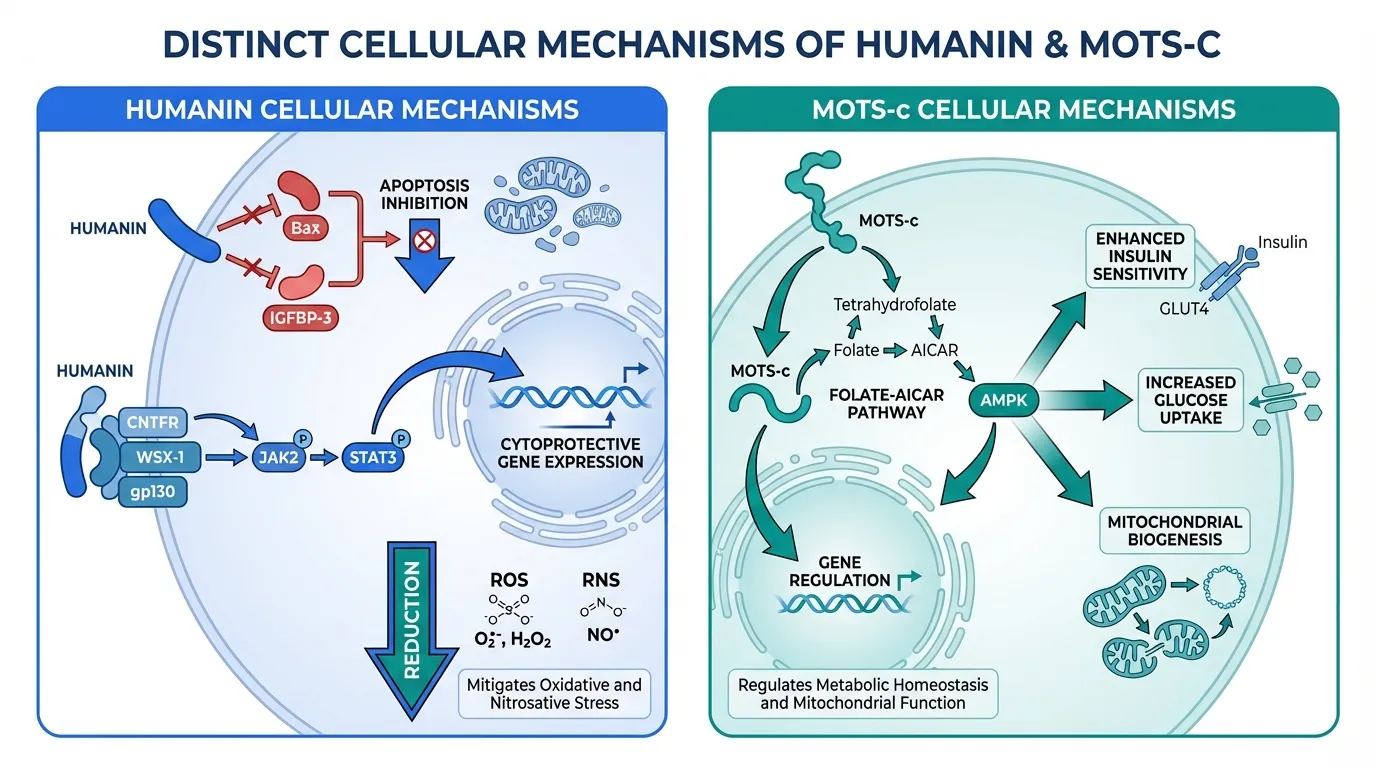
Humanin (HN) is a 24-amino acid peptide encoded by the MT-RNR2 gene within mitochondrial 16S rRNA. It was first identified in a screen for factors that protect neurons from amyloid-beta toxicity in Alzheimer disease. Its mechanisms include:
- Anti-apoptotic signaling: Humanin binds directly to Bax and IGFBP-3, two pro-apoptotic proteins, preventing their activation and subsequent mitochondrial membrane permeabilization
- JAK2/STAT3 pathway: Humanin activates a trimeric receptor complex (CNTFR/WSX-1/gp130), which signals through JAK2, leading to STAT3 phosphorylation and nuclear translocation to regulate cytoprotective gene expression
- MAPK activation: Also engages ERK1/2 and p38 MAPK pathways for cell survival signaling
- Oxidative stress reduction: Reduces intracellular reactive oxygen species (ROS) and reactive nitrogen species (RNS)
A potent synthetic analog, HNG (S14G-humanin), has approximately 1000-fold greater neuroprotective activity than native humanin and is commonly used in preclinical research.
MOTS-c#
MOTS-c (Mitochondrial Open reading frame of the Twelve S rRNA type-c) is a 16-amino acid peptide encoded by the MT-RNR1 gene within mitochondrial 12S rRNA. It was discovered by Pinchas Cohen's group at the University of Southern California. Its mechanisms include:
- AMPK activation: MOTS-c activates AMPK through the folate-AICAR-AMPK pathway, inhibiting the folate cycle and leading to accumulation of AICAR, a potent endogenous AMPK activator
- Insulin sensitization: Enhances insulin signaling in skeletal muscle and liver, improving glucose uptake and utilization
- Mitochondrial biogenesis: Promotes the creation of new mitochondria, increasing cellular energy production capacity
- Nuclear translocation: Under metabolic stress, MOTS-c translocates to the nucleus where it regulates gene expression related to antioxidant defense and metabolic homeostasis
- Exercise response: Skeletal muscle MOTS-c levels increase 11.9-fold during acute exercise in humans, with circulating levels rising approximately 1.6-fold
Mechanistic Comparison#
| Feature | Humanin | MOTS-c |
|---|---|---|
| mtDNA origin | 16S rRNA (MT-RNR2) | 12S rRNA (MT-RNR1) |
| Size | 24 amino acids | 16 amino acids |
| Primary pathway | JAK2/STAT3, Bax inhibition | Folate-AICAR-AMPK |
| Primary function | Cytoprotection/anti-apoptosis | Metabolic regulation/exercise mimetic |
| Key targets | Bax, IGFBP-3, gp130 receptor | AMPK, folate cycle |
| Age-related decline | Yes | Yes |
| Exercise response | Not well characterized | 11.9-fold increase in muscle |
| Insulin effects | Indirect (cell survival) | Direct insulin sensitization |
Dosing Comparison#
Humanin Dosing#
No standardized human dosing exists. Preclinical research has used:
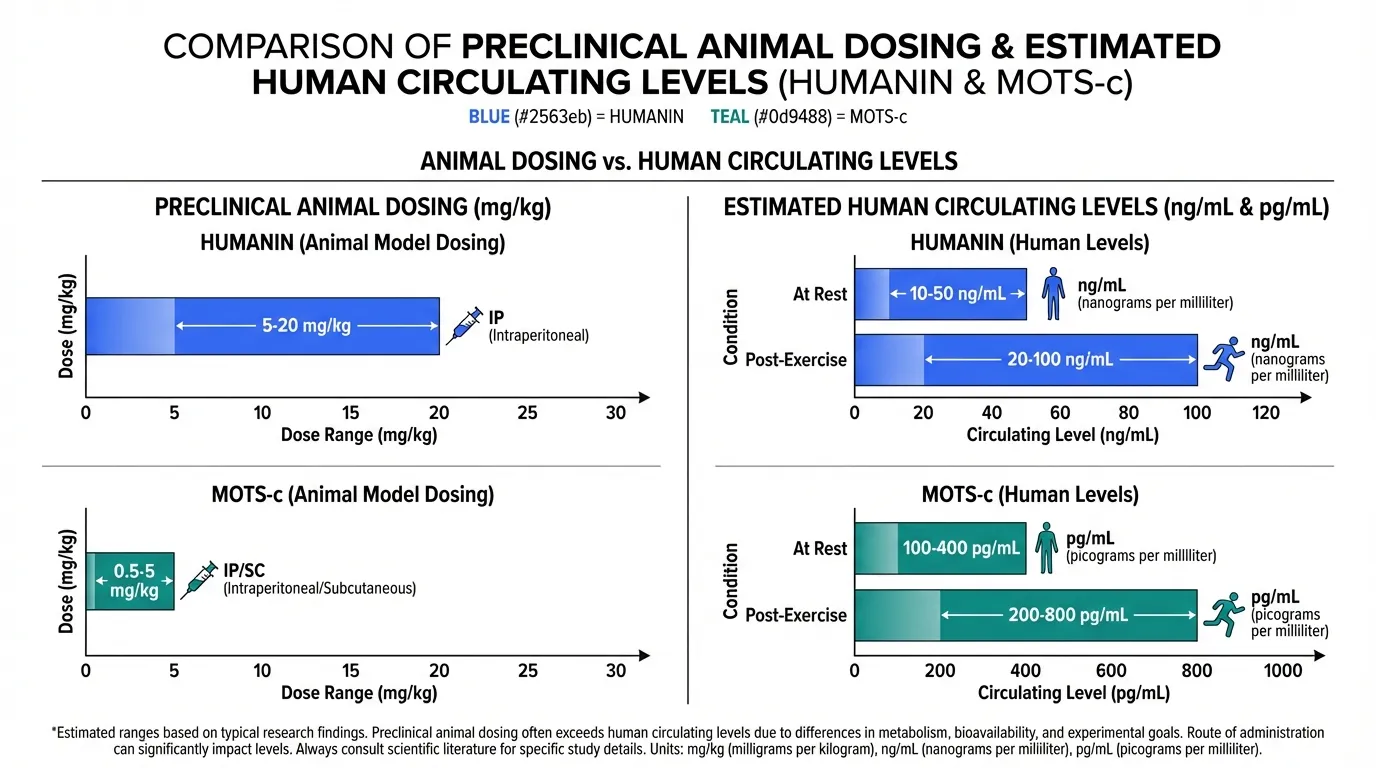
- HNG analog (S14G-humanin): 0.1-10 mg/kg in animal studies, typically intraperitoneal
- Native humanin: Circulating levels in humans are approximately 0.5-2 ng/mL, declining with age
- Route: Subcutaneous or intraperitoneal in animal models; crosses the blood-brain barrier
- Duration: Typically acute or short-course administration in preclinical studies
MOTS-c Dosing#
No established human dosing protocols. Research contexts include:
- Animal studies: 5-15 mg/kg intraperitoneal injection in mice
- Circulating levels: Approximately 125 pg/mL at rest in humans, rising to ~190 pg/mL with exercise
- Route: Intraperitoneal in animal studies; subcutaneous in research settings
- Duration: Daily administration in metabolic studies; single doses in exercise studies
Side Effects Comparison#
Humanin Side Effects#
No human interventional safety data exists. Based on preclinical research:
- Preclinical tolerance: Generally well tolerated in animal studies with no reported dose-limiting toxicities
- Endogenous peptide: As a naturally occurring molecule, expected to have favorable safety
- Theoretical concerns: Excessive anti-apoptotic signaling could theoretically interfere with normal programmed cell death (including cancer surveillance), though this has not been observed
- GH/IGF-1 interaction: Humanin levels are inversely regulated by GH/IGF-1 signaling, which may have implications for hormonal balance
MOTS-c Side Effects#
No substantial human safety data exists. Based on available research:
- Preclinical tolerance: Well tolerated in animal metabolic studies
- WADA status: Prohibited by the World Anti-Doping Agency, indicating recognized biological activity
- Endogenous peptide: Naturally produced, particularly during exercise, suggesting physiological safety
- Theoretical concerns: Chronic AMPK activation could theoretically affect fertility or bone metabolism, though not observed in preclinical studies
- Long-term effects: Unknown consequences of chronically elevating MOTS-c beyond physiological levels
Research Evidence Comparison#
Humanin Research#
- Neuroprotection: Original discovery showed protection against amyloid-beta-induced neuronal death. Subsequent studies confirmed protection in Alzheimer disease models, cerebral ischemia, and prion disease models
- Cardiovascular: HNG (S14G-humanin) reduced infarct size in myocardial ischemia-reperfusion models and showed anti-atherogenic properties
- Diabetes: Improved insulin sensitivity and reduced pancreatic beta-cell apoptosis in diabetic mouse models
- Longevity association: Higher circulating humanin levels correlated with longer lifespan in human cohort studies. Centenarians and their offspring tend to have higher humanin levels
- GH/IGF-1 axis: Humanin is negatively regulated by growth hormone, potentially linking it to the longevity benefits of reduced GH signaling
Evidence level: Low -- extensive preclinical data and observational human correlations, but no human interventional trials.
MOTS-c Research#
- Metabolic syndrome: Reversed diet-induced obesity and insulin resistance in mice without changes in food intake or physical activity
- Exercise physiology: Demonstrated 11.9-fold increase in skeletal muscle MOTS-c during acute exercise in healthy young men, establishing it as an exercise-responsive factor
- Aging: MOTS-c levels decline with age in both mice and humans. Exogenous MOTS-c improved physical performance in aged mice
- Diabetes models: Enhanced skeletal muscle glucose uptake and improved insulin signaling in diabetic animal models
- Mitochondrial function: Restored mitochondrial respiration in type 2 diabetic heart models
Evidence level: Low -- strong preclinical data with some human observational/biomarker studies, but very limited human interventional data.
Key Differences Summary#
- Primary function: Humanin protects cells from death (anti-apoptotic). MOTS-c regulates energy metabolism (exercise mimetic).
- Signaling pathway: Humanin signals through JAK2/STAT3 and Bax inhibition. MOTS-c signals through AMPK activation.
- Therapeutic niche: Humanin for neurodegeneration and cellular stress. MOTS-c for metabolic disease and physical performance.
- Exercise connection: MOTS-c is strongly exercise-responsive (11.9-fold muscle increase). Humanin's relationship to exercise is less characterized.
- Longevity link: Humanin has stronger human correlational data linking levels to lifespan. MOTS-c has stronger preclinical interventional data for healthspan.
- Discovery timeline: Humanin (2001) has a longer research history. MOTS-c (2015) is more recently discovered with a rapidly growing literature.
- Clinical development: Neither has advanced to formal clinical trials, though both are subjects of active research.
Conclusion#
Humanin and MOTS-c represent two distinct arms of mitochondrial-derived peptide biology. Humanin excels in cytoprotection -- keeping cells alive under stress -- with its strongest data in neuroprotection and cardiovascular protection. MOTS-c excels in metabolic regulation -- optimizing energy use -- with its strongest data in insulin sensitization and exercise mimicry.
Both peptides decline with age, and this decline may contribute to age-related disease. However, they address aging from different angles: humanin by preventing the cellular damage that accumulates with age, and MOTS-c by maintaining the metabolic fitness that declines with age. For longevity research, the two peptides are genuinely complementary rather than competitive, and understanding both is essential for the emerging field of mitochondrial-derived peptide biology.
Neither peptide has sufficient human interventional data to recommend for clinical use. Both remain primarily research tools, though the scientific rationale for both is strong and growing.
Further Reading#

Which Is Better For...
Neuroprotection and Cellular Stress
Humanin
Humanin has the most extensive preclinical data for protecting neurons and other cells from apoptotic stress, including Alzheimer disease models and oxidative damage. Its JAK2/STAT3 and Bax-inhibiting mechanisms directly promote cell survival.
Metabolic Health and Insulin Sensitivity
MOTS-c
MOTS-c directly activates AMPK and enhances insulin sensitivity in muscle and liver tissue. Preclinical models show reversal of diet-induced obesity and insulin resistance, making it the stronger candidate for metabolic applications.
Exercise Mimetic Effects
MOTS-c
MOTS-c levels increase dramatically with exercise in humans and preclinical data shows it mimics many exercise-induced metabolic adaptations including mitochondrial biogenesis and fatty acid oxidation.
Cardiovascular Protection
Humanin
Humanin has demonstrated cardioprotective effects in preclinical models of ischemia-reperfusion injury and atherosclerosis, with anti-apoptotic mechanisms that protect cardiomyocytes from stress-induced death.
Longevity Research
Humanin
Human observational data links higher circulating humanin levels with longevity. Humanin is regulated by the GH/IGF-1 axis and may mediate some of the lifespan benefits associated with reduced growth hormone signaling.
Continue Your Research
Get comparison updates
We publish new head-to-head comparisons regularly. Subscribe to see them first.
Frequently Asked Questions About Humanin vs MOTS-c: Mitochondrial-Derived Peptides for Aging and Metabolism
Which is better, Humanin or MOTS-c?
Humanin and MOTS-c are complementary rather than competing peptides. Both are mitochondrial-derived and decline with age, but they serve fundamentally different roles. Humanin is primarily a cytoprotective/anti-apoptotic peptide with the strongest data in neuroprotection and cellular stress resistance. MOTS-c is primarily a metabolic regulator and exercise mimetic with the strongest data in insulin sensitization and energy metabolism. Neither has robust human interventional data. The choice d... Individual responses may vary, and this comparison is based on available research data, not a treatment recommendation.
What are the key differences between Humanin and MOTS-c?
The main differences across comparison categories are: Mechanism of Action: advantage goes to neither (tie); Research Evidence: advantage goes to neither (tie); Side Effect Profile: advantage goes to neither (tie). 1 additional categories are analyzed in the full comparison. Each category evaluates a different dimension of the two peptides.
When should I consider Humanin over MOTS-c?
For the scenario of "Neuroprotection and Cellular Stress," research data suggests Humanin may be more relevant. Humanin has the most extensive preclinical data for protecting neurons and other cells from apoptotic stress, including Alzheimer disease models and oxidative damage. Its JAK2/STAT3 and Bax-inhibit.... This is based on currently available evidence and individual circumstances may differ.
How do Humanin and MOTS-c differ in their mechanisms of action?
Humanin: Mitochondrial-derived peptide (24 amino acids) encoded by mtDNA 16S rRNA. Cytoprotective and anti-apoptotic via JAK2/STAT3 signaling. Binds IGFBP-3 and Bax to antagonize pro-apoptotic activity. Act.... MOTS-c: Mitochondrial-derived peptide (16 amino acids) encoded by mtDNA 12S rRNA. Acts primarily through AMPK activation via the folate-AICAR-AMPK pathway. Enhances insulin sensitivity, promotes fatty acid....
Which has fewer side effects, Humanin or MOTS-c?
In terms of side effects and tolerability, the advantage goes to neither (comparable). Humanin: No human interventional safety data. Preclinical studies show favorable tolerance. Endogenous peptide with natural physiological role, suggesting l.... MOTS-c: No substantial human safety data. Endogenous peptide naturally produced during exercise. Preclinical studies show good tolerance. WADA-prohibited s....
Medical Disclaimer
This website is for educational and informational purposes only. The information provided is not intended to diagnose, treat, cure, or prevent any disease. Always consult with a qualified healthcare professional before using any peptide or supplement.