Melanotan-2 vs PT-141: Parent Peptide vs FDA-Approved Derivative
Melanotan-2 vs PT-141 compared: tanning vs sexual function, receptor selectivity, FDA approval status, and side effect profiles.
Verdict at a Glance
PT-141 is the clear winner for anyone seeking an evidence-based peptide for sexual function, with FDA approval, defined dosing, and a characterized safety profile. Melanotan-2 remains the more pharmacologically diverse compound with broader melanocortin effects including tanning, but its lack of regulatory approval and wider side effect profile reflect its status as an unrefined parent compound. PT-141 represents what happens when a promising lead compound is properly developed through clinical trials, while MT-2 remains in the research domain with significant safety concerns.
| Best for | Pick | Why |
|---|---|---|
| Female sexual desire disorder (clinical) | PT-141 | FDA-approved for HSDD in premenopausal women with defined efficacy from Phase 3 pivotal trials |
| Melanocortin receptor pharmacology research | Melanotan-2 | Non-selective agonist profile allows study of MC1R through MC5R activation and multi-system melanocortin signaling |
| Sexual function with regulatory backing | PT-141 | Only melanocortin-based sexual function treatment with FDA approval and standardized prescription dosing |
| Melanogenesis and tanning research | Melanotan-2 | Higher MC1R agonist activity produces more robust melanogenesis than PT-141, which was optimized away from tanning effects |
| Category | Melanotan-2 | PT-141 | Advantage |
|---|---|---|---|
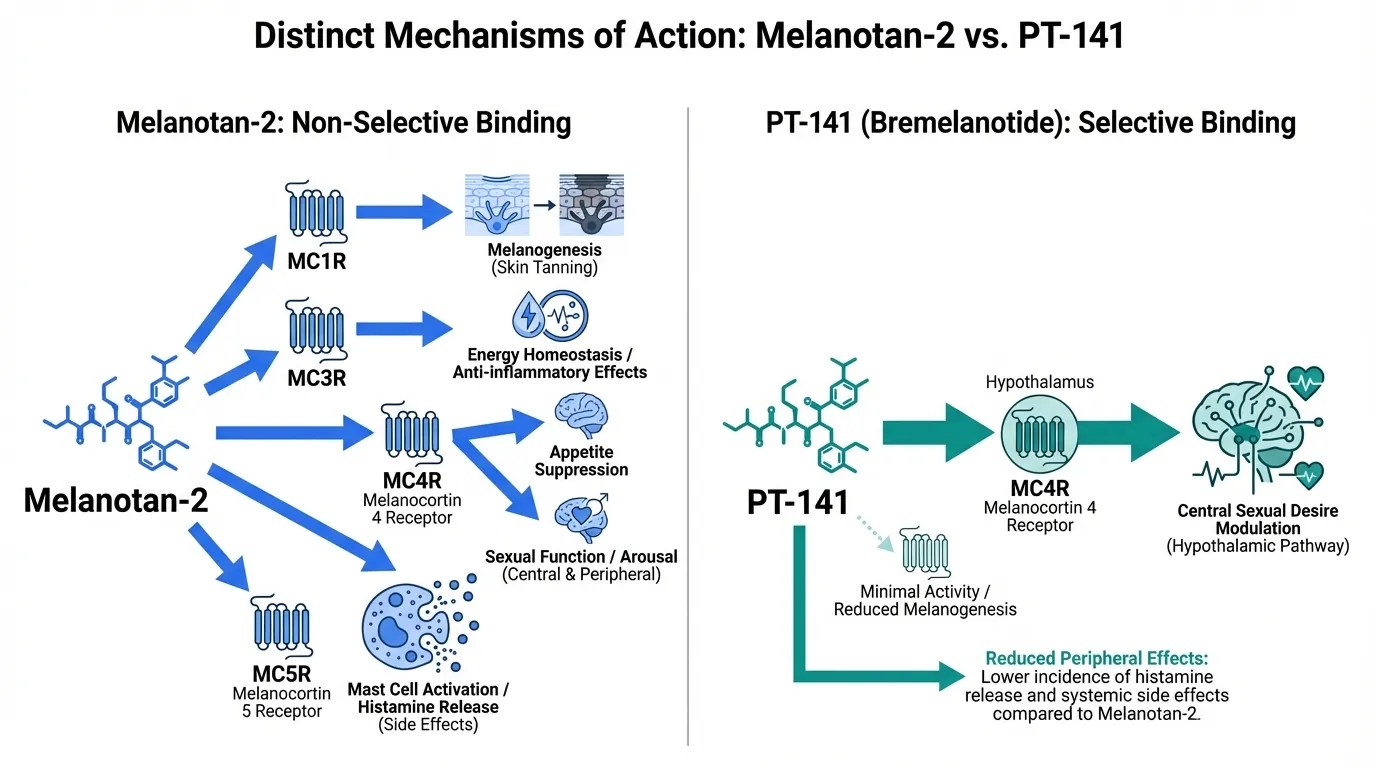
| Mechanism of Action | Non-selective melanocortin agonist activating MC1R (tanning), MC3R/MC4R (appetite, sexual function), and MC5R; also triggers mast cell histamine release as an off-target mechanism | Cyclic heptapeptide derived from MT-2 with primary activity at MC4R in the hypothalamus for sexual desire; retains some MC1R activity but optimized for central nervous system sexual function effects | Comparable |
| Research Evidence | Phase 2 clinical data for erectile dysfunction; preclinical data for tanning and appetite; university-developed but never achieved regulatory approval for any indication | FDA-approved (June 2019) as Vyleesi for HSDD in premenopausal women; completed Phase 3 pivotal trials with defined efficacy and safety data | PT-141 |
| Side Effect Profile | Significant nausea, facial flushing, mast cell-mediated histamine reactions; widespread pigmentation changes including nevi darkening; potential cardiovascular effects from broad receptor activation | Nausea in ~40% of patients; transient facial flushing; potential blood pressure elevation; FDA label limits use to 8 doses/month due to safety considerations | PT-141 |
| Regulatory Status | No regulatory approvals in any country; classified as an unapproved research peptide; subject to regulatory warnings in multiple jurisdictions | FDA-approved (Vyleesi) for HSDD in premenopausal women; marketed by AMAG Pharmaceuticals; available by prescription in the United States | PT-141 |
| Scope of Effects | Broad effects including melanogenesis/tanning, sexual arousal, appetite suppression, and mast cell activation; multi-system compound with diverse pharmacology | Primarily focused on central sexual desire pathways; some residual tanning and appetite effects but optimized for MC4R-mediated sexual function | Melanotan-2 |

Introduction#
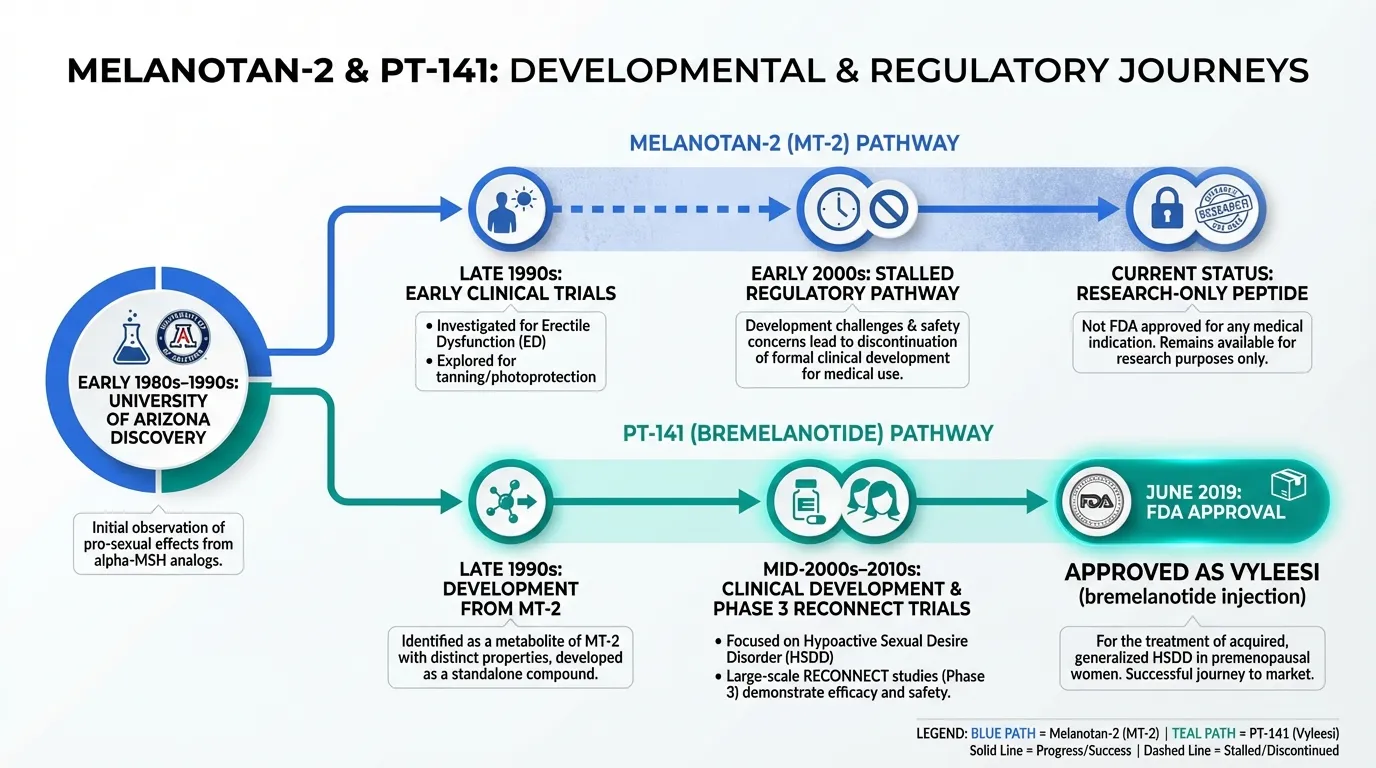
Melanotan-2 and PT-141 share a direct lineage: PT-141 (bremelanotide) was developed from Melanotan-2 when researchers at the University of Arizona noticed that their tanning peptide had unexpected pro-sexual effects. This observation led to the creation of PT-141 as a more targeted compound, eventually culminating in FDA approval as Vyleesi for hypoactive sexual desire disorder in 2019.
Despite their structural similarity, these two peptides occupy very different positions in both regulatory status and pharmacological profile. This comparison examines the parent compound against its refined derivative, clarifying when each is relevant and the significant evidence gap between them.
Quick Comparison#
| Feature | Melanotan-2 | PT-141 (Bremelanotide) |
|---|---|---|
| Structure | Cyclic heptapeptide, 1024 Da | Cyclic heptapeptide, 1025 Da |
| Sequence | Ac-Nle-c[Asp-His-D-Phe-Arg-Trp-Lys]-NH2 | Ac-Nle-c[Asp-His-D-Phe-Arg-Trp-Lys]-OH |
| Key Structural Difference | C-terminal amide (-NH2) | C-terminal free acid (-OH) |
| Primary Receptors | MC1R, MC3R, MC4R, MC5R (non-selective) | MC4R (optimized), some MC1R activity |
| Primary Effects | Tanning + sexual function + appetite | Sexual desire (central) |
| FDA Status | Not approved | Approved (Vyleesi, June 2019) |
| Indication | None approved | HSDD in premenopausal women |
| Brand Name | None | Vyleesi |
| Administration | Subcutaneous | Subcutaneous (autoinjector) |
Mechanism of Action Comparison#
Melanotan-2#
Melanotan-2 (MT-2) is a synthetic cyclic analog of alpha-melanocyte-stimulating hormone (alpha-MSH) developed at the University of Arizona. It acts as a non-selective melanocortin receptor agonist with the following binding profile (approximate Ki values):
- MC1R: ~0.67 nM (highest affinity, melanogenesis)
- MC4R: ~6.6 nM (appetite suppression, sexual function)
- MC3R: ~34 nM (energy balance)
- MC5R: ~46 nM (exocrine gland function)
This broad receptor profile produces multiple physiological effects. At MC1R on melanocytes, MT-2 activates the cAMP-PKA-MITF-tyrosinase cascade, increasing eumelanin synthesis and skin pigmentation. At MC4R in the hypothalamus, it suppresses appetite and modulates sexual arousal pathways through dopaminergic neurons. MT-2 also activates mast cells through MRGPRB2-dependent and independent mechanisms, causing histamine release, which produces an off-target hypothermic response and contributes to nausea and flushing.
The non-selectivity is both MT-2's strength (diverse pharmacology) and its weakness (unpredictable multi-system effects and increased side effect burden).
PT-141#
PT-141 was derived from MT-2 through a single structural modification: the C-terminal amide group of MT-2 (-NH2) was converted to a free acid (-OH). This change, while seemingly minor, altered the pharmacological profile to favor central MC4R-mediated sexual function effects while reducing some peripheral activities.
PT-141 exerts its therapeutic effect primarily through MC4R activation in the hypothalamus. MC4R-expressing neurons in the paraventricular nucleus project to brainstem autonomic centers and interface with dopaminergic pathways in the medial preoptic area, a region critical for sexual motivation and arousal. The mechanism is distinct from PDE5 inhibitors (which act peripherally on vascular smooth muscle) and from hormonal treatments (which modulate circulating hormone levels).
Key mechanistic features include:
- Central nervous system action: Effects mediated through hypothalamic MC4R, not peripheral vascular or hormonal mechanisms
- On-demand dosing: Single subcutaneous injection at least 45 minutes before anticipated activity
- Residual MC1R activity: Some melanogenesis can occur, though less pronounced than with MT-2
Evidence and Research Comparison#
Melanotan-2 Research#
MT-2 has been studied in clinical trials but never completed the regulatory pathway:
- Erectile dysfunction (psychogenic): Double-blind, placebo-controlled crossover trial in 10 men showed erections in 8/10 subjects vs. near-zero with placebo, with mean rigidity duration of ~38 minutes
- Erectile dysfunction (organic): Similar trial showing erections after 63% of drug injections vs. 5% with placebo
- Tanning: Phase 2 data demonstrating significant melanogenesis and UV-independent tanning; however, development for this indication was not pursued to approval
- Appetite: Preclinical data showing MC4R-dependent anorexigenic effects abolished in MC4R-deficient mice
- Safety concerns: Reports of nevi darkening and changes in existing moles have raised safety flags that contributed to the compound not progressing to approval
MT-2 has been widely used informally as a tanning agent, particularly in Australia, the UK, and Europe, prompting regulatory warnings from multiple health authorities including the TGA and EMA.
PT-141 Research#
PT-141 completed the full drug development pathway:
- RECONNECT trials: Two Phase 3 pivotal trials in premenopausal women with HSDD demonstrated statistically significant improvements in sexual desire scores compared to placebo, with a meaningful increase in satisfying sexual events
- FDA approval: Approved June 21, 2019, as Vyleesi for HSDD in premenopausal women
- Male sexual dysfunction: Earlier trials explored PT-141 for male erectile dysfunction, though this indication was not pursued to approval
- Dose limitations: FDA label restricts use to no more than 8 doses per month and recommends against use in patients with uncontrolled hypertension or cardiovascular disease
- Post-marketing: Ongoing pharmacovigilance with established adverse event reporting
The regulatory gap between MT-2 and PT-141 is the fundamental differentiator: PT-141 has undergone the rigorous efficacy and safety evaluation required for FDA approval, while MT-2 has not.
Side Effects and Safety Comparison#
Melanotan-2 Side Effects#
MT-2's broad receptor profile produces a wider side effect spectrum:
- Nausea: Common and dose-dependent; attributed partly to MC4R activation and partly to histamine release from mast cell activation
- Facial flushing: Occurs in most users; attributed to histamine H1 receptor activation downstream of mast cell degranulation
- Pigmentation changes: Darkening of nevi (moles), development of new pigmented lesions, and diffuse skin darkening; theoretical concern for melanoma risk with chronic use
- Appetite suppression: Significant in some users; mediated through MC4R
- Cardiovascular: Reports of blood pressure changes, particularly with higher doses
- Erections: Spontaneous erections in male users, particularly during initial dosing
- Injection site: Reactions common with subcutaneous administration
- Regulatory warnings: TGA (Australia), EMA, and other agencies have issued warnings about unregulated MT-2 use
PT-141 Side Effects#
PT-141's side effect profile is better characterized through Phase 3 data:
- Nausea: Most common adverse event (~40% of patients in trials); typically transient
- Flushing: Facial flushing reported in a significant minority of patients
- Headache: Reported at higher rates than placebo
- Blood pressure: Transient increases in blood pressure noted; contraindicated in uncontrolled hypertension
- Skin: Mild, transient skin hyperpigmentation in some patients (less than MT-2)
- Cardiovascular: FDA label includes warnings about cardiovascular risk; limited to 8 doses/month
- Injection site: Reactions at the injection site with the subcutaneous autoinjector
While both compounds share melanocortin-related side effects, PT-141's narrower receptor profile and regulated dosing provide a more controlled risk-benefit profile.
Dosing and Administration Comparison#
Melanotan-2 Dosing#
| Parameter | Details |
|---|---|
| Route | Subcutaneous injection |
| Research tanning dose | 0.5-1.0 mg per injection |
| Loading protocol | Often described as daily low-dose escalation |
| Maintenance | Variable; reduced frequency after loading |
| Standardized dosing | None (no approved protocol) |
| Storage | Requires reconstitution; refrigerated |
PT-141 Dosing#
| Parameter | Details |
|---|---|
| Route | Subcutaneous (autoinjector) |
| FDA-approved dose | 1.75 mg per injection |
| Timing | At least 45 minutes before activity |
| Frequency limit | No more than 1 dose per 24 hours |
| Monthly limit | No more than 8 doses per month |
| Storage | Room temperature; prefilled autoinjector |
The dosing difference is significant: PT-141 has FDA-defined dose limits based on safety and efficacy data, while MT-2 has no standardized dosing, leading to highly variable self-administration patterns with unknown risk.
Use Case Recommendations#
Choose Melanotan-2 When:#
- Melanocortin receptor research requires a non-selective agonist for broad pathway investigation
- Melanogenesis studies need potent MC1R activation for tanning research
- Multi-system melanocortin pharmacology is the research objective
- Appetite regulation research exploring MC4R-dependent anorexia mechanisms
- Comparative pharmacology studies with PT-141 and Melanotan-1 require the parent compound
Choose PT-141 When:#
- Female HSDD treatment is the clinical goal (FDA-approved indication)
- Regulatory-grade evidence and standardized dosing are required
- Sexual function research with a clinically validated melanocortin agonist is needed
- Minimized pigmentation effects are preferred over broad melanocortin activation
- Prescription access through established pharmaceutical channels is available
Can They Be Combined?#
Combining MT-2 and PT-141 would be pharmacologically redundant and potentially dangerous. Both activate overlapping melanocortin receptors, and concurrent use would effectively increase the total melanocortin agonist dose without adding any mechanistic benefit. This could amplify nausea, cardiovascular effects, and pigmentation changes.
For researchers studying melanocortin biology, the more informative comparison is between MT-2, PT-141, and Melanotan-1 (afamelanotide), which is a linear alpha-MSH analog with selective MC1R agonism approved by the EMA for erythropoietic protoporphyria. Together, these three compounds span the selectivity spectrum from non-selective (MT-2) to MC4R-optimized (PT-141) to MC1R-selective (MT-1).
Verdict#
PT-141 is the definitive choice for sexual function applications. Its FDA approval as Vyleesi validates both its efficacy for HSDD and its acceptable safety profile at the approved dose. The structured dosing limits (8 doses/month, no more than 1/day) reflect the rigorous risk-benefit analysis that only regulatory evaluation can provide.
Melanotan-2 remains relevant as a research tool for melanocortin pharmacology, offering broader receptor engagement that PT-141 was specifically designed to narrow. Its potent melanogenic effects also make it the more studied compound for tanning research. However, its unapproved status, wider side effect profile, and regulatory warnings make it a fundamentally different risk proposition.
The relationship between these peptides illustrates the drug development process: MT-2 was the discovery compound, PT-141 was the optimized derivative, and only PT-141 completed the journey to approval. For a comparison of different tanning peptides, see our Melanotan-1 vs Melanotan-2 article, or explore gonadorelin for another perspective on reproductive peptides. Use the half-life comparison tool to compare dosing frequencies across melanocortin peptides.
Further Reading#

Which Is Better For...
Female sexual desire disorder (clinical)
PT-141
FDA-approved for HSDD in premenopausal women with defined efficacy from Phase 3 pivotal trials
Melanocortin receptor pharmacology research
Melanotan-2
Non-selective agonist profile allows study of MC1R through MC5R activation and multi-system melanocortin signaling
Sexual function with regulatory backing
PT-141
Only melanocortin-based sexual function treatment with FDA approval and standardized prescription dosing
Melanogenesis and tanning research
Melanotan-2
Higher MC1R agonist activity produces more robust melanogenesis than PT-141, which was optimized away from tanning effects
Continue Your Research
Get comparison updates
We publish new head-to-head comparisons regularly. Subscribe to see them first.
Frequently Asked Questions About Melanotan-2 vs PT-141: Parent Peptide vs FDA-Approved Derivative
Which is better, Melanotan-2 or PT-141?
PT-141 is the clear winner for anyone seeking an evidence-based peptide for sexual function, with FDA approval, defined dosing, and a characterized safety profile. Melanotan-2 remains the more pharmacologically diverse compound with broader melanocortin effects including tanning, but its lack of regulatory approval and wider side effect profile reflect its status as an unrefined parent compound. PT-141 represents what happens when a promising lead compound is properly developed through clinic... Individual responses may vary, and this comparison is based on available research data, not a treatment recommendation.
What are the key differences between Melanotan-2 and PT-141?
The main differences across comparison categories are: Mechanism of Action: advantage goes to neither (tie); Research Evidence: advantage goes to PT-141; Side Effect Profile: advantage goes to PT-141. 2 additional categories are analyzed in the full comparison. Each category evaluates a different dimension of the two peptides.
When should I consider PT-141 over Melanotan-2?
For the scenario of "Female sexual desire disorder (clinical)," research data suggests PT-141 may be more relevant. FDA-approved for HSDD in premenopausal women with defined efficacy from Phase 3 pivotal trials. This is based on currently available evidence and individual circumstances may differ.
How do Melanotan-2 and PT-141 differ in their mechanisms of action?
Melanotan-2: Non-selective melanocortin agonist activating MC1R (tanning), MC3R/MC4R (appetite, sexual function), and MC5R; also triggers mast cell histamine release as an off-target mechanism. PT-141: Cyclic heptapeptide derived from MT-2 with primary activity at MC4R in the hypothalamus for sexual desire; retains some MC1R activity but optimized for central nervous system sexual function effects.
Which has fewer side effects, Melanotan-2 or PT-141?
In terms of side effects and tolerability, the advantage goes to PT-141. Melanotan-2: Significant nausea, facial flushing, mast cell-mediated histamine reactions; widespread pigmentation changes including nevi darkening; potential ca.... PT-141: Nausea in ~40% of patients; transient facial flushing; potential blood pressure elevation; FDA label limits use to 8 doses/month due to safety cons....
Medical Disclaimer
This website is for educational and informational purposes only. The information provided is not intended to diagnose, treat, cure, or prevent any disease. Always consult with a qualified healthcare professional before using any peptide or supplement.