Melanotan-1 vs Melanotan-2: Tanning Peptides Compared
Melanotan-1 vs Melanotan-2 compared: receptor selectivity, safety profiles, regulatory status, and clinical research evidence.
Verdict at a Glance
Melanotan-1 for regulated medical photoprotection with established safety data; Melanotan-2 remains a research compound with significant safety concerns and no approved indications
| Best for | Pick | Why |
|---|---|---|
| Erythropoietic Protoporphyria (EPP) | Melanotan-1 | Melanotan-1 (afamelanotide/Scenesse) is the only EMA-approved treatment for EPP, with Phase 3 RCT data showing increased pain-free sun exposure and improved quality of life |
| Vitiligo Adjunct Therapy | Melanotan-1 | Small RCT data shows faster and deeper repigmentation when afamelanotide implants are combined with NB-UVB phototherapy compared to phototherapy alone |
| Photoprotection Research | Melanotan-1 | Melanotan-1 enhances eumelanin production and DNA repair mechanisms with a favorable safety profile established across multiple clinical trials |
| Melanocortin Receptor Pharmacology | Melanotan-2 | Melanotan-2 nonselective receptor profile makes it a useful research tool for studying MC1R through MC5R signaling pathways |
| Sexual Dysfunction Research | Melanotan-2 | Melanotan-2 MC4R activation produces erectogenic effects; this research led to the development of PT-141 (bremelanotide), now FDA-approved for HSDD |
| Category | Melanotan-1 | Melanotan-2 | Advantage |
|---|---|---|---|
| Mechanism of Action | Linear alpha-MSH analog; preferential MC1R agonist driving eumelanin synthesis via cAMP/PKA/MITF pathway with enhanced DNA repair signaling | Cyclic alpha-MSH analog; nonselective agonist at MC1R, MC3R, MC4R, and MC5R with additional mast cell activation and histamine release | Melanotan-1 |
| Research Evidence | Two Phase 3 RCTs in EPP (n=74, n=94); real-world cohorts; EMA-approved as Scenesse; vitiligo adjunct RCT data | Small crossover ED trials (n=10-20); Phase I tanning pilot; no advanced clinical trials; evidence dominated by case reports | Melanotan-1 |
| Side Effect Profile | Well-tolerated in trials; transient headache, nausea, fatigue; no serious drug-related events in pivotal studies | High nausea rates (~38%); reports of priapism, renal infarction, eruptive nevi, and melanoma in situ; illicit product quality concerns | Melanotan-1 |
| Dosing Complexity | 16 mg subcutaneous implant every 60 days; controlled-release formulation; physician-administered | Self-administered subcutaneous injection; typical doses 0.5-1 mg; loading and maintenance phases; no standardized protocol | Comparable |
| Receptor Selectivity | Preferential MC1R agonist with high affinity; minimal activity at MC3R-MC5R; focused pigmentation effects | Nonselective across MC1R-MC5R; MC4R activation drives appetite suppression and sexual arousal; broader off-target effects | Melanotan-1 |
| Regulatory Status | EMA-approved (Scenesse) for erythropoietic protoporphyria; regulated pharmaceutical product with quality controls | Not approved in any jurisdiction; classified as unauthorized medicine; primarily available through unregulated sources | Melanotan-1 |

Introduction#
Melanotan-1 and Melanotan-2 are both synthetic analogs of alpha-melanocyte-stimulating hormone (alpha-MSH) developed at the University of Arizona, yet they differ substantially in structure, receptor selectivity, therapeutic applications, and safety profiles. These two melanocortin peptides are frequently confused due to their similar names, but understanding their distinctions is essential for researchers evaluating their respective roles in photoprotection, pigmentation, and beyond.
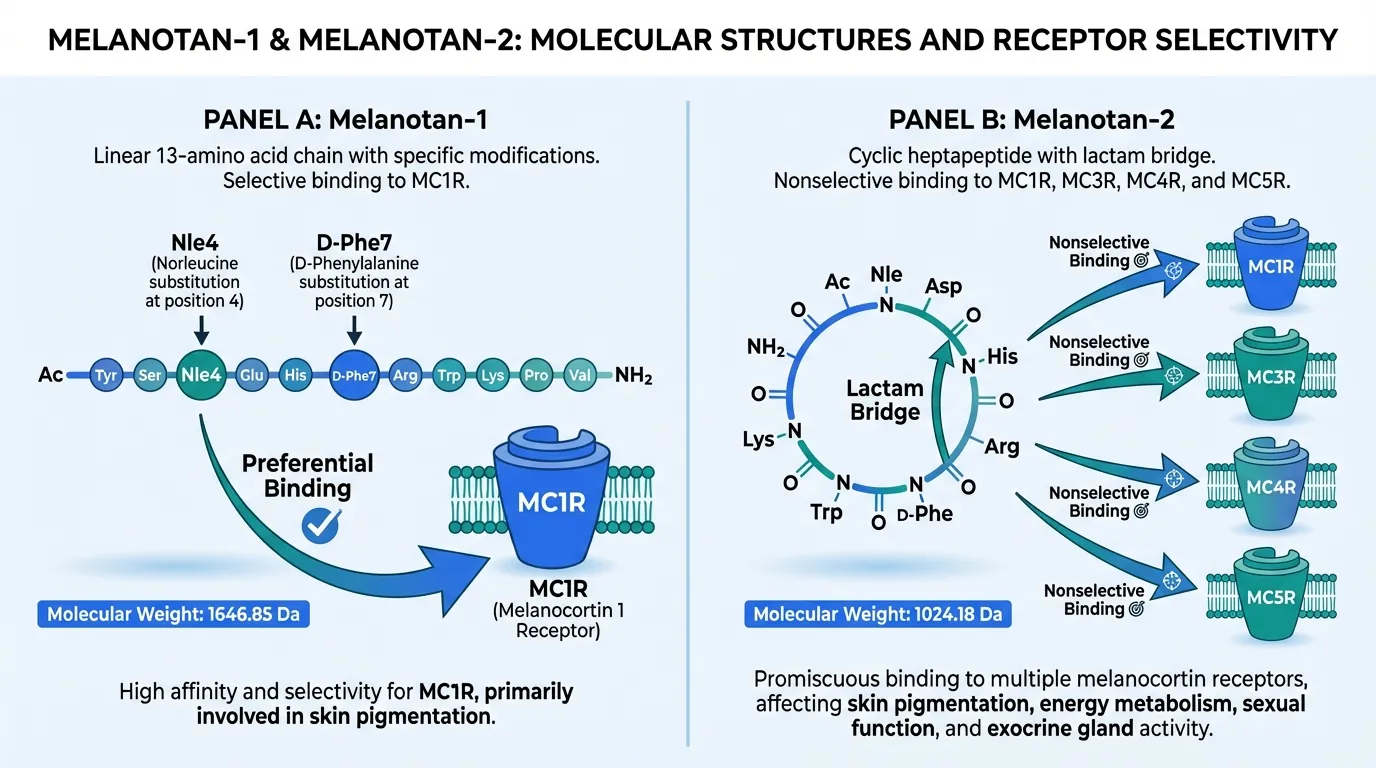
Melanotan-1, also known as afamelanotide (marketed as Scenesse), is a linear 13-amino acid peptide that preferentially activates the MC1R receptor. It has progressed through clinical development and received EMA approval for erythropoietic protoporphyria (EPP). Melanotan-2 is a cyclic 7-amino acid peptide that nonselectively activates multiple melanocortin receptors (MC1R through MC5R), producing a broader range of physiological effects including tanning, appetite suppression, and sexual arousal. It remains an unapproved research compound with significant safety concerns.
This comparison examines how these structurally related peptides diverge in mechanism, clinical evidence, safety, and regulatory standing.
Quick Comparison Table#
| Feature | Melanotan-1 | Melanotan-2 |
|---|---|---|
| Structure | Linear, 13 amino acids (1646.85 Da) | Cyclic, 7 amino acids (1024.18 Da) |
| Receptor selectivity | Preferential MC1R agonist | Nonselective MC1R-MC5R agonist |
| Primary effect | Eumelanin production, photoprotection | Tanning, sexual arousal, appetite suppression |
| Approval status | EMA-approved (Scenesse) for EPP | Not approved in any jurisdiction |
| Administration | 16 mg subcutaneous implant, physician-placed | Self-injected subcutaneously, 0.5-1 mg |
| Research status | Phase 3 completed; approved | Preclinical/early clinical only |
| Key safety concern | Transient headache, nausea, fatigue | Nausea (~38%), priapism, melanoma reports |
Mechanism of Action Comparison#
Melanotan-1#
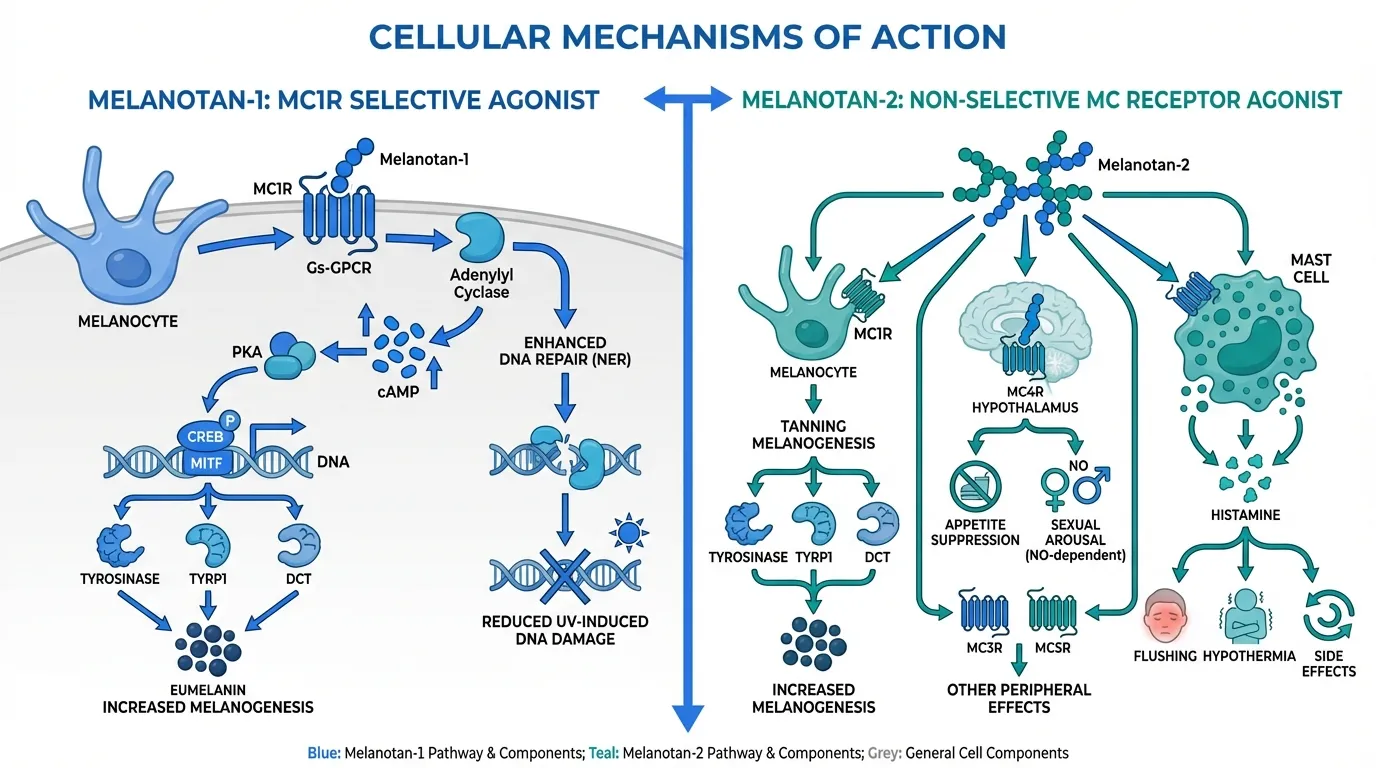
Melanotan-1 (afamelanotide; NDP-alpha-MSH) is a linear analog of alpha-MSH with Nle4 and D-Phe7 substitutions that confer increased MC1R binding affinity and metabolic stability compared to native alpha-MSH. The peptide preferentially activates MC1R, a Gs-coupled GPCR expressed primarily on melanocytes and immune cells.
Upon MC1R engagement, Melanotan-1 triggers the canonical cAMP/PKA/CREB signaling cascade, which upregulates MITF and melanogenic enzymes (tyrosinase, TYRP1, DCT). This drives eumelanin biosynthesis, the photoprotective brown-black pigment. Importantly, Melanotan-1 also enhances nucleotide excision repair (NER) capacity and reduces UV-induced DNA damage, providing photoprotection beyond pigmentation alone.
The peptide also activates anti-inflammatory pathways through MC1R on immune cells, inhibiting NF-kB and reducing pro-inflammatory cytokines (TNF-alpha, IL-1, IL-6). While described as nonselective at other melanocortin receptors, its clinical effects are predominantly MC1R-mediated.
Melanotan-2#
Melanotan-2 is a cyclic heptapeptide with a lactam bridge that increases metabolic stability. It binds with high affinity across multiple melanocortin receptor subtypes: MC1R (Ki approximately 0.67 nM), MC4R (approximately 6.6 nM), MC3R (approximately 34 nM), and MC5R (approximately 46 nM).
This broad receptor activation profile produces diverse physiological effects. MC1R activation stimulates melanogenesis similarly to Melanotan-1 but with somewhat lower MC1R-specific cAMP potency. MC4R activation in the hypothalamus suppresses appetite and stimulates sexual arousal pathways through NO-dependent mechanisms, which led to the development of PT-141 (bremelanotide) as a focused MC4R agonist for sexual dysfunction. MC3R and MC5R activation contribute to energy homeostasis and exocrine gland function, respectively.
A distinctive off-target effect of Melanotan-2 is mast cell activation and histamine release via MRGPRB2-dependent mechanisms, producing transient hypothermia and flushing independent of melanocortin receptor signaling.
Evidence and Research Comparison#
Melanotan-1 Research#
Melanotan-1 has one of the strongest clinical evidence bases among peptides studied for photoprotection:
- Phase 3 RCTs in EPP: Two pivotal randomized, double-blind, placebo-controlled trials demonstrated clinical efficacy. The EU trial (n=74) showed median pain-free direct sunlight exposure of 6.0 hours versus 0.8 hours on placebo, with fewer phototoxic reactions (77 vs 146; P=0.04). The US trial (n=94) showed median 69.4 hours versus 40.8 hours of pain-free sun exposure.
- Real-world data: Prospective cohorts (n=117) demonstrated sustained benefits over a median 2.0 years, with increased outdoor time (+6.1 hours/week) and improved quality of life (+14%). Treatment continuation rates reached 98%.
- Vitiligo: A randomized multicenter trial showed that afamelanotide combined with NB-UVB phototherapy achieved 48.64% mean VASI improvement versus 33.26% with phototherapy alone.
- Long-term safety monitoring: Over 1,000 exposed patients across studies with no melanoma events attributable to treatment.
Melanotan-2 Research#
The clinical evidence for Melanotan-2 is substantially more limited:
- Erectile dysfunction trials: Two small double-blind, placebo-controlled crossover studies (n=10, n=20) showed erectogenic effects. In the larger study, erections occurred after 69% of Melanotan-2 injections versus 2.4% with placebo, with mean tip rigidity >80% lasting approximately 41 minutes.
- Phase I tanning pilot: Early studies observed increased skin pigmentation at cumulative doses of approximately 0.1 mg/kg, though the erectogenic side effect shifted development toward sexual dysfunction.
- No advanced clinical programs: No Phase 2 or Phase 3 trials have been completed. The research remains confined to small early-phase studies.
- Case report evidence: The safety literature is dominated by case reports of serious harms including priapism, renal infarction, and melanoma in situ.
Side Effects and Safety Comparison#
Melanotan-1 Safety Profile#
Across Phase 3 trials and long-term cohorts, Melanotan-1 has demonstrated a favorable safety profile:
- Common effects: Transient headache, nausea, fatigue, flushing, and nasopharyngitis; typically resolving within 1-2 days of implant placement
- Expected effects: Skin hyperpigmentation at implant site and systemically (expected pharmacological effect)
- Melanocytic monitoring: Low rates of new nevi (4% versus 2% placebo in Phase 3); no melanoma events in over 1,000 treated patients across surveillance periods
- No serious drug-related events: No consistent serious adverse events attributed to afamelanotide in pivotal trials
Melanotan-2 Safety Profile#
Melanotan-2 carries substantially more safety concerns:
- Common effects: Nausea in approximately 38% of injections (severe in approximately 15%); yawning, stretching, and decreased appetite from central melanocortin activation
- Serious case reports: Priapism requiring medical management; renal infarction (approximately 50% kidney loss) after cumulative 27 mg exposure; rhabdomyolysis and renal failure
- Dermatologic concerns: Reports of eruptive melanocytic nevi, atypical nevi, and melanoma in situ temporally associated with use; causality unproven but biologically plausible
- Product quality issues: Illicit products show variable content (4.32-8.84 mg versus 10 mg labeled), impurities of 4.1-5.9%, and potential sterility breaches
- Mast cell activation: Histamine-mediated flushing, hypotension, and hypothermia from off-target mast cell degranulation
Dosing and Administration Comparison#
Melanotan-1 Dosing#
Melanotan-1 is administered as a 16 mg controlled-release subcutaneous implant (Scenesse), placed by a healthcare provider approximately every 60 days. The implant provides sustained drug release without measurable plasma levels by two weeks. Key characteristics include:
- Physician-administered procedure at clinical setting
- Biodegradable poly(D,L-lactide-co-glycolide) implant matrix
- Pigmentation onset at approximately week 2, maximal at weeks 3-5
- Standardized, regulated pharmaceutical manufacturing
Melanotan-2 Dosing#
Melanotan-2 has no approved dosing regimen. Reported protocols from research settings and case literature include:
- Subcutaneous self-injection at doses of 0.5-1 mg
- Loading phase protocols followed by maintenance dosing
- Typical research doses of 0.025 mg/kg in clinical studies
- No standardized reconstitution or storage protocols in unregulated use
The self-administration model and lack of pharmaceutical-grade products create additional safety risks absent from the Melanotan-1 paradigm.
Use Case Recommendations#
When Melanotan-1 Is Preferred#
- EPP patients: The only approved indication with robust clinical evidence
- Photoprotection research: Well-characterized mechanism with established safety data
- Vitiligo combination therapy: Emerging evidence as NB-UVB adjunct
- Researchers requiring regulatory-grade compounds: Standardized pharmaceutical formulation
When Melanotan-2 Is Relevant#
- Melanocortin receptor pharmacology: Useful as a nonselective agonist research tool
- MC4R pathway research: Its broad activation profile is valuable for understanding energy homeostasis and sexual function pathways
- Historical context: Its MC4R erectogenic effects led directly to the development of PT-141 (bremelanotide), now FDA-approved for hypoactive sexual desire disorder
Structural and Pharmacological Differences#
A key distinction between these peptides lies in their molecular architecture. Melanotan-1 is a linear 13-amino acid chain (molecular weight 1646.85 Da), while Melanotan-2 is a cyclic 7-amino acid peptide (1024.18 Da) with a lactam bridge between positions 4 and 10. The cyclic structure of Melanotan-2 confers greater metabolic stability but also reduces receptor selectivity, leading to its broad melanocortin receptor activation profile.
This structural difference has profound pharmacological consequences. Melanotan-1's linear structure and D-Phe7 substitution optimize MC1R interactions, explaining its focused pigmentation and photoprotective effects. Melanotan-2's cyclic constraint creates a molecular shape that fits multiple melanocortin receptor binding pockets, producing the diverse effects on appetite, sexual function, and pigmentation that define its pharmacological profile.
Verdict#
The comparison between Melanotan-1 and Melanotan-2 is not a close contest from a clinical development perspective. Melanotan-1 (afamelanotide) has progressed through rigorous clinical development, received regulatory approval for EPP, and established a favorable safety profile across thousands of patient exposures. It represents a legitimate pharmaceutical intervention for photoprotective medicine.
Melanotan-2 remains an early-stage research compound with limited clinical data, significant safety concerns documented in case reports, and no path to regulatory approval for its commonly promoted uses (tanning and sexual enhancement). Its principal scientific legacy is the MC4R-mediated erectogenic effect that led to PT-141 development.
For researchers, the choice depends on the question being studied. For melanocortin receptor pharmacology and MC4R pathway research, Melanotan-2 provides a valuable nonselective tool. For any application involving human photoprotection or pigmentation, the evidence and safety data overwhelmingly favor Melanotan-1.
Explore the full profiles of Melanotan-1 and Melanotan-2, or compare them with PT-141 (Bremelanotide) for sexual health applications. Use our Dosing Calculator for research protocol planning.
Further Reading#

Which Is Better For...
Erythropoietic Protoporphyria (EPP)
Melanotan-1
Melanotan-1 (afamelanotide/Scenesse) is the only EMA-approved treatment for EPP, with Phase 3 RCT data showing increased pain-free sun exposure and improved quality of life
Vitiligo Adjunct Therapy
Melanotan-1
Small RCT data shows faster and deeper repigmentation when afamelanotide implants are combined with NB-UVB phototherapy compared to phototherapy alone
Photoprotection Research
Melanotan-1
Melanotan-1 enhances eumelanin production and DNA repair mechanisms with a favorable safety profile established across multiple clinical trials
Melanocortin Receptor Pharmacology
Melanotan-2
Melanotan-2 nonselective receptor profile makes it a useful research tool for studying MC1R through MC5R signaling pathways
Sexual Dysfunction Research
Melanotan-2
Melanotan-2 MC4R activation produces erectogenic effects; this research led to the development of PT-141 (bremelanotide), now FDA-approved for HSDD
Continue Your Research
Get comparison updates
We publish new head-to-head comparisons regularly. Subscribe to see them first.
Frequently Asked Questions About Melanotan-1 vs Melanotan-2: Tanning Peptides Compared
What are the key differences between Melanotan-1 and Melanotan-2?
The main differences across comparison categories are: Mechanism of Action: advantage goes to Melanotan-1; Research Evidence: advantage goes to Melanotan-1; Side Effect Profile: advantage goes to Melanotan-1. 3 additional categories are analyzed in the full comparison. Each category evaluates a different dimension of the two peptides.
When should I consider Melanotan-1 over Melanotan-2?
For the scenario of "Erythropoietic Protoporphyria (EPP)," research data suggests Melanotan-1 may be more relevant. Melanotan-1 (afamelanotide/Scenesse) is the only EMA-approved treatment for EPP, with Phase 3 RCT data showing increased pain-free sun exposure and improved quality of life. This is based on currently available evidence and individual circumstances may differ.
How do Melanotan-1 and Melanotan-2 differ in their mechanisms of action?
Melanotan-1: Linear alpha-MSH analog; preferential MC1R agonist driving eumelanin synthesis via cAMP/PKA/MITF pathway with enhanced DNA repair signaling. Melanotan-2: Cyclic alpha-MSH analog; nonselective agonist at MC1R, MC3R, MC4R, and MC5R with additional mast cell activation and histamine release.
Which has fewer side effects, Melanotan-1 or Melanotan-2?
In terms of side effects and tolerability, the advantage goes to Melanotan-1. Melanotan-1: Well-tolerated in trials; transient headache, nausea, fatigue; no serious drug-related events in pivotal studies. Melanotan-2: High nausea rates (~38%); reports of priapism, renal infarction, eruptive nevi, and melanoma in situ; illicit product quality concerns.
Medical Disclaimer
This website is for educational and informational purposes only. The information provided is not intended to diagnose, treat, cure, or prevent any disease. Always consult with a qualified healthcare professional before using any peptide or supplement.