IGF-1 DES vs IGF-1 LR3: Comprehensive Comparison
A detailed comparison of IGF-1 DES and IGF-1 LR3 covering structural modifications, binding protein interactions, dosing protocols, side effects, and research evidence for these two modified insulin-like growth factor-1 analogs.
Verdict at a Glance
IGF-1 DES for localized, tissue-specific growth factor research requiring rapid-onset, short-duration effects; IGF-1 LR3 for systemic, sustained IGF-1R activation research requiring extended bioavailability
| Best for | Pick | Why |
|---|---|---|
| Localized Tissue Growth Research | IGF-1 DES | IGF-1 DES's short half-life and high local potency make it ideal for studying targeted growth effects at specific tissue sites without prolonged systemic exposure |
| Sustained Systemic IGF-1 Signaling | IGF-1 LR3 | IGF-1 LR3's 20-30 hour half-life and minimal IGFBP binding provide sustained, systemic IGF-1R activation from a single daily administration |
| Cell Culture and In Vitro Studies | IGF-1 LR3 | IGF-1 LR3 is the industry-standard IGF-1 supplement for cell culture due to its stability, sustained activity, and minimal binding protein interference in serum-containing media |
| Site-Specific Injection Research | IGF-1 DES | IGF-1 DES remains concentrated at the injection site due to rapid clearance, allowing researchers to study localized IGF-1R activation without confounding systemic effects |
| Body Composition Research | IGF-1 LR3 | IGF-1 LR3's systemic bioavailability and extended duration make it more suited for studies examining whole-body effects on lean mass, fat metabolism, and nutrient partitioning |
| Minimizing Hypoglycemia Risk | IGF-1 DES | IGF-1 DES's rapid clearance reduces the duration of insulin-like metabolic effects, lowering the risk of sustained hypoglycemia compared to the long-acting IGF-1 LR3 |
| Category | IGF-1 DES | IGF-1 LR3 | Advantage |
|---|---|---|---|
| Mechanism of Action | Truncated 67-amino acid IGF-1 variant missing the N-terminal tripeptide (Gly-Pro-Glu), resulting in ~10x greater potency than native IGF-1 due to dramatically reduced IGFBP binding | 83-amino acid IGF-1 analog with Arg3 substitution and 13-amino acid N-terminal extension peptide, producing >100-fold reduced IGFBP affinity while retaining full IGF-1R activation | Comparable |
| Research Evidence | Identified as a naturally occurring IGF-1 variant in bovine colostrum and fetal brain tissue; studied primarily in cell culture and animal models for tissue-specific growth effects | Engineered synthetic analog with extensive use as a cell culture supplement in biotechnology; well-characterized in vitro but limited in vivo data compared to native IGF-1 | Comparable |
| Side Effect Profile | Short half-life limits systemic exposure; localized effects reduce risk of systemic hypoglycemia; rapid clearance may reduce prolonged side effect duration | Extended half-life increases systemic exposure and duration of hypoglycemic risk; more sustained IGF-1R activation may amplify growth-related side effects | IGF-1 DES |
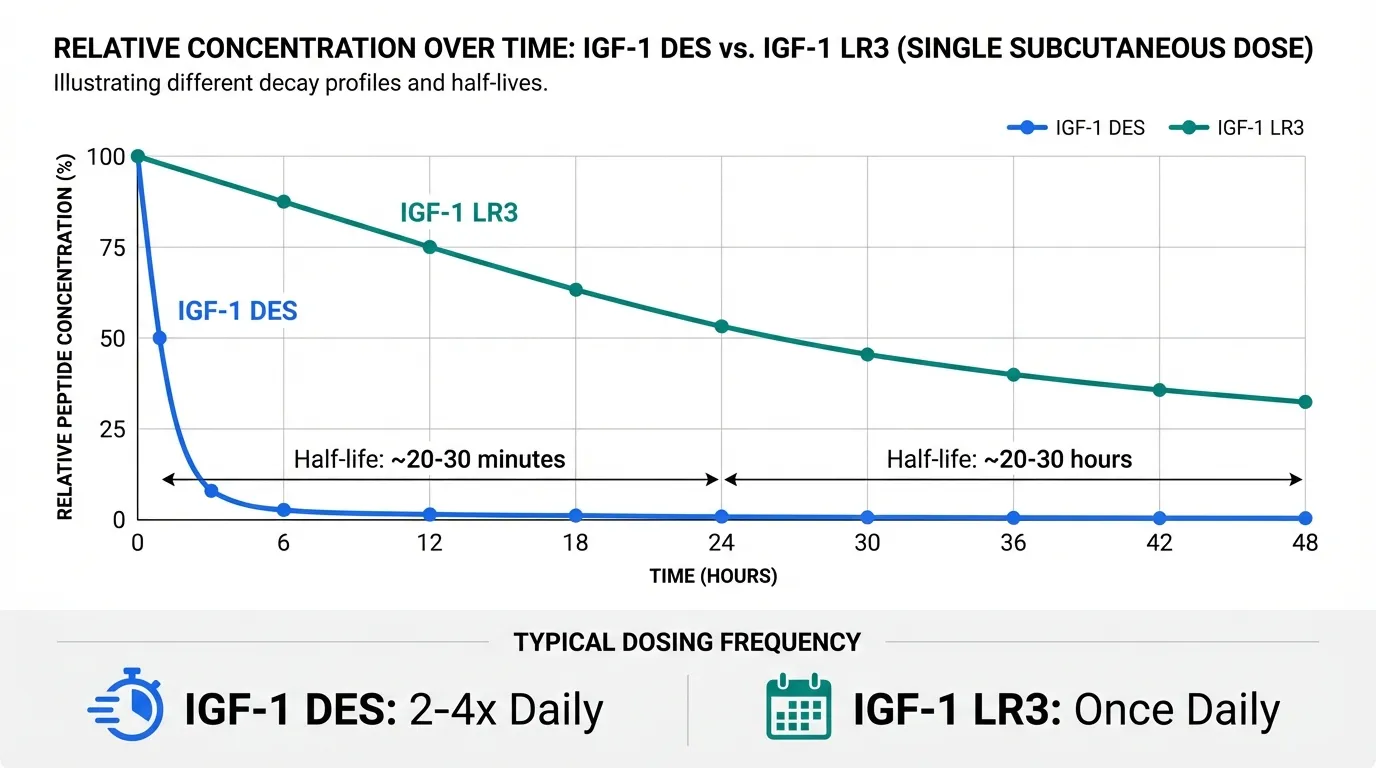
| Half-Life and Duration | Very short half-life of approximately 20-30 minutes due to rapid proteolytic degradation; effects are acute and localized to administration site | Extended half-life of approximately 20-30 hours due to reduced IGFBP sequestration; provides sustained systemic IGF-1R activation over a full day | Comparable |
| IGFBP Interaction | Approximately 10-fold reduced binding to IGFBPs compared to native IGF-1; retains some IGFBP interaction that provides modest buffering | Greater than 100-fold reduced binding to IGFBPs; essentially free from binding protein regulation, resulting in maximal bioavailability | IGF-1 LR3 |
| Scope of Effects | Primarily localized effects due to short half-life; suited for targeted tissue-specific applications; naturally occurring in specific tissues | Systemic effects due to extended half-life and high bioavailability; suited for whole-body growth factor augmentation research | Comparable |

Introduction#
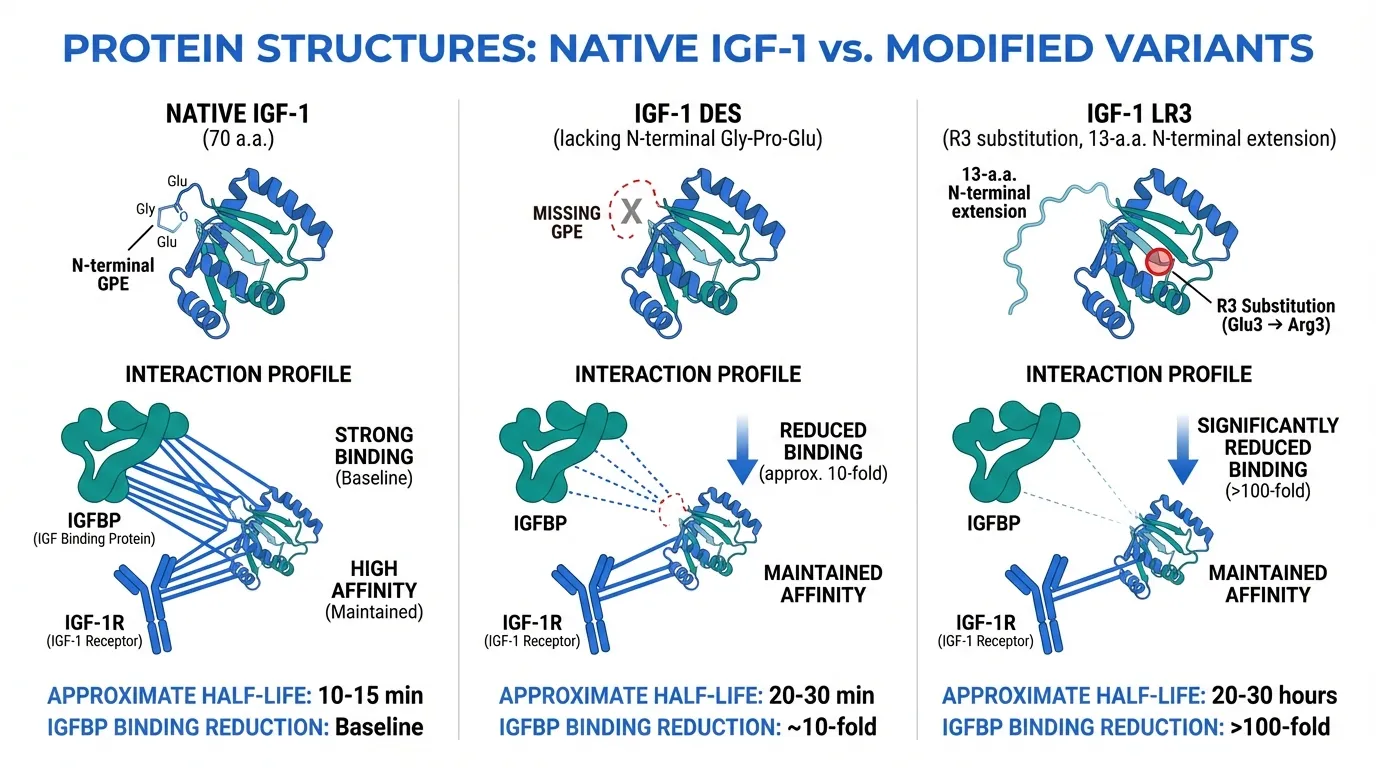
IGF-1 DES and IGF-1 LR3 are both structurally modified variants of insulin-like growth factor-1 (IGF-1), a 70-amino acid polypeptide that mediates many of the anabolic and growth-promoting effects of growth hormone. Native IGF-1 circulates in the bloodstream primarily bound to a family of six IGF binding proteins (IGFBPs), which regulate its bioavailability, half-life, and tissue distribution. Both IGF-1 DES and IGF-1 LR3 were developed or identified as variants with substantially reduced IGFBP binding, resulting in increased free IGF-1 receptor (IGF-1R) activation -- but they achieve this through very different structural modifications with distinct pharmacological consequences.
IGF-1 DES (des(1-3)IGF-1, MW 7371.4 Da) is a naturally occurring truncated form of IGF-1 that lacks the first three N-terminal amino acids (Gly-Pro-Glu). It was first identified in bovine colostrum and subsequently found in human fetal and adult brain tissue. The deletion of the N-terminal tripeptide reduces IGFBP binding approximately 10-fold, resulting in enhanced bioactivity at the IGF-1 receptor. However, this same modification renders IGF-1 DES susceptible to rapid proteolytic degradation, giving it a very short circulating half-life.
IGF-1 LR3 (Long R3 IGF-1, MW 9111.4 Da) is a synthetic 83-amino acid analog featuring two key modifications: substitution of arginine for glutamic acid at position 3 (the R3 substitution) and the addition of a 13-amino acid extension peptide at the N-terminus. These modifications reduce IGFBP binding by more than 100-fold while maintaining full affinity for the IGF-1 receptor, resulting in a dramatically extended biological half-life and sustained systemic activity.
This comparison examines how these structural differences translate into distinct pharmacological profiles relevant to researchers working with IGF-1 signaling.
Mechanism of Action Comparison#
IGF-1 DES#
IGF-1 DES activates the IGF-1 receptor (IGF-1R) through the same canonical signaling pathways as native IGF-1. Upon binding to IGF-1R, it triggers receptor autophosphorylation and activation of two major downstream cascades: the PI3K/Akt/mTOR pathway (promoting protein synthesis, cell survival, and glucose uptake) and the Ras/MAPK/ERK pathway (promoting cell proliferation and differentiation).
The critical distinction lies in the N-terminal truncation. The native IGF-1 N-terminal tripeptide Gly-Pro-Glu is a key determinant of IGFBP binding, particularly for IGFBP-3, which carries approximately 75-80% of circulating IGF-1 in a ternary complex with the acid-labile subunit (ALS). By removing these three residues, IGF-1 DES loses most of its ability to form these storage complexes, leaving a much higher proportion of the peptide in its free, receptor-active form.
This reduced IGFBP binding translates to approximately 10-fold greater potency than native IGF-1 in bioassays measuring mitogenic and metabolic activity. However, the same modification that enhances immediate bioactivity also exposes the peptide to rapid proteolytic clearance, resulting in a half-life of only approximately 20-30 minutes. This creates a pharmacological profile characterized by potent but brief activity, making IGF-1 DES more suited for localized, site-specific applications. Notably, IGF-1 DES is a naturally occurring molecule found in human tissues, particularly in fetal brain where it may play roles in neurodevelopment.
IGF-1 LR3#
IGF-1 LR3 also signals through IGF-1R via the PI3K/Akt/mTOR and Ras/MAPK/ERK cascades, with receptor binding affinity comparable to native IGF-1. Its pharmacological distinction arises from the dual structural modifications that virtually eliminate IGFBP interaction while preserving receptor engagement.
The R3 substitution (Glu3 to Arg3) disrupts the IGFBP binding interface at the N-terminal domain, while the 13-amino acid N-terminal extension peptide further sterically hinders binding protein interaction. Together, these modifications reduce IGFBP affinity by more than 100-fold, making IGF-1 LR3 essentially free from binding protein regulation. Because IGFBP sequestration is the primary mechanism controlling IGF-1 bioavailability and clearance, removing this regulatory layer dramatically extends the circulating half-life to approximately 20-30 hours compared to 10-15 minutes for native IGF-1.
The consequence is sustained, systemic IGF-1R activation. Unlike native IGF-1, which is released from IGFBP complexes in a regulated fashion at specific tissue sites, IGF-1 LR3 circulates freely and activates IGF-1 receptors throughout the body. This provides robust, prolonged growth factor signaling but also removes the physiological buffering system that normally prevents excessive IGF-1R stimulation. IGF-1 LR3 has become the standard IGF-1 supplement in cell culture and biomanufacturing, where its stability and sustained activity in serum-containing media provide consistent growth factor support.
Dosing Comparison#
IGF-1 DES Dosing#
IGF-1 DES dosing in research settings reflects its short half-life and localized pharmacology:
- Subcutaneous injection (local): Typical research doses range from 50-150 mcg per administration, injected at or near the tissue of interest
- Frequency: Due to its short half-life (~20-30 minutes), multiple daily administrations are often used in research protocols, commonly 2-4 times daily
- Timing: Often administered in temporal proximity to a stimulus (such as exercise in muscle research) to concentrate its effects during the recovery window
- In vitro: Used at concentrations of 10-100 ng/mL in cell culture experiments
The requirement for multiple daily injections is a practical limitation of IGF-1 DES. However, its rapid clearance also means that each administration provides a discrete, time-limited growth factor pulse rather than sustained stimulation, which some researchers consider advantageous for mimicking physiological signaling patterns. The peptide should be reconstituted fresh and stored appropriately, as its truncated structure is less stable than full-length IGF-1.
IGF-1 LR3 Dosing#
IGF-1 LR3 dosing benefits from its extended half-life:
- Subcutaneous injection: Research doses typically range from 20-100 mcg per day administered as a single daily injection
- Frequency: Once-daily dosing is sufficient due to the 20-30 hour half-life
- Cell culture: Standard supplement concentration of 50-100 ng/mL in serum-free or reduced-serum media; widely used in biotechnology at 10-20 ng/mL
- Reconstitution: Lyophilized powder reconstituted in acidified buffer (pH 4-5) for optimal stability
The convenience of once-daily dosing makes IGF-1 LR3 more practical for sustained research protocols. However, the extended systemic exposure also means that effects (including potentially adverse effects) persist for a full day after each administration. Steady-state levels are typically reached within 3-5 days of daily dosing, after which consistent systemic IGF-1R activation is maintained. The larger molecular weight (9111.4 Da vs. 7371.4 Da) and structural modifications provide greater proteolytic stability but also increase manufacturing complexity.
Side Effects Comparison#
IGF-1 DES Side Effects#
IGF-1 DES's side effect profile is shaped by its short half-life and localized activity pattern:
- Hypoglycemia: The most clinically significant concern with any IGF-1 analog; IGF-1 DES can cause insulin-like glucose lowering, but its rapid clearance limits the duration of hypoglycemic risk compared to longer-acting variants
- Local tissue effects: Site-specific administration may cause localized tissue growth or hypertrophy at the injection site, which can be asymmetric if injection sites are not rotated
- Injection site reactions: Pain, redness, and swelling at the injection site are commonly reported
- Headache and dizziness: Transient effects possibly related to glucose fluctuations
- Joint pain: Less common than with sustained IGF-1 signaling due to shorter exposure duration
- Theoretical cancer risk: As with all IGF-1 analogs, enhanced mitogenic signaling raises theoretical concerns about promoting growth of pre-existing neoplasms
The short half-life of IGF-1 DES is arguably a safety advantage, as any adverse effects resolve rapidly with discontinuation. The localized activity pattern also means systemic side effects are generally less pronounced than with IGF-1 LR3.
IGF-1 LR3 Side Effects#
IGF-1 LR3's extended duration and systemic activity produce a broader and more sustained side effect profile:
- Hypoglycemia: A significant and potentially dangerous concern; the 20-30 hour half-life means glucose-lowering effects persist throughout the day, requiring careful monitoring and carbohydrate management
- Organ growth (organomegaly): Sustained systemic IGF-1R stimulation can promote growth of internal organs, particularly the intestines, spleen, and kidneys, with chronic administration in animal studies
- Acromegalic-like features: Chronic exposure may promote soft tissue growth in extremities similar to acromegaly
- Joint pain and swelling: More common than with IGF-1 DES due to prolonged growth factor signaling in joint tissues
- Insulin resistance: Paradoxically, sustained IGF-1R activation can impair insulin signaling through receptor cross-talk and downstream feedback mechanisms
- Edema and fluid retention: Sodium and water retention through renal tubular effects
- Theoretical cancer risk: The sustained, systemic, and unregulated nature of IGF-1 LR3 signaling raises greater theoretical oncogenic concerns than IGF-1 DES's brief, localized activity
The removal of IGFBP-mediated regulation means the body's normal safety mechanisms for controlling IGF-1 activity are bypassed, making careful dose management and monitoring particularly important with IGF-1 LR3.
Research Evidence Comparison#
IGF-1 DES Research#
IGF-1 DES research spans its identification as a natural IGF-1 variant and its application in growth biology:
- Natural occurrence: Francis et al. identified des(1-3)IGF-1 in bovine colostrum, where it is present at biologically significant concentrations. Subsequent work identified it in human and rat brain tissue, particularly in fetal and neonatal samples, suggesting a neurodevelopmental role
- Enhanced potency: Ballard et al. and others demonstrated approximately 10-fold greater mitogenic potency than native IGF-1 in fibroblast and myoblast proliferation assays, directly attributable to reduced IGFBP binding
- Muscle biology: Preclinical studies showed that IGF-1 DES promotes satellite cell activation, myoblast proliferation, and muscle fiber hypertrophy when administered locally. Studies in rodent models demonstrated enhanced muscle regeneration following injury
- Wound healing: Research demonstrated accelerated wound closure and re-epithelialization in animal models when IGF-1 DES was applied locally to wound sites
- Neuronal effects: Given its presence in brain tissue, studies have investigated IGF-1 DES effects on neuronal survival and differentiation, with preliminary evidence supporting neurotrophic properties
Most IGF-1 DES research is preclinical, with no controlled human clinical trials. Its natural occurrence in human tissues provides some biological validation but does not substitute for clinical safety and efficacy data.
IGF-1 LR3 Research#
IGF-1 LR3 research is extensive in the biotechnology and cell culture domain, with more limited in vivo investigation:
- Biotechnology standard: IGF-1 LR3 is the most widely used IGF-1 supplement in mammalian cell culture, biopharmaceutical manufacturing, and stem cell research. Its reliability and stability in culture media have made it an industry standard with thousands of publications referencing its use
- IGFBP binding studies: Francis et al., Ross et al., and others systematically characterized the >100-fold reduction in IGFBP binding, establishing the structure-activity relationship between N-terminal modifications and binding protein interaction
- Pharmacokinetics: Studies confirmed the dramatically extended half-life (~20-30 hours) compared to native IGF-1, with sustained elevation of free IGF-1R-activating ligand in circulation
- Animal growth studies: Administration to livestock animals demonstrated enhanced growth rates and improved feed efficiency, providing in vivo evidence of systemic anabolic effects
- Muscle and metabolism: Limited preclinical studies in rodents showed increased lean body mass, improved nitrogen retention, and altered glucose metabolism with chronic IGF-1 LR3 administration
While IGF-1 LR3 has an enormous publication footprint in cell biology and biotechnology, the in vivo pharmacological data in the context of therapeutic development is comparatively limited. No human clinical trials have been conducted with IGF-1 LR3 as a therapeutic agent.
Key Differences Summary#
- Origin: IGF-1 DES is a naturally occurring truncation found in colostrum and brain tissue; IGF-1 LR3 is a fully synthetic engineered analog
- Structural modification: IGF-1 DES lacks the first 3 amino acids; IGF-1 LR3 has an Arg3 substitution plus a 13-amino acid N-terminal extension
- Molecular weight: IGF-1 DES is 7371.4 Da (67 amino acids); IGF-1 LR3 is 9111.4 Da (83 amino acids)
- IGFBP binding reduction: IGF-1 DES has ~10-fold reduction; IGF-1 LR3 has >100-fold reduction
- Half-life: IGF-1 DES has ~20-30 minute half-life; IGF-1 LR3 has ~20-30 hour half-life
- Scope of effects: IGF-1 DES acts locally at the injection site; IGF-1 LR3 acts systemically throughout the body
- Dosing frequency: IGF-1 DES typically requires multiple daily administrations; IGF-1 LR3 requires once-daily dosing
- Practical applications: IGF-1 DES is studied for site-specific tissue growth; IGF-1 LR3 is the standard cell culture supplement and is studied for systemic growth effects
- Safety profile: IGF-1 DES's short duration limits side effect exposure; IGF-1 LR3's sustained action increases the risk and duration of adverse effects
Conclusion#
IGF-1 DES and IGF-1 LR3 illustrate how different structural modifications to the same parent molecule can produce dramatically different pharmacological tools. Both reduce IGFBP binding to enhance free IGF-1R activation, but the magnitude and consequences of these modifications create distinct use cases.
IGF-1 DES, with its naturally occurring truncation, short half-life, and approximately 10-fold potency increase, is suited for research requiring localized, time-limited IGF-1R stimulation. Its rapid clearance provides a built-in safety margin against sustained systemic effects and makes it a more controllable research tool for site-specific applications such as localized muscle biology, wound healing, or neuronal studies. The multiple-daily-dosing requirement is a practical limitation but also ensures researchers have precise temporal control over growth factor exposure.
IGF-1 LR3, with its engineered dual modification, greater than 100-fold IGFBP reduction, and day-long half-life, is the clear choice for sustained systemic IGF-1R activation research and remains the gold standard for cell culture supplementation. Its convenience of once-daily dosing and reliable systemic bioavailability make it practical for in vivo studies examining whole-body anabolic effects. However, the removal of physiological IGFBP regulation demands greater caution regarding hypoglycemia, organomegaly, and other sustained-exposure side effects. Researchers should select between these analogs based on whether their experimental question requires localized, pulsatile signaling (IGF-1 DES) or sustained, systemic signaling (IGF-1 LR3).
Further Reading#

Which Is Better For...
Localized Tissue Growth Research
IGF-1 DES
IGF-1 DES's short half-life and high local potency make it ideal for studying targeted growth effects at specific tissue sites without prolonged systemic exposure
Sustained Systemic IGF-1 Signaling
IGF-1 LR3
IGF-1 LR3's 20-30 hour half-life and minimal IGFBP binding provide sustained, systemic IGF-1R activation from a single daily administration
Cell Culture and In Vitro Studies
IGF-1 LR3
IGF-1 LR3 is the industry-standard IGF-1 supplement for cell culture due to its stability, sustained activity, and minimal binding protein interference in serum-containing media
Site-Specific Injection Research
IGF-1 DES
IGF-1 DES remains concentrated at the injection site due to rapid clearance, allowing researchers to study localized IGF-1R activation without confounding systemic effects
Body Composition Research
IGF-1 LR3
IGF-1 LR3's systemic bioavailability and extended duration make it more suited for studies examining whole-body effects on lean mass, fat metabolism, and nutrient partitioning
Minimizing Hypoglycemia Risk
IGF-1 DES
IGF-1 DES's rapid clearance reduces the duration of insulin-like metabolic effects, lowering the risk of sustained hypoglycemia compared to the long-acting IGF-1 LR3
Continue Your Research
Get comparison updates
We publish new head-to-head comparisons regularly. Subscribe to see them first.
Frequently Asked Questions About IGF-1 DES vs IGF-1 LR3: Comprehensive Comparison
What are the key differences between IGF-1 DES and IGF-1 LR3?
The main differences across comparison categories are: Mechanism of Action: advantage goes to neither (tie); Research Evidence: advantage goes to neither (tie); Side Effect Profile: advantage goes to IGF-1 DES. 3 additional categories are analyzed in the full comparison. Each category evaluates a different dimension of the two peptides.
When should I consider IGF-1 DES over IGF-1 LR3?
For the scenario of "Localized Tissue Growth Research," research data suggests IGF-1 DES may be more relevant. IGF-1 DES's short half-life and high local potency make it ideal for studying targeted growth effects at specific tissue sites without prolonged systemic exposure. This is based on currently available evidence and individual circumstances may differ.
How do IGF-1 DES and IGF-1 LR3 differ in their mechanisms of action?
IGF-1 DES: Truncated 67-amino acid IGF-1 variant missing the N-terminal tripeptide (Gly-Pro-Glu), resulting in ~10x greater potency than native IGF-1 due to dramatically reduced IGFBP binding. IGF-1 LR3: 83-amino acid IGF-1 analog with Arg3 substitution and 13-amino acid N-terminal extension peptide, producing >100-fold reduced IGFBP affinity while retaining full IGF-1R activation.
Which has fewer side effects, IGF-1 DES or IGF-1 LR3?
In terms of side effects and tolerability, the advantage goes to IGF-1 DES. IGF-1 DES: Short half-life limits systemic exposure; localized effects reduce risk of systemic hypoglycemia; rapid clearance may reduce prolonged side effect .... IGF-1 LR3: Extended half-life increases systemic exposure and duration of hypoglycemic risk; more sustained IGF-1R activation may amplify growth-related side ....
Medical Disclaimer
This website is for educational and informational purposes only. The information provided is not intended to diagnose, treat, cure, or prevent any disease. Always consult with a qualified healthcare professional before using any peptide or supplement.