Argireline vs SNAP-8: Which Anti-Wrinkle Peptide Works Better?
Head-to-head comparison of Argireline and SNAP-8 for wrinkle reduction. Clinical data shows Argireline has stronger evidence at 10% concentration. See side-by-side results, pricing, and which to choose.
Verdict at a Glance
Argireline and SNAP-8 share the same SNARE complex mechanism and produce comparable wrinkle reduction effects in the 20-35% range over 28-30 days of topical application. Argireline has the stronger evidence base with more published clinical studies, broader commercial availability, and a longer track record in cosmeceutical formulations. SNAP-8 is positioned as a potentially more potent successor based on its extended peptide sequence, but this claim has not been validated in rigorous independent head-to-head trials. For most consumers, Argireline is the more evidence-supported and accessible choice. SNAP-8 is a reasonable alternative, particularly in formulations that combine it with other complementary peptides like Leuphasyl or Matrixyl.
| Best for | Pick | Why |
|---|---|---|
| Most Evidence-Supported Choice | Argireline | More published clinical studies, including controlled trials showing approximately 30% wrinkle depth reduction. The evidence base is broader and more independently validated than SNAP-8. |
| Maximum Theoretical Potency | SNAP-8 | The extended octapeptide sequence is designed to better mimic SNAP-25 and may offer improved SNARE complex inhibition. However, the potency advantage is based primarily on manufacturer data and has not been confirmed in independent head-to-head clinical trials. |
| Product Availability | Argireline | Found in far more commercial skincare products across all price ranges. Stronger consumer name recognition makes it easier to find in retail products. |
| Combination with Other Anti-Wrinkle Peptides | Either (both compatible) | Both peptides are compatible with complementary anti-wrinkle ingredients including Leuphasyl (enkephalin analog), Matrixyl (collagen stimulator), and GHK-Cu (copper peptide). Either can serve as the SNARE-targeting component in a multi-peptide formulation. |
| Sensitive Skin | Either (both well tolerated) | Both peptides have excellent safety profiles with no significant adverse effects reported at standard concentrations. Neither causes the irritation associated with retinoids or the muscle effects of botulinum toxin. |
| Category | Argireline | SNAP-8 | Advantage |
|---|---|---|---|
| Mechanism of Action | Argireline (Ac-EEMQRR-NH2) is a six-amino-acid peptide that mimics the N-terminal domain of SNAP-25, competing with native SNAP-25 for incorporation into the SNARE complex. By occupying binding sites on the complex, it reduces the efficiency of vesicle fusion and acetylcholine release at the neuromuscular junction, producing a partial reduction in muscle contraction and expression line depth. | SNAP-8 (Ac-EEMQRRAD-NH2) is an eight-amino-acid extension of Argireline that includes the same hexapeptide core plus two additional residues (Ala-Asp). It targets the same SNARE complex mechanism, competing with SNAP-25 for complex assembly. The longer sequence is designed to mimic a larger portion of the SNAP-25 N-terminal domain, potentially improving binding affinity and competitive inhibition. | Comparable |
| Research Evidence | Argireline has the most published clinical data among cosmeceutical SNARE-targeting peptides. Key studies include a controlled periorbital trial showing approximately 30% wrinkle depth reduction after 30 days at 10% concentration, dose-response data at multiple concentrations, and several additional published studies confirming wrinkle reduction versus vehicle controls. Most evidence is industry-funded but includes multiple independent publications. | SNAP-8 has a thinner published evidence base. Industry-sponsored studies report 25-35% wrinkle depth reduction after 28 days of topical application. The claim of superior potency over Argireline is based primarily on manufacturer technical data rather than independent peer-reviewed head-to-head clinical trials. Fewer total publications exist for SNAP-8 compared to Argireline. | Argireline |
| Side Effect Profile | Argireline is well tolerated at standard cosmetic concentrations (5-10%). No significant adverse effects have been reported in clinical studies. Rare mild skin irritation may occur in sensitive individuals. It is non-sensitizing and does not cause the muscle weakness, bruising, or systemic effects associated with injectable botulinum toxin. | SNAP-8 is similarly well tolerated at standard concentrations (3-10%). No significant adverse effects have been reported. The safety profile is comparable to Argireline, consistent with their similar chemical nature and shared mechanism. Both peptides are topical-only ingredients with minimal systemic absorption. | Comparable |
| Formulation and Application | Argireline is highly stable in aqueous formulations and compatible with most cosmetic ingredients including retinol, vitamin C, niacinamide, and hyaluronic acid. It is typically used at 5-10% concentration in serums and creams. Widely available from multiple ingredient suppliers. Extensively incorporated into commercial skincare products worldwide with a long track record of formulation stability. | SNAP-8 has similar formulation compatibility and stability to Argireline. It is water-soluble and compatible with most cosmetic actives. Typical concentration is 3-10% in finished products. Somewhat less widely available than Argireline in commercial products, though the number of SNAP-8-containing formulations has grown. Available from the same primary ingredient manufacturer (Lipotec/Lubrizol). | Argireline |
| Accessibility and Cost | Argireline is the most widely available SNARE-targeting cosmeceutical peptide. It is found in hundreds of commercial skincare products across all price ranges, from mass-market to prestige brands. Raw ingredient pricing is well-established due to long market presence. The name "Argireline" has strong consumer recognition and is often a featured marketing ingredient. | SNAP-8 is less widely available in commercial products than Argireline but is growing in market presence. It is often positioned as a "next-generation" or "enhanced" version of Argireline, sometimes commanding a slight price premium. Raw ingredient pricing is comparable to Argireline. Less consumer name recognition, which may reduce availability in mass-market products. | Argireline |

Introduction#
Argireline (acetyl hexapeptide-8) and SNAP-8 (acetyl octapeptide-3) are the two most commercially prominent cosmeceutical peptides targeting the SNARE complex for wrinkle reduction. Both were developed by Lipotec (now part of Lubrizol) and share the same fundamental mechanism: competitive inhibition of SNARE complex assembly to reduce neurotransmitter release at the neuromuscular junction. Argireline was developed first and has the larger body of published research, while SNAP-8 was introduced as a next-generation variant with an extended peptide sequence claimed to improve potency.
This comparison examines the molecular differences, clinical evidence, practical considerations, and best-use scenarios for each peptide.
Mechanism of Action Comparison#
Shared Target: The SNARE Complex#
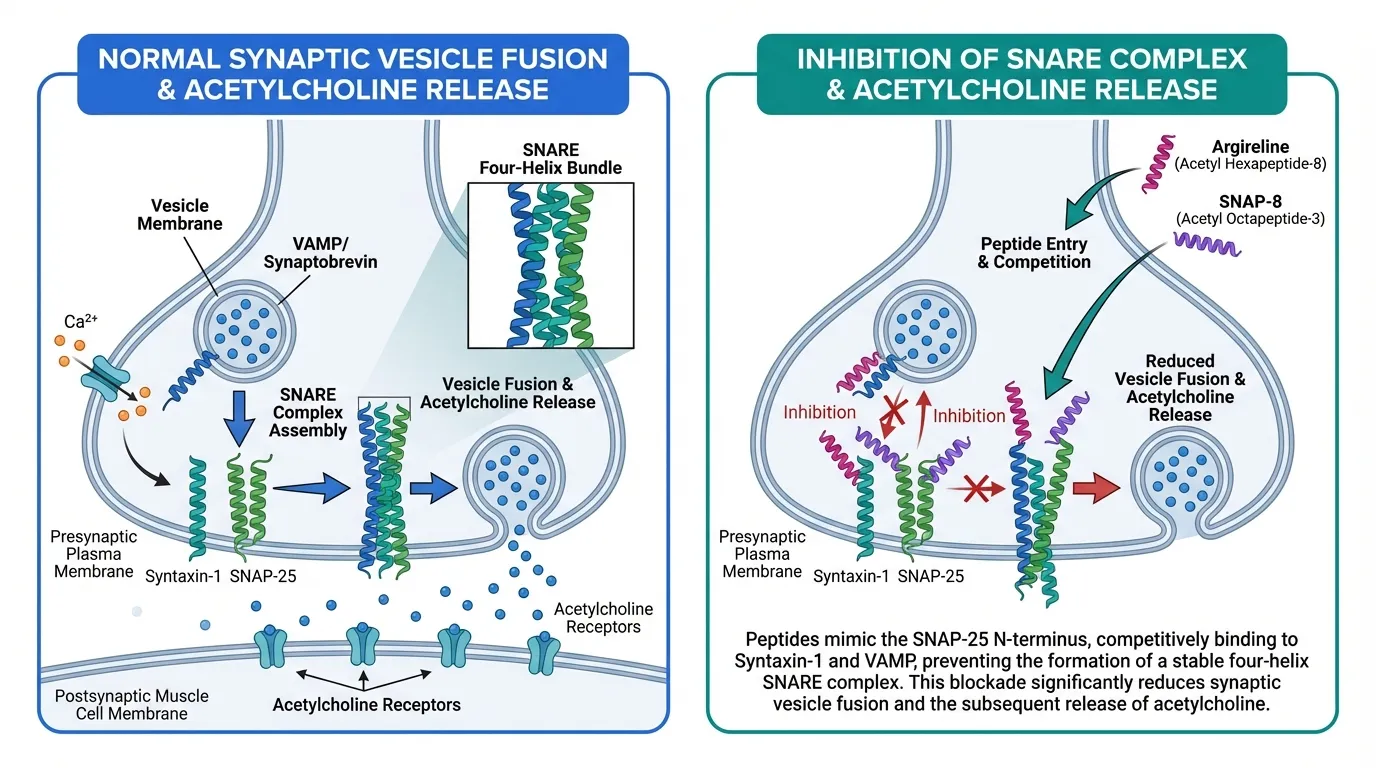
Both Argireline and SNAP-8 target the same molecular machinery. The SNARE complex consists of three proteins — SNAP-25, syntaxin-1, and VAMP/synaptobrevin — that assemble into a four-helix bundle to mediate synaptic vesicle fusion and acetylcholine release. This is the same target as botulinum toxin, though the toxin works by enzymatically cleaving SNARE proteins while these peptides work by competitive inhibition.
Both peptides mimic the N-terminal domain of SNAP-25, competing with native SNAP-25 for binding to syntaxin-1 during SNARE complex assembly. By occupying these binding sites, they reduce the number of functional SNARE complexes that form, decreasing (but not eliminating) acetylcholine release and the resulting muscle contraction.
Structural Differences#
The critical molecular difference between the two peptides is their length:
| Feature | Argireline | SNAP-8 |
|---|---|---|
| Sequence | Ac-EEMQRR-NH2 | Ac-EEMQRRAD-NH2 |
| Length | 6 amino acids | 8 amino acids |
| Molecular weight | ~889 Da | ~1,075 Da |
| CAS number | 616204-22-9 | 868844-74-0 |
| SNAP-25 mimicry | N-terminal 6 residues | N-terminal 8 residues |
SNAP-8 contains the complete Argireline sequence (EEMQRR) plus two additional C-terminal residues (Ala-Asp). The rationale for the extension is that a longer peptide fragment may more effectively compete with native SNAP-25 by engaging a larger portion of the protein-protein interaction surface.
Does Longer Mean More Potent?#
The claim that SNAP-8 is more potent than Argireline is biologically plausible — in protein-protein interactions, longer peptide mimetics often bind more tightly because they engage more contact surface area. However, increased chain length also brings trade-offs:
- Increased molecular weight — SNAP-8 (1,075 Da) is further above the ~500 Da threshold for passive transdermal absorption than Argireline (889 Da), potentially reducing skin penetration
- Altered pharmacokinetics — Different size and charge distribution may affect stability, receptor binding kinetics, and clearance
- Cost of synthesis — Longer peptides are marginally more expensive to synthesize, though this difference is negligible at commercial scale
The net effect of these competing factors (potentially better binding affinity versus potentially worse skin penetration) has not been resolved by head-to-head clinical data.
Clinical Evidence Comparison#
Argireline Clinical Data#
Argireline has the most extensive published evidence among SNARE-targeting cosmeceutical peptides:
Periorbital wrinkle study: A controlled study of 10% Argireline solution applied twice daily to the periorbital area for 30 days demonstrated approximately 30% reduction in wrinkle depth as measured by silicone replica analysis and image processing. This is the most widely cited Argireline study.
Dose-response data: Studies have evaluated Argireline at multiple concentrations (2%, 5%, 10%), showing dose-dependent wrinkle reduction effects with higher concentrations producing greater improvements.
Onset data: Some studies report measurable wrinkle depth reduction beginning within 15 days of twice-daily application, with continued improvement through 30 days.
Multiple publications: Argireline has been discussed in multiple peer-reviewed publications, review articles, and dermatology textbook chapters on cosmeceutical peptides.
SNAP-8 Clinical Data#
SNAP-8 has a smaller published evidence base:
Industry studies: Manufacturer-sponsored studies report wrinkle depth reductions of 25-35% after 28 days of topical application. These data are primarily from technical data sheets and ingredient marketing materials rather than independently published clinical trials.
Comparative claims: The claim that SNAP-8 is more potent than Argireline is based on in vitro SNARE complex inhibition assays and limited comparative application studies, primarily from the ingredient manufacturer. Independent head-to-head clinical trials comparing the two peptides in a blinded, controlled design have not been published.
Evidence Quality Assessment#
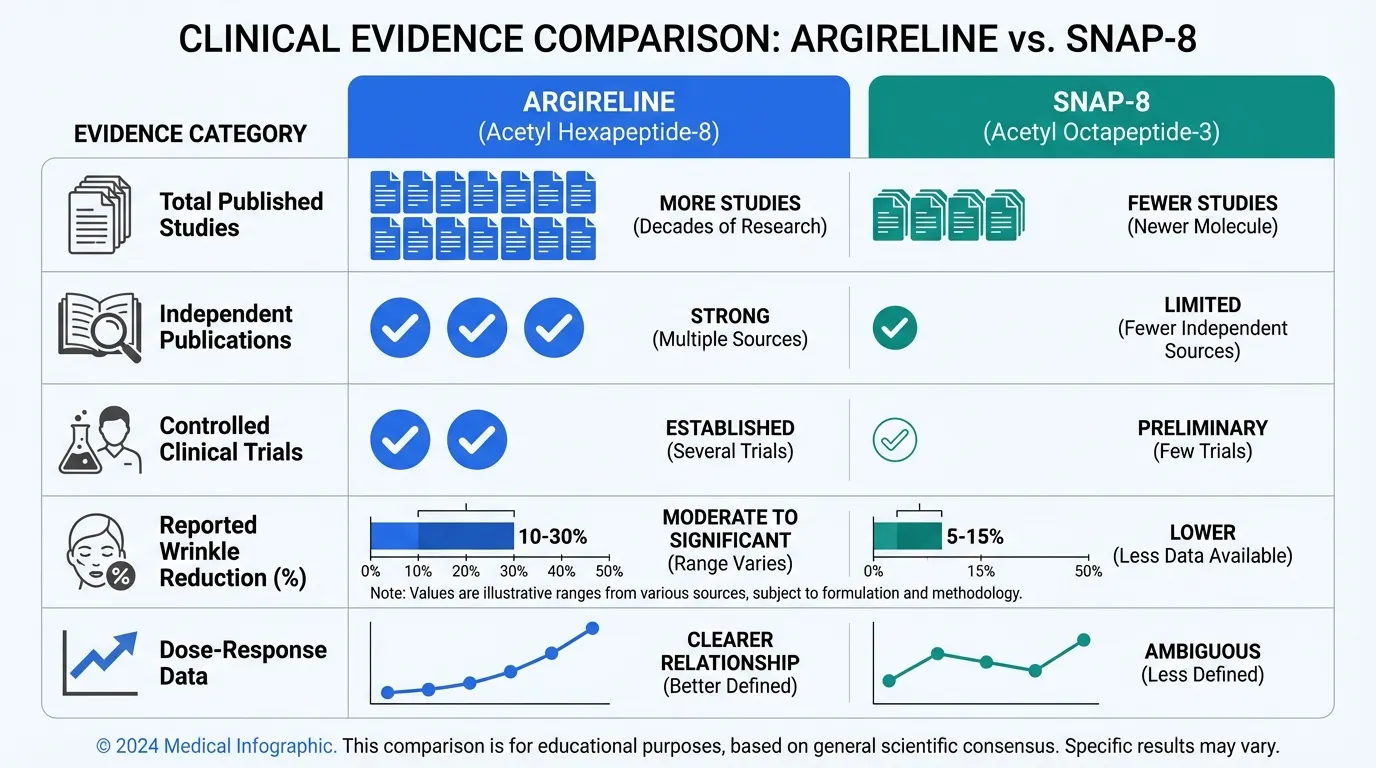
| Evidence Feature | Argireline | SNAP-8 |
|---|---|---|
| Total published studies | Multiple | Few |
| Independent publications | Yes (several) | Very limited |
| Controlled clinical trials | Yes | Limited to industry data |
| Head-to-head comparison | Not against SNAP-8 | Not against Argireline |
| Dose-response data | Available (2-10%) | Limited |
| Review article coverage | Extensive | Growing |
| Mechanism validation | In vitro SNARE inhibition confirmed | In vitro SNARE inhibition confirmed |
The evidence gap between the two peptides is a recurring theme. Argireline was first to market, has been available longer, and has accumulated more published research. SNAP-8 may eventually develop a comparable evidence base, but as of this writing, Argireline has the clear advantage in clinical documentation.
Formulation and Practical Considerations#
Stability and Compatibility#
Both peptides are water-soluble, stable in aqueous formulations, and compatible with the most common cosmetic actives:
- Retinol — Compatible with both
- Vitamin C — Compatible with both (unlike GHK-Cu, which is destabilized by acidic vitamin C)
- Niacinamide — Compatible with both
- Hyaluronic acid — Compatible with both
- AHAs/BHAs — Compatible with both
This broad compatibility is a practical advantage over copper peptides like GHK-Cu, which require a narrow pH range (5.0-6.5) and cannot be combined with strong acids.
Concentration and Application#
Both peptides are used at similar concentrations in finished products:
- Argireline: Typically 5-10% of the active solution in serums, with some products using lower concentrations in creams
- SNAP-8: Typically 3-10% of the active solution
Both are applied topically, usually twice daily to clean skin. They are most effective when applied to areas of dynamic wrinkles (crow's feet, forehead lines, glabellar lines) where muscle contraction is the primary driver of wrinkle formation.
Market Availability#
Argireline has a significant lead in commercial availability. It is found in hundreds of products across mass-market, mid-range, and prestige skincare lines. The name "Argireline" has become somewhat generic for this class of peptides, similar to how "Botox" is used colloquially for botulinum toxin treatments.
SNAP-8 is available in fewer commercial products but is increasingly appearing in formulations marketed as "advanced" or "next-generation" anti-wrinkle treatments. Some products combine both Argireline and SNAP-8, though the added benefit of this combination over either peptide alone is unclear given their shared mechanism.
Combination Strategies#
Both Argireline and SNAP-8 can be combined with peptides that work through different mechanisms for potentially enhanced effects:
With Leuphasyl (Pentapeptide-18): Leuphasyl targets calcium-dependent neurotransmitter release upstream of the SNARE complex. Combining it with either Argireline or SNAP-8 addresses two different steps in the neuromuscular signaling cascade. Manufacturer data suggests additive effects.
With Matrixyl: Combining a SNARE inhibitor with a collagen-stimulating signal peptide addresses both dynamic wrinkles (muscle contraction) and static wrinkles (collagen loss). This is one of the most rational multi-peptide approaches in cosmeceutical formulation.
With GHK-Cu: GHK-Cu provides broad gene modulation including collagen synthesis, anti-inflammatory effects, and antioxidant defense. However, GHK-Cu requires careful formulation due to copper reactivity and pH sensitivity, making this combination more complex than Matrixyl-based pairings.
The Penetration Question#
Both Argireline (889 Da) and SNAP-8 (1,075 Da) are above the conventional 500 Da threshold for passive transdermal absorption. Their molecular target — the neuromuscular junction — lies beneath the epidermis, requiring penetration through the stratum corneum and into the dermis or deeper.
This raises a legitimate scientific question: do topically applied SNARE peptides reach their target in biologically relevant concentrations? The clinical evidence for wrinkle reduction suggests some degree of activity, but whether this results from target engagement at the neuromuscular junction, partial penetration to superficial nerves, or alternative mechanisms has not been definitively established.
SNAP-8's higher molecular weight (1,075 vs 889 Da) may theoretically disadvantage it slightly in penetration, though neither peptide falls within the ideal range for passive transdermal delivery.
Key Differences Summary#
- Evidence base: Argireline has significantly more published clinical data, including multiple independent publications and controlled trials. SNAP-8 relies more heavily on manufacturer data.
- Molecular design: SNAP-8's longer peptide sequence (8 vs 6 amino acids) may offer better SNARE complex binding but also increases molecular weight and may reduce skin penetration.
- Market position: Argireline is the established first-generation product with broad availability. SNAP-8 is positioned as a next-generation enhancement.
- Shared features: Same mechanism (SNARE inhibition), similar efficacy range (20-35% wrinkle depth reduction), comparable safety profiles, and compatible with the same formulation ingredients.
- Unresolved question: Whether SNAP-8 is genuinely more potent than Argireline has not been answered by independent head-to-head clinical trials.
Conclusion#
Argireline and SNAP-8 are closely related cosmeceutical peptides that target the same molecular mechanism for dynamic wrinkle reduction. Argireline is the more evidence-supported choice with a longer clinical track record, broader availability, and more published research. SNAP-8 offers a biologically plausible improvement through its extended sequence but lacks the independent clinical validation to confirm its claimed potency advantage.
For consumers choosing between the two, Argireline is the safer bet based on evidence alone. SNAP-8 is a reasonable option, particularly in well-formulated products that combine it with complementary peptides like Leuphasyl or Matrixyl. The most important factor may be less about which SNARE peptide is chosen and more about the overall formulation quality, concentration, and consistency of application.
For a comprehensive guide to all anti-wrinkle peptide classes including signal peptides and copper peptides, see our anti-wrinkle peptides guide.
Further Reading#

Which Is Better For...
Most Evidence-Supported Choice
Argireline
More published clinical studies, including controlled trials showing approximately 30% wrinkle depth reduction. The evidence base is broader and more independently validated than SNAP-8.
Maximum Theoretical Potency
SNAP-8
The extended octapeptide sequence is designed to better mimic SNAP-25 and may offer improved SNARE complex inhibition. However, the potency advantage is based primarily on manufacturer data and has not been confirmed in independent head-to-head clinical trials.
Product Availability
Argireline
Found in far more commercial skincare products across all price ranges. Stronger consumer name recognition makes it easier to find in retail products.
Combination with Other Anti-Wrinkle Peptides
Either (both compatible)
Both peptides are compatible with complementary anti-wrinkle ingredients including Leuphasyl (enkephalin analog), Matrixyl (collagen stimulator), and GHK-Cu (copper peptide). Either can serve as the SNARE-targeting component in a multi-peptide formulation.
Sensitive Skin
Either (both well tolerated)
Both peptides have excellent safety profiles with no significant adverse effects reported at standard concentrations. Neither causes the irritation associated with retinoids or the muscle effects of botulinum toxin.
Continue Your Research
Get comparison updates
We publish new head-to-head comparisons regularly. Subscribe to see them first.
Frequently Asked Questions About Argireline vs SNAP-8: Which Anti-Wrinkle Peptide Works Better?
Which is better, Argireline or SNAP-8?
Argireline and SNAP-8 share the same SNARE complex mechanism and produce comparable wrinkle reduction effects in the 20-35% range over 28-30 days of topical application. Argireline has the stronger evidence base with more published clinical studies, broader commercial availability, and a longer track record in cosmeceutical formulations. SNAP-8 is positioned as a potentially more potent successor based on its extended peptide sequence, but this claim has not been validated in rigorous indepen... Individual responses may vary, and this comparison is based on available research data, not a treatment recommendation.
What are the key differences between Argireline and SNAP-8?
The main differences across comparison categories are: Mechanism of Action: advantage goes to neither (tie); Research Evidence: advantage goes to Argireline; Side Effect Profile: advantage goes to neither (tie). 2 additional categories are analyzed in the full comparison. Each category evaluates a different dimension of the two peptides.
When should I consider Argireline over SNAP-8?
For the scenario of "Most Evidence-Supported Choice," research data suggests Argireline may be more relevant. More published clinical studies, including controlled trials showing approximately 30% wrinkle depth reduction. The evidence base is broader and more independently validated than SNAP-8.. This is based on currently available evidence and individual circumstances may differ.
How do Argireline and SNAP-8 differ in their mechanisms of action?
Argireline: Argireline (Ac-EEMQRR-NH2) is a six-amino-acid peptide that mimics the N-terminal domain of SNAP-25, competing with native SNAP-25 for incorporation into the SNARE complex. By occupying binding sit.... SNAP-8: SNAP-8 (Ac-EEMQRRAD-NH2) is an eight-amino-acid extension of Argireline that includes the same hexapeptide core plus two additional residues (Ala-Asp). It targets the same SNARE complex mechanism, ....
Which has fewer side effects, Argireline or SNAP-8?
In terms of side effects and tolerability, the advantage goes to neither (comparable). Argireline: Argireline is well tolerated at standard cosmetic concentrations (5-10%). No significant adverse effects have been reported in clinical studies. Ra.... SNAP-8: SNAP-8 is similarly well tolerated at standard concentrations (3-10%). No significant adverse effects have been reported. The safety profile is com....
Medical Disclaimer
This website is for educational and informational purposes only. The information provided is not intended to diagnose, treat, cure, or prevent any disease. Always consult with a qualified healthcare professional before using any peptide or supplement.