ACE-031 vs Apitegromab: Myostatin Pathway Inhibitors Compared
Comparison of ACE-031 and apitegromab, two myostatin pathway inhibitors with different targets, selectivity, clinical data, and safety profiles for muscle wasting conditions.
Verdict at a Glance
Apitegromab represents a clear advancement over ACE-031 in myostatin pathway therapeutics. The key lesson from ACE-031 was that broad TGF-beta superfamily inhibition produces unacceptable off-target effects, particularly vascular toxicity. Apitegromab's selective targeting of proMyostatin and latent myostatin addresses this directly, inhibiting only the muscle-relevant pathway while leaving vascular, hematopoietic, and reproductive TGF-beta signaling intact. With an active Phase 3 program and FDA Fast Track designation, apitegromab is positioned as the most clinically advanced selective myostatin inhibitor currently in development.
| Best for | Pick | Why |
|---|---|---|
| Historical Understanding of Myostatin Therapeutics | ACE-031 | ACE-031 provided critical proof-of-concept that myostatin pathway inhibition increases lean mass in humans, and its safety failure drove the field toward more selective approaches like apitegromab. |
| Active Clinical Development | Apitegromab | Apitegromab is the only one of the two with an active clinical program. The Phase 3 SAPPHIRE trial in SMA represents the furthest advancement of selective myostatin inhibition in human trials. |
| Muscle Wasting in Neuromuscular Disease | Apitegromab | Apitegromab is specifically designed for neuromuscular disease applications, with SMA as the lead indication and a safety profile that avoids the vascular toxicity that derailed ACE-031 in DMD. |
| Broad TGF-beta Pathway Research | ACE-031 | As a non-selective ActRIIB trap, ACE-031 provided insights into the collective role of TGF-beta superfamily members in muscle biology, revealing how multiple ligands beyond myostatin contribute to muscle regulation. |
| Category | ACE-031 | Apitegromab | Advantage |
|---|---|---|---|
| Mechanism of Action | Soluble ActRIIB-Fc fusion protein (decoy receptor) that circulates in blood and traps multiple TGF-beta superfamily ligands including myostatin, activin A, activin B, and GDF-11. Broad inhibition at the ligand level before they reach cell-surface receptors. | Monoclonal antibody that specifically binds proMyostatin and latent myostatin, preventing proteolytic activation into mature myostatin. Selectively targets only the myostatin pathway without affecting other TGF-beta superfamily members. | Apitegromab |
| Clinical Evidence | Phase 2 trial in Duchenne muscular dystrophy demonstrated increases in lean body mass and reductions in fat mass, confirming pharmacological activity. Trial halted due to vascular safety signals (epistaxis, telangiectasias). Program discontinued. | Phase 2 TOPAZ trial in spinal muscular atrophy showed improvements in motor function measures. Phase 3 SAPPHIRE trial ongoing in SMA patients receiving background SMN-correcting therapy. Active clinical development with updated data presentations. | Apitegromab |
| Safety Profile | Caused epistaxis (nosebleeds) and telangiectasias (dilated blood vessels) in DMD trial, attributed to broad TGF-beta superfamily inhibition affecting ALK1 vascular signaling. These vascular effects led to trial discontinuation and program termination. | Generally well tolerated in Phase 2 TOPAZ data. Selective myostatin targeting avoids the vascular side effects seen with broader TGF-beta inhibitors. No treatment-related serious adverse events reported that led to discontinuation. Full Phase 3 safety data pending. | Apitegromab |
| Selectivity | Low selectivity. Traps myostatin, activin A, activin B, GDF-11, BMP-9, BMP-10, and other TGF-beta ligands that bind ActRIIB. This broad inhibition affects muscle, vascular, reproductive, and hematopoietic pathways simultaneously. | High selectivity. Targets only proMyostatin and latent myostatin, blocking the activation step specific to myostatin. Does not affect activin, GDF-11, BMP-9/10, or other ActRIIB ligands, preserving their normal signaling functions. | Apitegromab |
| Development Status | Discontinued. Acceleron Pharma halted ACE-031 development after the DMD trial safety signals. The company pivoted to more selective molecules including luspatercept (ACE-536, FDA-approved for anemia) and ACE-083 (local follistatin, also discontinued). | Active development by Scholar Rock. Phase 3 SAPPHIRE trial enrolling SMA patients. Received FDA Fast Track designation for SMA. Potential platform for broader muscle wasting indications if Phase 3 succeeds. | Apitegromab |

Introduction#
ACE-031 and apitegromab represent two generations of myostatin pathway therapeutics, separated by a critical lesson in drug development: selectivity matters. Both compounds aim to promote muscle growth by inhibiting myostatin signaling, but they approach this goal through fundamentally different strategies with dramatically different safety profiles and clinical outcomes.
ACE-031 (ramatercept), developed by Acceleron Pharma, was a first-generation soluble ActRIIB-Fc decoy receptor that broadly trapped multiple TGF-beta superfamily ligands. It confirmed that blocking the myostatin pathway increases lean mass in humans but was discontinued due to vascular safety concerns in its Duchenne muscular dystrophy trial.
Apitegromab (SRK-015), developed by Scholar Rock, represents the field's response to ACE-031's limitations. By targeting proMyostatin and latent myostatin specifically, apitegromab inhibits only myostatin activation while leaving other TGF-beta superfamily signaling intact, aiming to preserve efficacy while avoiding off-target vascular and hematopoietic effects.
For broader context on myostatin inhibition approaches for muscle wasting, see our guide on peptides for sarcopenia.
Mechanism of Action Comparison#
ACE-031#
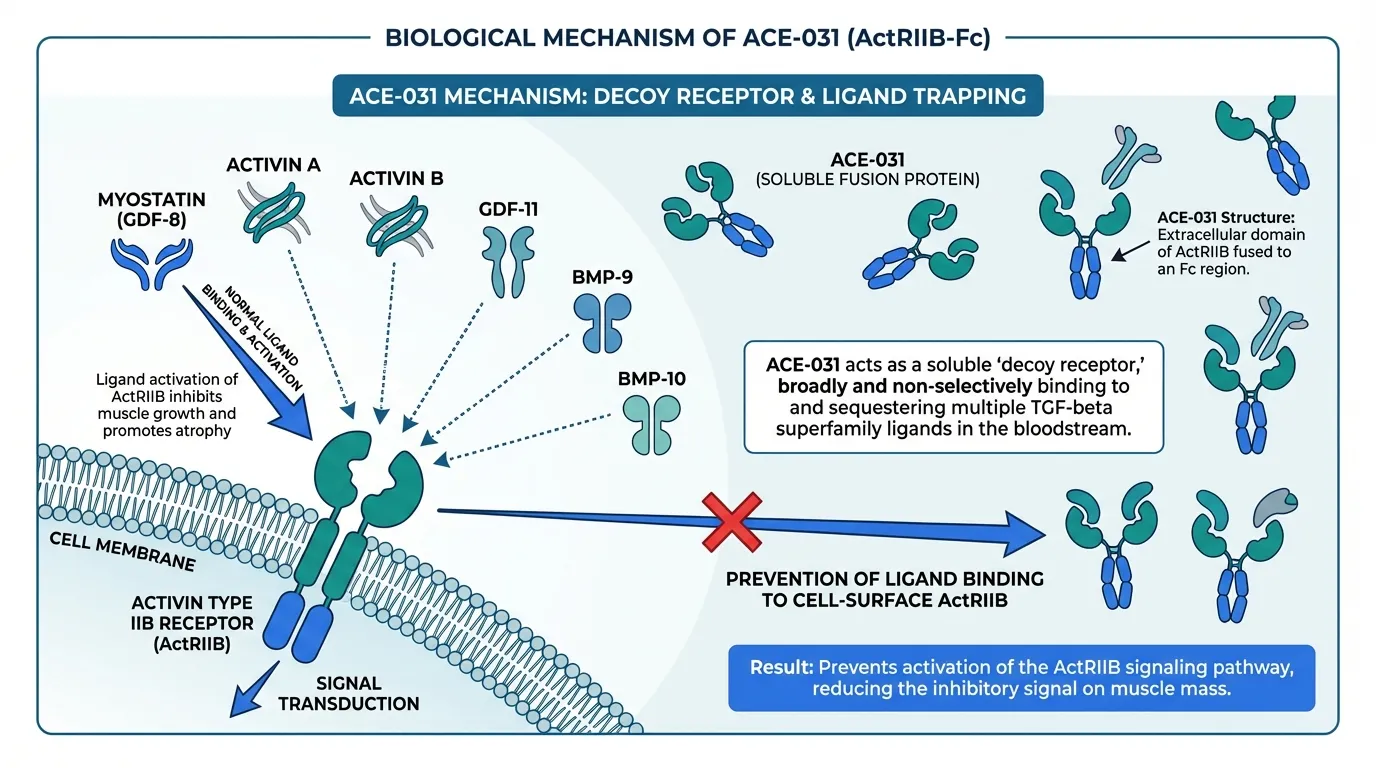
ACE-031 is a soluble fusion protein combining the extracellular domain of the activin type IIB receptor (ActRIIB) with the Fc region of human IgG1. This construct circulates in the bloodstream and acts as a decoy receptor, binding and sequestering TGF-beta superfamily ligands before they can reach cell-surface receptors.
The critical characteristic of ACE-031 is its broad ligand binding. ActRIIB naturally binds multiple TGF-beta superfamily members:
- Myostatin (GDF-8): Primary negative regulator of muscle mass
- Activin A and B: Regulate muscle, reproductive, and inflammatory pathways
- GDF-11: Roles in aging biology and hematopoiesis
- BMP-9 and BMP-10: Critical regulators of vascular biology and angiogenesis through ALK1 signaling
By trapping all of these ligands, ACE-031 produces broad downstream effects across multiple tissue types. The muscle effects (lean mass gain) are desirable; the vascular effects (BMP-9/10 sequestration disrupting ALK1 signaling) proved problematic.
Apitegromab#
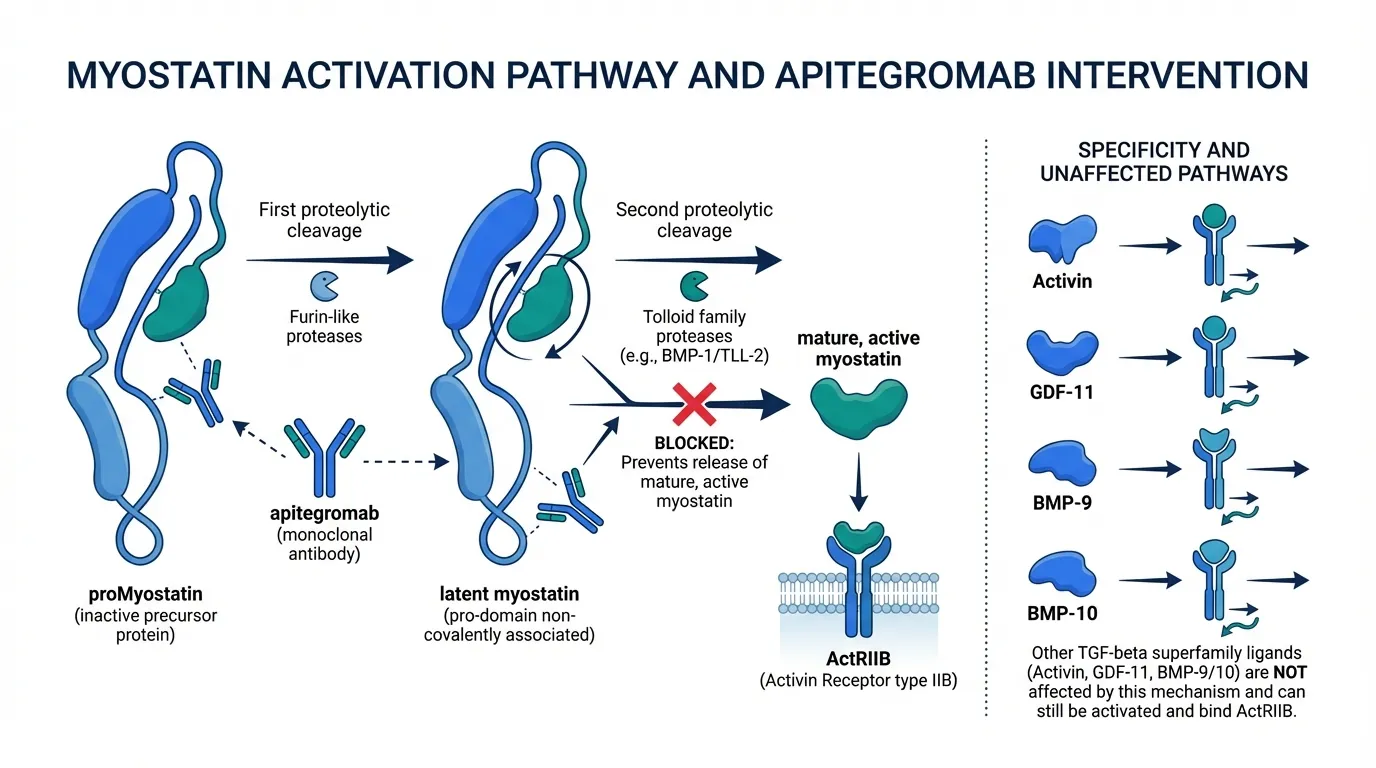
Apitegromab takes a fundamentally different approach. Rather than blocking the receptor or trapping mature ligands, apitegromab is a monoclonal antibody that binds to proMyostatin and latent myostatin, the inactive precursor forms of myostatin.
Myostatin is produced as an inactive pro-protein that requires two sequential proteolytic cleavage steps to become active. First, furin-like proteases cleave the pro-domain from the mature domain. The cleaved pro-domain remains non-covalently associated with the mature domain as "latent myostatin." A second cleavage by tolloid family proteases (BMP-1/TLL-2) releases the mature, active myostatin to bind ActRIIB.
Apitegromab blocks this second activation step, preventing the release of mature myostatin from its latent complex. This mechanism targets only myostatin, because activin, GDF-11, BMP-9, and BMP-10 have different activation pathways and are not affected by an antibody specific to the myostatin pro-domain.
Key Mechanistic Differences#
| Feature | ACE-031 | Apitegromab |
|---|---|---|
| Drug type | Soluble receptor-Fc fusion | Monoclonal antibody |
| Point of intervention | Traps mature ligands | Blocks ligand activation |
| Myostatin inhibition | Yes (among many ligands) | Yes (selective) |
| Activin inhibition | Yes | No |
| GDF-11 inhibition | Yes | No |
| BMP-9/10 inhibition | Yes (vascular toxicity) | No |
| Selectivity | Low (pan-ActRIIB ligands) | High (myostatin-specific) |
Clinical Evidence Comparison#
ACE-031 Clinical Data#
ACE-031 entered a Phase 2 clinical trial in boys with Duchenne muscular dystrophy (DMD). The trial produced two categories of results:
Efficacy signals: Participants showed measurable increases in lean body mass and corresponding reductions in fat mass, as measured by DXA. These changes were consistent with the expected pharmacological activity of myostatin pathway inhibition and provided human proof-of-concept that blocking ActRIIB signaling produces the predicted body composition effects.
Safety signals: Several participants developed epistaxis (nosebleeds) and telangiectasias (dilated small blood vessels visible on the skin). These vascular effects were attributed to ACE-031's sequestration of BMP-9 and BMP-10, which are essential for maintaining vascular integrity through ALK1 signaling. Mutations in ALK1 or its ligands cause hereditary hemorrhagic telangiectasia (HHT) in humans, and ACE-031 was effectively creating a pharmacological phenocopy of this condition.
The trial was halted, and Acceleron Pharma discontinued the ACE-031 program. The company subsequently developed more selective molecules, including luspatercept (ACE-536), which targets erythroid maturation through a modified ActRIIB domain and gained FDA approval for anemia.
Apitegromab Clinical Data#
Apitegromab's clinical development has focused on spinal muscular atrophy (SMA):
Phase 2 TOPAZ trial: This study evaluated apitegromab in SMA Type 2 and Type 3 patients, many of whom were receiving background SMN-correcting therapies (nusinersen or risdiplam). Results showed improvements in motor function as measured by the Hammersmith Functional Motor Scale Expanded (HFMSE) and Revised Upper Limb Module (RULM). These improvements exceeded what would be expected from SMN-correcting therapy alone, suggesting that apitegromab provides additive benefit by addressing muscle pathology alongside the neuronal correction.
Phase 3 SAPPHIRE trial: Based on the TOPAZ results, Scholar Rock advanced to a Phase 3 registrational trial (SAPPHIRE) in SMA patients. The trial evaluates apitegromab as an add-on to standard-of-care SMN-correcting therapy, with motor function as the primary endpoint.
Regulatory recognition: Apitegromab received FDA Fast Track designation for SMA, reflecting the agency's recognition of unmet medical need and the preliminary efficacy data.
Safety Profile Comparison#
ACE-031 Safety Issues#
ACE-031's safety problems were directly attributable to its lack of selectivity:
- Epistaxis: Nosebleeds resulting from impaired vascular integrity, caused by BMP-9/10 sequestration disrupting ALK1-dependent vascular maintenance
- Telangiectasias: Small dilated blood vessels visible on skin and mucous membranes, also caused by ALK1 pathway disruption
- Theoretical reproductive effects: Broad activin inhibition could affect reproductive hormone regulation, though this was not specifically characterized before discontinuation
- Theoretical hematopoietic effects: GDF-11 and activin involvement in blood cell production raised concerns about broader hematological effects
The vascular safety signals were serious enough to halt the trial, despite the efficacy signals. This reflected a clinical judgment that the risk-benefit ratio was unfavorable, particularly in a pediatric DMD population.
Apitegromab Safety Profile#
Apitegromab's selective mechanism predicts a cleaner safety profile, and Phase 2 data has been consistent with this prediction:
- No vascular safety signals: By not affecting BMP-9/10 or ALK1 signaling, apitegromab avoids the vascular toxicity that derailed ACE-031
- No significant reproductive effects reported: Selective myostatin targeting does not affect activin-mediated FSH regulation
- Generally well tolerated: Phase 2 TOPAZ data showed a favorable safety profile with no treatment-related serious adverse events leading to discontinuation
- Full Phase 3 safety data pending: The complete safety profile will be characterized by the SAPPHIRE trial results
Lessons from ACE-031 for the Field#
ACE-031's failure and apitegromab's design represent a textbook case in target-class drug development. Several key lessons emerged:
Selectivity Over Potency#
ACE-031 was pharmacologically effective at increasing lean mass, but its lack of selectivity produced unacceptable toxicity. The lesson: in the TGF-beta superfamily, where dozens of ligands regulate diverse tissues through overlapping receptors, broad pathway blockade is likely to produce off-target effects. Specificity for the intended target (myostatin) is more important than maximal pathway inhibition.
Understanding the Target Biology#
The vascular effects of ACE-031 could have been predicted from knowledge of ALK1 biology and hereditary hemorrhagic telangiectasia genetics. BMP-9 and BMP-10 are known ActRIIB ligands essential for vascular maintenance. This underscores the importance of comprehensive target biology analysis before clinical development of pathway inhibitors.
Iterative Development#
Acceleron's pivot from ACE-031 (broad ActRIIB trap) to luspatercept (modified ActRIIB with erythroid selectivity) to Scholar Rock's development of apitegromab (myostatin-specific antibody) illustrates how clinical failures inform the next generation of therapeutics.
Development Status and Future Outlook#
ACE-031#
ACE-031 is permanently discontinued. Its legacy is primarily as a proof-of-concept that myostatin pathway inhibition increases lean mass in humans, and as a cautionary example about the importance of selectivity in TGF-beta superfamily therapeutics. Acceleron Pharma was acquired by Merck in 2021, and no plans exist to resurrect the ACE-031 program.
Apitegromab#
Apitegromab is in active Phase 3 clinical development with several potential catalysts:
- SAPPHIRE trial results: The registrational trial will determine whether apitegromab gains regulatory approval for SMA
- Broader indications: If the selective myostatin inhibition approach proves safe and effective in SMA, Scholar Rock has indicated interest in exploring additional muscle wasting conditions
- Platform validation: Success with apitegromab would validate the selective myostatin inhibition approach and could encourage development of similar molecules for sarcopenia, cachexia, and other conditions
For comparison with other myostatin pathway approaches, see our bimagrumab vs follistatin comparison.
Conclusion#
The comparison between ACE-031 and apitegromab illustrates the evolution of myostatin pathway therapeutics from broad to selective inhibition. ACE-031 demonstrated that blocking myostatin signaling increases lean mass in humans, a critical proof of concept. But its broad mechanism of trapping multiple TGF-beta superfamily ligands produced vascular toxicity that ended its development.
Apitegromab was designed to avoid this failure mode by targeting only the myostatin activation step. Early clinical data supports both its efficacy (motor function improvements in SMA) and its safety (no vascular signals). With an active Phase 3 program and FDA Fast Track designation, apitegromab is the more clinically relevant molecule today.
The broader lesson extends beyond these two compounds: in the TGF-beta superfamily, selectivity is not optional. The pathway's involvement in vascular, reproductive, hematopoietic, and muscle biology means that indiscriminate inhibition will almost certainly produce off-target effects. Future myostatin therapeutics, whether for neuromuscular disease or age-related sarcopenia, will need to match apitegromab's selectivity to succeed clinically.
Further Reading#

Which Is Better For...
Historical Understanding of Myostatin Therapeutics
ACE-031
ACE-031 provided critical proof-of-concept that myostatin pathway inhibition increases lean mass in humans, and its safety failure drove the field toward more selective approaches like apitegromab.
Active Clinical Development
Apitegromab
Apitegromab is the only one of the two with an active clinical program. The Phase 3 SAPPHIRE trial in SMA represents the furthest advancement of selective myostatin inhibition in human trials.
Muscle Wasting in Neuromuscular Disease
Apitegromab
Apitegromab is specifically designed for neuromuscular disease applications, with SMA as the lead indication and a safety profile that avoids the vascular toxicity that derailed ACE-031 in DMD.
Broad TGF-beta Pathway Research
ACE-031
As a non-selective ActRIIB trap, ACE-031 provided insights into the collective role of TGF-beta superfamily members in muscle biology, revealing how multiple ligands beyond myostatin contribute to muscle regulation.
Continue Your Research
Get comparison updates
We publish new head-to-head comparisons regularly. Subscribe to see them first.
Frequently Asked Questions About ACE-031 vs Apitegromab: Myostatin Pathway Inhibitors Compared
Which is better, ACE-031 or Apitegromab?
Apitegromab represents a clear advancement over ACE-031 in myostatin pathway therapeutics. The key lesson from ACE-031 was that broad TGF-beta superfamily inhibition produces unacceptable off-target effects, particularly vascular toxicity. Apitegromab's selective targeting of proMyostatin and latent myostatin addresses this directly, inhibiting only the muscle-relevant pathway while leaving vascular, hematopoietic, and reproductive TGF-beta signaling intact. With an active Phase 3 program and... Individual responses may vary, and this comparison is based on available research data, not a treatment recommendation.
What are the key differences between ACE-031 and Apitegromab?
The main differences across comparison categories are: Mechanism of Action: advantage goes to Apitegromab; Clinical Evidence: advantage goes to Apitegromab; Safety Profile: advantage goes to Apitegromab. 2 additional categories are analyzed in the full comparison. Each category evaluates a different dimension of the two peptides.
When should I consider ACE-031 over Apitegromab?
For the scenario of "Historical Understanding of Myostatin Therapeutics," research data suggests ACE-031 may be more relevant. ACE-031 provided critical proof-of-concept that myostatin pathway inhibition increases lean mass in humans, and its safety failure drove the field toward more selective approaches like apitegromab.. This is based on currently available evidence and individual circumstances may differ.
How do ACE-031 and Apitegromab differ in their mechanisms of action?
ACE-031: Soluble ActRIIB-Fc fusion protein (decoy receptor) that circulates in blood and traps multiple TGF-beta superfamily ligands including myostatin, activin A, activin B, and GDF-11. Broad inhibition a.... Apitegromab: Monoclonal antibody that specifically binds proMyostatin and latent myostatin, preventing proteolytic activation into mature myostatin. Selectively targets only the myostatin pathway without affect....
Which has fewer side effects, ACE-031 or Apitegromab?
In terms of side effects and tolerability, the advantage goes to Apitegromab. ACE-031: Caused epistaxis (nosebleeds) and telangiectasias (dilated blood vessels) in DMD trial, attributed to broad TGF-beta superfamily inhibition affecti.... Apitegromab: Generally well tolerated in Phase 2 TOPAZ data. Selective myostatin targeting avoids the vascular side effects seen with broader TGF-beta inhibitor....
Medical Disclaimer
This website is for educational and informational purposes only. The information provided is not intended to diagnose, treat, cure, or prevent any disease. Always consult with a qualified healthcare professional before using any peptide or supplement.