MGF vs PEG-MGF: Native vs PEGylated Mechano Growth Factor
MGF vs PEG-MGF compared: half-life differences, satellite cell activation, local vs systemic action, and preclinical evidence.
Verdict at a Glance
MGF and PEG-MGF represent the same core peptide with fundamentally different pharmacokinetic profiles. Native MGF mirrors the endogenous local repair signal with its brief 5-7 minute half-life, has stronger direct research characterization, and preserves physiological signaling patterns. PEG-MGF extends the half-life to hours for practical dosing convenience, but this transforms a local paracrine factor into a systemic agent, which may not replicate natural MGF biology. Both remain entirely preclinical with no human clinical trials.
| Best for | Pick | Why |
|---|---|---|
| Studying endogenous muscle repair signaling | MGF | Identical to the natural IGF-1Ec E-domain; mirrors the local, transient expression pattern that initiates satellite cell activation after mechanical stress |
| Practical research dosing with sustained activity | PEG-MGF | PEGylation extends half-life from minutes to hours, reducing injection frequency and enabling sustained peptide exposure in research protocols |
| Local tissue-targeted delivery research | MGF | Rapid clearance confines activity to the injection site, making it suitable for studying local paracrine repair mechanisms |
| Systemic distribution research | PEG-MGF | Extended circulation time enables systemic bioavailability for studying effects on distant tissues beyond the injection site |
| Category | MGF | PEG-MGF | Advantage |
|---|---|---|---|
| Mechanism of Action | 24-amino acid E-domain peptide from IGF-1Ec splice variant; activates quiescent satellite cells independent of IGF-1R; locally expressed in response to mechanical stress and tissue damage | Same 24-amino acid core peptide with covalently attached PEG polymer; retains proposed satellite cell activation mechanism; PEG is biologically inert but may alter receptor interaction through steric effects | Comparable |
| Research Evidence | Characterized by Goldspink laboratory at UCL; published studies on exercise-induced expression, satellite cell activation, and age-related decline; entirely preclinical | Limited independent literature; most evidence extrapolated from native MGF studies; PEGylation effects on biological activity not definitively characterized; entirely preclinical | MGF |
| Side Effect Profile | Very short half-life (5-7 minutes) limits systemic exposure; local action may reduce off-target effects; unknown human safety profile | Extended half-life increases systemic exposure duration; PEG moiety carries theoretical immunogenicity risk with repeated dosing; unknown human safety profile | MGF |
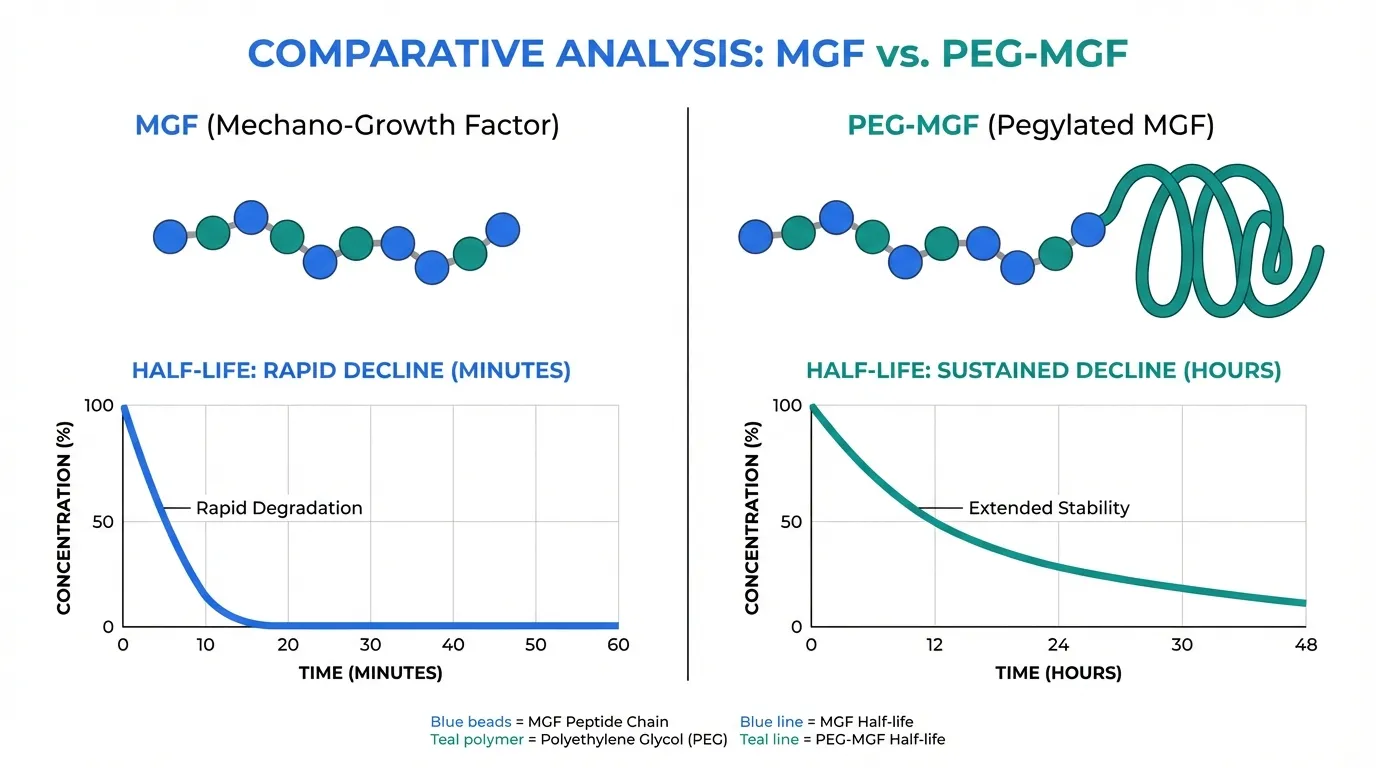
| Pharmacokinetics | Half-life approximately 5-7 minutes; rapidly cleared from circulation; acts as a local paracrine/autocrine factor; requires frequent dosing for sustained effect | Half-life extended to several hours via PEGylation; systemic distribution possible; reduced proteolytic degradation and renal clearance; less frequent dosing needed | PEG-MGF |
| Physiological Fidelity | Identical to endogenous MGF E-domain; mirrors natural local expression pattern following mechanical stress; acts as initiating signal before IGF-1Ea takes over | PEG modification creates a non-physiological sustained systemic signal; endogenous MGF is a brief local factor, not a circulating hormone; altered distribution profile | MGF |

Introduction#
MGF and PEG-MGF are two forms of the same muscle repair peptide separated by a single chemical modification with major pharmacokinetic consequences. Native MGF is a 24-amino acid peptide derived from the IGF-1Ec splice variant that acts as a brief, local repair signal following mechanical stress. PEG-MGF attaches a polyethylene glycol polymer to extend the half-life from minutes to hours, converting a local paracrine factor into a systemic agent. Both remain entirely preclinical.
Quick Comparison#
| Feature | MGF | PEG-MGF |
|---|---|---|
| Structure | 24 amino acids, 2.9 kDa | 24 amino acids + PEG, ~5 kDa |
| Half-Life | 5-7 minutes | Several hours |
| Action Type | Local paracrine/autocrine | Systemic distribution |
| Primary Target | Satellite cell activation | Satellite cell activation (proposed) |
| IGF-1R Binding | No | No |
| Endogenous Equivalent | Identical to IGF-1Ec E-domain | No natural equivalent |
| Research Status | Preclinical | Preclinical |
| Key Researcher | Geoffrey Goldspink, UCL | Derived from Goldspink MGF work |
Mechanism of Action Comparison#
MGF#
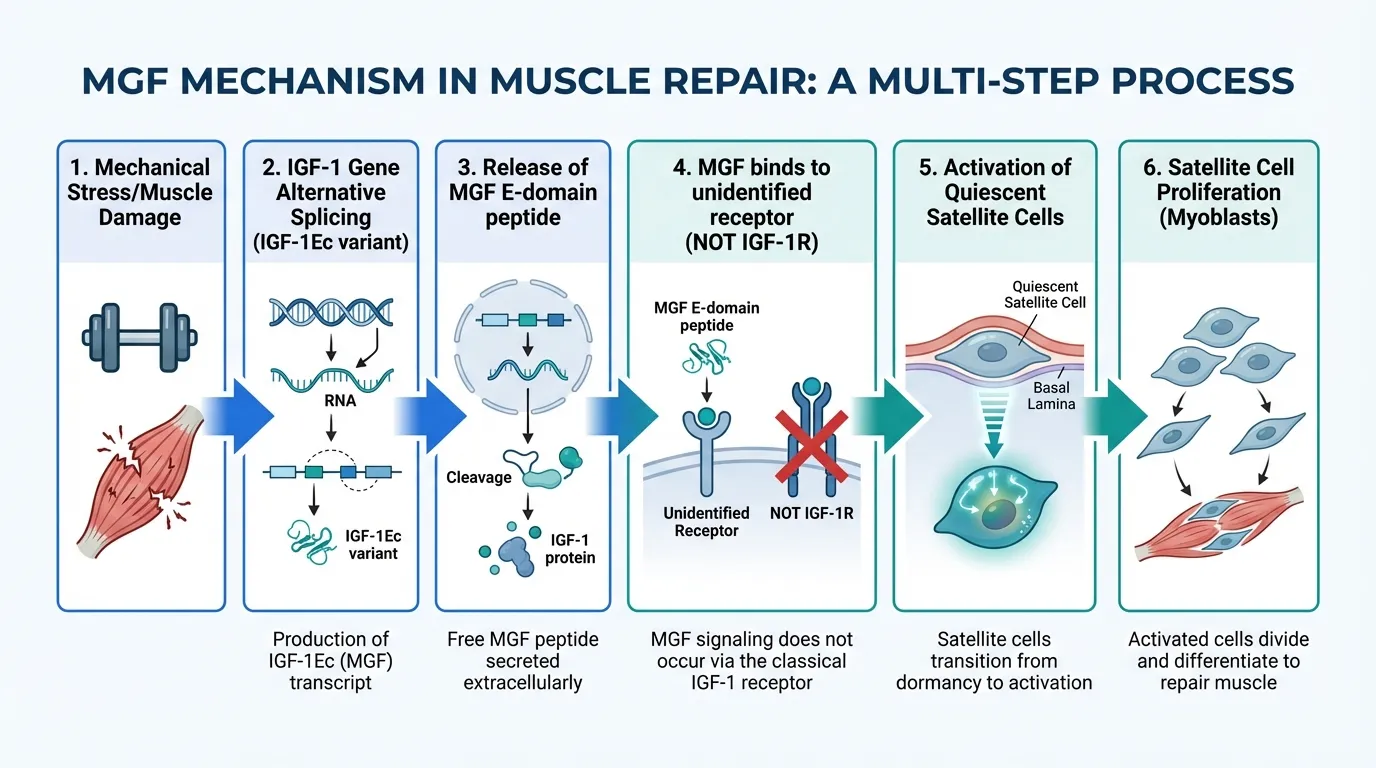
MGF (Mechano Growth Factor) is the unique 24-amino acid C-terminal E-domain peptide of the human IGF-1Ec splice variant. It was first characterized by Geoffrey Goldspink at University College London as a mechanosensitive repair factor. When skeletal muscle is subjected to mechanical overload or damage, the IGF-1 gene undergoes alternative splicing to produce IGF-1Ec, releasing the MGF E-domain as a distinct signaling peptide.
MGF's primary biological role is activating quiescent satellite cells, the resident stem cells of skeletal muscle. This activation stimulates their entry into the cell cycle and proliferation as myoblasts. Importantly, MGF promotes proliferation without premature differentiation, expanding the progenitor cell pool before differentiation signals (from later IGF-1Ea expression) drive myoblast fusion into mature myofibers.
MGF does not bind the IGF-1 receptor (IGF-1R), suggesting it signals through a distinct, unidentified receptor. This independence from IGF-1R is a critical distinction from other IGF-1 system peptides like IGF-1 LR3, which directly activates IGF-1R signaling.
PEG-MGF#
PEG-MGF retains the identical 24-amino acid core sequence (YQPPSTNKNTKSQRRKGSTFEEHK) with a polyethylene glycol polymer covalently attached, typically to an N-terminal or lysine residue. The PEG moiety is biologically inert and serves purely as a pharmacokinetic modifier, shielding the peptide from proteolytic degradation and reducing renal clearance.
The proposed biological mechanism is the same as native MGF: satellite cell activation through a non-IGF-1R pathway. However, the steric bulk of the PEG chain could theoretically alter receptor binding or cellular uptake. No studies have definitively confirmed that PEG-MGF and native MGF produce identical biological effects at the cellular level.
The fundamental pharmacological question with PEG-MGF is whether transforming a brief, local signal into a sustained, systemic one improves or undermines the biological intent. Endogenous MGF is expressed locally at sites of tissue damage for a brief period before the splicing pattern shifts to IGF-1Ea. PEG-MGF's hours-long systemic circulation does not replicate this temporal and spatial pattern.
Evidence and Research Comparison#
MGF Research#
MGF has the more established research literature:
- Discovery and characterization: Goldspink laboratory identified the IGF-1Ec splice variant and characterized MGF's expression in response to mechanical loading in rabbit and human muscle
- Satellite cell activation: In vitro studies demonstrate MGF-mediated activation of quiescent satellite cells and myoblast proliferation
- Age-related decline: Studies show impaired IGF-1Ec upregulation in older individuals following exercise, potentially contributing to sarcopenia
- Multi-tissue expression: IGF-1Ec expression documented in cardiac muscle (post-MI), brain (post-ischemia), bone, and cartilage, suggesting a general tissue repair mechanism
- Limitation: All evidence is preclinical; no human clinical trials have been conducted
PEG-MGF Research#
PEG-MGF has limited independent research:
- PEGylation characterization: Basic pharmacokinetic studies demonstrating extended half-life relative to native MGF
- Extrapolated activity: Most claims about PEG-MGF's biological effects are extrapolated from native MGF research, not demonstrated independently
- Incomplete validation: Whether PEGylation preserves the specific receptor interactions and satellite cell activation properties of native MGF has not been definitively established
- Limitation: Even less clinical evidence than native MGF; entirely preclinical with fewer direct publications
Side Effects and Safety Comparison#
MGF Side Effects#
- Very short exposure: 5-7 minute half-life limits systemic exposure and duration of any adverse effects
- Local action: Rapid clearance restricts activity to the injection site and immediate vicinity
- Unknown human profile: No clinical trials means no systematic safety data in humans
- Theoretical concerns: As a growth factor-related peptide, theoretical concerns about cell proliferation apply but are mitigated by the brief exposure window
PEG-MGF Side Effects#
- Extended exposure: Hours-long half-life means any adverse effects persist for substantially longer than native MGF
- Systemic distribution: Unlike native MGF's local action, PEG-MGF circulates systemically, potentially affecting tissues beyond the target site
- PEG immunogenicity: Repeated PEGylated peptide dosing can generate anti-PEG antibodies, which may reduce efficacy or cause hypersensitivity reactions
- Unknown human profile: No clinical trials; safety profile entirely unknown in humans
Dosing and Administration Comparison#
MGF Dosing#
| Parameter | Details |
|---|---|
| Route | Intramuscular (local) or subcutaneous |
| Research doses | 100-200 mcg per injection |
| Frequency | Multiple times daily (due to rapid clearance) |
| Timing | Typically post-exercise or post-injury in research contexts |
| Storage | Lyophilized; reconstitute with bacteriostatic water |
| Injection strategy | Local injection near target tissue preferred |
PEG-MGF Dosing#
| Parameter | Details |
|---|---|
| Route | Subcutaneous or intramuscular |
| Research doses | 200-500 mcg per injection |
| Frequency | Once daily or less frequent |
| Timing | No specific timing requirements |
| Storage | Lyophilized; reconstitute with bacteriostatic water |
| Injection strategy | Systemic injection acceptable due to extended circulation |
Use Case Recommendations#
Choose MGF When:#
- Physiological accuracy is the research goal, studying the natural local repair signal
- Local tissue repair is targeted, with injection near the site of interest
- Minimal systemic exposure is preferred for safety reasons
- Exercise physiology research studying the endogenous IGF-1 splicing response
Choose PEG-MGF When:#
- Dosing convenience is needed, with less frequent injections
- Systemic activity is desired rather than purely local effects
- Sustained peptide exposure is required for experimental protocols
- Distant tissue effects beyond the injection site are being investigated
Can They Be Combined?#
Combining native MGF with PEG-MGF has no established rationale, as they deliver the same core peptide through different pharmacokinetic profiles. Using both simultaneously would provide overlapping local (MGF) and systemic (PEG-MGF) exposure to the same E-domain peptide, which has not been studied.
A more pharmacologically rational combination involves either MGF form with a differentiation-promoting factor like IGF-1 LR3, mirroring the natural sequential signaling where MGF first expands the satellite cell pool and IGF-1 then drives differentiation. However, this combination has not been validated in clinical studies.
For related growth factor comparisons, see IGF-1 LR3 vs MGF and our profiles on HGH 191AA and IGF-1 LR3.
Verdict#
MGF and PEG-MGF present a clear trade-off between physiological fidelity and practical convenience. Native MGF is the better-characterized molecule with direct research from the Goldspink laboratory, preserves the local and transient signaling pattern of the endogenous IGF-1Ec E-domain, and limits systemic exposure. PEG-MGF offers practical advantages in dosing frequency and systemic bioavailability, but transforms a local paracrine signal into something the body does not naturally produce.
Both compounds are entirely preclinical with no human clinical trials. Neither has demonstrated efficacy in humans. The limited independent research on PEG-MGF specifically means that much of its proposed activity is extrapolated from native MGF data. For researchers studying muscle repair biology, native MGF more closely models endogenous physiology; for protocols requiring sustained peptide exposure, PEG-MGF provides a practical alternative with important caveats about biological equivalence. The dramatic half-life difference between these two forms can be visualized in the half-life comparison tool.
Further Reading#

Which Is Better For...
Studying endogenous muscle repair signaling
MGF
Identical to the natural IGF-1Ec E-domain; mirrors the local, transient expression pattern that initiates satellite cell activation after mechanical stress
Practical research dosing with sustained activity
PEG-MGF
PEGylation extends half-life from minutes to hours, reducing injection frequency and enabling sustained peptide exposure in research protocols
Local tissue-targeted delivery research
MGF
Rapid clearance confines activity to the injection site, making it suitable for studying local paracrine repair mechanisms
Systemic distribution research
PEG-MGF
Extended circulation time enables systemic bioavailability for studying effects on distant tissues beyond the injection site
Continue Your Research
Get comparison updates
We publish new head-to-head comparisons regularly. Subscribe to see them first.
Frequently Asked Questions About MGF vs PEG-MGF: Native vs PEGylated Mechano Growth Factor
Which is better, MGF or PEG-MGF?
MGF and PEG-MGF represent the same core peptide with fundamentally different pharmacokinetic profiles. Native MGF mirrors the endogenous local repair signal with its brief 5-7 minute half-life, has stronger direct research characterization, and preserves physiological signaling patterns. PEG-MGF extends the half-life to hours for practical dosing convenience, but this transforms a local paracrine factor into a systemic agent, which may not replicate natural MGF biology. Both remain entirely p... Individual responses may vary, and this comparison is based on available research data, not a treatment recommendation.
What are the key differences between MGF and PEG-MGF?
The main differences across comparison categories are: Mechanism of Action: advantage goes to neither (tie); Research Evidence: advantage goes to MGF; Side Effect Profile: advantage goes to MGF. 2 additional categories are analyzed in the full comparison. Each category evaluates a different dimension of the two peptides.
When should I consider MGF over PEG-MGF?
For the scenario of "Studying endogenous muscle repair signaling," research data suggests MGF may be more relevant. Identical to the natural IGF-1Ec E-domain; mirrors the local, transient expression pattern that initiates satellite cell activation after mechanical stress. This is based on currently available evidence and individual circumstances may differ.
How do MGF and PEG-MGF differ in their mechanisms of action?
MGF: 24-amino acid E-domain peptide from IGF-1Ec splice variant; activates quiescent satellite cells independent of IGF-1R; locally expressed in response to mechanical stress and tissue damage. PEG-MGF: Same 24-amino acid core peptide with covalently attached PEG polymer; retains proposed satellite cell activation mechanism; PEG is biologically inert but may alter receptor interaction through ster....
Which has fewer side effects, MGF or PEG-MGF?
In terms of side effects and tolerability, the advantage goes to MGF. MGF: Very short half-life (5-7 minutes) limits systemic exposure; local action may reduce off-target effects; unknown human safety profile. PEG-MGF: Extended half-life increases systemic exposure duration; PEG moiety carries theoretical immunogenicity risk with repeated dosing; unknown human saf....
Medical Disclaimer
This website is for educational and informational purposes only. The information provided is not intended to diagnose, treat, cure, or prevent any disease. Always consult with a qualified healthcare professional before using any peptide or supplement.